JobMaker appears poorly targeted – great analysis from ex-Senator John Black

Former Queensland Labor Senator and Executive Chairman of Education Geographics John Black has a great article on his website arguing We told you so…JobMaker misses the real target. Recall that JobMaker is the federal government’s hiring credit for newly engaged workers aged up to 35 who were previously receiving a government benefit payment. Regarding the latest ABS payroll jobs data released yesterday, John writes:

Today’s ABS Single Touch Payroll data confirms that JobMaker has come too late to help younger workers displaced by Covid job lockdowns and it is now missing the real target – older workers in retirement and tourist regions.

Outside of Victoria, Australia’s younger workers are already a lot better off than their parents, when it comes to jobs lost due to Covid lockdowns.

The Jobs Index numbers from today’s ABS release (below) shows workers aged 20-29 years are well ahead of their parents’ generation in the mainland states, with the exception of Victoria.

This is because younger workers tend to lose their more casual jobs in food and retail first during downturns, but then typically lead the recovery. This means, as a policy response, that JobMaker has come about four months too late for all Australian states except Victoria, which was held back by its second wave.

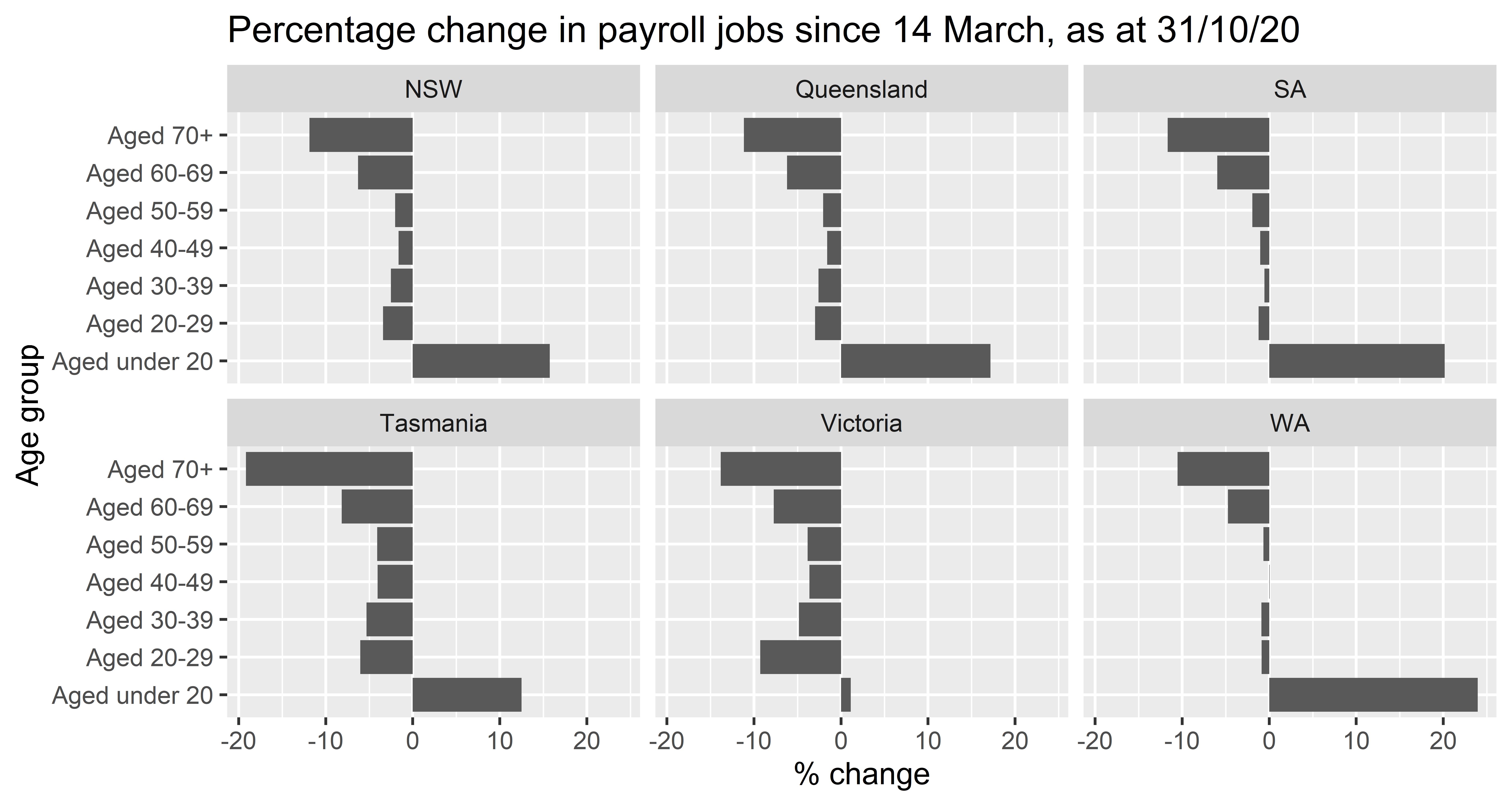
John’s analysis of the data is excellent. Check out my chart below of the percentage changes in jobs on payrolls as reported to the ATO since mid-March, just before all the restrictions began. Note that the big pick up in employment of under 20 year olds since mid-March is likely related to the ordinary pattern of school/VET leavers from the previous year taking up new jobs through the year. These data aren’t seasonally adjusted which is one thing you need to consider when interpreting them.
Please feel free to comment below. Alternatively you can email comments, suggestions, or hot tips to contact@queenslandeconomywatch.com
Posted in Uncategorized | Tagged , , , , , , , , , , | Leave a comment

Stamp duty to land tax switch has long been argued for by economists

It’s good to see the NSW Government considering a switch from stamp duty on property transactions to a broader land tax, at least for future transactions where it’s possible people could be offered a choice of either an up-front payment of stamp duty or an annual property tax (see Making home ownership more achievable in NSW). Effectively, the annual property tax would be a more broadly applicable land tax, for which various exemptions (e.g. for principal place of residence) are currently available.

Designing the proposal so it applies to future transactions only would allay concerns about asset-rich but cash poor retirees struggling to pay property tax bills. The devil will be in the detail, but in principle it’s a good idea and one the Queensland Treasury should be considering, too.

The NSW 2020-21 Budget (on page 1-15 of Statement 1) nicely summarises the rationale for the switch:

The current tax system is not fit for a modern society. It impedes home ownership and makes it harder for people to move to where they want to live. Rather than moving to a more suitable home, people may stay in a home that is too big or too small for their needs or endure longer commutes than necessary. The tax also acts as a brake on the economy.

Certainly, the NSW Government sees this as a measure which could help stimulate the economy in the short-run by leaving more money in the hands of home buyers rather than sucking it into Consolidated Revenue. It would also improve housing affordability.

Replacing stamp duty with land tax is something economists have long advocated for and is long overdue. I’ve written about the merits of doing so on QEW in years past, and this year my colleague Nick Behrens suggested it on his blog:

Tax reform is the antidote for Australia’s COVID-19 economic crisis

Incidentally, I spoke about how stamp duty should be replaced with land tax in a long-form podcast discussion yesterday with Matt Wong of Discernable:

Among other things, Matt and I spoke about the Queensland election outcome (from 53:54 in the video). I spoke about how Premier Palaszczuk repositioned herself expertly during the election campaign to appeal to regional voters, appearing in high-vis vests and with big trucks at mine sites, for example. The Premier also had a very simple message, that she was Keeping Queenslanders Safe, and objectively the Government had generally done a good job on COVID (except for its harsh policy on borders, in my view). The Keeping Queenslanders Safe message obviously appealed to regional former One Nation voters who shifted to Labor in large numbers. Other factors helping Labor were Jackie Trad’s departure from the Cabinet earlier in the year and Palaszczuk’s promise to keep her out of it if Labor were re-elected, as well as the strong Labor vote among public servants in SEQ who remember the job cuts during the Newman years.

Posted in Uncategorized | Tagged , , , , , , | Leave a comment

Qld risks becoming a hermit state if vaccine isn’t safe and effective

Even though Adelaide doesn’t yet meet the Commonwealth’s definition of a COVID hotspot (as pointed out by Andrew Clennell on Sky Australia today), the Queensland Government rushed to declare it one and to impose quarantine requirements on travellers from Adelaide, in stark contrast to the sensible wait-and-see approach of the NSW and Victorian Governments. Sky’s Andrew Clennell was right to call it a “knee-jerk reaction”. Possibly the Queensland Government is worried about its testing and tracing capabilities and its ability to get on top of a coronavirus outbreak if one were to occur. So it’s quick to shut down interstate travel at the first indication there may be any risk of COVID getting into Queensland, no matter how small.

Imposing quarantine requirements on travellers from Adelaide probably won’t matter a great deal to the Queensland economy via direct impacts, but it does reinforce the impression held by many in the business community that the Government is overly risk-averse on borders and doesn’t care much about the adverse impacts its decisions are imposing on industry. Many tourism operators will be worried Queensland won’t fully reopen to interstate travel by Christmas, and they’ll miss out on trade that would help them make up for heavy losses of trade earlier in the year (see my post from last Saturday).

Queensland runs the risk of becoming a hermit state if the COVID vaccine doesn’t end up being as effective or safe as we expect. Furthermore, the actions of our state government are undermining the Federation. We are treating fellow Australians as foreigners. We are inviting residents of other states to treat us as foreigners in the event of an outbreak of COVID here, or the outbreak of another disease sometime in the future.

The near future remains as uncertain as ever. We hope this Adelaide outbreak is contained and our Queensland Premier honours her alleged commitment to PM Scott Morrison to drop border restrictions by Christmas, although of course that decision may not be up to her, but instead up to our Chief Health Officer Jeannette Young. Hence, there’s no guarantee that interstate travel will be free and that families can reunite over Christmas.

Posted in Uncategorized | Tagged , , , , , , , , | 3 Comments

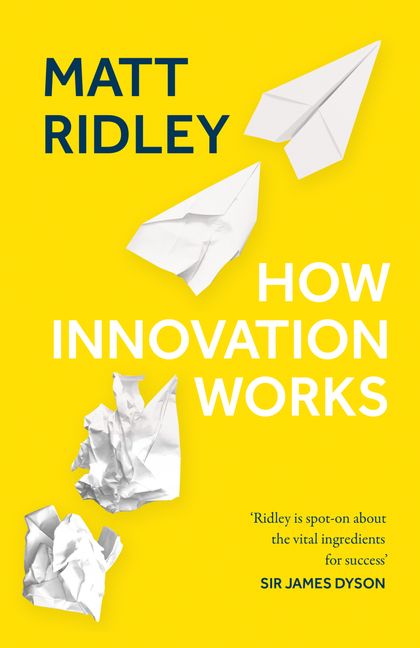
Matt Ridley’s How Innovation Works is recommended reading

This weekend I finished reading Matt Ridley’s excellent How Innovation Works, which makes a compelling case in favour of leaving innovation largely to the free market, rather than having it guided and supported by government.

Ridley is a great storyteller and appears to have a story to illustrate every point. For example, Ridley illustrates the general superiority of private-sector-led innovation by describing the UK Government’s experiment in the 1920s whereby it commissioned both a private sector company and a government ministry to develop an intercontinental airship. The Vickers-built R100 was a well-built airship which flew to Canada and back without incident. In contrast, the R101 was built by the Air Ministry, was afflicted by a range of problems, and tragically crashed in France in October 1930 on its maiden overseas trip, killing 48 of 54 people on board, with the Air Minister Lord Thomson among the dead.

Apparently, the notoriety of the R101 airship is due partly to author Nevil Shute, who wrote about it in his autobiography The Slide Rule. Shute, who spent his last decade in Australia, also wrote On the Beach, the 1959 film adaptation of which incidentally contains some brilliant black-and-white footage of empty Melbourne CBD streets after the fallout cloud eventually reaches the city and kills all the inhabitants. I remembered that scene as I watched the news reports from Melbourne during the stage 4 restrictions to combat the COVID-outbreak.

In How Innovation Works, Ridley brilliantly showcases what may be considered as rather prosaic innovations which turn out to be unlikely heroes, such as corrugated iron, which sits atop many Australian houses. Ridley writes (on p. 161):

By 1885 Australia was the largest market for the stuff in the world, and in the 1970s it was an Australian firm, BHP, that patented Zincalume steel…Recently, corrugated iron’s place in Australian history has made it a trendy material for architects and artists: the opening of the Sydney Olympics included a specially-composed ‘Tin Symphony’ in its honour, while the artist Rosalie Gascoigne used the material in her sculptures.

Ridley’s book contains some other fun facts relevant to Australia. For instance, Ridley discusses the domestication of dogs (and other animals) as an important innovation, and in his discussion of how dogs came from wolves, he observes (on p. 223):

Dogs made it to Australia with one wave of people, probably not the first wave, and re-wilded themselves as dingoes.

Ridley’s breadth of knowledge and research is astounding, and there are plenty of fascinating facts and stories like those I’ve mentioned above sprinkled throughout the book.

How Innovation Works should be read by anyone working on industry and innovation policy. It contains a strong critique of current intellectual property laws and regulations more broadly which are stifling innovation. In his conclusion, Ridley writes (on p. 373):

Somehow we must find a way to reform the regulatory state so that while keeping us safe it does not prevent the simple process of trial and error on which all innovation depends.

Innovation is the child of freedom and the parent of prosperity.

This book gets five stars from me, and if you haven’t read it yet I fully encourage you to do so soon.

Please feel free to comment below. Alternatively you can email comments, suggestions, or hot tips to contact@queenslandeconomywatch.com
Posted in Uncategorized | Tagged , , , , , , , , , , , , | Leave a comment

PM thinks he has agreement with Premier on border, but it’s the CHO who makes the decisions

Sky News has reported PM confident Berejiklian- Palaszczuk border battle will end by Christmas, and PM Scott Morrison has said he has an agreement with both Premiers for Queensland to be fully open to NSW, including Greater Sydney, by Christmas. The Premier said she will look closely at the border at the end of the month, but she hasn’t actually committed to reopening fully to NSW, and you may recall the Premier has previously said she doesn’t make the decisions regarding COVID-related restrictions (see Qld’s harsh border policy – a conversation with Joe Branigan). That’s the job of Chief Health Officer Jeannette Young, who has been granted extraordinary and, in my view, unwarranted powers by the Government during the public health emergency which has been declared since late January.

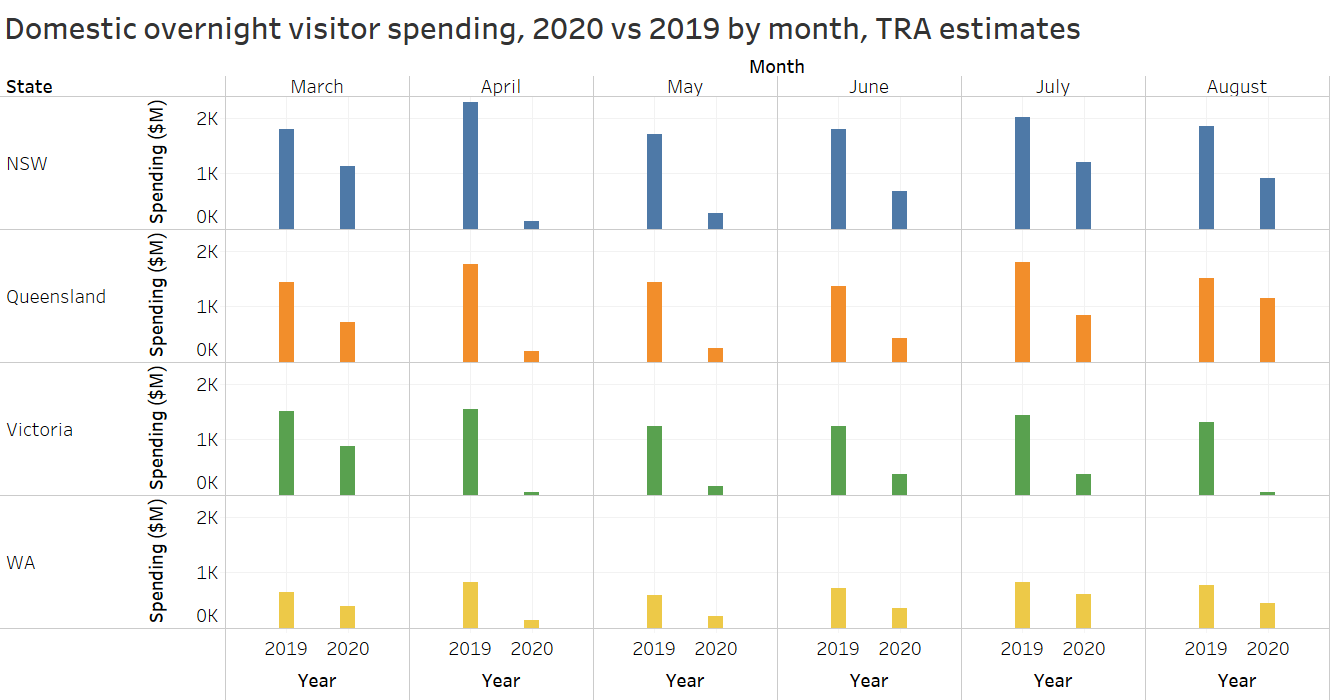
As I’ve written previously, the border restrictions should be assessed much more regularly than every month and we should see all the advice from the CHO justifying the closure (NSW border policy still lacks solid justification). Without certainty very soon on the border, Queensland tourism businesses will miss out on many interstate visitors who may decide travelling to Queensland is all too hard and they’d better plan to go elsewhere (see ABC PM comment on border closure cost – Qld tourism worried about loss of interstate visitors over Christmas season). I’ve heard that upcoming holiday bookings are strong at many popular tourist destinations in Queensland, but if we’re still locking out Sydneysiders and Victorians, activity won’t be as strong as it otherwise would be, and tourism businesses would miss out on vital revenues that would help them make up for the massive losses of trade they’ve experienced so far during the COVID-recession (see chart below).

We need the leaders of the Government to have a sense of urgency on this issue, and not just delegate these hugely consequential decisions to the CHO.

Please feel free to comment below. Alternatively you can email comments, suggestions, or hot tips to contact@queenslandeconomywatch.com
Posted in Uncategorized | Tagged , , , , , , , , | Leave a comment

Qld Assistant Min. McCallum given huge challenges – 50% renewable energy by 2030 and hydrogen economy

Premier Annastacia Palaszczuk has given one of her government’s rising stars, Lance McCallum, MP for Bundamba, the huge and arguably near impossible task of overseeing the achievement of the 50% renewable energy target by 2030. Yesterday, McCallum was appointed as Assistant Minister for Hydrogen Development and the 50% Renewable Energy Target by 2030 (see this media release). Regardless of the large amount of renewable energy capital investment Queensland expects over the next decade, the 50% target will very likely not be achieved.

As Tony Moore reported in August in his Brisbane Times article Queensland warned it will fall short of 50 per cent renewable target:

Green energy groups have cast doubt the Queensland government can meet its commitment to provide 50 per cent of the state’s energy from renewable energy sources in 10 years’ time.

However, they are confident it will be able to provide more than one-third of Queensland’s energy needs by 2030.

I think the green energy groups Tony Moore refers to are correct. Adept Economics Research Officer Ben Scott and I investigated this issue last year and reached the same conclusion as Green Energy Markets, which has been forecasting that Queensland won’t reach the 2030 target for a while now (see our post Queensland’s Renewable Energy Target Alive but Only Just). Renewable energy generation is certainly growing rapidly, but 50% by 2030 was just too ambitious a target.

I’ve always been sceptical of the Government’s target, partly based on the years I spent in state and federal bureaucracies, regularly reporting on policy targets that governments had set and had either failed to achieve or had no chance of ever achieving. My former colleagues in Queensland’s Employment and Training department will probably remember the Finn target for year 12-equivalent attainment as an example of an aspirational target never achieved in the timeframe set.

The other big challenge that Assistant Minister McCallum has been set is to oversee the emerging hydrogen economy. Hydrogen certainly offers a lot of potential, but we’re still in the early stages of the development of a hydrogen economy, and it’s unclear whether so-called green hydrogen will become a cost-effective source of energy. For further information on hydrogen projects in Queensland, check out this recent post I co-authored with Adept Economics Research Assistant Taylor-Rose Hull: What’s going on with the so-called hydrogen economy?

Finally, if you’re interested in energy issues, check out this upcoming ESA Qld webinar on the impact of renewables on the National Energy Market (Spoiler: they’re not good for the NEM and we need to figure out a solution) and also Brian Fisher’s chat with Menzies Research Centre Director Nick Cater: Step on the Gas.

Posted in Uncategorized | Tagged , , , , , | Leave a comment

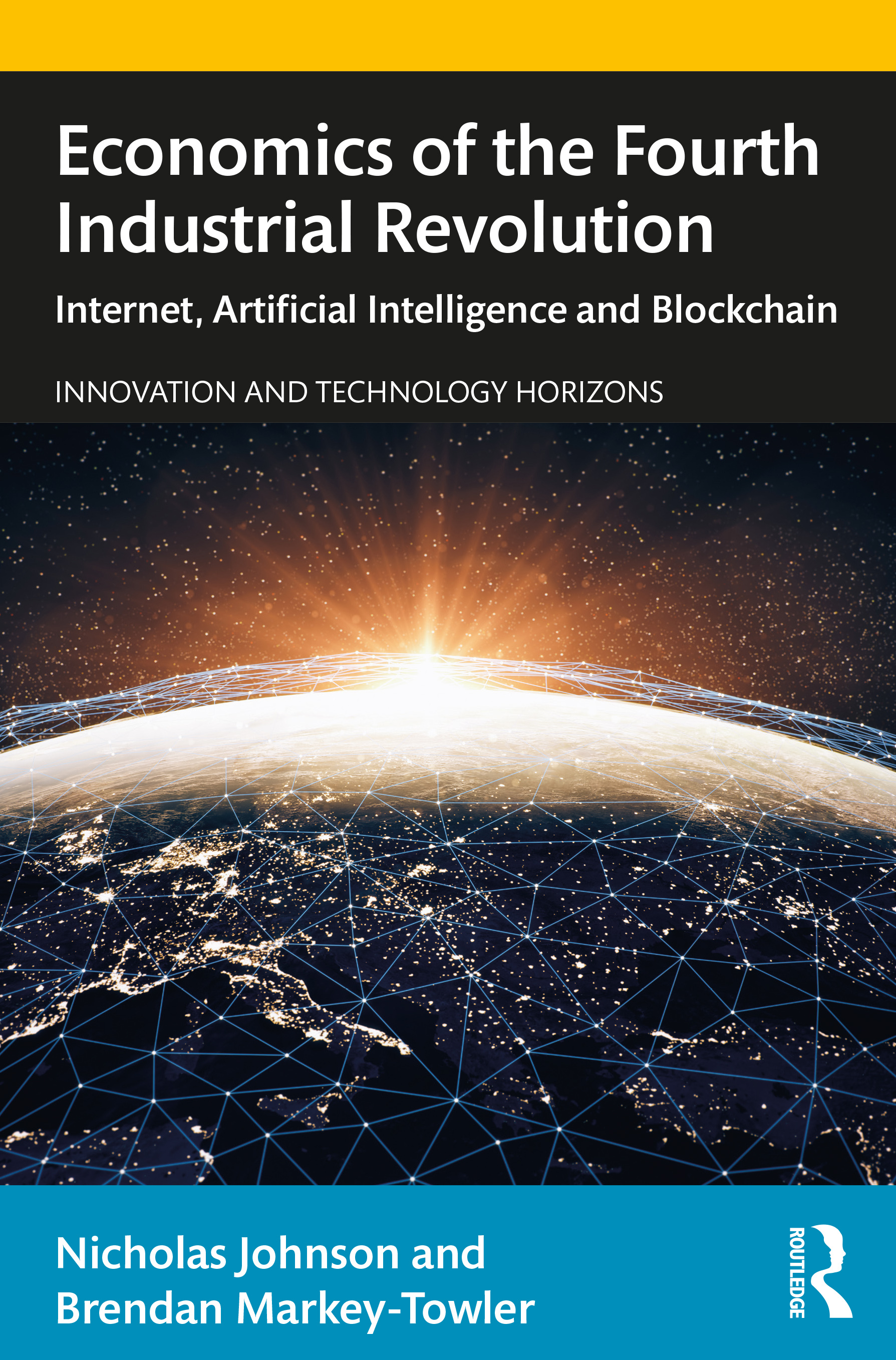
Economics of the Fourth Industrial Revolution podcast chat with Nick Johnson and Brendan Markey-Towler

My fellow Queensland economists Nicholas Johnson and Brendan Markey-Towler have written an impressive new book Economics of the Fourth Industrial Revolution: Internet, Artificial Intelligence and Blockchain, which was published by Routledge last month. I spoke with Nick and Brendan earlier this week and the recording of our conversation is now available as my latest podcast episode.

Here’s an excerpt from the beginning of our conversation:

Brendan: …an industrial revolution is constituted by a series of what we call in economics general purpose technologies converging all at once. So what’s the general purpose technology, as Nick was saying, it’s not a technology that’s improving one production process, not even a technology that’s improving two production processes. It’s improving, or radically changing all of the production processes, and making new ones possible.

So an industrial revolution is characterised by a vast increase in the outputs that society can produce, and a fundamental change in the way the society produces those outputs. And while that fundamental change is being brought about, you’re seeing entirely new ways of producing goods and services open up, so entirely new markets [are] opening up as well…

…the three big ones that we’ve focused on are internet and artificial intelligence and blockchain…these three general purpose technologies that we believe are really underlying the emergence of the fourth industrial revolution. You can talk about biotech, you can talk about machine learning, you can talk about automation, but really, an industrial revolution is characterised by the convergence of these general purpose technologies, which are not just an iPhone, they’re not even just a smartphone. They’re the base technology that enables that technology. So something like the internet, something like artificial intelligence, something like blockchain is a wholly new way of doing things all across the economy that majorly disrupts the way we produce and consume things, and makes entirely new ways of producing and consuming possible.

The excerpt above is from a transcript (with some minor edits) first generated by otter.ai, an amazing AI tool which transcribes audio files, which I mentioned in the episode as a good example of the growing use of AI.

Please check out our conversation and consider buying a copy of the book via Book Depository or Amazon.

Posted in Uncategorized | Tagged , , , , , , , , | Leave a comment

No Qld upper house means poorly thought through legislation

Queensland has too many poorly thought through pieces of legislation, arguably due to the lack of an upper house and the failure of Parliamentary Committees, ruled by the Government of the day, to properly scrutinise legislation. This is clear today, as we have learned the Government is having to rush through changes to local government legislation to ensure Rockhampton residents get to choose their new Mayor after the current Mayor announced her resignation. As reported by the Brisbane Times yesterday:

Queensland Local Government Minister Stirling Hinchliffe has been accused of “backtracking” on rushed laws to close a door allowing the runner-up in a mayoral election to take the robes if a first-year leader leaves the job.

In one of the first actions of a returned Palaszczuk government, the move would ensure the resignation of Rockhampton mayor Margaret Strelow on Monday night would instead trigger a byelection, rather than elevating an anti-Adani activist who ran second in the March poll.

The problem arose from a change to the Local Government Act which was designed to discourage Councillors from running in the state election, by requiring any vacancy created by the resignation of a Councillor less than one year into their current term to be filled by the runner up in the last election for their position. Now, due to the unintended consequences of the relevant provision, the Government has to amend it urgently.

Unfortunately, the lack of proper scrutiny of legislation in Queensland leads to some poorly thought through pieces of legislation. I expect many QEW readers can name several pieces of state legislation they loathe, but here are a couple of examples which come to my mind:

As I’ve written many times before, we desperately need to improve the quality of our governance in Queensland (see Deficient Qld state public administration is a major theme of my new book). We should consider reintroducing an upper house or look for some other way of providing oversight of our Parliament and Executive – e.g. via some sort of Committee of the Great and the Good. This is even more important now we have four-year terms.

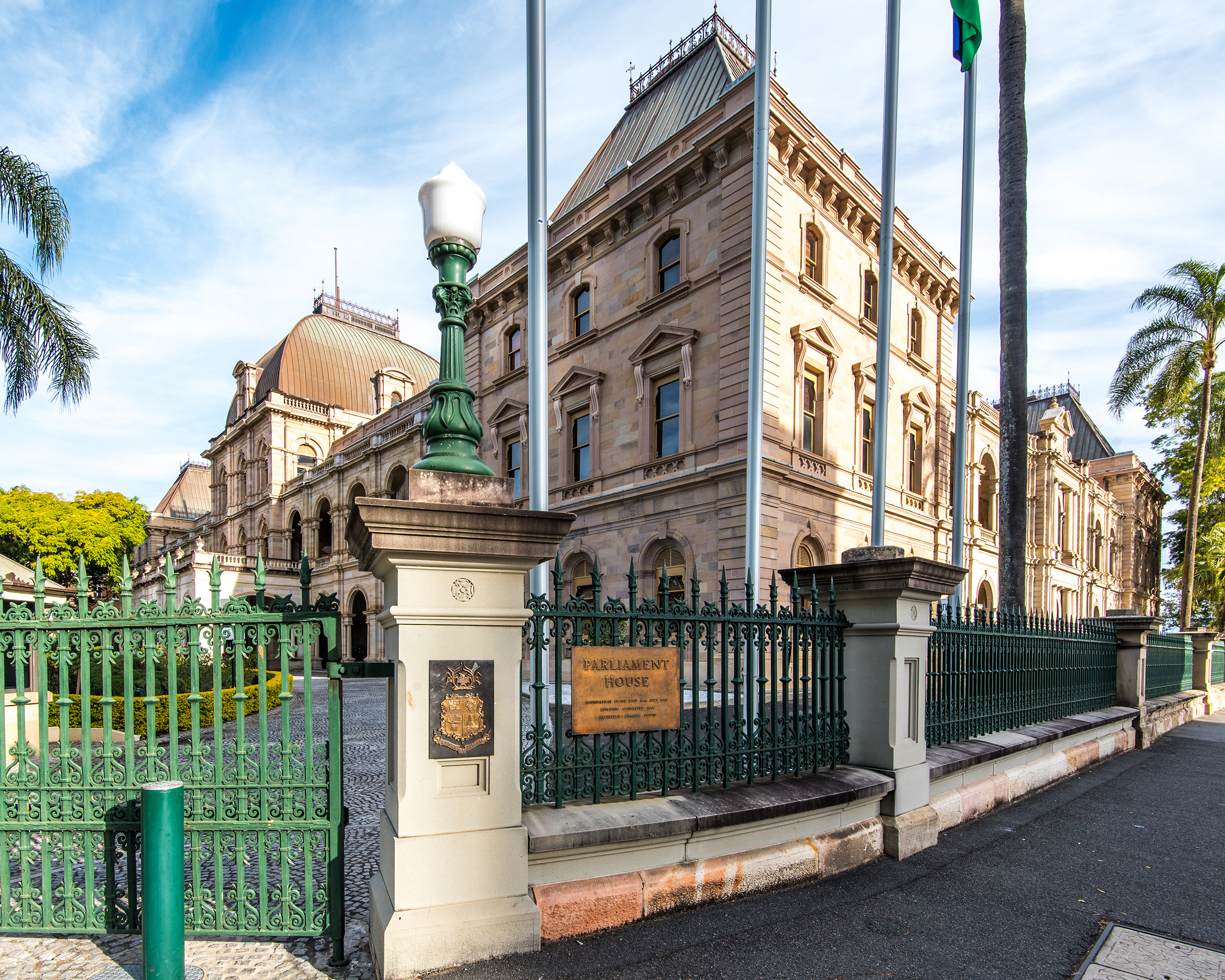
Queensland Parliament House, corner of Alice St and George St, Brisbane.
Posted in Queensland Government | Tagged , , , , , , , | 4 Comments

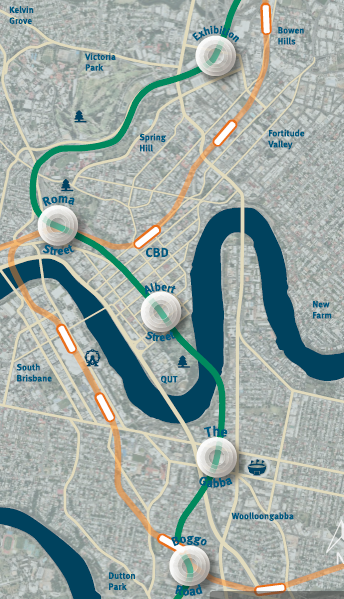
Cross River Rail scrutinised by Grattan and AiP

Brisbane’s under-construction inner city subway system Cross River Rail has been identified as an example of a risky megaproject (a $5bn+ project) subject to cost blowouts by the highly respected Grattan Institute in its latest report The rise of megaprojects: counting the costs. Cost blowouts we already know about (e.g. the problem with Boggo Rd station) could amount to an additional $900 million, as reported by the Courier-Mail in August, and there is speculation the cost could blow out by several billion dollars more (e.g. see this February QEW post).

In addition to highlighting cost overruns for several megaprojects across Australia, including CRR, Grattan notes (on p. 12):

Projects conceived pre-pandemic are likely to suffer benefit underruns

CRR certainly falls into this category as there is the possibility public transport use remains below pre-COVID levels for a while yet and does not grow at previously projected growth rates. Grattan notes there are two reasons why projects conceived pre-COVID are likely to have lower benefits than previously estimated (from pp. 12-13):

  • “Population growth has fallen off a cliff”
  • “Work and travel patterns are likely to be different post-pandemic” (i.e. because more people are working from home or driving, riding, or walking to work)

Together, in my view, the cost blowouts and benefits shortfall could drive the benefit-cost ratio for CRR below 1, meaning the project doesn’t stack up, as many observers have long suspected.

Releasing a report on CRR last month, the Australian Institute for Progress (AiP)* called for a Commission of Inquiry to investigate CRR in its media release Cross River Rail: privatisations, cost over-runs, and no patrons:

CRR is the largest and most complex state government infrastructure project. It involves original expenditure of $6.26 Bn, which with known current cost over-runs could now be as high as $7.16 Bn.

The report identifies a number of planning and governance risks and failures which provide lessons for the future. These risk a cost blowout which will crowd-out other much-needed infrastructure.

The consultants call for an immediate review, which we believe should have the powers of a Commission of Inquiry.

Certainly, there are big questions to answer regarding CRR. Recent reports by the Grattan Institute and AiP suggest the Government should immediately review the project and assess whether it will still be good value for money for Queensland taxpayers.  

*Regular readers may recall I co-authored an AiP commissioned report on the Queensland budget in September.

Stylised map of CRR, which will take you from the Boggo Rd precinct to the RNA/Ekka precinct

Posted in Uncategorized | Tagged , , , , , , | 1 Comment

Minimum wages and employment podcast discussion

Apart from Joe Biden winning the US Presidency and the Democratic Party otherwise under-performing, in my view, the major news coming out of last week’s elections in the US was Florida voting to increase its minimum wage to $15/hour by 2026. Its current minimum wage is under $9/hour (see this CNBC report). You may be aware that a $15/hour minimum wage was adopted by Seattle in 2015 and there is a growing movement to increase minimum wages across the US to improve living standards of minimum-wage workers and to reduce inequality.

But is increasing the minimum wage a good way to achieve these outcomes? Not necessarily, once you take into account the well-established adverse impact of minimum wages on teenage and low-skilled employment seen in many countries, including the US and Australia. The evidence tends to suggest that a 1% increase in the minimum wage would reduce the employment of low-skilled workers by 0.1% to 0.3%. While arguably not as large as might be expected, this adverse impact should be considered by decision makers and voters when deliberating on increases to the minimum wage, as I discuss in my latest podcast episode on minimum wages and employment.

In my view, the best summary of the evidence on the employment impact of minimum wages is this piece by University of California, Irvine Professor David Neumark:

David Neumark on the Employment effects of minimum wages

Arguably, Australia’s Fair Work Commission needs to pay more attention to the adverse employment impacts of minimum wage increases in its decision making. In June, the FWC ordered a $13/week minimum wage increase despite the opposition of FWC member Economics Professor Mark Wooden. According to the Guardian Australia:

Wooden believed “risks are weighed in one direction” and growth in jobs and hours should be prioritised over a wage increase, he said.

The bulk of evidence suggests Wooden’s view was the correct one.

Posted in Labour market, Macroeconomy | Tagged , , , , | 4 Comments