Ten years ago today, a swelling Brisbane River flooded the city, and made us question whether we really needed that $9 billion of climate-resilient water infrastructure the state government had commissioned in the middle of the drought, when there were fears rainfall would be permanently lower due to climate change.* The Queensland floods, which caused tragic loss of life and billions of dollars of property damage, were Premier Anna Bligh’s finest moment, as she rallied Queenslanders in that challenging time, and we saw thousands of Queenslanders help out in the clean up, the so-called Mud Army.
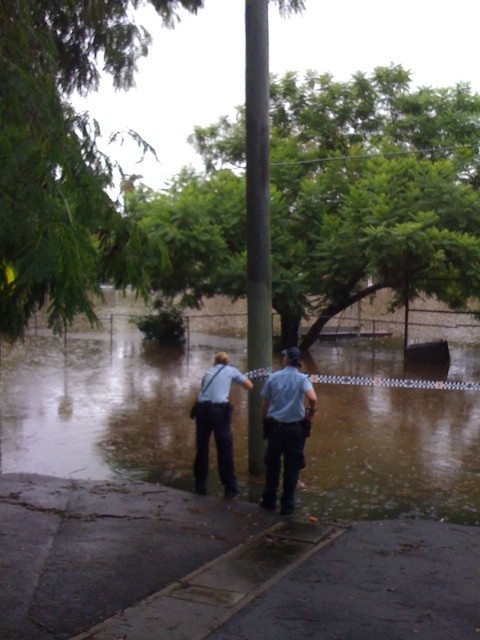
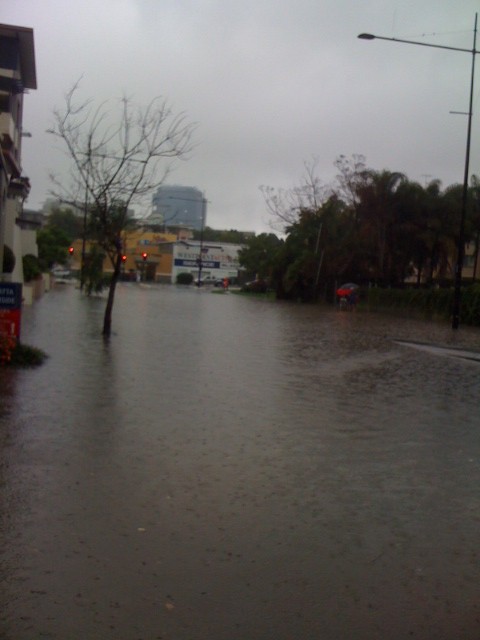
Ten years ago today, I posted the following images on QEW, which I snapped around Toowong and Auchenflower on Tuesday afternoon, 11 January 2011.
Police officers inspecting the flooding on the street running alongside Auchenflower train station. In the background, the croquet club field is a lake.
Land St, Toowong on the afternoon of 11 January 2011. I had to take off my shoes and roll up my trousers to walk through the water to get home around the corner.
Flood tourism at Regatta CityCat Terminal, hours before the flooding Brisbane River lifted the pontoon off its support poles and it drifted away.
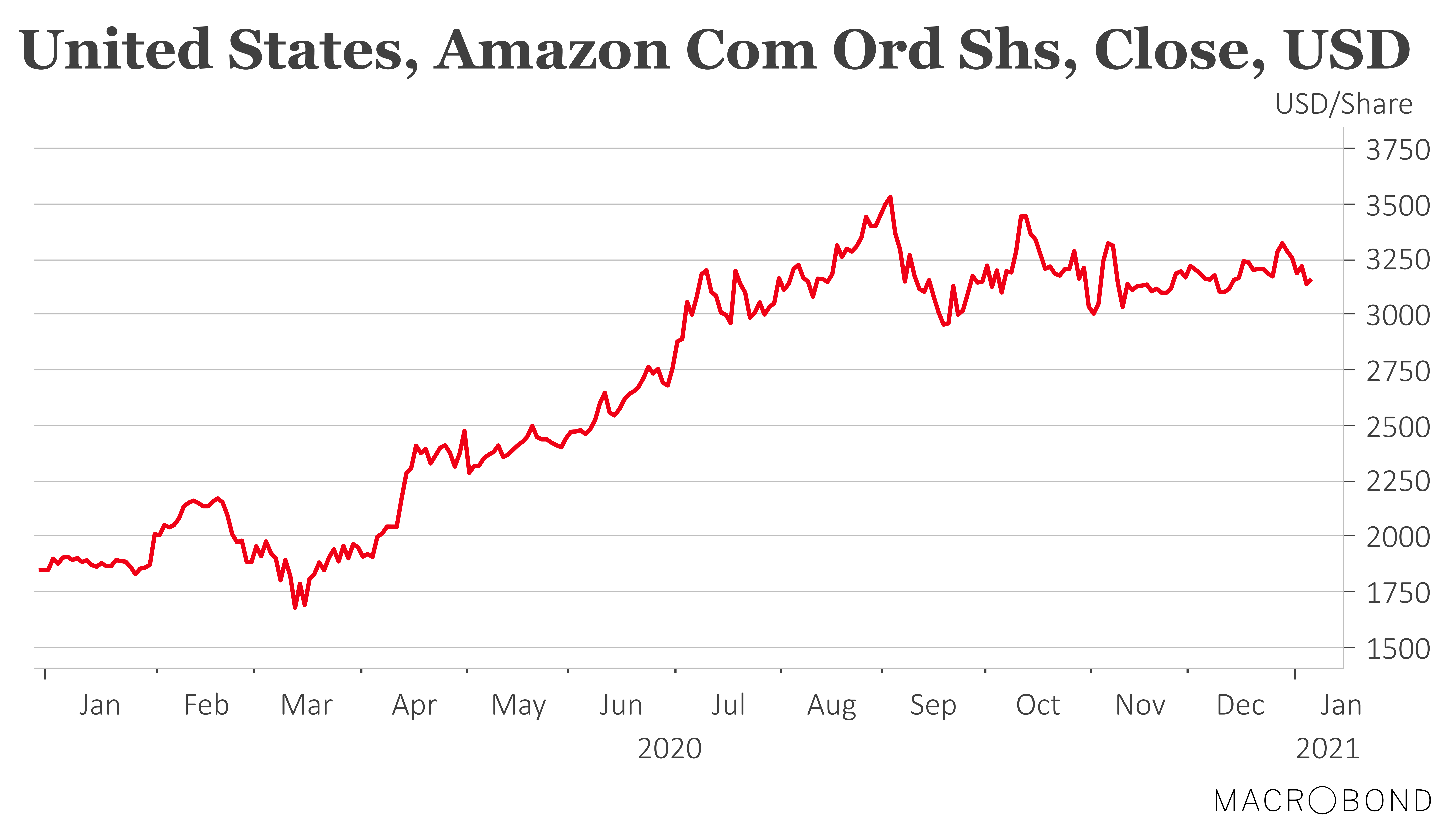
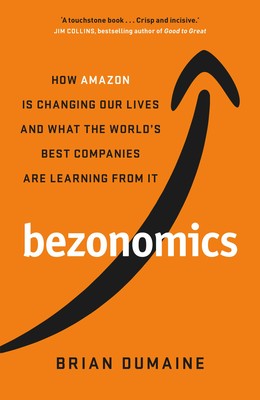
One company that has done very well out of COVID is Amazon (see share price chart below). The wealth of its founder Jeff Bezos soared, and he has seemed untouchable as the richest man in the world, although he has just lost that title to Elon Musk, possibly only temporarily. Bezos is obviously an exceptional entrepreneur, but I never realised just how exceptional until I read Brian Dumaine’s Bezonomics, which I finished reading today, during the Greater Brisbane Lockdown. As other reviewers have suggested, Bezonomics is hagiographic about Bezos, but it clearly shows how he’s always had a long-term vision of global domination of multiple markets, and how he’s been extraordinarily successful in achieving his objectives so far.
Amazon takes advantage of what Dumaine calls the “AI flywheel” (borrowing from Jim Collins), whereby Amazon gets to know its customers better as it gathers more data on them and is then able to offer them better targeted products they are more likely to buy, meaning larger sales volumes and economies of scale, driving down prices, and encouraging further purchases. In the context of the development of Alexa in 2011, Dumaine explains the basics of the AI flywheel on p. 226:
…start with the customer first, find ways to drive down costs, which frees capital to invest in more features, which attracts more customers, which allows for economies of scale to drive down costs, and so on…
Bezonomics explains how Amazon pushes its customers into Prime membership and how Prime has forced Amazon to become super-efficient in warehousing and distribution, so it is now a threat to traditional logistics giants such as FedEx. The book also highlights Amazon’s large market share in cloud services through Amazon Web Services (AWS), which NYU Marketing Professor Scott Galloway has predicted Amazon will spin off this year as a way of appeasing US regulators who may be contemplating antitrust action against Amazon (check out this WebProNews story).
Dumaine argues Amazon is moving into new industries such as healthcare and its AI flywheel will help it quickly gain large market share. Bezonomics speculates Amazon won’t just be in the pharmaceuticals sales business, but in telemedicine as well, via its Alexa devices. On p. 230, Dumaine writes about the potential for a Prime Health service:
Feeling down in the dumps? Alexa might suggest that the [Prime Health] member contact their doctor. (Amazon has filed a patent for Alexa to pick up the sound of sniffles or a cough, and Alexa already offers simple first-aid advice.) When the member asks Alexa to set up an appointment with an Amazon-recommended doctor (five stars!), a time and day is downloaded to his or her calendar. At the appointed time, a doctor pops up on the screen and conducts the exam.
You can see where this is going. The consultation could result in pharmaceutical products being purchased via Amazon. Genius, and all part of Bezos’s plan for global whole-of-economy domination.
In the end, Dumaine does not see a need for antitrust action against Amazon (e.g. forcing a breakup of Amazon into different businesses, and at least separating the selling platform from Amazon’s own retail business, as Senator Elizabeth Warren has suggested). This is even though Bezonomics does highlight some pretty sketchy practices of Amazon, including aggressively competing against independent sellers on the platform with its own line of products. Dumaine accepts Amazon’s assurance it is not using confidential data on independent sellers, and he rejects antitrust action against Amazon, as he sees Amazon ultimately as a force for good for consumers, providing a wider range of products at lower prices than otherwise.
Here I should note that the European Commission has a different view on Amazon’s use of independent sellers’ data, as announced on 10 November last year, in a press release:
The European Commission has informed Amazon of its preliminary view that it has breached EU antitrust rules by distorting competition in online retail markets. The Commission takes issue with Amazon systematically relying on non-public business data of independent sellers who sell on its marketplace, to the benefit of Amazon’s own retail business, which directly competes with those third party sellers.
The Commission also opened a second formal antitrust investigation into the possible preferential treatment of Amazon’s own retail offers and those of marketplace sellers that use Amazon’s logistics and delivery services.
Let’s see what happens in the US under the Biden administration, as I wouldn’t be surprised if we see some aggressive action there, although Bezos’s ownership of the Washington Post may provide some protection.
Bezonomics may be too uncritical of Amazon and Bezos, but it’s very worthwhile reading nonetheless. It opened my eyes to the scope and scale of Bezos’s ambition, and the chance that he may well realise it.
Please feel free to comment below. Alternatively, you can email comments, questions, suggestions, or hot tips to contact@queenslandeconomywatch.com
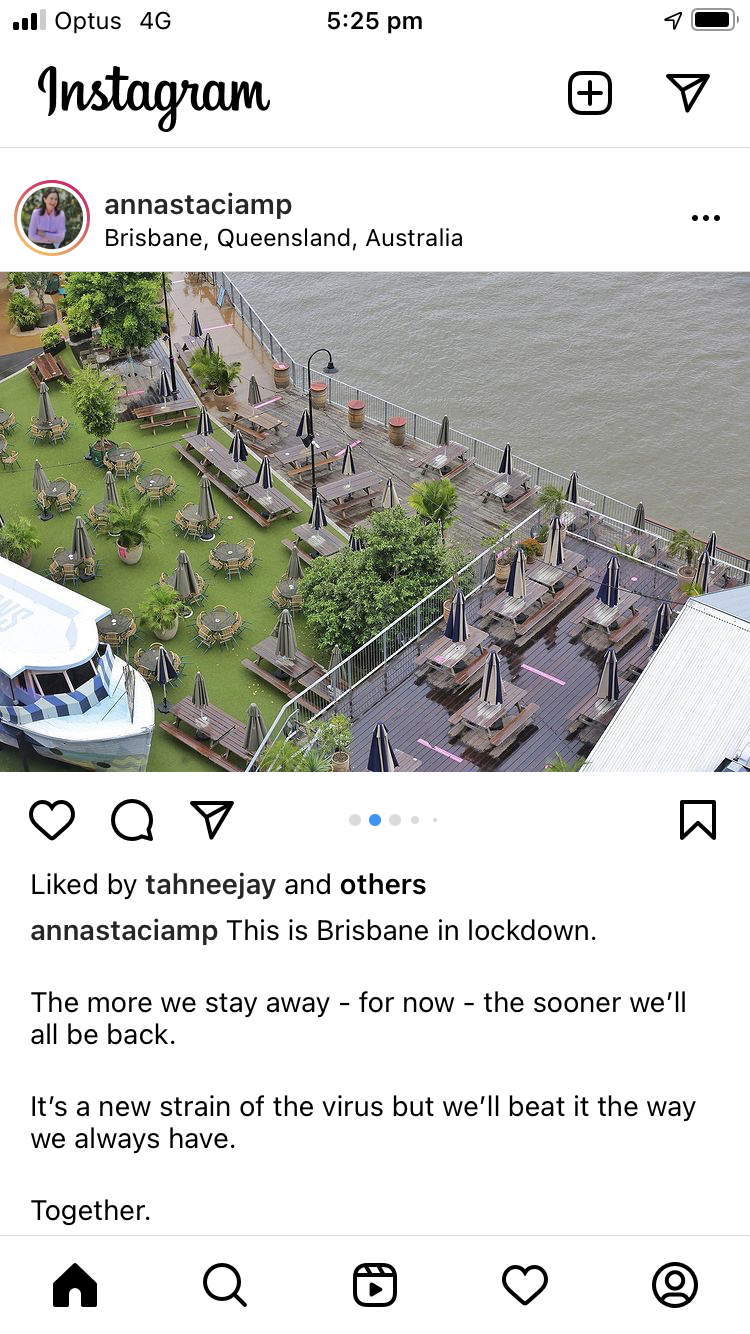
Twenty-seven hours into it, I’m still doubtful about the wisdom of the Greater Brisbane lockdown, especially on a day when no new COVID community transmission cases were announced, and on a day when, bizarrely, our Premier appeared to celebrate her power to close down the capital in her social media posts (see below).
Instagram post from Qld Premier showing how lockdown has shut down Felons Brewery at Howard Smith Wharves
Yes, COVID is a serious disease, and we don’t want to end up like the US or UK, but it’s currently the middle of Summer, not Winter, Brisbane is much less dense than British or American cities, and we’ve only had one recent case of community transmission.
Before substantially inconveniencing two million people and denying many businesses much needed trade, it would have been good for the government to provide a firmer justification for the sudden lockdown. Yes, the government is applying the Precautionary Principle, but, as I discussed with Joe Branigan last year, we should be sceptical of using that principle in public policy:
Apparently, if we have just one more case of community transmission before Monday 6pm, the lockdown will be extended until the end of the month. How can people or businesses make plans if a panicky Chief Health Officer and Premier can impose a lockdown with only ten hours’ notice and with such sketchy justification, as they did yesterday?
Please feel free to comment below. Alternatively, you can email comments, questions, suggestions, or hot tips to contact@queenslandeconomywatch.com
To keep Queenslanders safe, our state government has decided to lock down the over 2 million residents of Greater Brisbane for the next three days, but its sudden, unexpected announcement at 8am sparked immediate panic buying in our supermarkets, and an exodus of people from the capital to the regions and other states, possibly spreading the mutant UK COVID strain there. Great job, Queensland Government.
The National Cabinet is supportive of the lockdown so I will withhold judgment for now, other than noting it would have been good for our Premier or Chief Health Officer to have signalled earlier this week they would even contemplate doing this. It came as a bit of a surprise, given we only have one reported case (so far) of the mutant UK strain, the cleaner from the Grand Chancellor, and thankfully she doesn’t appear to have travelled many places.
It’s too early to predict what the economic implications of this will be, as so much depends on whether the mutant COVID bug has been spreading in the community. That said, we fear this Brisbane lockdown will extend well beyond three days, as the Health Minister has suggested it could (e.g. check out this Brisbane Times report). When I dropped into my office at the Johnson Hotel this afternoon, I saw one of my neighbours, an engineer, and his partner carrying out two widescreen monitors from his office. He needs them to work on his spreadsheets and CAD diagrams, and he’s obviously thinking this is going to last much longer than three days.
We may need to rush that vaccine out after all if the mutant COVID strain is spreading. Otherwise, we will see further lockdowns and loss of economic activity, possibly requiring an extension of JobKeeper, meaning larger deficits and more debt.
On financing the COVID-19 government debt, I spoke with UQ Associate Professor Begoña Dominguez earlier this week, and our conversation is now available as Episode 69 of my Economics Explored podcast. I interviewed Begoña about a thought provoking video she recorded for the UQ Economics School at the end of last year on Financing the COVID-19 Government Debt. One idea of Begoña’s that I really like is that we should think of support provided during COVID in the context of a social contract, whereby in an emergency like a pandemic we readily assist people but if it turns out we have over-compensated people (as we may have in Australia as I noted in my 9 December 2020 post) we have some mechanism to claw back some of that assistance. Conversely, if it turns out we’ve under-compensated some people, we increase assistance to them or give them a tax rebate in the future. Possibly, assistance could be generous in a pandemic, given the radical uncertainty about the future, but the assistance could be given as an income-contingent loan.
Please feel free to comment below. Alternatively, you can email comments, questions, suggestions, or hot tips to contact@queenslandeconomywatch.com
The win by the US Democratic Party of two federal senate seats representing the state of Georgia creates a situation whereby the Republican Party will lose their majority in the Upper House. Given the Democrats control the House of Representatives, this means their legislative agenda will now be able to be more easily realised. One positive outcome of the win, depending on your viewpoint, is that the cannabis industry in the United States and elsewhere is likely to be a beneficiary of the flip of the senate seats.
Cannabis bills have been passing the US Lower House in recent years but stalling in the Upper House. As reported in the Motley Fool, the win by the Democrats may see important financial services legislation enacted to allow the industry access to much needed banking services which would be a boon for cannabis companies. While most states in the US have legalised medicinal cannabis and almost one-third of states have legalised, or are in the process of legalising, recreational use cannabis, it is still illegal at the federal level. This should now change.
The Queensland Government should be watching this closely. Here, things have moved a lot slower. While medicinal cannabis is now available for doctors to prescribe, including in Queensland, the Therapeutic Goods Administration (TGA) expects that medicines included in the Australian Register of Therapeutic Goods (ARTG) will have been considered or prescribed first before seeking approval to prescribe cannabis. Up to 31 December 2020, the TGA had only approved around 85,000 applications for medicinal cannabis products for conditions including chemotherapy-induced nausea and vomiting, cancer and neuropathic pain, and spasticity from neurological conditions.
However, there has been some movement as reported by FreshLeaf Analytics with the TGA having decided to allow registered low-dose CBD products, up to 150mg per day, to be sold over the counter at Australian pharmacies without a prescription. While the implementation date is February 2021, product availability is expected to be later this year or even in 2022.
But it is the recreational cannabis use space where we are still a long way behind the US. As I wrote in 2018, an Australian Senate committee considered a private member’s bill from (then) Senator David Leyonhjelm to allow any State or Territory Government to legalise and regulate cannabis due to it being considered less harmful than alcohol use and tobacco use, and that otherwise law-abiding recreational cannabis users were cast as criminals, which increases pressure on the criminal justice system and supports organised and violent crime. Leyonhjelm’s lead should be followed by one or more of the major political parties, with support from the states.
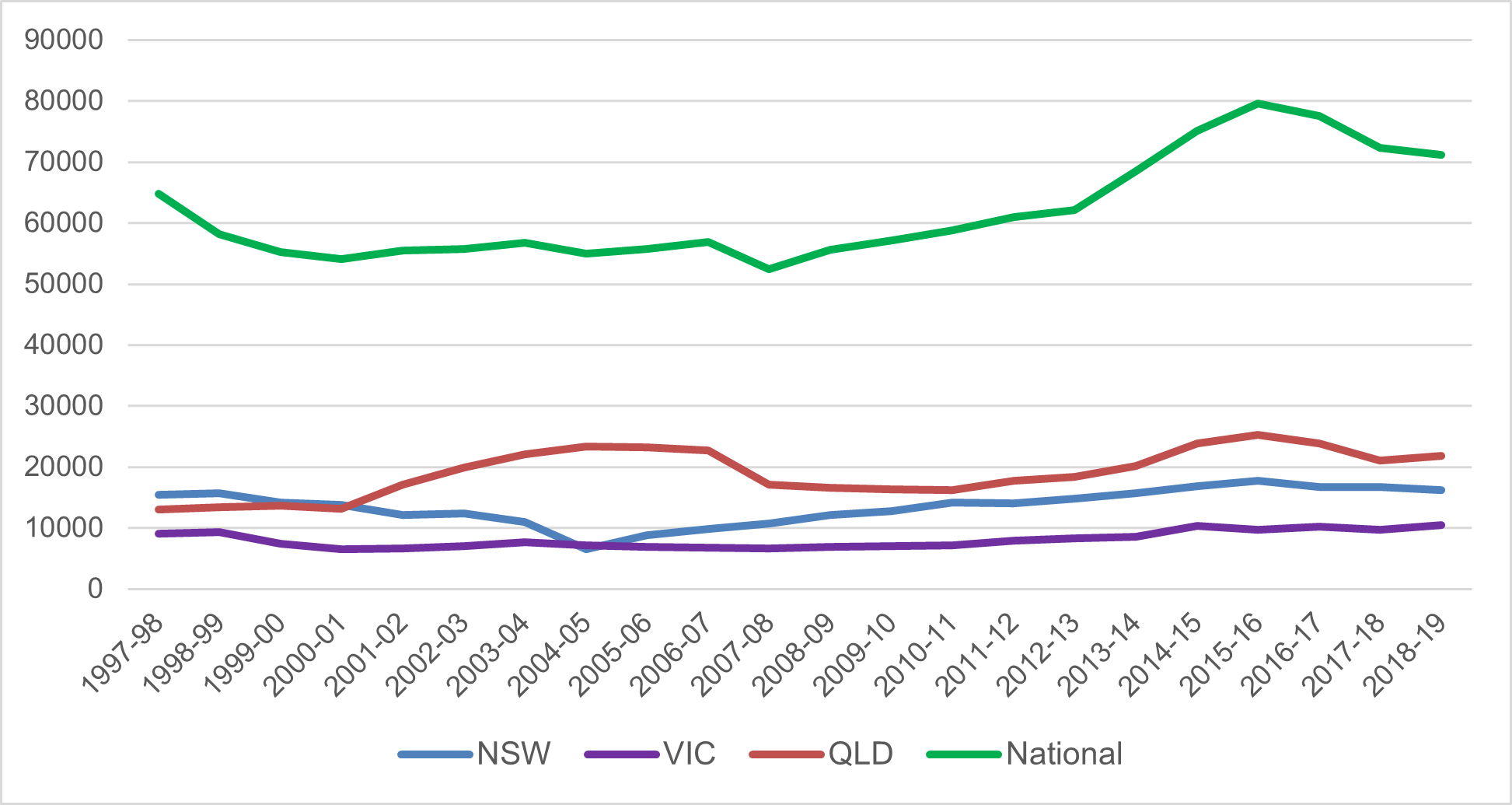
Number of cannabis arrests 1997-98 to 2018-19 in NSW, Victoria, Queensland & national total
Source: BGE, compiled from Australian Crime Intelligence Commission annual Illicit Drug Data reports
Queensland has been the leading state for cannabis arrests for the last 20 years, arresting nearly 22,000 people in 2018-19, which places an unnecessary financial burden on the state budget given similar sized states like Colorado are now collecting taxes from cannabis sales. Indeed, I have previously estimated that the tax revenue alone for Queensland could be around $90 million/year with criminal justice system and other cost savings on top of that.
It is likely that the legalisation of cannabis at the federal level in the US will take place in the next year or so. Canada legalised recreational cannabis on a national level in 2018. This is the time for Queensland to commence a comprehensive investigation into the benefits and costs of a regulate-and-tax model, of which I undertook a preliminary examination in 2016 (see report here). For a wide-ranging discussion on the cannabis industry both overseas and in Australia, you can listen to this episode of the Economics Explored podcast.
Dr. Stephen Thornton is the principal of BG Economics. Disclosure: Stephen has a shareholding in a cannabis company listed on the ASX. This article should not be considered as providing financial advice.
The best commentator on what the post-Corona business world will look like is arguably NYU Stern Business School Professor Scott Galloway, an entrepreneur turned professor and YouTuber who GQ has labelled “Gordon Gecko with a social conscience”. I’ve recently read his brilliant new book Post Corona: From Crisis to Opportunity, which is available at Dymocks on Queen St Mall. Galloway’s thesis, as summarised in the back-cover blurb, is that:
…the pandemic has generally not been a change agent so much as an accelerant of trends that were already well underway.
For instance, higher education has been ripe for disruption for a couple of decades now. With the pandemic, we are seeing traditional universities across the world struggling, and some below the top tier may fail. Galloway sees potential collaborations between the top universities worldwide and Big Tech, collaborations which certainly could threaten Australian universities. This is an interesting idea Galloway advances on p. 147:
MIT and Google could jointly craft two-year degrees in STEM. The myth/magic of campuses and geography is no longer a constraining factor—most programs will be hybrid soon, dramatically increasing enrollments among the best brands.
Australian universities have already had to make big cuts to deal with a loss of international students and their fees during COVID (check out the Guardian Australia report Almost 10% of Australian university jobs slashed during Covid, with casuals hit hardest), and I know it’s been tough on many academics, some of whom have taken Voluntary Early Retirements. But universities may face further pain as students worldwide come to expect online learning and as agile new providers stand up to challenge universities. One idea I heard on a podcast the other day was that a major consulting firm, say a McKinsey, could offer its own MBA program and attract students and revenues away from business schools. Traditional university programs will also be threatened by providers who have fully adapted to the potential of online learning. Seth Godin’s Akimbo workshops which encourage activity-based learning and regular peer feedback are good examples of what is possible. So, I think Scott Galloway is on the right track with his observations regarding higher education.
In Post Corona, Galloway reiterates his critique of the big four tech companies (Google, Facebook, Apple, and Amazon), noting big tech has profited from COVID as lockdowns have prompted people to spend more time online: using social media, streaming, and shopping. Galloway has been calling for antitrust action against Big Tech for several years, and, as I discussed on my podcast a couple of weeks ago (check out Regulating Big Tech), such action does appear to be forthcoming, which is good news.
Galloway ends his book with a call for measures for greater redistribution to deal with growing inequality in the US. He makes a good point about how COVID relief in the US has tended to favour corporations and their shareholders rather than the bulk of the population. Assistance in Australia has been much better targeted, although arguably it has been overly generous, as I discussed in my post Aussies over-confident after being over-compensated by Gov’t for COVID-recession.
The ACCC’s Final Report on its Northern Australia Insurance Inquiry has been released at last and, among other things, it rightly reiterates a recommendation made in previous reports to (on p. xxiii):
Abolish stamp duty on home, contents and strata insurance products
The governments of Western Australia, the Northern Territory and Queensland should abolish stamp duties on home, contents and strata insurance products. State and territory revenue needs could be more equitably met through other means.
While the main reason home insurance premiums are higher in Northern Australia is the risk of cyclones and flooding, having stamp duties on insurance products levied on the premium paid doesn’t help and adds substantially to the cost. Eyeballing Figure 3.37 on p. 56 of the Final Report, it appears stamp duty is adding around $200 to the average cost of home and contents insurance in North Queensland.
The state government receives $65 million per annum from stamp duty on home, contents, and strata insurance policies in North Queensland (see Table 3.7 on p. 56), so, if it were going to abolish it state-wide, such a move would cost several hundreds of millions of dollars and, hence, may be unattractive to a fiscally challenged state government. The ACCC has thought of this, and notes state governments could instead make stamp duty proportional to the property value rather than the insurance premium, in a revenue-neutral fashion, a change which would still see the bulk of NQ households paying lower insurance premiums.
The state government should seriously consider the ACCC’s proposed changes to stamp duty on home, contents, and strata insurance. Reading over all the ACCC’s recommendations, which include a range of improved transparency and disclosure measures among other things, a cut in stamp duty appears to be the recommended action most likely to generate some significant savings for North Queenslanders on insurance products.
Note I am assuming the federal government won’t choose to directly subsidise insurance premiums in Northern Australia, which the ACCC isn’t necessarily recommending, but says would be preferable to the government acting as a reinsurer (see Recommendation 8.1 on p. xxiv).
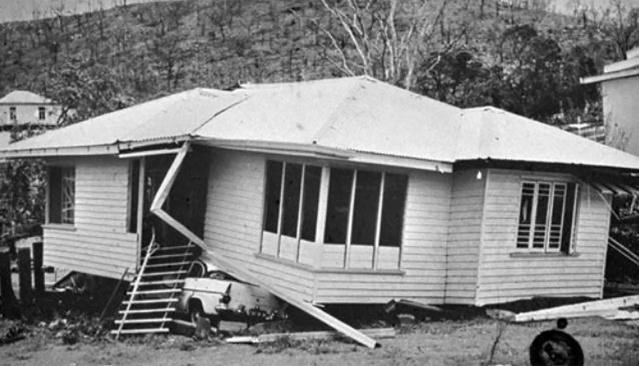
Let’s hope North Queenslanders can see some real relief on home insurance costs. They certainly need insurance given the huge damage that cyclones can bring. I well remember growing up in Townsville and hearing from my family members just how bad Cyclone Althea on Christmas Eve in 1971 was (see image below), and how important it was to be prepared for another cyclone. I recall various preparations such as taping up windows and some very heavy winds and rain several times in the eighties, but luckily Townsville was spared a direct hit when I was growing up there. Given the population growth in North Queensland which has occurred since the seventies, a direct hit of a cyclone on a large city would be even more devastating and costly nowadays.
Damage to a house and car by Cyclone Althea which devastated Townsville on the morning of 24 December 1971. Image available under Creative Commons Licence from Commonwealth of Australia, Australian Emergency Management Institute
The latest episode of my Economics Explored podcast features a conversation on whether COVID can be compared to wartime. The episode considers the different scales and scopes of the shocks, and what it all means for prospects for economic recovery. In the episode, I chat with my good friend Tim Hughes, who was the one who originally asked me whether dealing with COVID was similar to a war effort, and we conclude that a comparison of COVID to wartime isn’t valid. For instance, World War II required a complete reorganisation of the economy to maximise production for the war effort, while COVID has involved restrictions that have reduced economic activity. This is a point that was well made in a Conversation article earlier this year from a Canadian academic Comparing COVID-19 to past world war efforts is premature — and presumptuous.
In the episode, I give various examples of how economic resources were marshalled in the interests of the war effort during WWII, including the construction of Beaufort bombers at the Chullora Railway Workshops in Sydney and the addition of 5 million women into the US workforce during the war. On the Australian and US economic experiences during wartime, check out:
In the episode, we also consider the debt build up associated with responding to COVID, and I mention to Tim that federal debt-to GDP in the US will likely exceed what it got to during WWII, largely because the US started with such a high debt-to-GDP ratio (check out US Council on Foreign Relations Backgrounder on The National Debt Dilemma). Incidentally, in Australia, debt-to-GDP will end up much lower than what it got to during WWII when it exceeded 120% (see the 2009 Treasury Economic RoundupPublic Debt in Australia article, written by my then team members Kat DiMarco and Mitch Pirie and another colleague Wilson Au-Yeung).
Finally, I should note that, in our conversation, Tim and I compare COVID and wartime in terms of economic impacts. It’s undeniable that COVID is resulting in a large loss of life in many countries across the world, and, in terms of total lives lost, it could be compared to some wars.
Dr Scott Prasser, Senior Fellow at the CIS, gave a great ABC radio interview this morning on the proposal from former state Premiers Peter Beattie and Jeff Kennett for a Royal Commission into Australia’s COVID response. For background, check out the Brisbane Times article ‘People have tried to minimise the errors’: Leaders call for royal commission into nation’s COVID response. You can hear Scott from around 2:15:45 on the recording of his interview which the ABC will probably remove after a week or so, so listen soon if you’re interested.
I agree with Scott that a Royal Commission wouldn’t be the right vehicle for reviewing and learning from Australia’s COVID response given:
a Royal Commission is most appropriate for finding out what or who is to blame for a tragedy (e.g. bushfires or a bridge collapse),
it’s not the best vehicle for reviewing government policy decisions because it’s overly legalistic,
a Royal Commission would cost tens of millions of dollars given the fees paid to judges and lawyers, and it would also take a long time.
That said, Scott does favour reviewing Australia’s COVID response, just not by a Royal Commission.
In my view, the review of Australia’s COVID response would best be handled by the Productivity Commission, given its impressive analytical grunt and well-tested ability to hold public inquiries into important national issues with both economic and social aspects. I’d hope our state governments would cooperate with a Productivity Commission inquiry, but I expect they won’t fully cooperate. It would be good to see what written advice (if any) was provided by our Chief Health and Medical Officers justifying the more extreme restrictions (e.g. Stage 4 and a curfew in Melbourne) and interstate border closures, but we probably won’t get to see that. Nonetheless, I think the Productivity Commission could do a great job assessing all the evidence and advice from medical experts outside of government, and weighing up where Australia’s COVID response was reasonable and proportionate, and where it was excessive and harsh in application (e.g. not letting people attend the funeral of a parent).
Please feel free to comment below. Alternatively, you can email comments, questions, suggestions, or hot tips to contact@queenslandeconomywatch.com
Watching Catherine McGregor chatting with psychologist Dr Tanveer Ahmed on Sky Australia (People will have to ‘rethink’ New Year goals as a result of COVID-19 uncertainty), I remembered that many of my friends have been coping with COVID-related stress by substantially increasing their alcohol consumption. This is a general phenomenon across the community, not just among my friends, as evidenced by survey data (e.g. Alcohol consumption rises in Australia as COVID pandemic continues) and retail turnover data, which show a huge spike in liquor sales at bottle shops in 2020 (see chart below, noting SA stands for seasonally adjusted).

There was some substitution from liquor which would otherwise have been purchased at restaurants and pubs (see chart below), of course, but it appears very likely alcohol consumption has increased.

Indeed, ABS National Accounts data up to September quarter confirm substantially higher consumption expenditure on alcoholic beverages in 2020 (see chart below).
Alcohol brings substantial pleasure to consumers…However, alcohol also brings major costs to drinkers, others in proximity and to broader society. The full range of costs to society as a whole includes health harms from over 50 cancers, absenteeism, workplace accidents and productivity loss across the economy, motor vehicle accidents and a wide range of harms to others.
If someone gets around to doing a comprehensive cost-benefit analysis of Australia’s COVID response, they ought to consider any long-term damage resulting from Australians upping their booze consumption this year.
Please feel free to comment below. Alternatively, you can email comments, questions, suggestions, or hot tips to contact@queenslandeconomywatch.com





 Queensland Economy Watch