The Australian is reporting ‘Hollywood Australia’ a $1.5bn movie blockbuster extravaganza, covering the surge in international film productions such as Thor: Love and Thunder filming in Australia. This is partly related to Australia’s success in managing COVID and also to super-charged tax incentives and other government subsides offered by the federal and state governments. For example, check out the PM’s July 2020 announcement New $400 million incentive to boost jobs for screen industry.
I’ve long been sceptical about the special industry assistance provided to the film industry. In my view, this assistance mostly benefits multinationals such as Disney rather than Australian taxpayers, who may end up being worse off (e.g. check out my 2017 Centre for Independent Studies Policy paper: The case against film industry subsidies).
In my latest Economics Explored episode, EP74 Industry Assistance and Crony Capitalism, I catch up with my good friend Darren Brady Nelson, Chief Economist at LibertyWorks and a policy advisor at the Heartland Institute, to chat about the economics and political economy of industry assistance. We also touch on the concept of Crony Capitalism. Like me, Darren has long been a critic of industry assistance, aka corporate welfare, and in the episode he tells me about his time in NSW Treasury advising against state government financial assistance for Fox Studios in Sydney.
Hollywood sign, LA, California, USA
Please feel free to comment below. Alternatively, you can email comments, questions, suggestions, or hot tips to contact@queenslandeconomywatch.com
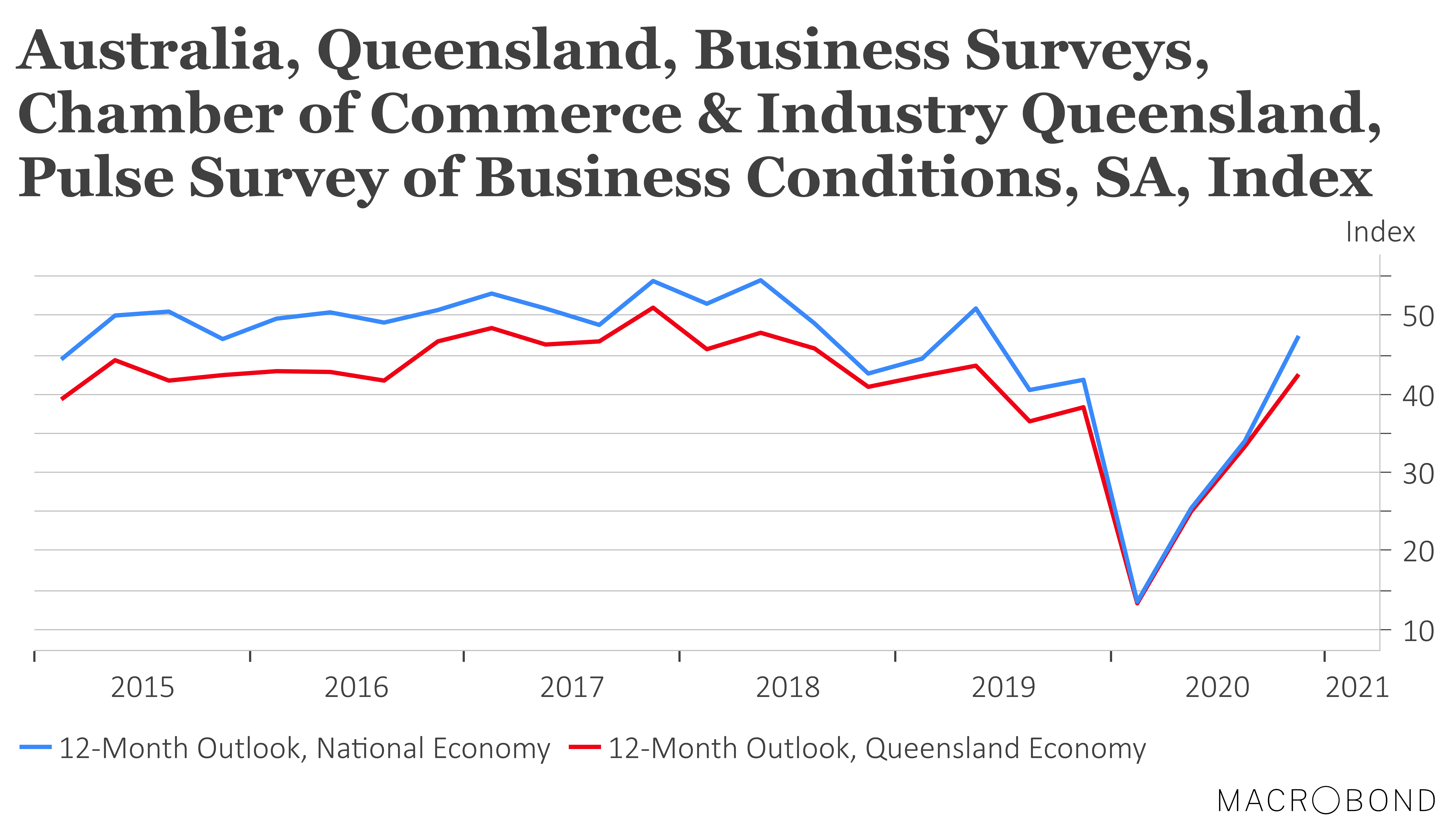
The Chamber of Commerce and Industry Queensland (CCIQ) has released its CCIQ Pulse Survey of Business Conditions for December quarter 2020, and it shows a continuation of the recovery in the second half of 2020 in business conditions and confidence (see chart below). That’s consistent with what we know from ABS data and other surveys. The 12-month outlook for Queensland businesses is actually higher than it was at the end of 2019, although the high degree of sampling error in the survey should be acknowledged, as should the outlook measure still being below the neutral level of 50.
Importantly, the report (on p. 13) also shows that a minority, but apparently a sizable minority, of Queensland businesses remain concerned about the future, and I suspect many businesses are very concerned about what happens when JobKeeper ends in late March:
At the close of 2020, businesses are mostly optimistic for their ongoing sustainability when stimulus support ends. Following a mostly positive December quarter, the proportion of optimistic respondents grew to over two thirds (67%). This finding does not suggest that challenges aren’t still present. There remains 32 per cent of businesses that believe their operation may cease in 2021 due to persisting challenges stemming from the COVID-19 crisis. [emphasis added]
That’s very concerning. While it’s expected the economic recovery will continue in 2021, there is no doubt that there is a lot of uncertainty regarding what happens when JobKeeper ends, particularly whether consumers and businesses will spend a good fraction of the $200 billion of savings accumulated during the pandemic.
Over the next few months, the insolvency statistics will reveal just how much financial damage has been done to businesses across Australia. I’m particularly concerned about those in Queensland’s regions most dependent on international tourism, such as Cairns and the Whitsundays. In a recent LinkedIn post, former CCIQ Chief Economist Dr Marcus Smith observed:
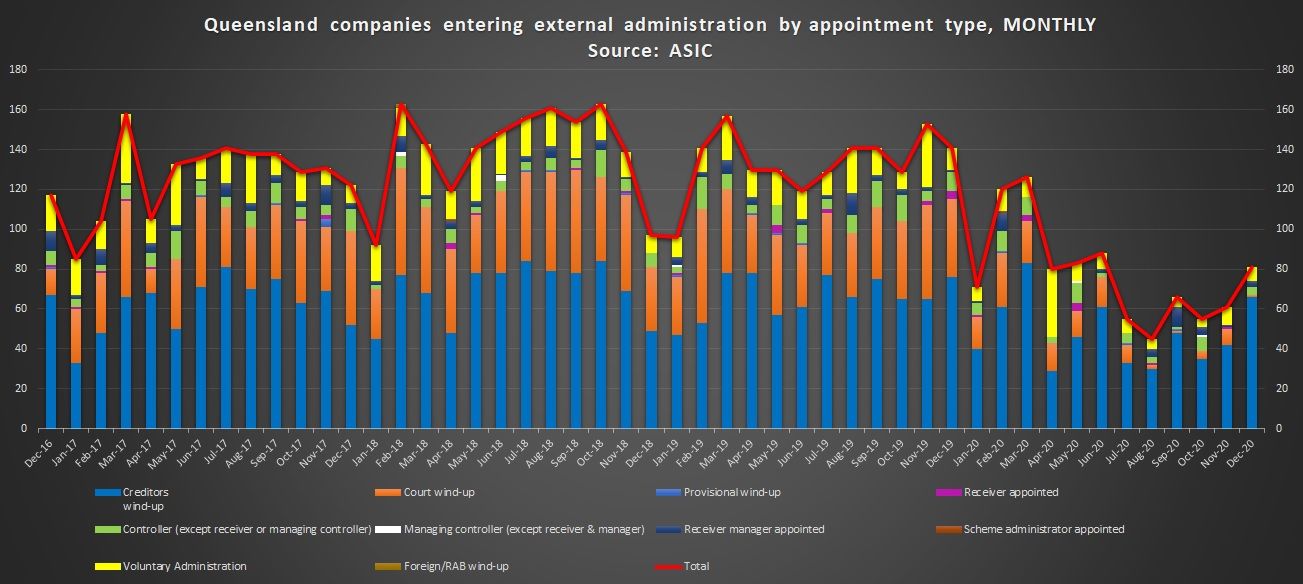
The number of business insolvencies fell dramatically over the period of the Federal Government’s moratorium to December, but is the honeymoon over?
Insolvencies started to tick up at the end of 2020, as Marcus showed in charts of ASIC data he posted earlier today (see chart below). We expect to see many more over the coming months.
Please feel free to comment below. Alternatively, you can email comments, questions, suggestions, or hot tips to contact@queenslandeconomywatch.com
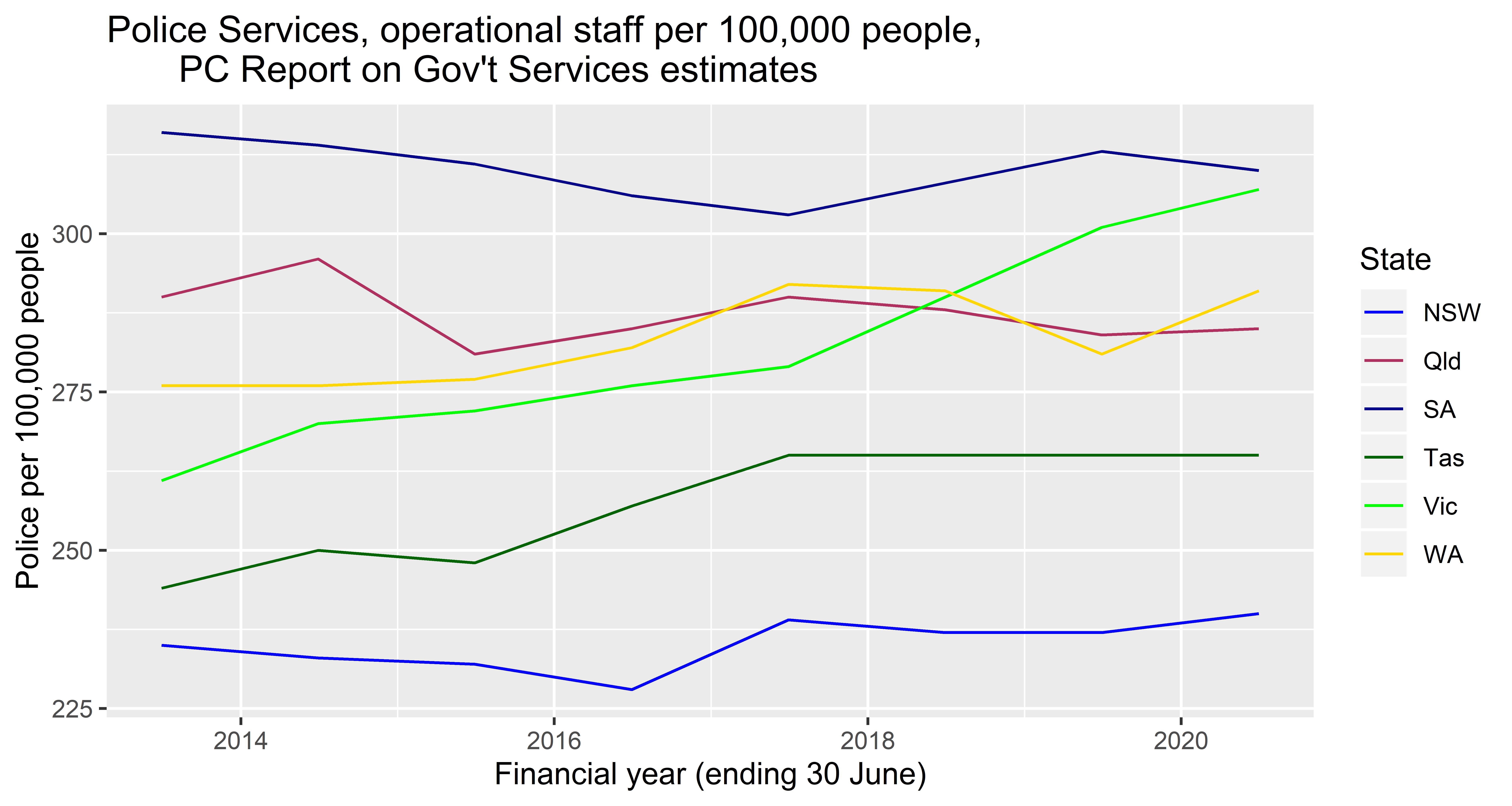
The number of Police Service operational staff per capita has fallen nearly 4% since 2013-14, from 296 per 100,000 people in 2013-14 to 285 per 100,000 people in 2019-20 (see chart below). That’s according to the very useful and somewhat underappreciated resource for policy analysis which is the Productivity Commission’s Report on Government Services, the 2021 edition of which was released progressively over late January and early February. You can find the data I’m quoting in the data tables (specifically Table 6.A2) for Part C Justice, Section 6 Police Services.
I’m not a criminologist and, hence, won’t speculate on whether the decline in police per capita has contributed to Queensland’s increase in youth crime and its tragic consequences, but these are obviously important data points which should figure in the public discussion on crime and the justice system in Queensland.
Please feel free to comment below. Alternatively, you can email comments, questions, suggestions, or hot tips to contact@queenslandeconomywatch.com
Yesterday’s post covered the surge in net interstate migration to Queensland during the pandemic. The surge reflects:
a) departures from Queensland to other states falling a lot (by 16% in September quarter 2020 compared with September quarter 2019), which could be due to both a decline in job opportunities down south and Queenslanders believing it’s better to live in (practically) COVID-free Queensland during the pandemic, and
b) the number of people moving to Queensland (i.e. arrivals from interstate) only dropping 5% through-the-year to 30 September 2020 – i.e. while Queensland hasn’t seen a spike in arrivals from other states, interstate arrivals haven’t collapsed as much as they have in other states (i.e. -11% in NSW and -30% in Victoria).*
Combined, the changes in arrivals and departures meant net interstate migration to Queensland jumped over 30% in September quarter 2020 (relative to September quarter 2019) according to the latest ABS estimates.
Pete Faulkner from Conus Consulting made a great observation regarding the interstate migration data in a comment on my post on LinkedIn:
Big moves indeed, and it’s regional QLD that’s seeing the most significant change. Consider that over the course of the first three quarters of 2020 regional Queensland added 12,000 new residents. Compare that to an average for the same period from 2015 to 2019 of just 3,700.
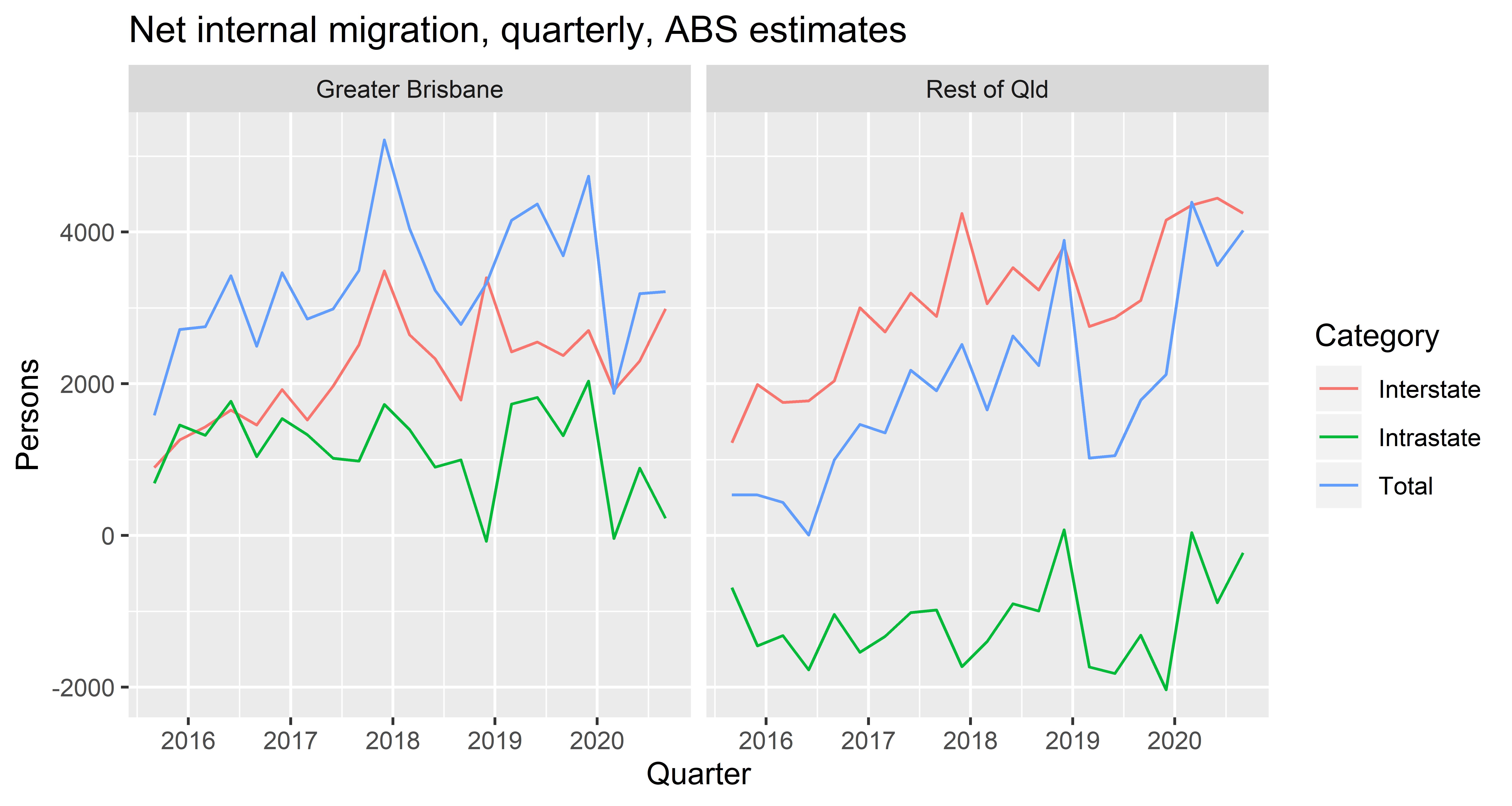
Pete’s right about that. Check out how net internal migration (from across Australia) to regional Queensland (i.e. non-Greater Brisbane**) has jumped up to a level of around 4,000 people per quarter in 2020 compared with an average of 1,500 per quarter in 2019 and 2,600 in 2018 (see chart below). Over the first three quarters of 2020, net internal migration to regional Queensland, at an average of 4,000 per quarter, exceeded average net internal migration to Greater Brisbane of 2,800 per quarter.
As the chart makes clear, the increase in net internal migration to regional Queensland was due to pick ups in net internal migration from both Greater Brisbane (i.e. intrastate) and from outside Queensland (i.e. interstate), to roughly equal extents. In September quarter 2020, net intrastate migration to regional Queensland increased by 1,088 people from the level in September quarter 2019. Instead of losing over 1,300 people to Greater Brisbane as it did in September quarter 2019, regional Queensland only lost around 200 people in September quarter 2020. Net interstate migration to regional Queensland has usually been positive and increased by 1,151 people, from 3,098 people in September quarter 2019 to 4,249 people in September quarter 2020.
*In a comment on yesterday’s post, regular reader Glen noted that interstate arrivals to Queensland would have included many people who were previously FIFO’ing to Queensland (e.g. to work in mines) and who have been forced to relocate (i.e. to avoid regularly having to go into quarantine).
**Greater Brisbane includes the metropolitan area but does not include the Gold Coast or Sunshine Coast, which are hence part of regional Queensland or rest of Queensland as it’s labelled in the ABS data set.
Please feel free to comment below. Alternatively, you can email comments, questions, suggestions, or hot tips to contact@queenslandeconomywatch.com
Queensland’s acting Premier has pointed to migration data showing a surge in new residents as an endorsement of the state’s pandemic response…
Interstate migration data, released by the Australian Bureau of Statistics this week, revealed Queensland gained the most new residents during the September quarter while NSW and Victoria went backwards.
I have previously speculated that the pandemic would prompt many people in southern states to contemplate a change of lifestyle and a move to Queensland. And there have been plenty of anecdotes from real estate agents about prospective buyers from southern states inquiring about Queensland properties, particularly on the Sunshine and Gold Coasts. Are we already seeing a pick up in interstate migration to Queensland in the data up to the end of September 2020? Let’s have a closer look at the data published by the ABS earlier this week (chart below).*
Net interstate migration to Queensland was over 7,200 people in September quarter 2020 compared with around 5,500 people in September quarter 2019, a 32% increase through-the-year, so the Deputy Premier is on solid ground referring to a surge. Notice how net interstate migration has been on an upward trend since 2015, but still has not reached the levels of the early 2000s, or the late eighties or early nineties.
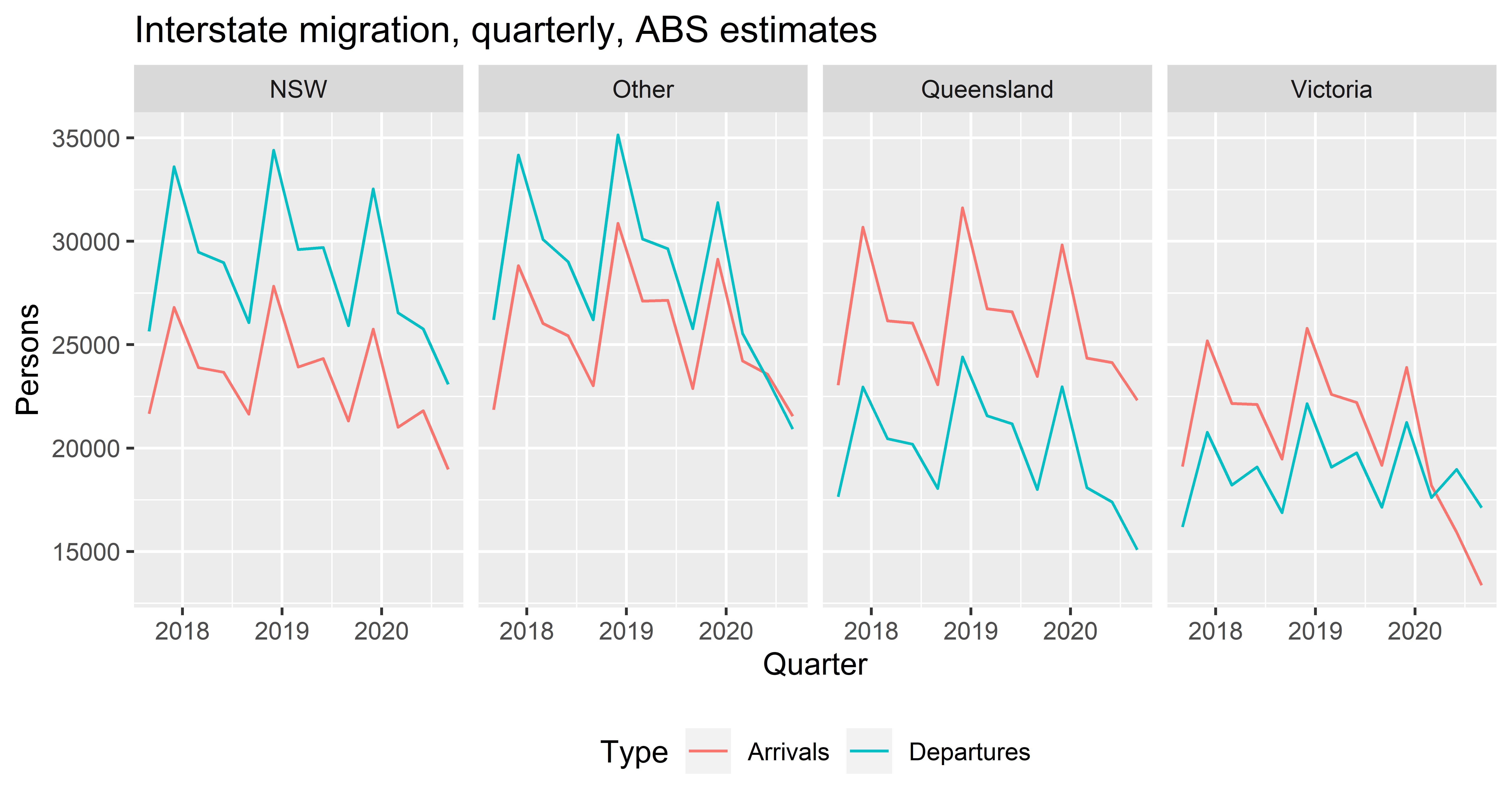
Net interstate migration to a state is equal to interstate arrivals to the state less interstate departures from the state. It can be positive, if arrivals exceed departures, or negative if the opposite occurs. Let’s break down the net interstate migration figures into arrivals and departures to have a closer look at what’s going on in the recent data (see chart below).
In September quarter 2020, interstate arrivals to Queensland were around 22,300 and were lower than arrivals in September quarter 2019 of around 23,500 people. That’s to be expected given the suppressed level of economic activity and hiring during the pandemic and due to the difficulties in travelling during this time. Even though arrivals from interstate were lower, net interstate migration to Queensland was much higher in September quarter 2020 than in September 2019 because there was a big drop in people departing to other states from Queensland. Around 15,100 people moved from Queensland to other states and territories in September quarter 2020, down around 2,900 people from the September quarter 2019 level of around 18,000 people. So nearly 3,000 Queenslanders who may otherwise have moved to other states in September quarter, stayed in Queensland instead.
Notice how arrivals to Victoria have dropped substantially through-the-year (13,400 in September quarter 2020 vs 19,200 in September quarter 2019), but departures from the state have stayed similar to the level in September 2019, at around 17,100 people. So net interstate migration to Victoria turned around from a positive figure of 2,030 people in September quarter 2019 to a negative figure of -3,749 in September quarter 2020. In NSW, interstate departures declined more than interstate arrivals, so net interstate migration was around -4,100 in September quarter 2020 compared with around -4,600 in September quarter 2019, meaning NSW actually lost fewer people in the September quarter in 2020 than in 2019.
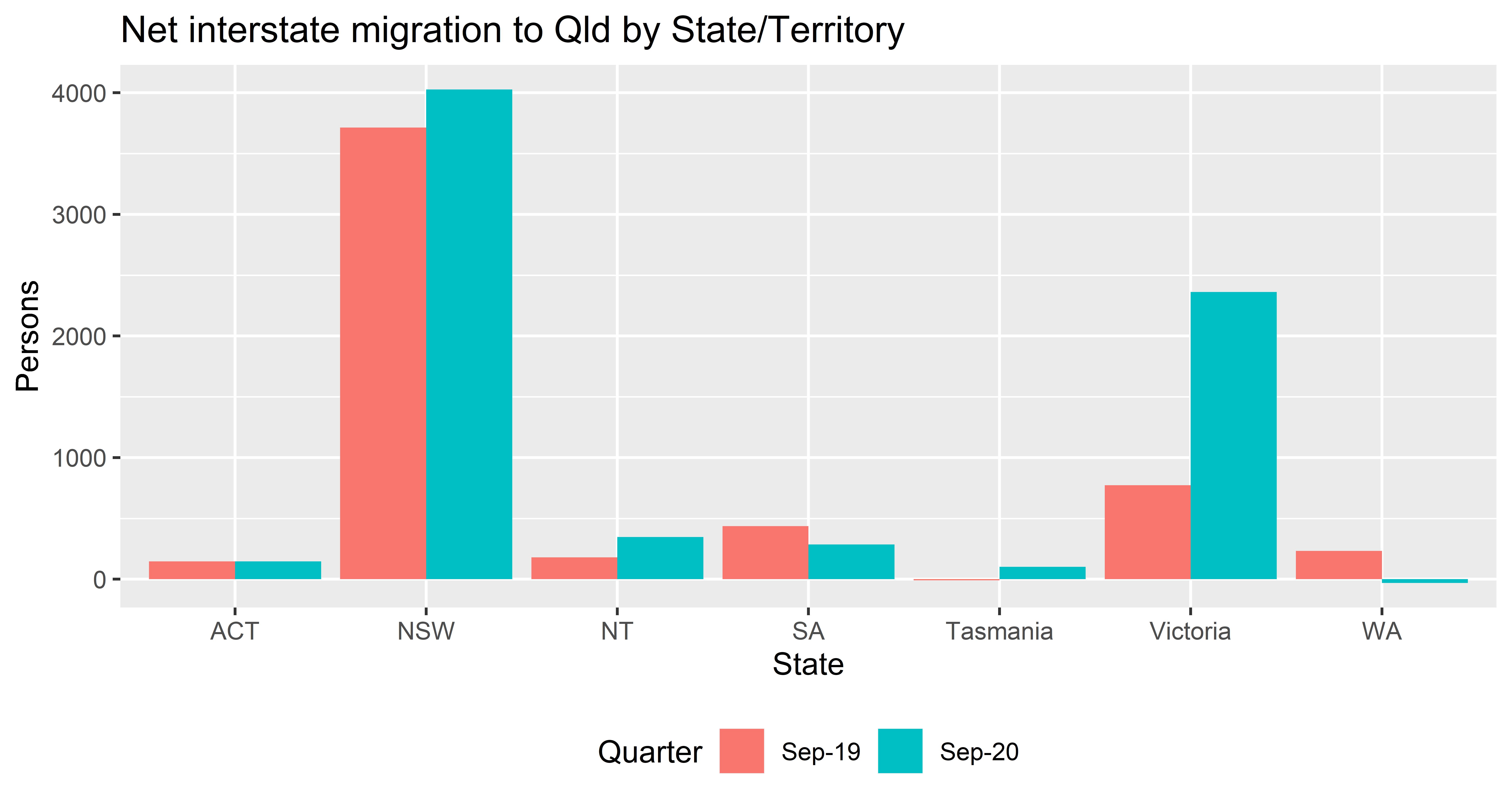
If we look at the ABS’s estimates of net interstate migration flows between specific states, we see that the major contributor to the surge in net interstate migration to Queensland in September quarter 2020 was the big increase in the loss of people from Victoria to Queensland (see chart below). In September quarter 2019, Queensland gained 772 people from Victoria, but in September quarter 2020 we gained 2,362 people from Victoria. The net gain from NSW increased, too, but not by as much as it did for Victoria. In September quarter 2019, Queensland gained 3,714 people from NSW, and in September quarter 2020 we gained 4,027 people from NSW.
*Note there is a seasonal pattern in the data, which have not been seasonally adjusted by the ABS, and hence September quarter 2020 data will be compared with data for September quarter 2019.
Please feel free to comment below. Alternatively, you can email comments, questions, suggestions, or hot tips to contact@queenslandeconomywatch.com
The Queensland Audit Office’s Energy 2020 Financial Report has been making news (e.g. in the Brisbane Times), although not for the same reasons I think it’s important. It demonstrates, to me at least, that Queenslanders are worse off because the current Queensland Government rejected the previous government’s plan to offload the state’s energy assets as part of its Strong Choices program.
Let’s start with one of the facts reported by the QAO, that the state government’s renewable energy business CleanCo has written down the value of the relatively high cost Swanbank E gas power station to zero. Swanbank E is expected to lose money each year until it’s shutdown in 2036. This is because wholesale electricity prices have fallen with the growth of renewable energy sources, growth which has partly been driven by government subsidies.
We’ve known for some time that our National Electricity Market (NEM) isn’t sufficiently rewarding generators for maintaining reliable generation capacity, and we need to find a solution fast, or our rapidly expanding renewable energy generation capacity will render more fossil fuel-powered generators uneconomic too soon and threaten the reliability of our electricity supply. For more on the big challenge posed by renewables for Australia’s NEM, and possible solutions, check out the excellent webinar held by the Economic Society of Australia (QLD) last November:
Clearly, the rapid expansion of renewable energy is leading to some peculiar outcomes, as highlighted by the QAO in its report on p. 9:
Increased solar generation during the middle of the day has meant that, on occasion, supply for electricity is so much greater than demand that power generators have had to pay the market to take the electricity they generate. This is referred to as a ‘negative price event’.
With ever-growing renewable electricity supply and a reduction in electricity demand during the pandemic, there were several hundred negative price events in 2019-20 according to the QAO’s figure on p. 9.
Lower electricity prices, partly due to the growing presence of renewables, have reduced the profitability of state-owned generators and prompted asset write downs. The QAO report highlights the value of the Queensland Government’s energy assets is falling. I should note this is not a new revelation, but was revealed in annual reports last year (e.g. see Robert MacDonald’s excellent write up at InQueenslandState’s power companies at a loss due to COVID and switch to renewables). CS Energy and Stanwell wrote down the value of their assets by 15-20% or over $1 billion in 2019-20 (see p. 8 of the QAO report). This was not solely due to COVID, as the QAO report makes clear, identifying “increased generation from renewable sources” as another contributing factor to the lower electricity prices which have reduced generator profitability. On its one page summary of the report, the QAO notes (on p. 1):
While the energy sector is still financially viable, its profits have declined significantly.
It’s a shame privatisation was an election issue in 2015 and the then Opposition led by now Premier Palaszczuk committed so strongly to public ownership of existing state assets, because it would have been good for Queensland taxpayers for the Government to have offloaded the energy assets back then. The Queensland Treasury was strongly convinced they weren’t worth holding on to, as I discussed in my 2018 book Beautiful One Day, Broke the Next and in this 2018 QEW post:
Fiscal stimulus is very topical worldwide, with the new US President Joe Biden proposing a US$1.9 trillion COVID relief and stimulus package. And, in Australia, there is a debate occurring over how to support the tourism sector once JobKeeper finishes at the end of March. In Episode 73 of my Economics Explored podcast, I discuss fiscal stimulus with Professor Fabrizio Carmignani, Dean (Academic) of Griffith Business School. Highlights of our conversation include:
how the size of the multiplier (and the degree of “crowding out”) varies with the state of the economy (from about 7:00);
how governments really do need to run surpluses (or, at worst, very small deficits) when the economy recovers so the debt-to-GDP ratio can be stabilised and reduced in the long-term (discussion from around 14:15);
how Modern Monetary Theory (MMT) is “a repackaging of traditional Keynesian theory, under very specific conditions” and why it shouldn’t guide macroeconomic policy (from around 20:35); and
how vouchers may be a more effective stimulus than cash handouts (relevant discussion begins around 25:00).
Please feel free to comment below. Alternatively, you can email comments, questions, suggestions, or hot tips to contact@queenslandeconomywatch.com
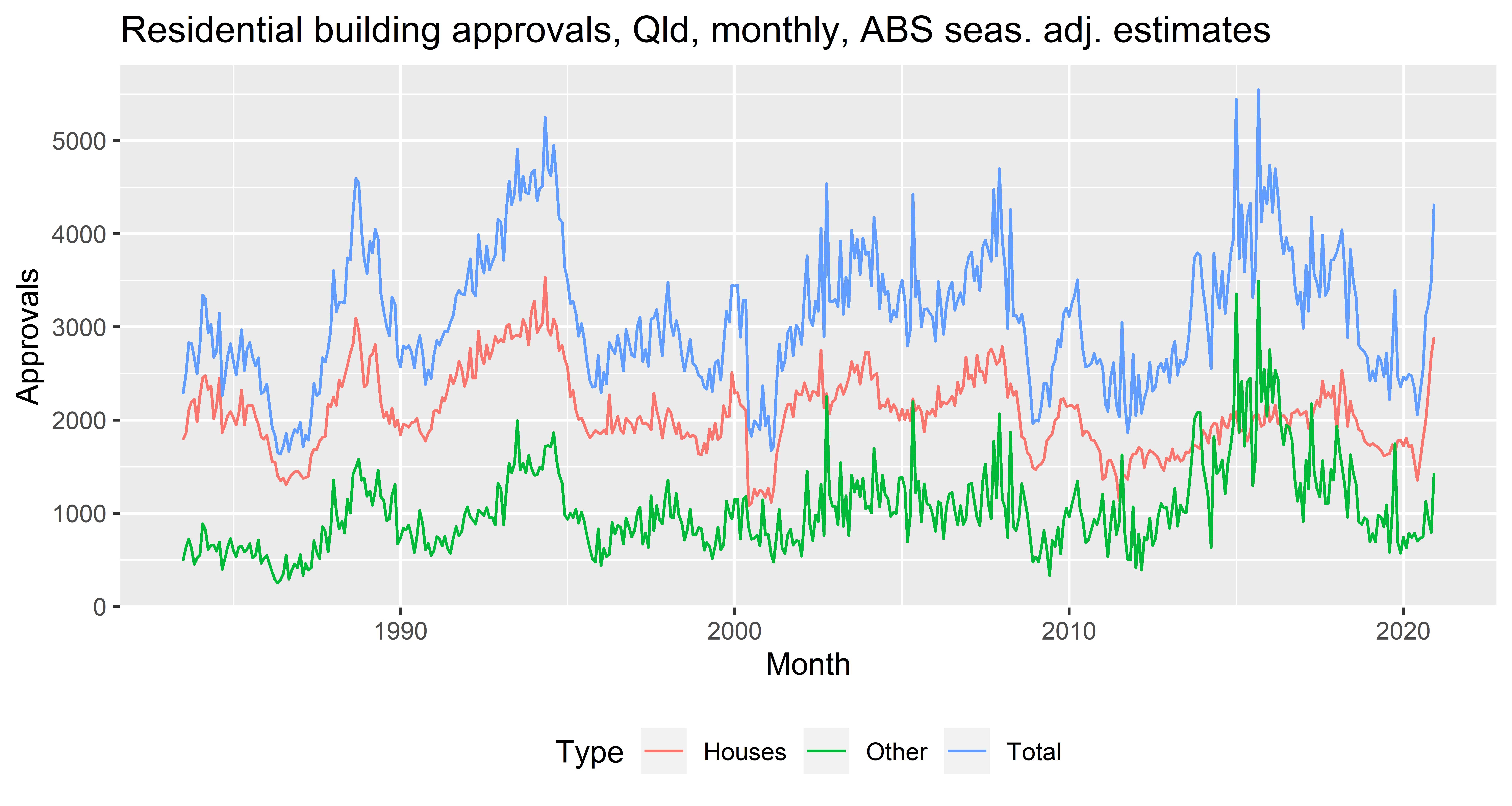
The Housing Industry Association was quick to proclaim Detached Building Approvals Reach Record High after the ABS published the December building approvals data today. “Detached building approvals” are approvals for houses, as opposed to approvals for apartments or townhouses. Obviously, the record high is related to ultra-loose monetary policy from the RBA, less rigorous lending policies from banks, and the federal government’s HomeBuilder grant. In Queensland, it wasn’t a record high for housing approvals, but rather the highest level since the peak period of interstate migration to Queensland in the early to mid-nineties (see chart below), when Queensland was gaining up to 1,000 people per week from interstate migration, in net terms (i.e. arrivals less departures). Note that total approvals aren’t yet near the peaks of five years ago, when there was an apartment building boom in Brisbane.
The surge in approvals is good news for the building industry, its supply chain, and the economy more broadly. We’ll need dwelling investment to add substantially to Gross State Product (and GDP nationally) to offset the contractionary impact coming from the winding down of JobSeeker and JobKeeper. We also need to see additional supply to moderate the growth in property prices. According to CoreLogic, Brisbane property prices rose 0.9% in January and 2.5% in the three months to 31 January (see Australian housing values reach a new record high as values continue to rise across every broad region of the country).
Regular QEW reader Andrew Aschman has alerted me to a current Queensland Parliamentary Inquiry into a bill which, among other things, would make it easier for artisan distillers and craft brewers to sell their products on or off their premises (see Liquor (Artisan Liquor) Amendment Bill 2020). The bill could be much more ambitious, however, as noted by David Ridden, President of the Australian Distillers Association and owner of Granddad Jack’s Craft Distillery, in response to a question from Opposition MP Laura Gerber at the public hearing into the bill on 21 January. Ms Gerber asked “Is there anything that could be added, changed or amended to better support the industry at this time?” Ridden replied:
Potentially. We are a new industry. Distilling has been around a long time but this artisan segment has really grown phenomenally across the country and in Queensland in the last couple of years. It has not grown so rapidly in Queensland because of our current laws. In terms of having a fair playing field, small producers will never have the finances to be able to produce that sort of volume that allows us to go into those big, major retailers, the ones that Coles and Woolworths control.
It would be nice in the future if the something like 750 small independent grocers across the state had something that allowed just people with the artisan producers licence, this new licence, to sell to them. It would then make it a bit more of an even playing field for us and at least the consumer would see us. At the moment, the reality is that when most consumers want to buy something they go to Dan Murphy’s, First Choice or Liquorland. They do not see all those other brands that we produce across the state because we are not as visible.
Andrew Aschman expanded on this idea in a submission he made to the Inquiry, which was provided after the due date so it isn’t available on the Parliamentary website, unfortunately. Here’s what Andrew wrote:
I am supportive of proposed sales and marketing of Artisan Liquor via Independent Grocers and relevant convenience stores…In relation to supermarkets sales this should be extended and include supermarkets up to 1800sqm. This would cover most Independent supermarkets as well as some metro supermarkets owned by the larger brands that could also help market and sell Artisan Liquor effectively and safely.
This extra convenience would be great for consumers. I’d go even further and allow supermarkets of all sizes to sell all types of liquor as they do in some other states and countries. In my view, the Government should allow a trial of supermarket liquor sales for say 24 months and see if there are any noticeable impacts on alcoholism or alcohol-related violence. If there are not, supermarkets should then be allowed to continue selling alcohol. Current regulations inconvenience consumers, but really aren’t going to stop problem drinkers from accessing alcohol.
Finally, credit to Andrew for his ongoing advocacy for more liberal retail trading regulations in Queensland.
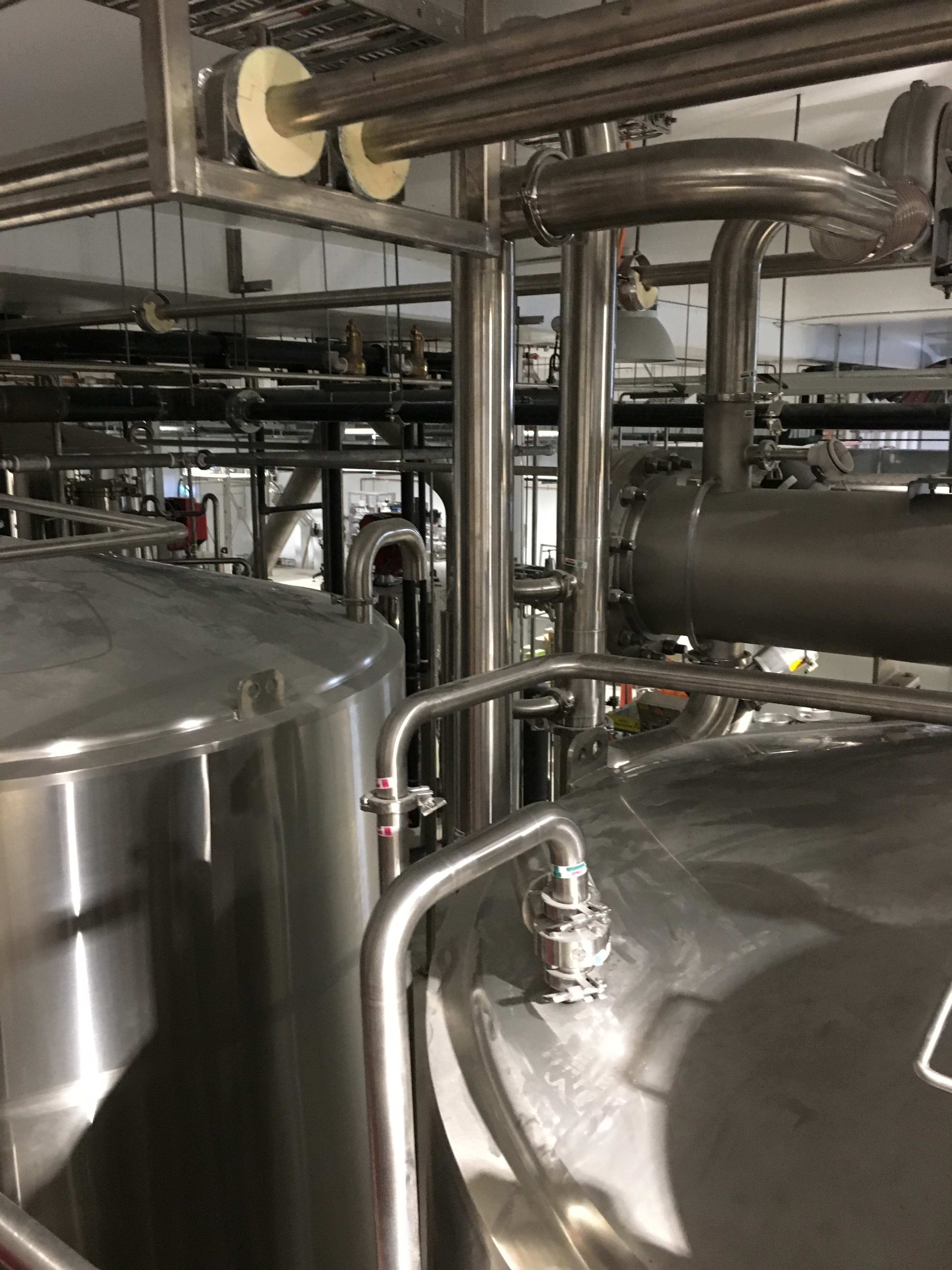
Out the back at Newstead Brewing Co., Milton, Brisbane.
Please feel free to comment below. Alternatively, you can email comments, questions, suggestions, or hot tips to contact@queenslandeconomywatch.com
Now that COVID has escaped from inner-city hotels in four cities, Melbourne, Sydney, Brisbane, and Perth, our governments should finally realise we need to do things differently. Otherwise our economic recovery will be jeopardised by repeated “short, sharp” lockdowns that our Chief Health Officers will regrettably recommend if they see even one case of community transmission of a mutant strain.
Queensland Premier Annastacia Palaszczuk has tried to get her own remote quarantine program up and running near Gladstone, but her efforts have failed with the local Mayor refusing to cooperate, as reported by The Australian. Arguably, it’s time for the level of government which actually has responsibility for quarantine, the federal government, to take over, as state governments may be too financially constrained to think on the right scale of what is needed.
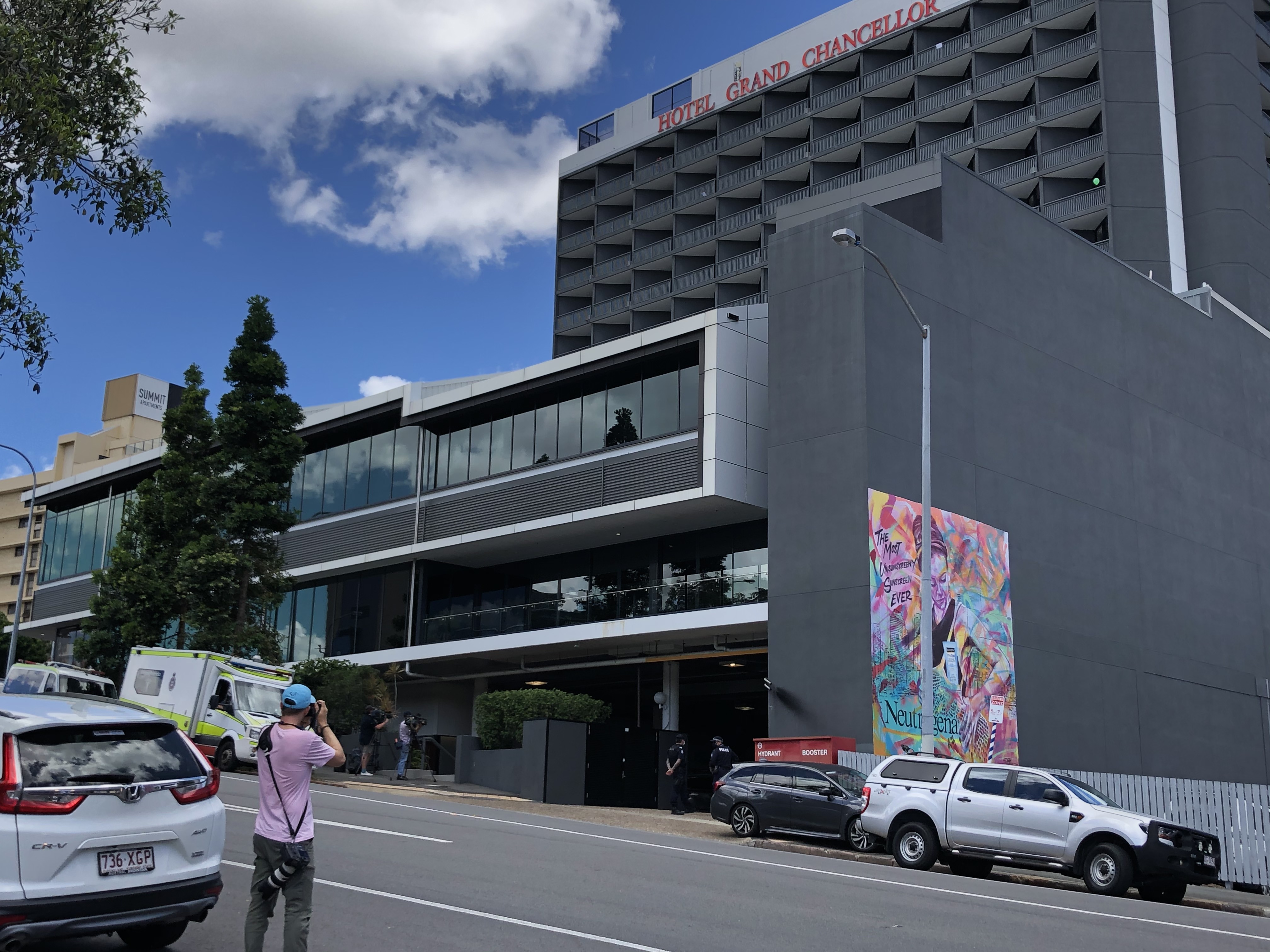
As regular QEW reader Paul has previously suggested, the federal government could set up dedicated quarantine facilities in remote areas, possibly near remote RAAF bases to allow for flights in and out. I quoted Paul in my post on the Grand Chancellor COVID incident and I think his comments are still relevant and worth reading. Perhaps the planning for remote federal quarantine facilities needed to start last year, and it would take the rest of 2021 to proceed from planning to procurement to construction, by which time COVID should be much less of a threat due to widespread vaccination (hopefully). We may have to make do with state-run hotel quarantine for the rest of this pandemic, but we should probably include federal quarantine facilities in remote locations in our plans for future pandemics.
Inner city hotels, such as the Grand Chancellor at Spring Hill, Brisbane, only 300 metres away from my office, probably aren’t the best places to run a quarantine program.




 Queensland Economy Watch