Clever election commitment wording – Govt actually didn’t promise Tier 1 hospital for Cairns

When I read the news that new Health Minister Lawrence Springborg is backing away from upgrading Cairns Base Hospital to a Tier 1 hospital, I thought it was very soon for the Government to back away from clear election commitments (see Cairns Post coverage at LNP backs off from Tier 1 hospital pledge). But if you read the election commitment closely you realise the Government never actually promised to upgrade the hospital to Tier 1, but just to put it on the path to Tier 1 by giving it some additional funding (which the Cairns Post only notes at the end of its article). Here’s the clever wording from the election commitment:

A CanDo LNP Government will put Cairns Base Hospital on the path towards ‘tier one’ status by providing $15 million to begin recruiting extra specialists.

The LNP will put Cairns Base Hospital on the path towards ‘tier one’ status beginning with $15 million in flexible funding over four years to recruit extra specialists as part of our plan to revitalise front line health services.

Obviously putting something on the path to somewhere isn’t the same as getting it to the destination. While the Government can rightly claim it didn’t breach an election commitment, it’s not a good look because it seems many Cairns residents were under the impression the hospital would be upgraded. One of Dr Phil’s most useful pieces of advice is that “There is no reality, only perception”, so the Government will need to be careful it isn’t perceived as being tricky when it points to the precise wording of election commitments in explaining its actions.
Posted in Budget, Health | 4 Comments

Wintergarden stage 2 opening at a good time

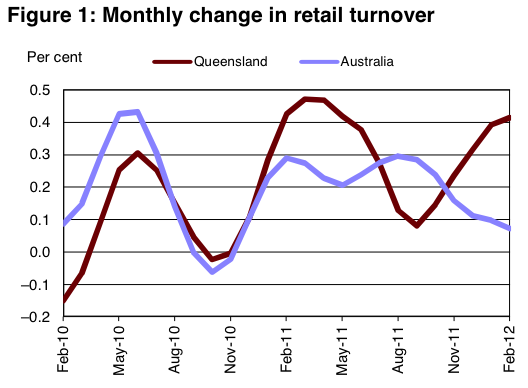
Retailers in the newly opened Stage 2 of the redeveloped Wintergarden shopping centre on Brisbane’s Queen St Mall will be pleased with today’s ABS retail trade figures which show solid retail trade growth in Queensland, despite sluggish conditions in other States (with the exception of fellow resources State WA). The OESR information brief contains some interesting charts, including this one:

The Brisbane Times has coverage of the Wintergarden stage 2 opening here:

Autumn opening for Wintergarden revamp

Gents looking for some interesting new kit should check out the new Pistols at Dawn store in the Wintergarden, which features the ready-to-wear collection from Brisbane’s best menswear store, the Cloakroom. I was fortunate enough to attend the Cloakroom’s fifth birthday celebrations last month, and I can be seen in the ninth photo on this Cloakroom blog post standing next to store owner Andrew Byrne (the really tall gent in the photo).

Posted in Retail trade | Leave a comment

Annual cap on mining approvals undesirable and impractical

In the Cairns Post today, in an article with the over-the-top title of People desert Cairns in droves, there is reference to the South of the Embley mining project which is being held up by the need to secure environmental approval from the Commonwealth Government. I can’t comment on the merits of the project, and I note it has attracted strong criticism from the Wilderness Society, but it strikes me as another example demonstrating how, contrary to the suggestion of an Australia Institute paper yesterday, Governments are attempting to manage the mining boom in a responsible manner.

As discussed in yesterday’s post, I believe the Australia Institute’s policy recommendation for slowing down the mining boom is undesirable and impractical. In its report (Too much of a good thing?), the Institute describes its proposal as follows:

A simple and direct way to both reduce the negative consequences of a rapid mining construction boom and maximise the returns of that boom to Australian citizens would be to place an annual cap on mining development approvals and to auction the access to those limited approvals.

That is, in order to both minimise the negative externalities associated with attempting to simultaneously build record numbers of new resource projects and ensure that each project is rigorously examined by the relevant government agencies a fixed number of new mining projects could be determined on national interest grounds based on the size of the existing workforce, infrastructure and bureaucratic capacity.

Having determined the cap, in terms of either the total number or size of projects, mining companies could then bid for the right to apply for prioritised approval. The willingness of mining forms to pay for such projects would be directly proportional to the expected profitability of their project. Such an approach would ensure that the national benefits of mining expansion were maximised for a fixed value of the negative externalities associated with the projects.

If the Institute wants to progress this idea in the public debate it needs to provide more detail on how it would work in practice. It needs to explain at least:

  • how Governments can sensibly set an annual cap on approvals in four to five year’s time, which they will need to do given that approvals processes can take this long (see the project overview for the South of the Embley project for example);
  • whether the auction is run by the State or Commonwealth Government, noting that approvals of new mines can involve both levels of Government; and
  • how the State and Commonwealth Governments would share the auction proceeds.

In my view, Governments setting a cap on mining approvals several years in advance, when they have limited understanding of what prevailing economic and labour market conditions will be at the time, is just silly.

If there is concern about the capacity of bureaucracies to process applications then a simpler policy solution would be to increase application fees and use the funds to provide more resources in departments. If there is concern around adverse impacts on other sectors from the expansion of the mining sector, such as through poaching skilled labour,  Governments should review whether our current regulations allow Ministers sufficient discretion to block or to attach conditions (e.g. around workforce training) to approvals for projects that are likely to result in the adverse impacts the Australia Institute has identified.

Posted in Macroeconomy, Mining, North Queensland, VET | 1 Comment

Qld only State with recovery in building approvals

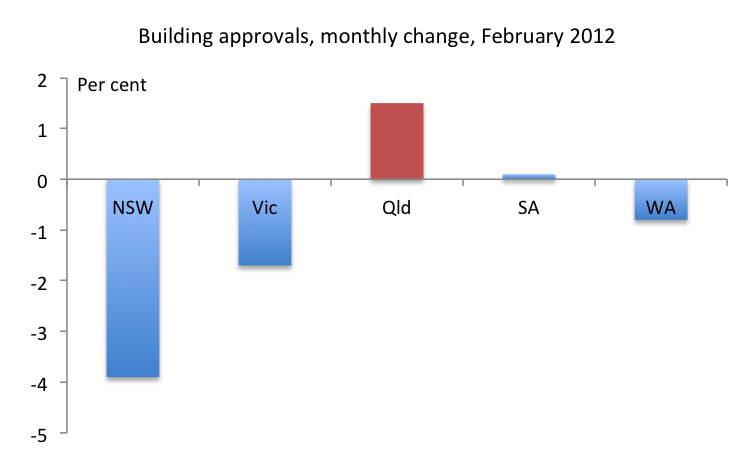
Obviously today’s shocking building approvals data from the ABS increase the chances of an interest rate cut tomorrow (see Pressure grows for rate cut). Based on the ABS’s trend estimates for the major States, Queensland is the only State in which building approvals, which predict future construction activity, appear to be recovering (although approvals in Queensland remain at below pre-GFC levels):

I’m a little surprised by the WA estimate, and I wonder if it is a supply-side issue. Is dwelling construction in Perth constrained by shortages of building workers who are all away working in the mines?

Posted in Uncategorized | Leave a comment

A case for slowing down the mining boom – aren’t we doing that already?

In today’s Sydney Morning Herald, Ross Gittins discusses a new paper from the Australia Institute on the case to slow down the mining boom. I may be biased, but I thought we already were slowing it down? For example, see Burke delays Abbot Point decision. There are already extensive requirements for environmental and economic impact assessments prior to Government approvals.

According to Gittins’s summary, which I’ve had to rely on as the Australia Institute paper is not on the web yet, the Australia Institute identifies a number of adverse impacts of the mining boom that justify Governments slowing it down, including skilled labour shortages and the impact on the Australian dollar.

But the Australia Institute doesn’t appear to appreciate the extensive consultation and collaboration already occurring between industry and Government to address skills requirements in the resources sector, such as the Mining and Gas Jobs Expos coordinated by Skills Queensland. Nor does it appear to appreciate the potential for the resources sector to provide job opportunities to people in those regional areas, such as the Gold Coast and Far North Queensland, that have sluggish economies.

Rather than arguing to slow down the mining boom, the Australia Institute would have a better case if they instead argued for Governments to push for greater contributions from industry, both financial and in-kind (e.g. equipment), to support training. Of course, the industry would then point to the new super profits tax it will be paying.

I find the Australia Institute’s suggestion that “new mining projects be required to bid at auction for a set number of development permits” (Gittins’s words) very odd, because there is no such thing as a homogeneous development permit. Approvals for new mines are site specific and typically have a range of conditions attached, particularly relating to environmental protection. As such, I can’t see any auction of a generic development permit being possible, as resources companies would have no idea what to bid for it.

Finally, I’ve expressed my views on the resources sector’s impact on the Australian dollar in a previous post:

Australia Institute’s mining boom analysis ignores benefits to consumers

Posted in Macroeconomy, Mining | 2 Comments

Australians returning to Qld tourism regions (except for the Gold Coast)

Gold Coast community leaders will be disappointed by data published yesterday by Tourism Queensland which show domestic visitor numbers declined in the 2011 calendar year, while other Queensland regions experienced an increase in domestic visitors:

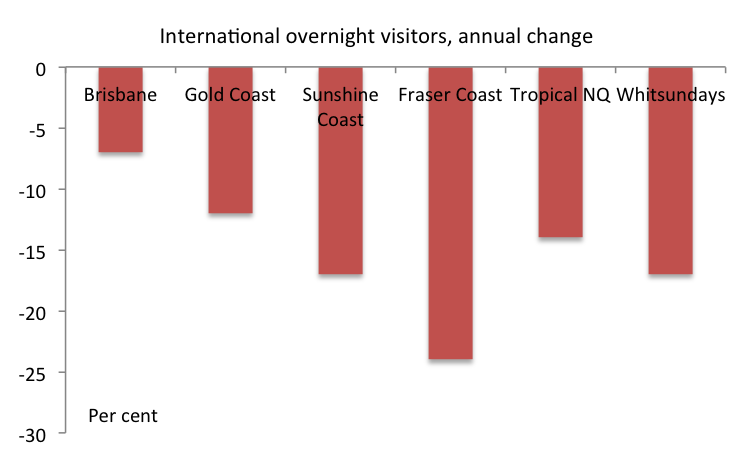
International visitor numbers have declined in all regions, obviously due in large part to the high value of the Australian dollar:

The Tourism Queensland regional snapshots which contain these data are unfortunately not easy to find on the Tourism Queensland website. You need to start on the destination visitor data page and drill down into the specific region.

Posted in Tourism, Uncategorized | Leave a comment

Farmers miss out when Govt gives $275M handout to Holden

There is a great opinion piece in the rural press today (available at Queensland Country Life) on “Why Holden’s crutch matters to ag.” The author Gregor Heard opines:

Some tough questions have to be asked about our car manufacturers and their ongoing viability, given cheap labour costs internationally.

No one wants to see a repeat of Thatcher’s Great Britain, where the manufacturing sector was forcibly brought to its knees, causing great hardship to many families, however could we not transition these manufacturing workers into industries that have a real future in Australia?

That $275 million could go a long way towards improving profitability in many rural-based businesses.

You look at the creaky infrastructure moving the nation’s grain to port.

Investment in this is a long-term positive for the government, who will see return on their capital for 35 years to come.

How long before the car manufacturers have their hands out again?

I don’t think it will be long until Ford comes to the Federal Government pleading for more money, as it’s been obvious for a number of years that Ford is the next Mitsubishi and its future as a manufacturer in Australia is doubtful.

While we’d need to assess investments on a case-by-case basis, the rural sector clearly deserves greater attention from the Federal Government, particularly given the huge increase in demand for food globally that will occur over the next few decades. Australia has a real comparative advantage in agriculture based on abundant land, skilled labour, world leading R&D and a reputation for high quality.

Greater attention to the rural sector would be good from the Queensland economy’s perspective, too, as it would mean we’d get a greater share of federal largesse, rather than having it go to car manufacturers in Victoria and SA.

Posted in Agriculture, Industry policy, Infrastructure | Leave a comment

Costello is a good choice for the Commission of Audit

I was pleased to see that Premier Newman has appointed Peter Costello to head the Commission of Audit (Newman hires Costello for financial check-up). Costello is first class and did a good job in restraining excessive spending under the Howard Government (yes, it could have been much worse), including stopping the Howard Government from adopting the home insulation/pink batts scheme (see Federal run health another batty idea). Unfortunately the Rudd Government wasn’t as perceptive.

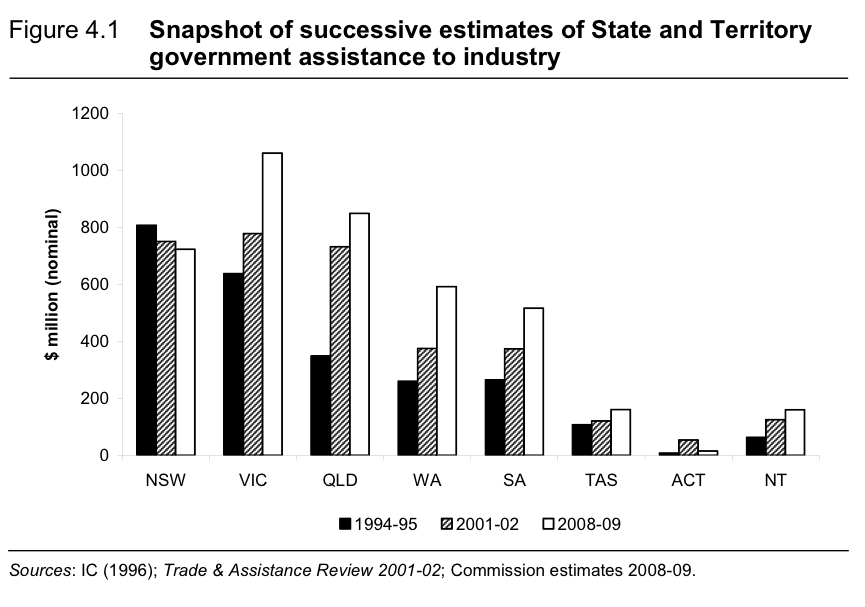
If I were advising the Commission of Audit, the first thing I’d put in front of them is the Productivity Commission’s Trade and Assistance Review 2009-10 which outlines the extent of industry assistance/corporate welfare provided by the Queensland Government. Industry assistance costs the Government around $800 million per annum:

The Commission of Audit should be able to recommend some easy cuts out of this $800 million.

Posted in Budget, Industry policy | Leave a comment

Carbon tax will disproportionately impact Qld, so Newman has good reason to oppose it

New Premier Campbell Newman has urged the Gillard Government to “think again” about the carbon tax (PM promises to listen as Newman warns), which is the right position for a Queensland Premier to take given: (a) the carbon tax will disproportionately affect Queensland and (b) we’re imposing a major cost on our economy that major emitters such as the US and China are not.

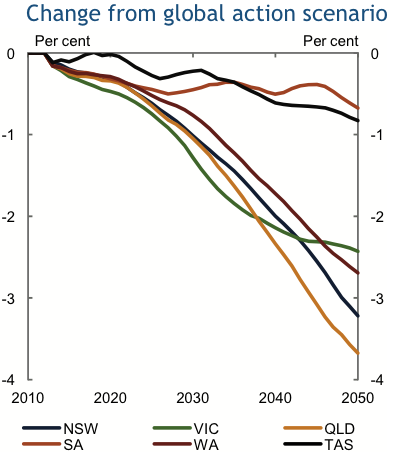
I’ve previously posted on how Queensland has to make the biggest adjustment to the carbon price and on Carbon tax impacts on tourism and construction sectors. The authoritative source on the impacts of the carbon tax on the States is the Commonwealth Treasury carbon price modelling report. This chart shows the disproportionate adverse impact on Queensland’s gross state product (GSP) of the carbon tax (Chart 5.37 from p. 134):

I am not denying we need to do something on climate change, but we need coordinated international action, rather than unilateral action that will make us worse off for no measurable reduction in climate change.

Posted in Climate change | Leave a comment

Valuer-General’s report shows big slump from pre-GFC Gold Coast land values

While I’m generally positive about the Queensland economy, I remain concerned about the short-term prospects of Cairns and the Gold Coast. Loose Change has coverage of the bad news on land valuations in the Cairns region contained in today’s report from the Queensland Valuer-General (Snapshot of the 2012 valuation). The news is just as bad for the Gold Coast, particularly for Surfers Paradise, with the Valuer-General noting (p. 6):

Gold Coast land values have continued to decline following the global financial crisis in 2008. Since then peak values in the central Surfers Paradise area have declined by approximately 50 per cent. The decline in values this year is more widespread across the Gold Coast than in previous annual valuations.

Despite the bad news, I’m confident Gold Coast land values will start to recover sometime in the next couple of years, as the region’s long-term prospects are good, given its excellent climate and lifestyle and the upcoming Commonwealth Games.

Posted in Cairns, Gold Coast, Housing | Tagged , , , , | Leave a comment