Good news from the OECD on Australia’s economic outlook

There is good news from the OECD via Acting PM Wayne Swan tonight (OECD Economic Outlook 91):

The OECD Economic Outlook released tonight confirms that the Australian economy will significantly outperform OECD economies as a whole over this year and next.

Australia’s economic fundamentals remain strong, with our economy expected to grow more strongly than every single major advanced economy over the next two years.  The OECD forecasts our growth to be 3.1 per cent in 2012 and 3.7 per cent in 2013.

This sounds reasonable to me. WA is growing strongly and I’m very confident about the Queensland economy, too – confidence which was affirmed today by a report on the Brisbane Times website (Boom to cause space squeeze):

Queensland’s booming resources and finance sector is set to cause a shortfall in Brisbane office accommodation, a major developer said today.

Leighton Properties state manager Brian McGuckin told reporters there was “unprecedented demand” for office space in Brisbane as he toured the top level of the company’s new CBD building, King George Central.
Posted in Brisbane, Macroeconomy | Leave a comment

Boom and bust in international student numbers in Qld

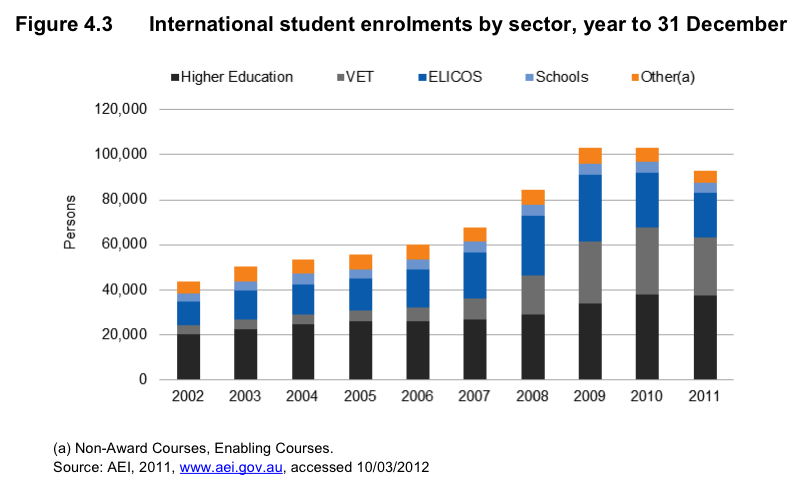
I suspect the large drop in international students in Queensland (and across Australia) due partly to the high Australian dollar is a concern to universities, TAFEs and private providers, such as the Sarina Russo Group, which have made a lot of money out of English language intensive courses for overseas students (ELICOS). OESR’s handy new compendium of migration statistics, Overseas Migration, Queensland, released today, contains this informative chart on international student numbers in Queensland:

Posted in Education, Migration | Leave a comment

Potential savings for Newman Govt through cutting ineffective VET funding (e.g. for hairdressing)

In a recent conference paper published today by NCVER, Australia’s leading expert on vocational education and training (VET) Tom Karmel summarises recent research on the wage premium due to completing an apprenticeship or traineeship as follows (p. 11):

This research is important because it shows the apprenticeship and traineeship system is uneven in delivering skills of value. It raises questions about why public money is going to traineeships in some occupations. Among the apprenticeships, hairdressing emerges with a low premium and this raises issues about the efficacy of the apprenticeship model for this occupation.

The research shows that, while completing an apprenticeship in automotive trades can boost annual earnings by nearly $14,000, people who complete a hairdressing apprenticeship only earn a wage premium of around $600 per annum (compared with what the person would have earned in alternative employment). While this research is based on national data, I strongly suspect Queensland shows a similar pattern of wage premiums.

The low return to training in hairdressing suggests that too many people are being trained as hairdressers and the Government needs to review its level of public support for hairdressing training. Given the complexity of the training system, involving both apprenticeship/traineeship and formal study options, as well as TAFE and private providers, this is easier said than done. The Government ought to commission Skills Queensland to undertake a thorough review of public subsidies for different VET courses right away.

Tom Karmel’s paper is available here, though you will need to register with NCVER to download it:

VET research for industry

Posted in VET | Leave a comment

New OESR data confirm huge increase in FIFO & DIDO workers in Bowen Basin

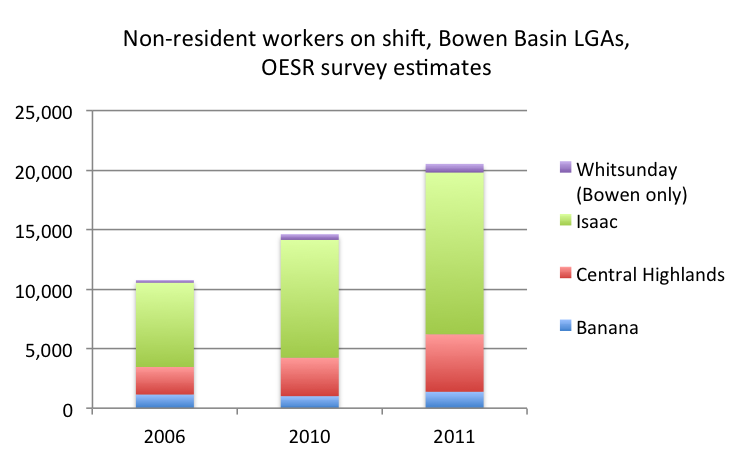
New OESR survey data confirm the huge increase in fly in-fly out (FIFO) and drive in-drive out (DIDO) work arrangements in the Queensland resources sector. Here’s a chart based on the excellent new report from OESR Bowen and Galilee Basins Population Report, 2011:

OESR notes that the big jump in non-resident workers in 2011 was, in part, due to the reconstruction effort:

The estimated number of non‐resident workers on‐shift in the Bowen Basin grew from 14,610 in 2010 to 20,520 in 2011, an increase of 5,910 people or 40 per cent. This represents the largest single year increase recorded since annual data collections began in 2006, and takes the non‐resident worker population of the Bowen Basin to over 20,000 for the first time.

Factors contributing to this growth include the scale of recovery work associated with floods in late 2010 and early 2011, increased efforts to return to full production following flooding, and the construction and expansion of existing mines and related projects. The non‐resident population was also boosted by workers involved in the construction of mining related infrastructure, such as the Northern Missing Link rail project, and independent contractors who service mining operations.

Posted in Mining, Population | Leave a comment

Commonwealth support for Cross River Rail a legacy of Rudd’s nation building agenda

This comment from Infrastructure Australia official Michael Deegan on the proposed Cross River Rail project is a concern (reported in the Brisbane Times today):

We think it will be a transformational project for Brisbane and that’s a very important part of the nation,” he said.

Mr Deegan said Infrastructure Australia believed Cross River Rail offered genuine growth opportunities for the city.

“It will provide opportunities for the growth of the Brisbane CBD and provide more work opportunities for the people of Brisbane and the southeast corner,” he said.

Why does it need to be transformational, however? Doesn’t it just need to move people around at an acceptable frequency and comfort level at least cost? Alas, Infrastructure Australia maintains the wooly, costly nation building agenda it was given by former PM Kevin Rudd. Hence Infrastructure Australia appears to be on the look out for big projects that can be labelled nation building, even though funding may be better directed to an alternative more cost-effective project or a number of smaller projects.

The Newman Government is right to be skeptical of the high cost $6-8 billion Cross River Rail project, and the review it launched earlier this week of the project and other options is welcome. I wonder if the new Premier is still interested in the Brisbane Metro proposal he raised last year, as discussed in my previous post Cross River Rail or a Brisbane Metro?

Posted in Brisbane, Infrastructure, Transport | 2 Comments

Could our go cards be set up to pay for quiet carriages?

The Economist has a great article in its latest issue on how we might get quiet carriages on trains that are truly quiet (Shhhh!). Unfortunately, as with experiments with quiet carriages elsewhere in the world, QR’s experiment has failed, and some people still have loud conversations and talk on their mobiles, disturbing other passengers engrossed in the latest mX. I fully support the Economist’s solution to ensuring truly quiet carriages (although I’m not confident QR will be able to set up the go card system to implement it):

Another tack would be to use prices to separate quiet and noisy passengers—in effect, creating a market for silence. A simple idea would be to sell access to the quiet carriage as an optional extra when the ticket is bought. Making the quiet coach both an active choice and a costly one would dissuade many of those who do not value a peaceful ride.

QR should explore the feasibility of charging for quiet carriages, and indeed why not also explore charging for a premium service, including a clean carriage with a guaranteed seat?

Posted in Transport | 1 Comment

CCIQ hoping for relief from high Aussie dollar

The Chamber of Commerce and Industry Queensland was quick to welcome the temporary decline in the Australian dollar below parity with the US dollar today:

Some Aussie Dollar respite for Queensland businesses

Clearly many Queensland businesses, especially in tourism, are experiencing hard times due to the high exchange rate, but according to the CCIQ the harm may be more widespread:

Alarmingly two in three Queensland businesses are negatively impacted by the continued strength of the Australian dollar and more than half (56 per cent) of businesses have altered their practices as a result.

The overall message from businesses is clear; they are hurting and will continue to do so until our currency drops further.

If there is another interest rate cut this year, I can see the Australian dollar falling to the low nineties, but given the continued demand for our resources, I doubt the dollar will fall back to the pre-resources boom levels of 60-70 cents that our tourism operators and manufacturers desperately would like to see again.

Posted in Macroeconomy, Uncategorized | Leave a comment

Tax reform roadmap politicises Commonwealth Treasury

When I was at the Treasury, it was well understood that, while Treasury is not independent and works for the Government of the day, Budget documents should nonetheless be written in a non-partisan way, as it would be an inappropriate use of public resources to produce partisan material. In my view, the Tax Reform Roadmap released with the Budget on Tuesday night breaks that previously well-understood rule. The Roadmap contains strong criticism of the former Government for inappropriate spending of the revenue gains from the mining boom:

From 2003‐04 to 2007‐08 Budgets, including the forward estimates, the previous government received an additional $334 billion in unexpected revenue, and spent an unsustainable $314 billion in new expenditure and poorly targeted tax policy.

Regardless of whether or not that is true, unless the Treasury can prove it advised the former Government to run bigger surpluses at the time, it is completely inappropriate for a document prepared by the Treasury to contain this partisan attack.

Posted in Budget, Tax | 1 Comment

Qld Treasury expects weak employment growth in short-term

Yesterday’s new ABS labour force data were weird (see OESR information brief). While the Queensland unemployment rate came down to 5.1% seasonally adjusted from 5.5% the month before, employment barely grew. So while unemployment fell, it may have fallen because many of the 8,100 people who left the unemployment pool gave up looking for work. I find these figures hard to reconcile with strong data on, among other things, expected investment in Queensland, state final demand, retail trade and improving building approvals. OESR, however, is pessimistic based on these new labour force data and ANZ job ads data:

With global economic conditions continuing to weigh on business sentiment and recent declines in indicators, such as ANZ Job Ads, any employment growth in Queensland will likely be subdued over the near–term.

This seems too pessimistic to me. I’m going to stick by my rule not to worry too much about one month’s set of figures.

Posted in Labour market, Macroeconomy | 1 Comment

Possible recovery in Far North tourism – record high for domestic flights to Cairns

The Far Northern economy has struggled in recent years due to the impact of the high Australian dollar on tourism and an over-supply of housing. But there appears to be good news coming out of Cairns airport, which suggests tourism might be picking up. The Cairns Post reports:

THE number of scheduled domestic flights and seat capacity to and from Cairns airport are at record highs.

There are now 38,384 seats available each week on 235 flights operated by Qantas, Jetstar, Virgin Australia and Tiger Airways, according to Tourism Queensland figures for May.

Cairns Airport chief executive Kevin Brown said capacity was up 3 per cent on May 2011, or nearly 1200 passengers a week.

“Domestic capacity for Cairns for May 2012 is the highest on record. This is excellent news for the region’s tourism industry and will also include some response to growing demand from the resources sector,” he said.

Cairns to Brisbane remains the most popular route with 14,296 seats on 89 flights a week provided by Virgin (39 flights, 5574 seats), Qantas (27, 4536) and Jetstar (23, 4186).

While these figures are only for domestic flights, the majority of international visitors coming to Cairns arrive via domestic flights from other airports (e.g. Brisbane, Sydney). Of course, Far North tourism industry leaders will be hoping airlines increase direct international flights, too, as a number of direct flights, especially to and from Japan, have been cut in recent years. Industry leaders are eagerly awaiting the launch of the Newman Government’s promised Aviation Attraction Fund, which they hope will help lure direct flights from China:

Cairns airport boosts efforts to lure China flights

The Government, however, ought to think about whether it’s sensible to spend money to attract direct international flights when it’s unclear whether the necessary level of demand to sustain these flights over the long-term will be forthcoming.

Posted in Cairns, Tourism | 2 Comments