Mining riches should help pay off debt, not fund dubious regional development projects

Just as it is odd to call for a sovereign wealth fund to save the benefits of the resources boom, so it is also odd to call for those benefits to be diverted to funding regional development projects. The Cairns Post reported yesterday on such a proposal (Cairns deserves its share of mining riches):

THE mining boom has ”adversely affected” the Far North and the State and Federal governments need to come up with a plan to boost the population and the region’s economy, the co-author of a new report says.

The Australian Local Government Association released its latest State of the Regions report yesterday, and it showed the region was not recovering from the global financial crisis as quickly as other parts of Australia…

…The report’s co-author, economist Dr Peter Brain, told The Cairns Post the Far North’s population growth was “slowing very sharply”, going from an increase of 3.4 per cent in 2007-08 to a projected surge of just 1.7 per cent in 2011-12.
He said higher levels of government support was needed to ensure mineral wealth was spread to “regions that are adversely affected by the mining boom, such as Cairns” by developing a planning framework.

But there aren’t massive amounts of mineral wealth, at least not enough to keep our Government budgets at Commonwealth and State levels in surplus. So a call for extra funding for regional development is as premature as calls for a sovereign wealth fund, which I have discussed in a previous post (Sovereign Wealth Fund not a priority).

The Commonwealth Government has already boosted funding for regional development by $1 billion via the Regional Development Australia Fund, but it appears Cairns missed out. Strangely, the Fund is providing $5 million for the Robelle Domain (Stage 2) Parkland development at Springfield, which, at around only 30 kilometres from Brisbane CBD, doesn’t strike me as a regional area.
Posted in Budget, Cairns | 2 Comments

Will Qld have problems rolling over its debt?

The Queensland Commission of Audit report released yesterday contains a solid analysis of the risks facing the budget, some of which are highly probable (e.g. a blowout in the cost of the Commonwealth Games), and some of which are remote. A risk that I see as remote, but which is obviously exercising minds in the Queensland Treasury Corporation, is the risk that another financial crisis means investors shun Queensland Government Bonds, as noted in the Commission of Audit report (p. 25):

In the current fragile and volatile financial market environment, government debt raising can become very difficult at reasonable rates and conditions without a AAA credit rating. Queensland’s large ongoing funding requirement continues to be challenging, and Queensland has experienced increasing difficulty in accessing funds from international capital markets…

…Queensland has a very large program of bond maturities over the period to 2016 relative to other large states, and therefore faces a sizeable task in ‘rolling over’ existing Government bonds, even before sourcing new funds.

The risk of funding drying up for Queensland is very remote, however. If State Governments have difficulty borrowing money, as they did during the 2008 financial crisis, the Commonwealth Government would no doubt again step in to guarantee State debt or, in the worst case, borrow on their behalf. And as noted at Loose Change last week, investors have actually shown a healthy demand for Queensland Government bonds recently:

Mug investors buy up unsustainable queensland debt

So while there is a risk here, it’s very remote, and the best rationale for bringing down our debt is to restore our AAA credit rating to reduce our borrowing costs, which are around 30-40 basis points higher than other States (see p. 24 of the Audit report).

Posted in Budget | Leave a comment

No surprises in Commission of Audit findings

I’m unimpressed by the Commission of Audit’s findings that have been reported this morning, prior to the formal launch of its report later today. The Brisbane Times reports Debt paid Labor’s bills, which isn’t a revelation and wasn’t covered up by the previous Government. Indeed, some of the evidence cited comes straight from the Mid-Year Economic Review released in January.

The Courier-Mail has a marginally more interesting story, reporting Queensland’s debt headed for $100b in six years. The previous Government had projected that its gross borrowings would reach $85 billion in 2014-15, so there may be something interesting driving the $100 billion projection, but we’ll need to see the full report when it’s released this morning. If the Commission of Audit can show that previous capital expenditure projections by Government departments (e.g. Transport and Main Roads) or Government-owned corporations (e.g. ENERGEX) were under-done, this may be a cause for concern. Otherwise, it’s just a hypothetical number based on assumptions about what the previous Government might have done beyond 2014-15, which is now a pretty meaningless exercise.

Posted in Budget | Leave a comment

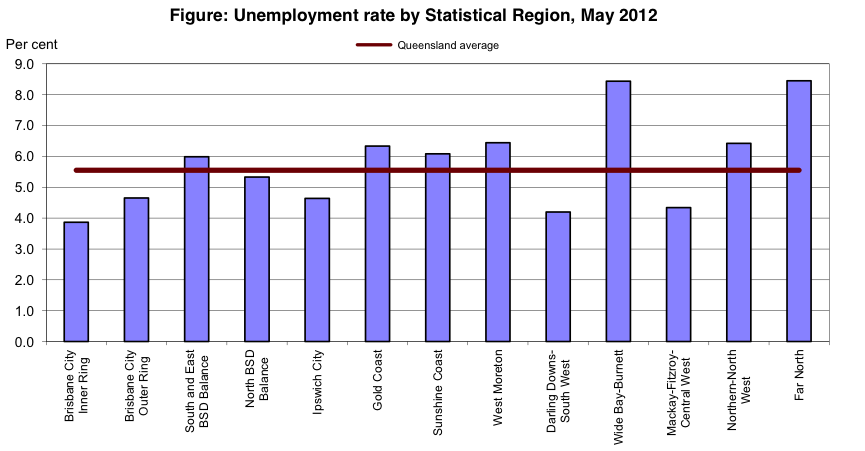
Unemployment remains high in Far North & Wide Bay-Burnett

OESR’s information brief on the latest ABS regional unemployment data shows that unemployment remains stubbornly high in the tourism-dependent regions of Far North Queensland and Wide Bay-Burnett:

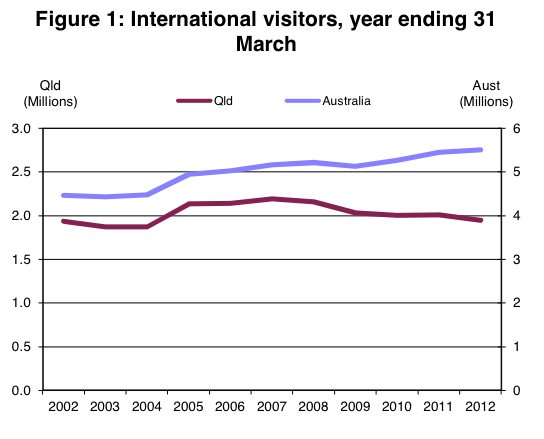
These high unemployment rates are no doubt due in part to declines in international visitor numbers. An OESR information brief on international visitors, released yesterday, charts the decline in recent years:

Posted in Cairns, Labour market, Tourism, Wide Bay-Burnett | Leave a comment

Qld tourism recovers from natural disasters, but still below pre-GFC peak

Tourism Queensland released its Domestic Tourism Snapshot for the Year ended March 2012 today, and it shows Australians are increasingly holidaying in Queensland and domestic tourism is out of the slump caused by the natural disasters in 2010-11. However, domestic tourism remains below the high level recorded in 2008 prior to the worst phase of the financial crisis later in that year. Here’s a chart from the publication with the relevant data:

Posted in Tourism | Leave a comment

Qld employer surveys suggest solid employment growth over rest of 2012

In contrast to the depressing national NAB survey released today (see MacroBusiness for coverage), recent surveys of Queensland employers suggest a rebound in employment in the State, as reported in the Courier-Mail today (Job prospects on the up):

According to recruitment company Manpower, 22 per cent of Queensland employers would employ more people in the coming three months while the number of those planning lay offs had fallen.

…An Australian Institute of Management survey also found a much higher confidence in job creation, but warned that more than half of all employers were struggling to find the workers they wanted and that had increased dramatically in the past year…

…This follows similarly upbeat figures yesterday from Hays Recruitment.

This is more evidence for Fitch Ratings to consider before it unjustifiably downgrades our credit rating. On the possible credit rating downgrade, this post from KS at Loose Change is worth reading:

More on Queensland’s debt

Posted in Budget, Labour market, Macroeconomy | 1 Comment

Qld credit rating downgrade by Fitch would be unjustifiable

Ratings agency Fitch has hinted it will downgrade Queensland’s credit rating again, according to a report in today’s Courier-Mail:

QUEENSLAND’S battered credit rating looks set to take another hit with ratings agency Fitch preparing to downgrade the state’s outlook yet again.

The Courier-Mail can reveal Fitch Ratings last week met with Queensland Treasury and gave “strong indications” it planned to revise its AA+ rating down to AA within weeks.

It is understood Fitch, which first foreshadowed a possible downgrade a year ago, has again cast doubt about forecast economic growth amid the eurozone crisis and slowing Chinese markets, while also raising concerns at the state’s high debt level, already at $62 billion and set to reach $85 billion by 2014-15.

The move would knock confidence and increase borrowing costs for the fledgling Newman Government, which is attempting to bring the state’s overblown Budget back to surplus by 2014-15.

In a previous post, I’ve argued that Fitch’s outlook for the Queensland economy is bizarre, and I stand by that assessment. While there are some regional areas that are struggling to recover (Far North and Gold Coast), overall the Queensland economy’s prospects are very good. Upon reflection, last week’s mediocre March quarter National Accounts numbers for Queensland are probably not a large cause for concern. They were largely driven by a drop in business investment from an historic high level in the December quarter (as discussed in the latest OESR information brief).

The Queensland Government remains set to benefit billions in royalties from the resources boom in coming years and, even in the worst case, highly unlikely scenario where the Government struggles to meet interest payments on its debt, I’d expect the Commonwealth Government to step in and assist. It would be odd that Australia as a whole has a AAA credit rating (and has a stable outlook), but one of the major States has only AA. The Under-Treasurer should pick up the phone to Fitch and tell them to re-assess their rating or they won’t have any credibility in the future whatsoever.

Posted in Budget, Macroeconomy | 2 Comments

Weak labour market consistent with Qld’s mediocre National Accounts data

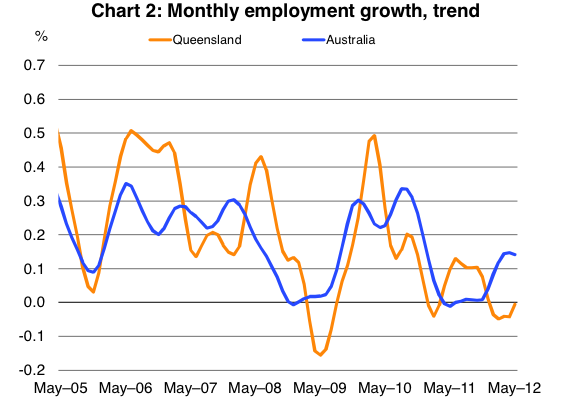
After seeing today’s new ABS Labour Force data, I’m worrying a bit more about the state of the Queensland economy. Employment in Queensland appears to have contracted slightly in recent months. Here’s a chart I’ve borrowed from OESR’s information brief:

The impression I get when I’m out and about is that Brisbane is doing well, so the problem must be in regional economies, and most likely in those not directly benefiting from the resources boom – i.e. possibly the Gold Coast and Far North Queensland.

Posted in Labour market | 1 Comment

Business Council bemoans high cost of regulation

The new Business Council of Australia (BCA) report released today Pipeline or Pipe Dream? presents interesting data on the high cost of delivering investment projects in Australia and comments that this could threaten future investment, exports and employment. Some of the numbers on the comparative cost of projects in Australia versus the US look unbelievably high (e.g. it costs 90% more to build an airport and 62% more to build a hospital in Australia than the US), and I wonder if they have adjusted for quality? But at least it gets people talking and I’m sure someone will produce more believable numbers in time. The report points out one useful example of possible over-regulation in Queensland:

A BCA member told us it required 70 approvals and 19 different decision points to build two bitumen import terminals in Queensland.

That BCA member appears to be BP (see BP plans to build two bitumen import terminals), which can probably handle the extra paperwork and time taken to get approvals from processes designed to protect the environment and local amenity. Nonetheless it may make a useful case study for the Government to review the efficiency of its regulations.

Posted in Infrastructure | Leave a comment

Queensland had lacklustre March quarter, while WA is hero of National Accounts

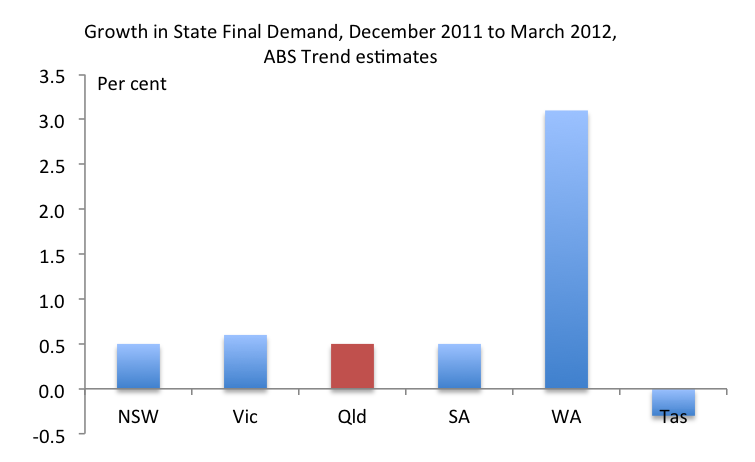
I’m unclear why today’s ABS March quarter National Accounts have generated such surprise among commentators, as the data were wholly consistent with the two-speed economy we know we have. To me, the only new information was that the mining boom in WA is an even bigger deal for the national economy than previously imagined. Consider the March quarter growth in State Final Demand using the ABS’s trend estimates (which smooth out irregular quarter-to-quarter volatility):

WA’s performance is outstanding while Queensland’s is mediocre.  I expect this is partly because the slump in tourism is offsetting the positive stimulus to the Queensland economy from the resources boom.

Let’s not even talk about the volatile seasonally adjusted figures for State Final Demand, which have Queensland contracting 0.8% in the March quarter.

Posted in Macroeconomy, Mining | Leave a comment