Should we worry about food security?

The push for greater local food production in urban and peri-urban areas makes no economic sense in a country where there is abundant farm land, and hence I was pleased to learn about the views of a University of Queensland expert on food security, Michael D’Occhio, in Queensland Country Life today (Food security ‘overblown’):

…with Australia producing a huge surplus of food relative to its population, “I think we’re a little bit indulgent when we talk about food insecurity in Australia”.

But a combination of fears about food security and food miles (how far the food travels before it gets to the table and hence how much greenhouse gas is created) is driving urban planners to promote inefficient agriculture within and close to our cities. For example, in a piece at the Conversation today, Griffith University Professor of Urban Management and Planning Paul Burton writes (Grow your own: Making Australian cities more food secure):

A significant opportunity exists to support the re-localisation of food production, processing, and consumption. While cities historically grew as places where local food surpluses were traded, urban food supply lines have become increasingly long, complex, and vulnerable to disruption by a number of factors, including climate change but also by natural disasters and by wars and other conflicts. By growing more of our food within our cities and in their immediate peri-urban hinterlands we can become less dependent on these vulnerable supply lines.

I find it hard to worry about supply lines getting disrupted, as any disruption is likely to be temporary and there are still other supply lines to ensure our cities won’t starve. The risk of all the potential supply lines – roads, rail, shipping, air freight – getting knocked out at the same time for an extended period seems very remote to me, outside of a nuclear war, in which case a bunker full of baked beans and pop tarts would be the best contingency.

Hence I agree that concerns about food security domestically are overblown. All the discussions I’ve had with people in rural communities in Queensland suggest there is clear potential to grow more food, but economics dictates it isn’t feasible (e.g. it can’t economically be grown at current prices, or it can’t economically be taken to the port because there isn’t a rail line nearby).

Regarding concerns about food miles, these are best addressed by encouraging the adoption of a price on greenhouse gas emissions (i.e. a carbon tax) throughout the world. Otherwise it’s difficult to weigh up exactly how much more carbon dioxide is released through the shipping of olive oil from Italy and its distribution in Australia, compared with producing olive oil in Australia, which may have to be moved a long way on a truck across Australia.

Posted in Agriculture | 2 Comments

Bunnings a big beneficiary of retail revival

Delving into the retail trade data released yesterday by the ABS, it appears Queenslanders are DIY renovating and gardening more, brunching and dining out more, stocking up on shoes and boots, and buying much cheaper furniture, most likely due to the growing dominance of IKEA (see chart below).

Posted in Retail trade | Leave a comment

Great analysis of rebound in building approvals from HIA

The strong rebound in building approvals across mainland Australia in May was welcome news today, although as noted by my former Treasury colleague Andrew Harvey, now Senior Economist at the Housing Industry Association, there are reasons for the rebound that should restrain our optimism somewhat. From the HIA media release:

“Building approvals were up by a sizeable 27.3 per cent in May 2012. This result provides some hope of an improved new home building outlook emerging in time and delivers preliminary evidence that recent interest rate cuts may be starting to have an impact,” said HIA Senior Economist, Andrew Harvey.

“However, we need to keep in mind that the result comes off a very low base in April and is driven by the highly volatile multi-unit part of the market. The level of approvals in the core segment of detached housing remains well below the levels recorded one year ago,” said Andrew Harvey.

“Key factors behind the strong May result include a partial rebound in Western Australia which saw approvals up by 24.8 per cent in May after a 47.2 per cent fall in April, along with a similar rebound in South Australia. There is also a “bring forward” effect in both Victoria and NSW where buyers have rushed into the housing market to secure state government home buyer incentives before they end on 30 June 2012,” said HIA Senior Economist, Andrew Harvey.

The HIA media release is much more informative than the OESR brief on building approvals, which misses the big story that there was a rebound in Queensland building approvals (seasonally adjusted), too (an increase of over 10%).

OESR only reports the trend series of building approvals, which is a smoothed out version of the seasonally adjusted series. Unfortunately, the ABS’s smoothing procedure smoothed out the significant rebound in building approvals in Queensland. OESR should include the seasonally adjusted figures in its next building approvals brief.

Posted in Housing, Macroeconomy | 1 Comment

Far too early to call end of resources boom

The slowdown in the Chinese economy has some market players worried about the outlook for the Australian resources sector, as reported by AAP (Mining boom over says, analyst). These concerns seem unwarranted, as any slowdown will be temporary, and there will still be strong demand from China over the medium to long-term due to the ongoing shift of Chinese people from rural areas to the cities where they are more productive. This fundamental economic transformation was well covered in a Treasury working paper in 2010 that I’ve previously posted on:

Treasury sees China-driven resources boom continuing for decades

Also, the Bureau of Resources and Energy Economics report released yesterday on the outlook for bulk commodity exports to 2025 doesn’t give cause for any concern the resources boom will come to an end. The report (available here) notes (p. 67, emphasis added):

World demand for resources is projected to grow over the long term, underpinned by robust growth in emerging economies, including China and India…Modelling scenarios in which Australia’s export market shares decline, remain the same or grow in the long term indicates that it is likely Australia’s mineral and energy exports will continue to experience robust growth…Although increasing competition is a market risk, there will need to be substantial falls in Australia’s market shares for future growth in export volumes to stagnate or decline from current levels.

Posted in Macroeconomy, Mining | Leave a comment

Is Townsville or Cairns the capital of North Qld?

There is an amusing debate occurring in North Queensland between Cairns economist Bill Cummings and Townsville economist Colin Dwyer over whether Cairns or Townsville has the larger population, as reported in the Townsville Bulletin on Friday. While there are more people living within the Townsville urban area than in the Cairns urban area, there are more people living in Cairns and its hinterland – taking in Cardwell and the Atherton Tableland, for example – than in Townsville and its hinterland. The Bulletin article, while a bit over the top in its opening, is nonetheless informative:

CAIRNS has been accused of fudging figures from the 2011 census in a desperate attempt to show its population is larger than Townsville’s.

The dodgy population count for the greater Cairns region includes residents from areas as far flung as Cardwell, Innisfail, the Tableland and even the Gulf bringing the grand total to 283,197 18,000 more than the greater Townsville area count of 265,170…

…Townsville economist Colin Dwyer questioned the sense in including surrounding towns in the analysis, saying the resident population of the two local government areas was a more accurate comparison.

A total of 178,375 people live within the Townsville City Council boundaries, while just 156,169 live in the Cairns Regional Council area.

For the purposes of settling the meaningless question of whether Townsville or Cairns is the capital of North Queensland, it makes more sense to look at the population of the relevant urban area, and in that case the numbers based on Council boundaries are more suitable. Hence Townsville takes the title. But there remains merit in the claim the broader Cairns region is more populous than the broader Townsville region, and it is confirmed in an informative Census brief released on Friday by OESR:

SA4 comparison

Don’t be put off by the weird title. SA4 stands for Statistical area level 4, and is the ABS’s uninformative, bland new name for the largest sub-state regions, formerly called Statistical Divisions. This OESR brief reports the Cairns SA4 population at  224,436 and the Townsville SA4 population at 217,897 on Census night in 2011.

Posted in North Queensland, Population, Uncategorized | 4 Comments

Two-speed economy shows up in job vacancies data

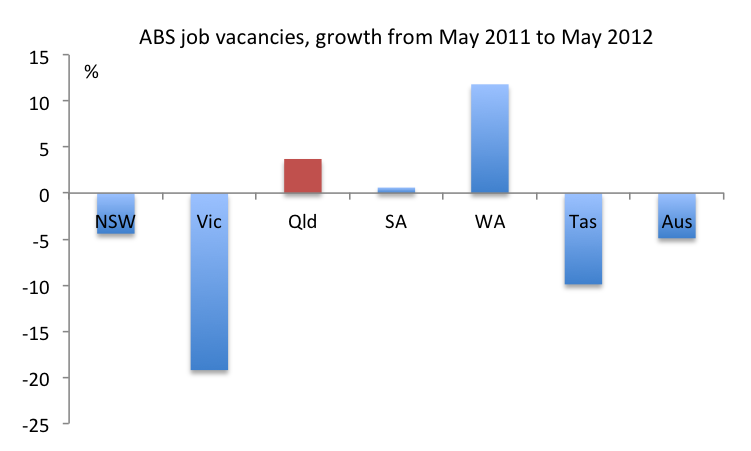
The economies of the non-resources States are not looking healthy, if today’s ABS job vacancies data are any indication:

MacroBusiness has good coverage of the national data (ABS job vacancies fall), with Houses and Holes observing:

It appears that growth in the jobs market is weaker this year than it was last, so unless we see more falls in the participation rate, and all things being equal, unemployment must climb ahead, assuming there is sense in the ABS figures.

So, while Queensland’s economic prospects are good, we may need to prepare for a downturn in the other eastern States. I’ve previously posted on our exposure to the other States:

How exposed is Qld to a downturn in southern States?

Posted in Labour market, Macroeconomy, Mining | 1 Comment

Mining not the only job generator in two-speed economy

Matt Grudnoff of the Australia Institute has a provocative piece in the Courier-Mail this morning (Newman is digging in wrong hole) in which he calls for the Government to slow down the resources boom due to its adverse impacts on other sectors. Mr Grudnoff notes:

In Queensland, the effects of Dutch disease are clear for all to see. The Queensland manufacturing sector has been shedding jobs for the past four years. The accommodation and food services industry, which includes a large portion of the tourism industry, has not had positive economic growth in five years. The continued growth in exports of Australia’s resources has pushed up the exchange rate and, as a result, other industries are declining.

Mr Grudnoff is correct that the resources boom, through its impact on the exchange rate, has had adverse impacts on tourism and manufacturing. But the Australia Institute’s recommendation to slow down the resources boom doesn’t make a lot of sense, as I’ve discussed in these previous posts:

Annual cap on mining approvals undesirable and impractical

A case for slowing down the mining boom – aren’t we doing that already?

Australia Institute’s mining boom analysis ignores benefits to consumers

And while some industries such as manufacturing and retail trade have performed poorly in recent times, others such as health care and finance and insurance have had strong employment growth (see chart below based on May 2012 ABS Labour Force data). Overall, the Queensland economy is still slowly gaining jobs, and I expect the labour market will pick up strongly over the next year as the money generated from the resources boom increasingly flows through to other sectors in the Queensland economy.

Posted in Labour market, Mining | Leave a comment

Decentralisation much harder than it sounds

The Newman Government faces a challenge in fulfilling its commitment to relocate public servants to regional centres such as Townsville, if the experience of Queensland Rail’s passenger business is instructive. The Queensland Times reports this morning (Cancelled: QRS move to Ipswich):

THE envisaged migration of Queensland Rail employees from Brisbane to the Ipswich CBD has fallen short with only a fraction of the promised number moving to their new home.

Two years ago the former Labor Transport Minister and Ipswich MP, Rachel Nolan, announced 400 staff from QR’s passenger arm would move to Ipswich ahead of the newly-developed CBD.

Queensland Rail revealed last week only 27 full-time and 22 part-time staff had moved to the Limestone St offices.

The move was touted as a precursor to QR finding a home in the Icon Ipswich building.

A spokesman for Transport Minister Scott Emerson said a decision on where QR would find a home within Icon Ipswich was still pending.

Even putting aside the HR challenge of getting people reasonably happy to relocate, or finding new people in new regions, it appears very difficult to decentralise public services because Ministers will always want the top public servants close by to respond to their needs, and likewise the top public servants will want their people as close as possible to them. For this reason there is limited scope to decentralise public servants engaged in policy advice.

And I wonder about the scope to decentralise public servants in procurement, IT and HR roles, too, as any public service CEO will want to keep a close eye on these areas. In the wake of the Queensland Health payroll debacle and fake Tahitian prince fraud, public service chiefs need to keep a close eye on back office operations.

I’ve previously questioned the logic behind decentralisation of public services here:

Move public servants to regions only if cost-effective

Posted in Ipswich, Queensland Government, Townsville | 1 Comment

2011 Census data shows Qld population previously over-estimated – implications for GST carve up

Queensland Treasury bean counters wouldn’t have been happy when they saw the new ABS population estimates, which incorporate 2011 census data, and which contain a downward revision in Queensland’s estimated population (by 106,000 people) and share of Australia’s total population (from 20.3% to 20.1%). All other things equal, this has implications for Queensland’s share of GST revenue, and could cost Queensland up to $100 million (based on a back-of-the-envelope calculation I probably shouldn’t have attempted at this time of the day).

The re-basing of population estimates to reflect the 2011 Census is described in an informative ABS feature article. The ABS notes these are preliminary estimates, and Queensland Treasury will hope they are substantially revised when the final estimates are released in June next year.

Posted in Budget, Population | Leave a comment

Resources boom impacts on volunteering

As a gesture of goodwill to the local community, the LNG companies moving into Gladstone may wish to consider investing in training their workers in emergency services and rescue work, because the local State Emergency Services (SES) group is struggling to find volunteers, according to the Gladstone Observer this morning (SES warns of decline in volunteers):

WHEN a disaster strikes, you can only guarantee 20% of volunteers to show up.

That’s according to the Calliope SES group leader Brian Pitt who has watched it happen for 20 years.

“It’s only a rough figure,” he said. “It’s because of home, work and family commitments.”

This isn’t out of the ordinary for most SES groups or other volunteer organisations.

But when volunteer numbers dwindle, so does the number of people who show up when they are needed.

“It’s a real issue for Gladstone SES,” Mr Pitt said.

Currently the Calliope SES has 36 members.

For the size of the region it covers, the group should have about 50 volunteers.

“All out SES groups need significant numbers,” he said.

“I suspect all volunteer organisations are having significant issues.”

Mr Pitt said the decline in numbers was something that happened gradually over the past four or five years.

“We are suffering because of the resources boom,” he said. “The twelve-hour shifts that people do, by the time they do their hours, they don’t get time to volunteer.

Posted in Gladstone, Mining | Leave a comment