QTC inadvertently stumbles into Cairns vs Townsville debate

KS at Loose Change has a good eye for the amusing and ironic, and has spotted that Queensland Treasury Corporation’s investment guide includes a map identifying Brisbane, the Gold Coast and Cairns, but not Townsville:

Townsville wiped off map!

I’ve previously posted on the amusing debate around whether Cairns or Townsville is the capital of the non-existent State of North Queensland:

Is Townsville or Cairns the capital of North Queensland?

I share KS’s surprise that the Cairns Post and Townsville Bulletin haven’t picked this up yet.

Posted in Cairns, Townsville | 2 Comments

Does tourism promotion on a Statewide basis make sense?

A report in the Courier-Mail that the Government is considering a cut to Tourism Queensland’s funding reminded me of a comment by Simon Anholt, an international advisor on national branding, in the latest Monocle (p. 93, Issue 55) regarding the debate around whether South Australia needs to re-brand itself (e.g. by renaming itself Bradman):

Apart from anything else, who cares?…You’d struggle to name a single sub-national region apart from California and Tuscany. These people should be spending their tax-payers’ money on something more useful.

While I think many people could readily name a few more sub-national regions than those two, he is right to question the utility of promoting tourism on a Statewide rather than a national or region-specific basis. Many international tourists may never have heard of Queensland and would be more receptive to messages about Australia, while domestic tourists would be more responsive to messages regarding particular holiday destinations (e.g. Gold Coast or Port Douglas) rather than Queensland as a whole.

Posted in Tourism | 1 Comment

Opening Brunswick St Mall to traffic is a great idea

I fully support the Lord Mayor’s exploration of options to improve the Brunswick St Mall in the Valley, as reported at the Brisbane Times this morning:

Recreating Brunswick Street Mall as a two-lane road is one of the proposals being considered by lord mayor Graham Quirk as part of his plan to “fix” Fortitude Valley.

Speaking at a lunch held by the Valley Chamber of Commerce yesterday, Cr Quirk said transforming the pedestrian mall at the heart of the Valley Entertainment Precinct was core component of his economic development vision for Fortitude Valley.

He said that there were two main perspectives on how the mall might be “reactivated” including one seeking to re-open the central strip up to traffic.

“Perhaps a one-way and a slow way [road],” Cr Quirk said.

The best option, however, is probably to get rid of the Mall altogether and replace it with four lanes of traffic, so that Brunswick St runs continuously all the way from the Valley fiveways at St Paul’s Terrace down to New Farm Park. This would yield major gains in reduced travel times. It would mean motorists heading to New Farm or the Valley south of the Mall could make a right turn onto Brunswick St from Wickham St, rather than having to turn after McWhirters and head back in the opposite direction along Ann St before getting onto Brunswick St south of the Mall.  My intuition tells me that these travel time savings would swamp any reductions in profits earned by businesses currently on the  Mall, and a cost-benefit analysis would show a high rate of return from re-opening the mall to traffic.

Posted in Brisbane, Transport | 3 Comments

HIA calls for Government action as building industry poised to recover

While I think the Housing Industry Association (HIA) has some top-notch economists, the Industry Roundtable Communique it issued today is overly pessimistic:

It was agreed that the housing industry is currently facing the worst conditions in decades and a lack of action by all levels of government is constraining the ability of Australians to access affordable housing.

Further, the current environment is having negative implications for job security in residential building and related sectors.

Industry leaders are united in calling for urgent action from government of all levels to address the dire levels of housing supply in Australia.

This should include immediate investment to promote building activity, and reform measures to improve productivity and reduce taxation in the medium and longer term.

This has come on the same day as BIS Shrapnel has released credible forecasts that the industry is set to recover later this year, particularly in NSW, Queensland and WA, as reported by Peter Martin today:

Housing investment will ‘replace’ the mining boom

Australians are strongly attached to the idea that owning a home and/or an investment property is the key to financial security and wealth, and I have no doubt the building industry will recover strongly over the remainder of 2012, particularly in Queensland and WA as the dollars from the resources boom wash through the economy.

That said, the HIA is right to call for taxation reform, particularly cutting stamp duty, which is a very inefficient tax, as I’ve discussed previously:

Inefficient State taxes


Posted in Housing, Tax | 1 Comment

Bright outlook for Qld economy

I agree with Access Economics’s assessment of the Queensland economic outlook reported in the Courier-Mail this morning:

THE future for Queensland is bright, with the state back in control of its mojo.

That’s the upbeat view of Deloitte Access Economics, which released a report that found the state has recovered from an onslaught of natural disasters and remains well placed to take advantage of fast-growing Asian markets.

Despite the two-speed economy affecting different industries and regions, Deloitte partner Chris Richardson said Queensland’s economic growth was “roaring back in to life”.

“In part that is a rebound in coal and farm sector production from last year’s lows.

“But an even bigger part has been played by the resource development boom,” Mr Richardson said.

Recent posts of mine on Queensland’s economic outlook include:

Qld employer surveys suggest solid employment growth over rest of 2012

Qld credit rating downgrade by Fitch would be unjustifiable

Qld & WA the winners in the two-speed economy

Posted in Macroeconomy, Mining | Leave a comment

Council amalgamations may not have gone far enough

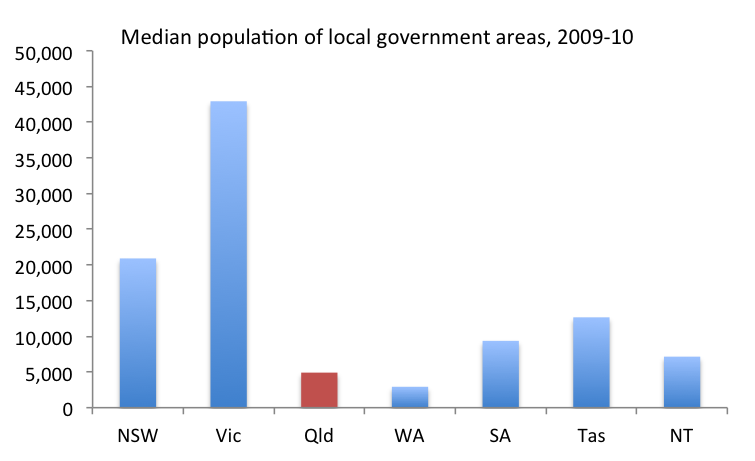
Even after the forced amalgamations of many regional councils in 2008, Queensland still has a significant number of councils with very small populations. The median population of Queensland local government areas is 4,910 – far below the median for most other States (see the chart below, based on data I found in a new Productivity Commission report on the Role of Local Government as Regulator). So out of Queensland’s 73 local government areas, 36 of them have populations below 4,910. This suggests substantial scope for future amalgamations and cost savings to me.

Posted in Population | Leave a comment

Dump Ford before it dumps us

While having lunch at the Jam Corner cafe on Palmer St, South Townsville on Sunday, I found my gaze constantly drawn over to Dean St when I heard the distinctive sounds of large V8 engines in big Aussie cars coming over the bridge from town. The V8 super cars race was just on the previous weekend, and I think the local lads were still excited by the high-octane action and were driving around town emulating their heroes.

It made me think that the future of the Australian car industry would be assured if the rest of Australia shared the enthusiasm of the local lads for well-built cars with powerful V8 engines. But alas no, as tastes have changed and people have responded to higher fuel prices, and Corollas and little Mazdas and VWs have taken vital market share from the Commodore and Falcon.

Ford is in a very bad state, and astute commentators have observed that Ford is the next Mitsubishi – i.e. the next car manufacturer that will abandon Australia. But still the Government refuses to cooperate with the inevitable, as evidenced by the federal Government’s response to Ford’s decision to cut production and jobs yesterday. According to a report in APN papers (Ford ‘need to restructure production’):

FORD Australia has blamed motorists’ desires for more fuel-efficient cars for the loss of 440 jobs at its Victorian car factories.

The company’s restructuring will see the number of vehicles produced at the Victorian plants fall from 209 to 148 a day.

While the job cuts, which will take effect late this year, were blamed on changing consumer habits, it comes just six months after the Federal Government gave the company $34 million to protect jobs.

But Industry Minister Greg Combet would not be drawn on whether the car industry subsidies were a success, instead pointing to changing dynamics and the high Australian dollar hurting the manufacturing industry.

“Ford has made it very clear to me that their decision is due to the company needing to restructure its production in response to changing consumer preferences, away from larger cars towards more fuel efficient vehicles,” he said.

In my view, we need to accept that Ford will dump Australia sometime in the next five years and stop pretending that the company is just adjusting to new market conditions.

Previous posts of mine on the car industry include:

Recommended reading on the car industry

Time to cut our losses on industry assistance

If Holden is so good for the economy, why does it need $275M more from taxpayers?

Posted in Industry policy | Leave a comment

Why does the Qld Government even have a nursery business?

As a great believer in government transparency and FOI, I find it hard to be too concerned about the Party official going in to review the Government businesses GoPrint and GoPlant, as reported in the Courier-Mail. Of course, it appears there was a breach of protocol, but we shouldn’t forget the bigger issue around whether there is any justification for these Government businesses. I would argue there is not.

GoPrint is obviously the Government printer, but many people would be surprised to learn about GoPlant, which according to the Courier-Mail report is:

…a state-owned nursery that provides: long-term and short-term plant hire for government offices and events; project management (landscape design, site reviews, planting guides etc); and a range of advice and consultancy services.

There does not appear to be a market failure argument for either GoPrint or GoPlant, as there must be dozens of printers and nursery businesses in Brisbane. Nor could concerns around the security of Government information justify GoPrint, as I seem to recall the Commonwealth Government even uses a private sector printer to print the Budget.

I’ve previously written about Queensland’s long history of inappropriate Government involvement in business in a post on the Urban Land Development Authority, which thankfully the new Government is emasculating (Council development hand-back begins).

Posted in Industry policy, Queensland Government | Leave a comment

Las Vegas a poor example for Gold Coast to follow

The Gold Coast Bulletin reports this morning that Las Vegas may become Coast’s sister city:

MAYOR Tom Tate will today officially ask Las Vegas to become a sister city of the Gold Coast and says our region’s tourist strip can learn a lot from the US.

I’ve previously posted on why the Gold Coast shouldn’t try to imitate Las Vegas (Does the Gold Coast need to compete with Vegas and Macau?). The Gold Coast needs to diversify its economy rather than become more dependent on the discretionary spending of fickle tourists. Due to its dependence on spending by visitors, the Las Vegas economy has suffered more than most in the US, according to Bureau of Labor Statistics estimates (Local Area Unemployment Statistics):

Queensland regional unemployment rates can be found at OESR’s website. The Gold Coast unemployment rate is currently around 6.3 per cent, which is much lower than Las Vegas’s unemployment rate of 11.8 per cent.

Posted in Gold Coast, Labour market, Tourism | 3 Comments

Better outlook for building industry in struggling regions

New ABS small area data released yesterday appear to confirm last week’s reported rebound in building approvals is widespread across the Queensland regions, and has even shown up in the struggling regions of the Gold Coast and Far North. The Master Builders media release notes:

The May 2012 regional Building Approvals figures released today by the Australian Bureau of Statistics show that the 12.3% state increase is spread right across Queensland, according to Master Builders, Queensland’s peak body for housing and construction.

Master Builders Director of Housing Policy, Paul Bidwell, said total house approval numbers rose across all regional centres during May, which is a good sign that the housing sector is taking small but positive steps towards recovery.

“Mackay was once again the stand out region with a 105.7% increase from 88 in April 2012 to 181 in May 2012,” he said.

“As expected the figures confirm that regions with good exposure to the mining boom, particularly Central Queensland and Mackay, are doing well.

“We are cautious about reading too much into these positive figures as we know that at a regional level the data can be volatile from one month to the next.

“However, we are anticipating the trend to continue for the next few months as the latest two interest rate rises and the Building Boost Grant flow through the system.”

Master Builders is right to point out the volatility of the monthly data. Indeed, the data aren’t even seasonally adjusted, and to some extent the Easter period would impact on approvals in April, leading one to expect an increase in May. But the growth in May is so large that it’s reasonable to conclude there is more than a seasonal movement.

The sluggish building industry has been closely watched in the Far North, which has also suffered a slump in tourism due to the high Australian dollar. Pete Faulkner of Conus Consulting posted on the new regional figures yesterday:

Building approvals in the Far North bounce back

Also, KS at Loose Change has found a striking chart that shows the crazy over-investment in new property in Cairns prior to the financial crisis, which created a glut in the market and suppressed building industry activity.

Posted in Cairns, Gold Coast, Housing | Leave a comment