Easy way to make Brisbane more liveable

Rather than criticising the Economist Intelligence Unit for ranking Brisbane behind Melbourne, Adelaide, Sydney and Perth in liveability (Brisbane leaders in disbelief at our city’s low liveability ranking), we should ask how can we make our city more liveable so we can achieve a better ranking in the future? There is one obvious way Brisbane is less liveable than other major Australian cities (except Perth): our ridiculously restrictive retail trading hours. See my previous post:
How can Brisbane get into the top 25 liveable cities?

Posted in Brisbane, Retail trade | 2 Comments

Great map from OESR showing CSG wells in Surat Basin

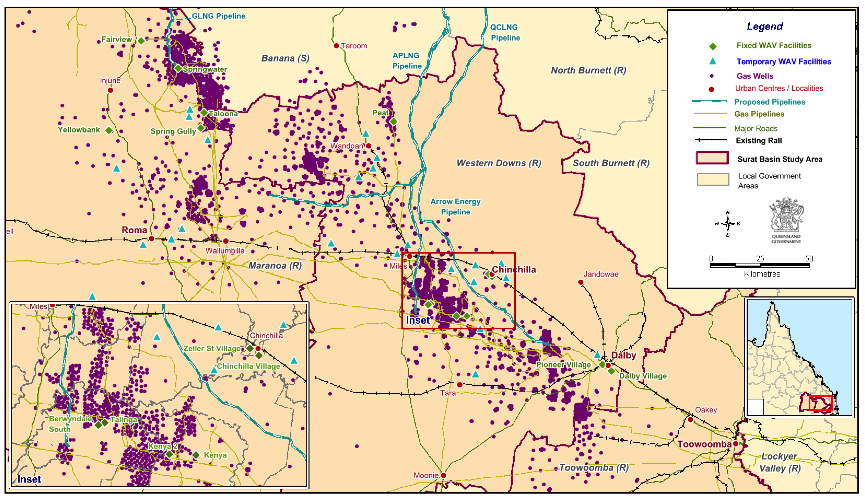
OESR’s latest Surat Basin Population Report provides an update on the size of the Basin’s FIFO/DIDO workforce, which effectively adds 3,300 persons to the population of the region. This is a full-time equivalent population estimate, so the actual number of FIFO/DIDO workers would be a multiple of this.  The report contains this great map showing the incredible extent of coal seam gas (CSG) extraction in the Surat Basin:

Posted in Mining | Leave a comment

Adverse impacts of carbon tax becoming apparent

While a carbon tax would make sense as part of a worldwide effort to limit greenhouse gas emissions – which is clearly a global priority given the mounting evidence on climate change – it makes no sense as a unilateral policy enacted in the absence of similar action by the US and China. We are imposing significant costs on our economy for an immaterial reduction in the likelihood of dangerous climate change. Examples of these costs are noted in the Courier-Mail today:

THE carbon tax has begun hitting Queensland small businesses, including a Brisbane private school which faces a $70,000-a-year hike in its electricity bill.

Six weeks into the carbon tax regime, price hikes are starting to hit hip pockets as power bills drop into letterboxes.

Queensland Chamber of Commerce and Industry president David Goodwin said the “weird distortions” were becoming apparent.

“We are finding that ordinary supermarkets like the local IGA may be up for up to $15,000 on the carbon tax alone if they have to re-gas their giant refrigeration system,” Mr Goodwin said. “Somehow these guys are going to have find ways to cover these extra costs.”

The Anglican Church Grammar School (Churchie) faces a 30 per cent increase in electricity for the month of July, well above the 9 per cent increase predicted by the Federal Government.

My previous posts on climate change include:

UQ study confirms carbon tax will hit Qld the hardest

Carbon tax will disproportionately impact Qld, so Newman has good reason to oppose it

Posted in Climate change | 2 Comments

Volatile labour force data suggest ABS needs bigger Qld sample

The ABS urgently needs to boost its sample of Queensland households for the Labour Force Survey so we don’t get weird month-to-month changes like we’ve seen lately. Pete Faulkner from Conus Consulting has a good post on today’s new data (Strong jobs data; QLD corrects after last month (as predicted)). Pete notes that the increase in the unemployment rate was a correction from last month’s odd decline associated with a sharp drop in labour force participation:

In QLD the unemployment rate has risen sharply to 5.8% (from 5.3%), although this will not have come as a surprise to anyone who read our post a month ago (see here) where we identified a highly suspect collapse in the Participation Rate. The sharp decline in June was indeed revised upwards (as we forecast) and has jumped back to more “usual” levels this month of 66.5. It is this increase in the Participation Rate which has seen such a sharp uptick in the unemployment rate despite a 6,200 increase in jobs in the State.

Public service job cuts (7,717 so far according to the Courier-Mail’s informative job cuts ticker) will obviously slow down employment growth a bit over the next few months.

Posted in Labour market | 1 Comment

We’re not selling off the farm

Gregor Heard has an insightful post on the Queensland Country Life website on how to get rural issues right. I agree with him that closer scrutiny of foreign investment in Australian agricultural land, a policy commitment of the Federal Opposition’s, would likely conclude there’s not much to worry about. Gregor notes:

We definitely need the boost that foreign investment can give our agriculture sector, yet there’s certainly no harm in having investment decisions vetted, and also of having some idea how much farmland is in foreign hands.

We suspect it will show up to be somewhat of a mountain out of a molehill, with the vast majority of ground remaining Australian owned, but it will be nice to have a clearer picture of what is happening in that sphere.

Posted in Agriculture | Leave a comment

Brisbane housing market recovery call seems right

Given the amount of money washing through the Queensland economy due to the resources boom, I think noted property expert Michael Matusik is right to claim the Brisbane housing market is recovering, as reported in the Courier-Mail:

The Greater Brisbane housing market has past the bottom of the cycle and is now in recovery, says property analyst Michael Matusik.

Mr Matusik, the director of independent property advisory Matusik Property Insights, said the market would continue to improve for a range of reasons, including tight vacancy rates in the rental market, and house prices would slowly start to rise in the first half of next year.

“In the last three to five years we’ve had a pretty slow period,” he said.

“I think largely that has corrected any imbalances.”

Of course, one still unknown factor (until the September Budget) is the extent of the Queensland Government’s fiscal tightening and job shedding, which, if it is up to 20,000 public servants, could significantly impact the economy for a couple of quarters and moderate the recovery somewhat.

Posted in Brisbane, Housing, Macroeconomy | Leave a comment

Grattan Institute calls for uni course subsidy review

Andrew Norton, formerly attached to the Centre for Independent Studies, is now at the Grattan Institute and is continuing to produce hard-hitting reports on our generously subsidised university system, with his latest called Graduate Winners. Andrew is one of Australia’s leading experts on Australia’s higher education system and his work has always been widely discussed by Canberra policy wonks, even if they were never able to fully implement Andrew’s vision for higher education reform.

The media release for the report notes:

By the middle of this decade, higher education tuition subsidies will cost taxpayers around $7 billion. Yet it is not clear why the public rather than students should pay.

Since most graduates do well out of higher education, enjoying good jobs and high social status, most subsidies are for courses that students would take anyway. Tuition subsidies therefore merely redistribute income to students and graduates, at the expense of the general public – particularly those who do not go to university.

The implications of Andrew’s analysis are profound and could lead to large increases in HECS-HELP repayments for engineering, IT and medicine graduates, for example. There are already different rates of tuition fees for different courses, depending on the perceived balance between public and private benefits, so science courses get a greater subsidy than law courses, for example. However, there doesn’t appear to be much science behind the subsidy levels, so a review of subsidy levels applying Andrew’s framework would be welcome.

I’ve previously thought Grattan was too worried about losing its federal funding to produce frank and fearless advice, but I’m pleased to have been proven wrong, and I have no doubt Andrew’s latest report will have a long shelf life and influence policy into the future.

Posted in Education | Leave a comment

Lots of scope to reduce regulatory burden in Qld

The Queensland Competition Authority has released an informative issues paper on Measuring and Reducing the Burden of Regulation for the purposes of an inquiry it is undertaking for the new Government. The issues paper contains a lot of useful ammunition for the economic rationalists among us, including the following:

The burden of regulation is estimated to be of the order of 1% of Gross State Product, or some $2.5 billion…

…Queensland led the states and territories in the number of pages of rules and regulations [in 2007]

I found the last quote so interesting I created the following chart based on the underlying Productivity Commission data:

Posted in Industry policy, Queensland Government | Leave a comment

Good signs for building industry recovery

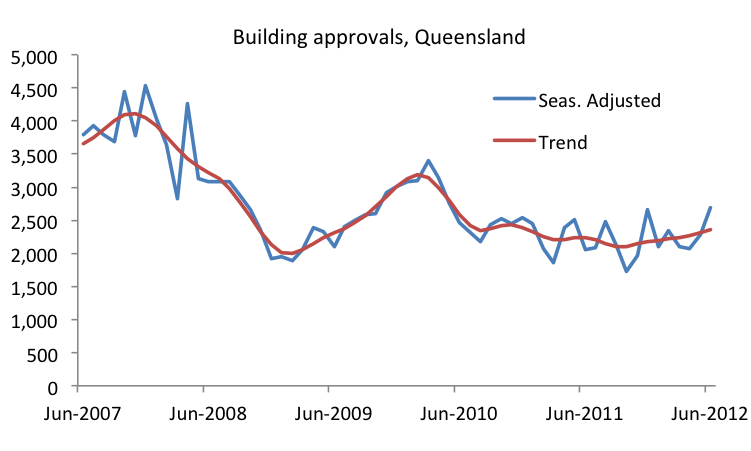
I was very pleased to see the ABS building approvals data for Queensland today (see chart below), which confirmed in my mind that the building industry is set to recover (see my previous post HIA calls for Government action as building industry poised to recover).

Posted in Housing | Leave a comment

Productivity Commission should go back to giving frank and fearless advice

Productivity Commission Chairman Gary Banks gave a great speech in Brisbane last week on competition policy (Competition Policy’s regulatory innovations: quo vadis?), which, as usual with the Chairman’s speeches, documents the failure of recent Governments to prosecute much needed reforms. But the speech shows a lack of self-awareness regarding the Commission’s failure to offer frank and fearless advice on anti-dumping legislation.

Traditionally the Commission has been viewed as the provider of hard-line economic rationalist advice. It appears that, to avoid this perception, the Commission has more recently been attempting to offer more politically savvy advice. Unfortunately, this approach failed in the Commission’s 2009 review of anti-dumping laws, as the Chairman relates:

The Commission did not recommend abolition of the regime, notwithstanding its costs, in recognition of the ‘system preserving’ value of a safeguard on what is widely (if wrongly) perceived to be an unfair trade practice. However, its central recommendation to insert a ‘public interest’ clause into the statute, as a safety valve for averting certain anomalous outcomes, was rejected (ironically, being a NCP-related review). More problematic though, given that the protectionist devil always lurks in the detail of anti-dumping administration, was the establishment of a Forum to advise on policy implementation comprising mostly import-competing interests.

Basically, the Commission didn’t recommend anti-dumping laws be scrapped because it sees them as providing some peace of mind to the business sector, and if it weren’t for the anti-dumping laws the business lobby groups might campaign harder for other protectionist measures (e.g. tariffs). But the Commission should be providing frank and fearless economic advice, not playing the political game. I’m confident the Treasury would never ever send up a brief supporting anti-dumping legislation, and I’m surprised the Commission lacked the courage to call bad policy when it sees it. The Commission can do much better.


Posted in Industry policy | Leave a comment