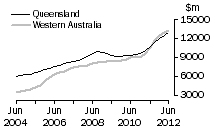
Building approvals data difficult to interpret

While I feel the Queensland building industry will recover later this year, it’s difficult to be confident there is any significant improvement in building approvals, which are a reasonably good forward indicator of activity:

While growth in the ABS trend estimate is positive, this could change if there are another few months of low approvals. I’ve never had much confidence in ABS trend measures because they are basically backward-looking moving averages.

Commentary from Peter Faulkner from Conus Consulting is here:

Building approvals weak but trend still points up

Posted in Housing | Leave a comment

Encouraging construction industry data for Qld

The ABS preliminary construction work done data released today were encouraging, with a continuation of growth in construction work done, largely associated with the resources boom:

Data on housing construction in States other than Queensland were less encouraging as noted in a media release sent around today by the Housing Industry Association (HIA), which observed:

Residential building work done fell in five out of six states in the June 2012 quarter, Queensland providing the exception.

The two-speed economy persists.

Posted in Housing | Leave a comment

Toowong-West End bridge should be next on the agenda

I’m pleased to see the Government is allowing 12-storey high-rise developments in Brisbane’s West End (New ending in tale of West End’s 12 storeys), because I’ve long believed Brisbane needs to increase its population density if it is to meet the ambitious objectives set by organisations such as Brisbane Marketing.  Next on the agenda should be an investigation into the viability of a bridge linking Toowong and West End, which would create vibrant economic and social precincts on both sides of the river. As much as I love Toowong for its iconic pubs, the Regatta and RE, and its availability of public transport, including the CityCat which I take into work each day, Toowong lacks a certain vibrancy that other areas such as Paddington and New Farm have.

Also, as I argued in a previous post, the Government should re-open Brunswick St Mall to traffic, an idea which is gaining some support, as reported by the Courier-Mail.

Posted in Brisbane | 1 Comment

Swan: Australia has investment pipeline of 1/2 trillion dollars

In a press conference today Treasurer Wayne Swan (correctly) made it clear the resources boom isn’t over:

Can I just make a couple of points about the Olympic Dam project. Australia has an investment pipeline in resources of half a trillion dollars, half a trillion dollars. It’s a very long pipeline and in that pipeline there was no accounting for Olympic Dam. Olympic Dam was a project with a long-life which the company was looking at for the long-term…

…The most important thing that Australians need to understand and know is that the advanced pipeline of projects in resources is at the level of $270 billion. That is going to continue for a long time to come. That pipeline will be there creating wealth and in the future creating exports for Australia and we will see an export boom that will follow this investment boom. It’s sad that one project has not gone ahead because of those international circumstances but we shouldn’t ignore that fact that many projects are currently being bought and will produce a stream of income for our country for a long time to come.

So while we might be getting paid less for the resources we sell overseas, we’ll be exporting so much in volume terms that royalties and resource rent tax revenues should be healthy. The RBA Governor said pretty much the same thing this morning when he appeared before the House Economics Committee.

Posted in Mining | Leave a comment

RBA Governor has serious questions to answer

Based on the story just broadcast on the 7.30 Report, the RBA Governor may have been less than fully frank with Parliament and may have failed to report alleged criminal activity to the Federal Police. The ABC website first reported the story as follows:

A memo obtained by the ABC’s 7.30 program shows that senior officials at the Reserve Bank knew of allegations that RBA subsidiary companies were involved in corruption but failed to disclose it to Parliament or the police.

The memo reveals that former deputy governor Ric Battellino was advised of the alleged illegal behaviour at a meeting with a whistleblower in 2007.

The allegations were then detailed in a five-page memo which was sent to Mr Battelino.

Reserve Bank governor Glenn Stevens has previously told Parliament the RBA was unaware of the allegations until they appeared in the media in 2009.

This is simply extraordinary and raises serious questions about the managerial competence of the RBA Governor Glenn Stevens. In the future, the Treasurer at the time should consider appointing an experienced bureaucrat, such as a Treasury Deputy Secretary, rather than an internal RBA candidate to the Governorship.

Posted in Macroeconomy | Leave a comment

QRC warns of coal mining slump as it campaigns against royalties increase

The Queensland Resources Council’s handy Queensland Economy website shows that the coal industry generates around $2 billion in royalties for the Queensland Government, so any decline in the coal industry would have serious budgetary implications. Hence I expect the Government will pay close attention to the QRC’s latest claims that the industry is struggling and action is needed on flooded coal mines. The Courier-Mail reports:

THE coal industry has hit a brick wall with another major miner reviewing all its expansions as exports plunge and BHP Billiton winds back its capital program.

Most thermal coal mines in Queensland are now claimed to be running at a loss.

Throughput at the ports has fallen dramatically with Dalrymple Bay down 8 per cent for the financial year and Abbot Point down 10 per cent.

The Queensland Resources Council has claimed that further job losses are certain.

It is urging the State Government to find a new way to shift a vast volume of water – the equivalent of half of Sydney Harbour – from central Queensland mines that is holding back about 25 million tonnes of production.

The water has been locked in since the 2011 floods and the industry cannot dispose of it into creeks and rivers because of environmental concerns.

The floods that filled the mines cost the industry about $7 billion and allowed US producers to take about 6 per cent of the market share.

Luckily Queensland will start exporting LNG in the next few years, as it is becoming apparent that the coal industry may not deliver the economic bounty the QRC has previously advised us was coming – indeed the large projected increase in coal royalties can still be seen on the Queensland Economy website I linked to above.

Earlier this year, CBA Commodity Analyst Lachlan Shaw questioned the outlook for Queensland’s coal industry:

CBA sees risks to Qld resources sector

Posted in Mining | Leave a comment

Consumer sentiment decline most likely only temporary

There is a good post at Macro Business by blogger Delusional Economics on Westpac’s consumer sentiment index, which has fallen sharply in Queensland:

Sentiment nosedives in Queensland

I expect consumer sentiment will rebound when next month’s budget reveals public service cuts won’t be as large as originally flagged, as suggested by comments from the Premier today reported by the Brisbane Times:

Mr Newman today tried to play down the 20,000 job cuts rumoured to be confirmed in the state budget next month.

“I don’t think we’ll see that many people go. We’re doing everything we can to make sure we don’t lose that many people,” he told the network.

My experience with government budgets is that courageous reductions in expenditure made in the early weeks of the budget process tend to get a lot smaller by the time the budget is printed. I expect the boffins in Queensland Treasury are working late nights as they continually update budget measures and re-estimate the budget bottom line for each new budget review committee meeting.

Posted in Budget, Labour market, Macroeconomy | Leave a comment

Moving Labour Day to October a good decision

Given the disruption to workplace productivity caused by having Labour Day so soon after ANZAC Day, I’m pleased the Government has decided to move Labour Day, rather than the Queen’s Birthday holiday, to October:

Labour Day to be pushed to October

I’ve previously posted on this issue:

Move Labour Day, not Queen’s Birthday

Posted in IR | Leave a comment

Garnaut to deliver this year’s Colin Clark lecture

In my first public service job, on my way to my desk on the sixth floor of the Neville Bonner Building in Brisbane I’d walk past a photo portrait of Colin Clark, a former head of the Queensland Employment, Training and IR department in an earlier incarnation many decades before. It was a daily reminder of the extraordinary career of a man who made outstanding contributions to national income accounting, the study of economic development and the practical economic management and development of Queensland in the late 1930s and the 1940s. His national income estimates for Britain were used by Maynard Keynes in his General Theory, and the great man considered Clark “quite first-class.”

The University of Queensland’s annual Colin Clark lecture hence deserves a distinguished speaker and this year it certainly has one, Professor Ross Garnaut. This is a must attend event on a very important topic:

GLOBAL COOPERATION ON CLIMATE CHANGE MITIGATION: IS AGREEMENT NECESSARY?
Presented by Professor Ross Garnaut, Vice-Chancellor’s Fellow and Professorial Fellow, University of Melbourne and Distinguished Professor, Australian National University.

Abstract: The world failed in its first approach to international cooperation on climate change mitigation: comprehensive agreement on allocation of national responsibilities to achieve an agreed objective. In 2010, a different approach was adopted by default: bottom-up unilateral action disciplined by peer review. This lecture examines the economics and the international relations of the new approach. Along the way, it assesses the economics of Australian policy in the light of international action.

WHEN
Tuesday, 11 September, 2012
12:00 PM – 2:30 PM

Posted in Climate change | Leave a comment

Commonwealth public service shrinking, too

In a speech in Brisbane today, Treasury Secretary Dr Martin Parkinson made some astute comments on the growing imbalance between the demands the public places on government and the public’s willingness to pay for government services:

What will be required – of governments at all levels – to meet the community’s demand for new spending, will be more revenue or significant savings in other areas. In short, the public will need to make thoughtful decisions about what it wants government to provide, and how it expects these things will be provided.

What is clear is that we will have to do more with less. Increased fiscal and budgetary constraints will mean agencies – Treasury included – must continue to find efficiencies and will become smaller, even as the expectations of what they can deliver do not fall commensurately. As with a number of other agencies, we’ve already started the process of downsizing and will continue to find efficiencies over the next few years. Indeed, we are reducing staff numbers by over 20 per cent by mid 2014, a reduction that some business stakeholders are already noticing.

I expect consultants and contractors will do very well out of our downsized public services, once the immediate budgetary pressures are over.

Posted in Labour market | Leave a comment