Unemployment keeps rising as sub-trend growth continues

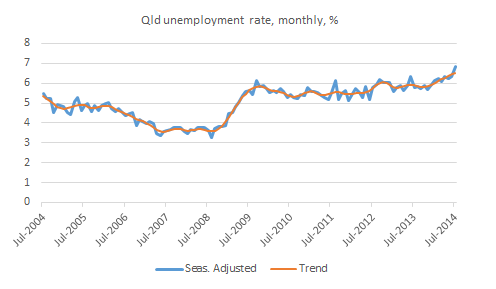
According to ABS labour force data just released, Queensland’s unemployment rate is now 6.8% seasonally adjusted and 6.5% in trend terms (see chart below). In part, this must be related to the mining slowdown and the sub-trend economic growth we’ve been experiencing.

Unemployment July 2014

Posted in Labour market | Tagged , , , | Leave a comment

Students to rally against bureaucratic inefficiency

photoWhile out at the University of Queensland today, I picked up the above flyer in the uni refectory regarding a rally against the new Tertiary Transport Concession Card (TTCC), which is designed to ensure only people genuinely studying can claim public transport concessions. I suspect this Card is designed to stop the “students in suits” problem – i.e. where former students use out-of-date student ID cards to claim concessions. While I’m generally against student rallies, which are typically either misguided or ineffective, this one appears to have some justification, as students appear to have been unnecessarily inconvenienced due to bureaucratic inefficiency in processing TTCC applications. As the flyer notes on the other side:

All tertiary students already carry student concession cards to prove that they are studying. Other states like WA and NSW have found solutions to fare evasion that don’t include forcing students to possess a third card that requires students to wait indefinitely after lodging an application. The policy costs the government money to cover administration, and it forces universities to spend student fees on processing TTCC applications instead of on teaching and learning.

Because of delays in processing TTCC applications by universities and Translink, students either have to pay full fare while they’re waiting for a TTCC or fare evade and run the risk of a fine.

What I find interesting about the planned rally is that the students don’t appear to be against the policy intent of the TTCC. The flyer appears to imply the Student Union might support an alternative approach to ensuring only genuine students get concessions, such as the approach in Western Australia, where the Transport Department and universities share data so genuine students can be identified on their Go Card equivalents. This sounds like a reasonable alternative and should have been considered by Translink.

Posted in Transport, Uncategorized | Tagged , , , , , , | Leave a comment

Brunswick St Mall should have been re-opened to traffic

McWhirters

The Brunswick St Mall facelift is now complete (see Brisbane Times coverage), but I remain of the view that the Mall should have been re-opened to traffic instead. From an economic perspective, I suspect the costs of having a mall on Brunswick St outweigh the benefits, as I noted in a post in 2012 (Opening Brunswick St Mall to traffic is a great idea):

The best option…is probably to get rid of the Mall altogether and replace it with four lanes of traffic, so that Brunswick St runs continuously all the way from the Valley fiveways at St Paul’s Terrace down to New Farm Park. This would yield major gains in reduced travel times…My intuition tells me that these travel time savings would swamp any reductions in profits earned by businesses currently on the  Mall, and a cost-benefit analysis would show a high rate of return from re-opening the mall to traffic.

My doubts about the economic benefits of the Mall upgrade were added to by comments by the Valley Chamber of Commerce President that one of the objectives of the Mall upgrade was to divert business from Emporium and Gasworks. That is, it might lead to a reallocation of spending and business activity from elsewhere in Brisbane, but it won’t necessarily create any new activity.

Re-opening Brunswick St Mall to traffic may also have brought a benefit through cleaning up that area of Brunswick St north of the Mall to the fiveways, one of the seediest strips in Brisbane and a frequent scene of drug dealer arrests. I suspect a more desirable mix of businesses would locate in the area if there was a much larger amount of passing traffic.

Posted in Brisbane, Crime, Transport | Tagged , , , , | Leave a comment

Leading US supply-side economist Dan Mitchell to speak at Economic Society event

DanMitchell2Dan Mitchell, Cato Institute

As Deputy Secretary of the Queensland branch of the Economic Society of Australia, it’s incumbent upon me to promote an upcoming Society event in Brisbane on Wednesday 20 August, at which leading US supply-side economist Dan Mitchell of the Cato Institute will speak on tax avoidance and tax competition.

Dan is apparently an advocate of a flat tax, which would be a good topic to speak on in Queensland, given we once had a Premier who proposed a flat tax as part of his pitch to become PM. While a flat tax would certainly reduce the efficiency loss associated with income tax, it would be less equitable than our current progressive income tax, and hence may be politically unpalatable.

Regardless of your views on the merits of supply-side economics, it’s sure to be an interesting event and I expect much discussion and debate after Dan’s address. You can find further information at the ESA website:

Dan Mitchell event on tax avoidance and tax competition

Posted in Tax | Tagged , , , | Leave a comment

What is the Four Pillars’ share of the Queensland economy?

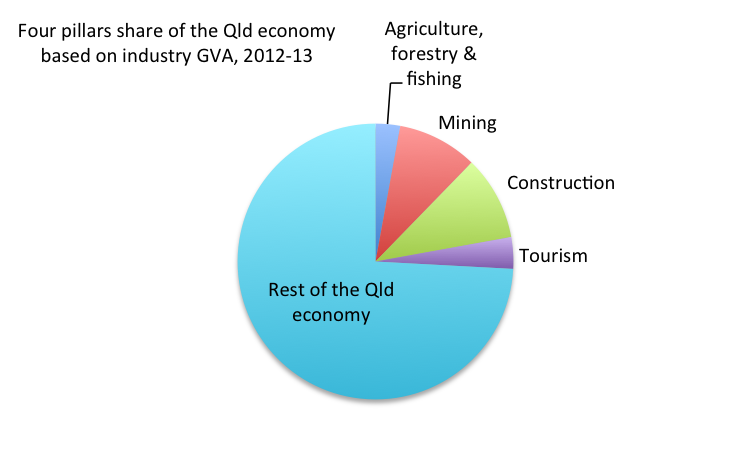
Last week I noted how Nick Behrens of CCIQ made the good point on Steve Austin’s ABC radio show that the Queensland economy is much more than the so-called four pillars of agriculture, construction, resources (i.e. mining) and tourism. In terms of their direct contribution to industry gross value added (GVA), the four pillars account for around 25% of the Queensland economy (see my chart below based on ABS State Accounts and Tourism Research Australia data).

fourpillarsThis chart shows the direct contribution the sectors make, without trying to undertake the difficult and conceptually challenging task of also identifying the indirect or flow-on/multiplier effects of the sectors. Peak bodies for the different sectors will of course claim that their particular sector is more important because it underpins activity in other sectors. I’ve previously posted on this argument regarding the resources sector:

RBA confirms QRC analysis – resources sector spends mega bucks domestically

Resources sector jobs multiplier

Also, see my post How important is tourism to the Queensland economy?, in which I note the calculation of multiplier impacts in controversial. Again, I’ll aim to elaborate on this point in the future.


Posted in Agriculture, Mining, Tourism | Tagged , , , , , , , , , | 2 Comments

Good employment outlook for Qld, but still waiting for strong economic recovery

Steve Austin had a good chat with Nick Behrens from CCIQ yesterday morning on 612 ABC Brisbane, covering the economic outlook for Queensland and the Queensland Plan (What the job market in Queensland will look like in the future). Nick made a number of excellent points, particularly about how while we have had strong jobs growth our unemployment rate remains relatively high. As Nick noted, in part this is due to rising participation as people re-enter the labour market looking for work. Nick also pointed out that the larger part of the Queensland economy is outside of the so-called four pillars (construction, agriculture, tourism, and resources) and it’s actually in the non-pillar sectors that we’ll experience the largest jobs growth, such as health, education and aged care.

Incidentally, new data relating to one of the pillars, construction, was released by the ABS yesterday, and wasn’t particularly encouraging, with residential dwelling approvals in Queensland falling in June, particularly the unit component (see chart below). That said, anecdotal reports suggest the industry is doing much better than it has in recent years. However, the industry won’t return to levels seen before the financial crisis anytime soon, unless there is a big pickup in interstate migration, I suspect.

Approvals Jun 2014For more coverage of yesterday’s building approvals data, with a Far North focus, see:

Building approvals slip but the FNQ data holds up

Building approvals: the south fights back?

Posted in Housing, Labour market, Macroeconomy | Tagged , , , , , , , , , | Leave a comment

IR reform should have same priority as tax reform

Jessica Irvine has a great piece in the News Limited media today on how Tony Abbott must act now to reverse Australia’s economic demise. I agree with her that reforming the tax system is extremely important, but I’m surprised she doesn’t see industrial relations reform as equally relevant. The Business Council of Australia, which has been pushing hard for IR reform (see Unions defiant on IR reform), will be unhappy with Jessica’s criticism that their prescriptions for growth fall short of the mark.

IR reform needs to focus on three main issues:

  • Australia’s minimum wage is high relative to average wages;
  • it’s difficult to dismiss poorly performing employees; and
  • penalty rates make it unviable for many businesses to extend their opening hours, which has been a major issue in the restaurant industry – although a recent Fair Work Commission ruling has provided some relief regarding penalty rates, a ruling which Unions appear to be contesting in the Federal Court (Hospitality union to take fight over weekend penalty rates to court).

I expect IR reform would benefit the economy through lower unemployment and improved productivity. I have no doubt WorkChoices partly contributed to the low rates of unemployment we saw prior to the financial crisis, including a Queensland unemployment rate between 3-4%, although the mining boom and the construction boom were obviously major influences. On productivity impacts, I’d refer to the excellent 2005 article Comparing Australian and US Productivity written by my former Treasury colleague Jyoti Rahman (N.B. MFP stands for multi-factor productivity):

Scarpetta and Tressel (2002) consider the impact of employment protection legislation on MFP. They find that a substantial liberalising of employment protection legislation would reduce Australia’s MFP gap with ‘the frontier economy’ by 10.8 per cent. This implies that, subject to the above caveats, reforming Australia’s employment protection legislation may reduce the productivity gap by about 2 percentage points, with likely significant beneficial impacts on living standards…

That would imply a productivity benefit per worker of around $1,000 per annum. Certainly IR reform would allow greater flexibility for businesses and would allow them to more readily replace poorly performing employees, so I expect productivity gains of this magnitude are plausible.

Posted in IR | Tagged , , , , , | Leave a comment

Good news for regional Qld if Carmichael mine goes ahead – jobs market weaker than in SEQ

The big news for the Queensland economy today is the Federal Government’s approval, subject to meeting environmental conditions, of Adani’s massive Carmichael Coal and Rail Project. There are, however, doubts about whether the project remains economically viable given the downturn in coal prices (Adani coal mine approved amid weaker prices). Let’s hope the project still stacks up, because regional Queensland outside of SEQ has faced challenging economic conditions recently, partly due to the slowdown in the mining sector.

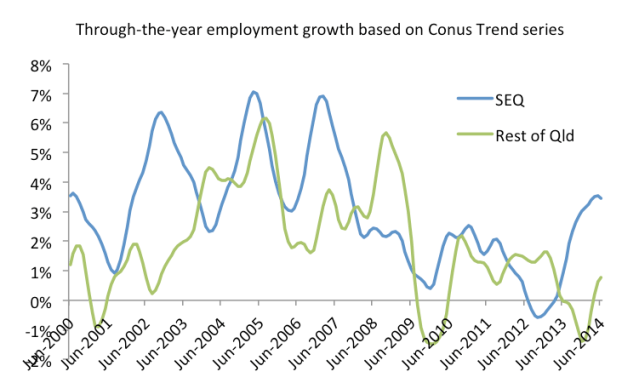
The challenging conditions in regional Queensland were clearly evident in the regional employment data released by the ABS the week before last. Smoothed, trend estimates of the data by the Queensland Government Statistician’s Office showed that, broadly speaking, all the jobs growth in Queensland in the 12 months to June 2014 occurred in SEQ (see the June 2014 information brief). Employment declined in regional Queensland by 2,000 employed persons over that period, compared with growth of 42,600 employed persons in SEQ. (N.B. I’ve defined SEQ as Greater Brisbane, Gold Coast and Sunshine Coast.)

The Government Statistician’s Office’s estimates rely on a 12-month moving average, which is a pretty basic smoothing technique and arguably could be improved upon. One effort to produce better trend estimates of regional employment data has been made by Pete Faulkner of Conus Consulting. Pete’s trend estimates (available at this link) are a by-product of an advanced seasonal adjustment routine. Based on Pete’s trend estimates, non-SEQ Queensland is no longer subtracting jobs from the Queensland economy, but jobs growth is much weaker than in SEQ (see the chart below).
tty_employment


I have some doubts about whether the ABS regional employment data are suitable for the seasonal adjustment procedure that Pete applies, given the huge degree of noise in the data, so I’ll withhold judgment for now on whether the Conus or Government Statistician’s trend estimates are more useful. However, I will applaud Pete for making the effort to better understand what is occurring in our regional economies. The ABS’s noisy, regional employment data cause a lot of confusion about the state of our regional economies, as a recent Townsville Bulletin article demonstrates:

TEL takes issue with reports Townsville has highest unemployment

Posted in Uncategorized | Leave a comment

Productivity and Privatisation – panel discussion at Griffith University, Southbank

I was delighted to speak alongside productivity expert Dean Parham at a Griffith University panel discussion earlier tonight on productivity and privatisation. Thanks to Alex Robson of Griffith for organising the excellent, well-attended event. My prepared remarks are below. I varied them slightly in the delivery but the main points I made were the same as below.

Good evening. The issue of privatisation or asset sales is obviously very topical in Queensland, with the Government seeking to raise over $30 billion from a range of privatisation proposals. These include the sale of power generators CS Energy and Stanwell, the long-term leasing of Townsville and Gladstone ports, and private equity injections into Energex , Ergon and Powerlink. The Government, however, has appeared somewhat unprepared for the lively debate that has occurred and which I expect will continue right up to the election.

Continue reading

Posted in Infrastructure, Queensland Government | Tagged , , , , , , , , , | Leave a comment

Unclear whether Qld Govt will have evidence needed to win asset sales debate

The Queensland Government is right to have begun advertising for advisers on asset sales, to ensure that assets such as CS Energy and Stanwell are sold in a timely fashion after the next election (Government advertises for asset sales advisors). The Government needs to get these assets ready for sale, and will no doubt benefit from advice from professional services firms and investment banks.

The Government, however, seems to have missed the important step of undertaking comprehensive cost-benefit studies of the sale proposals. I’ve written before on the failure of the Strong Choices campaign to provide useful information to the public regarding the impacts of asset sales on the economy and community. I was disappointed the Government spent $6 million on the campaign which could have been better spent undertaking comprehensive studies of privatisation proposals and marshalling the evidence that could help convince the public these proposals are in the public interest (see my post Failure of Strong Choices now obvious – missed chance to persuade on asset sales).

As a supporter of asset sales, I’ve disagreed with a number of my fellow economists around town on the merits of assets sales, but one thing I think we can all agree on is the need to do the rigorous analysis of the costs and benefits to the community of proposed sales. This does not appear to have been done so far, and the Government is now highly exposed because it is basically signalling that it will sell assets after the election, but it may not have the evidence and arguments it needs to justify its actions.

For more on the issue of asset sales, please consider attending a panel discussion tomorrow night at Griffith, Southbank, at which I’m speaking:

Productivity and Privatisation panel discussion

Posted in Infrastructure | Tagged , , , , , , | Leave a comment