Jobs boom ahead?

The Queensland Treasurer Andrew Fraser today referred to a “jobs boom coming”:

Jobs boom ahead, Treasurer promises

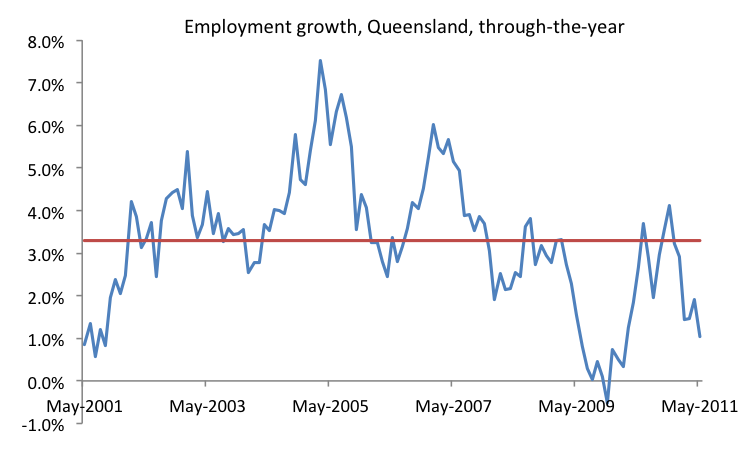
It’s good the Treasurer is upbeat about our economy – that’s part of his job description – but the employment growth that Queensland Treasury is forecasting (3.0% p.a.) is only around the average employment growth (around 3.3% p.a.) Queensland has experienced over the last ten years (see chart below).

That said, reaching 3% employment growth p.a. may be an achievement, given that working age population growth is slowing down as baby boomers are retiring. The Treasury employment forecasts would imply a resurgence in interstate migration to Queensland, which is probably reasonable given the mining sector can afford to offer wages that encourage people to move. All things considered, the Treasury forecasts are reasonable, but, compared with the historical record, we aren’t exactly expecting a jobs boom.

Posted in Budget, Macroeconomy | Leave a comment

Mall activation – T minus 10 and counting

The economic development chapter of the latest Brisbane City Council budget has left me wondering whether there is someone sitting in the Council building, with one hand hovering over a red button, counting down to “mall activation”:

Service 7.4.2.2 Queen Street Mall Activation and Marketing

This service comprises Queen Street Mall promotions and the new “The City” CBD destination branding delivered by Brisbane Marketing. It includes brand and tactical advertising to position and promote the Brisbane CBD and Queen Street Mall, Australia’s most successful pedestrian mall, as the main shopping and entertainment destination in Brisbane.

It includes colourful, vibrant entertainment daily such as emerging music of all genres to support our brand as an Australia’s New World City.

Over 1000 events will be rolled out in 2011-12 to activate the precinct and attract residents and visitors. Previously successful campaigns including Christmas will be enhanced and the Farmer’s Markets in Reddacliff Place will be continued.

Anyone who has tried to make their way through the mall during a typical lunch hour would need some convincing that it needs any further activation, especially if there is some circus display/fashion show/Salvation Army band blocking the centre of the mall and squeezing the passing traffic into a thin ribbon hugging the extremities. And why are we spending so much money (around $4 million p.a.) promoting and activating the Queen St Mall, which pretty much sells itself, while we’re spending under $500,000 promoting and activating the Valley Malls, which have a lot more character and are probably better aligned with the whole Brisbane as Australia’s New World City concept?

Posted in Brisbane, Retail trade | 1 Comment

Live exports suspension could mean cheaper steaks

The Gillard Government did the right thing today in suspending live cattle exports to Indonesia. The reaction from the beef industry is over the top, particularly given the Government and the PM personally have stressed this is a temporary ban – i.e. it may only last a few months. In the meantime, meat-eating Australian consumers may benefit from cheaper beef due to an increase in supply to the domestic market, as reported by AAP (Ban will hurt beef industry: grazier):

Central Queensland grazier Melinee Leather says northern producers will be forced to compete with their southern counterparts.

She said they’ll have to fork up to $200 per head of cattle in transporting their stock to southern feedlots for the domestic and other international markets already covered by other producers.

“The markets will be flooded because we have a percentage of northern cattle that used to go live and now have to go somewhere else,” Ms Leather told AAP.

Posted in Agriculture | Leave a comment

Queensland most at risk from sea level rise

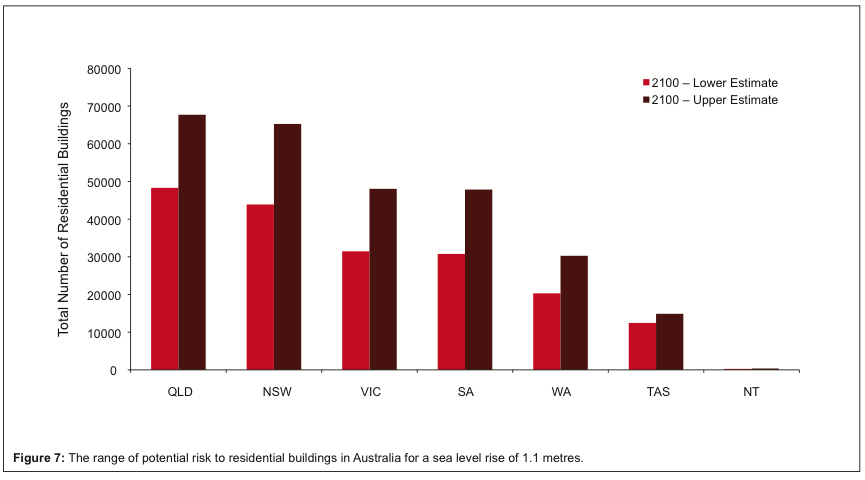
While the Gold Coast Bulletin is doing its best to generate alarm (Coast to go under in climate crisis), it’s surprising there hasn’t been more coverage of the latest Department of Climate Change report:

Climate Change Risks to Coastal Buildings and Infrastructure

Maybe it’s no surprise, given the forecasts are for 2100, and it’s hard to trust (or worry too much about) forecasts that far out – those doomsaying demographers from the sixties and seventies have a lot to answer for. Plus it seems like we’ll have plenty of time to adapt and relocate if the sea level does keep rising.

Here’s a chart from the report showing the number of residential buildings at risk:

Posted in Climate change, Gold Coast | Leave a comment

Tourism regions responsible for Queensland’s higher than national average unemployment rate

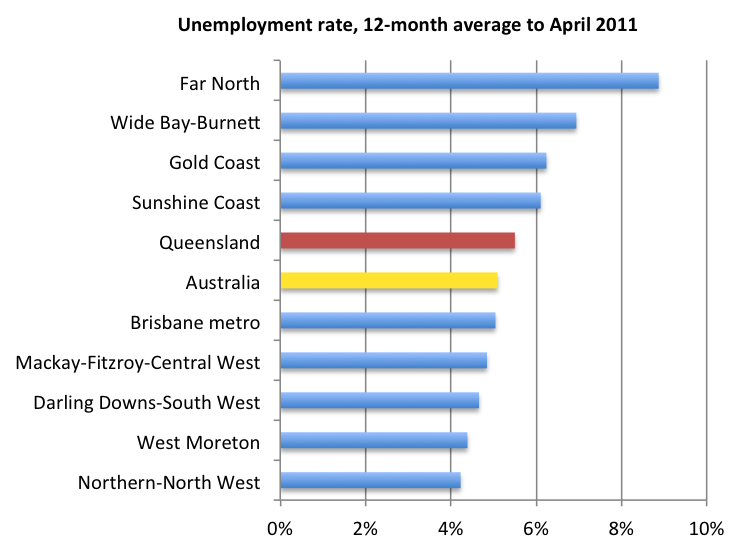
The downturn in Queensland’s tourism sector is largely responsible for Queensland’s higher than national average unemployment rate. This is reasonably clear from the following chart I prepared based on the ABS Labour Force data released last month.

According to my calculations, Far North Queensland is responsible for over half of the 0.4% difference between the Queensland and Australian-average unemployment rates. So, if Cairns’s tourism sector and broader economy remain sluggish, it’s likely Queensland’s unemployment rate will remain above the national average.

Posted in Cairns, Macroeconomy | 1 Comment

Swan says relax about GDP fall, check out this pipeline

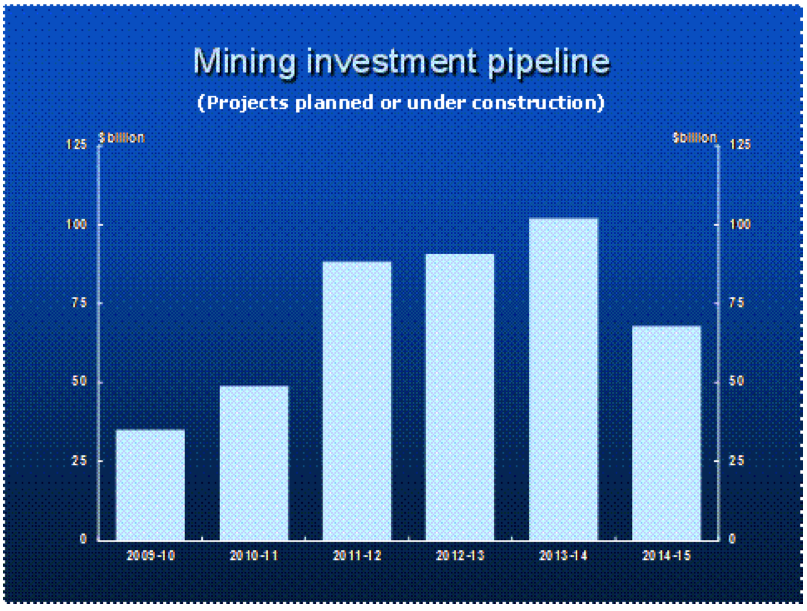
Deputy PM-Treasurer Wayne Swan gave an informative press conference on the National Accounts today, noting that the flood-related GDP decline will only be temporary, and there’s a massive pipeline of mining investment on its way. Check out this great chart:

That looks like over $100 billion in mining sector investment in 2013-14. No doubt a big chunk of that will be in Queensland.

Posted in Macroeconomy, Mining | 1 Comment

Carbon tax will be even harder to sell after electricity price hike

The Queensland Competition Authority’s decision today that power prices can increase by 6.6% certainly makes PM Julia Gillard’s job of selling the carbon tax even tougher in Queensland (Power price hike set to cost $118 a year):

Queensland power prices are set to rise by 6.6 per cent next financial year, an increase that is higher than originally expected.

The Queensland Competition Authority, announcing its final decision on benchmark retail power prices today, said the new prices would apply from July 1.

The authority said it would allow price rises of 6.6 per cent, which was above the 5.83 per cent increase foreshadowed in its draft decision.

The 6.6 per cent increase would mean an average annual power bill of $1781.50 was set to rise by $117.58.

The carbon tax is expected to be between $20-30 per tonne of CO2-equivalent emissions. As reported earlier this year (Start price set for carbon tax):

At $20 a tonne, electricity prices would rise about 10 per cent, or $2.70 a week based on Treasury modelling for Kevin Rudd’s abandoned carbon pollution reduction scheme.

That would be an extra $140 per year, or around an extra $35 per quarter. Given the large price increases that are already locked in, it’s not surprising that the carbon tax is unpopular in the community.

Part of the problem, of course, is that the Government has not fully explained to ordinary Australians why it considers a carbon tax is necessary. Why doesn’t PM Julia Gillard buy 5-10 minutes of time from each of the TV networks to present her case on prime-time TV, taking the time to explain why a carbon price is necessary and the differences between a carbon tax, a cap-and-trade scheme and direct action policies?

Currently Australians are confused and worried. All they hear are glib assertions about taxing Australia’s biggest polluters, when everyone except the most daft realises that this means we will end up paying higher prices, because the costs will get shifted on to consumers. We need to be convinced that a carbon price is a good idea.

Paul Keating was arguably the greatest communicator of complex policy ideas that Australia has ever seen. He simplified, but he didn’t treat people like dummies. The PM can still recover her standing and win the debate on climate change, but it will require a great speech.

In her book On Speaking Well,  former White House speechwriter Peggy Noonan observes that at the heart of every great speech is great policy. People want to know what the great policy is, and people can generally be moved by logic. The PM should start working on a great speech and book the time with the networks. It would certainly make for better TV than that lamentable ad featuring Cate Blanchett.

Posted in Climate change, Energy | Leave a comment

New population projections confirm strong expected growth in Ipswich and Gold Coast

From the new local government population projections which Treasurer Andrew Fraser released yesterday:

Ipswich to have fastest growth but Gold Coast to have most growth

In the decade to 2021, Ipswich (C) is projected to grow rapidly at a very high 5.0 per cent per annum (a total of 111,000 people), while Gold Coast (C) is projected to have the largest amount of growth (133,800 people) of any local government area (LGA) in Queensland.

In other economic news, company profits have taken a hit due to Queensland’s cruel Summer, and no doubt the March quarter GDP figure (to be released on Wednesday) will be a shocker:

Weak company profits signal risk of sharp economic contraction in the first quarter

It’s likely only a temporary contraction, however, given the massive amount of mining sector investment that is on its way. Hence the trajectory of interest rates is still in an upward direction, although the RBA may defer further rate rises until later this year or early next year.

Posted in Floods, Macroeconomy, Population | Leave a comment

Great charts from OESR showing surges in online retail & mining investment

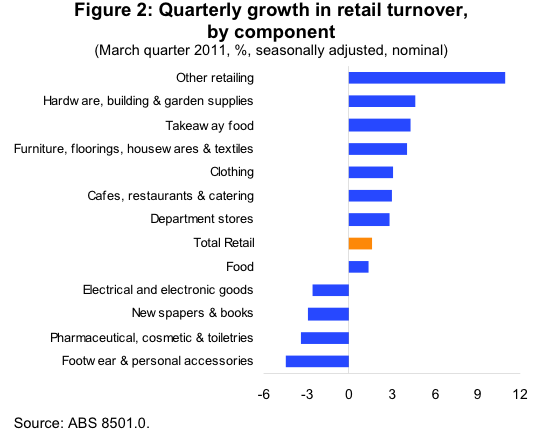
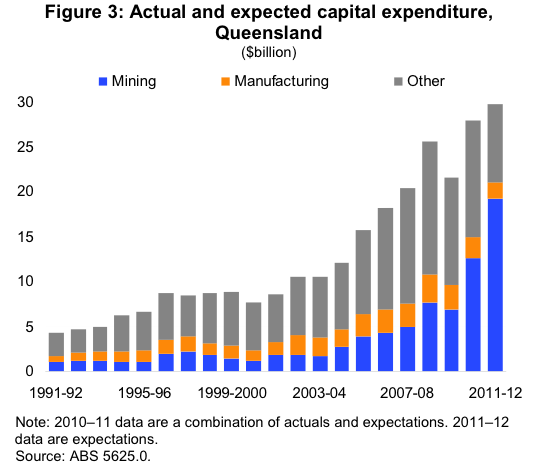
The Office of Economic and Statistical Research (OESR) in Queensland Treasury released its latest Queensland Economic Review on Friday, and it contains some excellent charts showing surges in domestic online retailing (which is part of ‘other retailing’ in the first figure below) and mining investment (in the second figure below).

No doubt these trends will have profound implications for the structure of Queensland’s economy in five to ten years’ time – including the jobs we have and the bricks-and-mortar stores we still shop in.

Posted in Macroeconomy, Mining, Retail trade | Leave a comment

Manufacturing continues its long steady decline

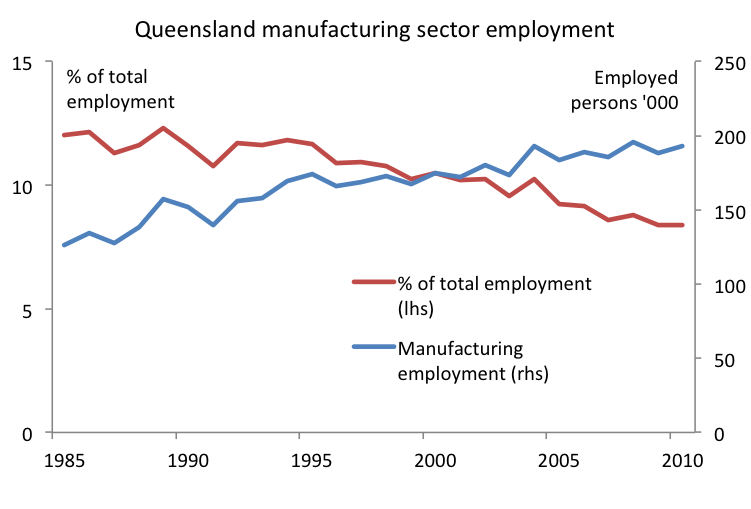
The loss of 160 jobs at Golden Circle’s Northgate plant is obviously terrible news for the workers and their families. Anyone working in the manufacturing sector needs to be aware that the long-run economic trend of de-industrialisation (and a shift to services) in OECD economies is against them, and they need to invest in their education and skills.

The chart below shows the stabilisation of manufacturing employment in Queensland over the last five years at around 185,000 to 195,000 jobs, as well as the steady decline in manufacturing employment as a share of total employment – from around 12% in 1985 to 8.5% today.

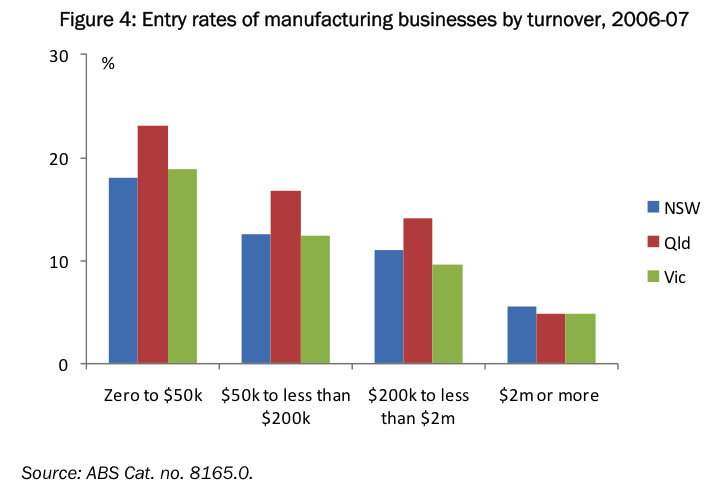
With the high Australian dollar, the relative decline in manufacturing will no doubt continue. There are of course opportunities remaining in manufacturing, especially for niche manufacturers – e.g. synthetic turf manufacturers supplying a local market. In a study on the manufacturing sector last year, I found that Queensland had a higher proportion of new small turnover manufacturers than other States. These are possibly the innovative niche manufacturers who are the future of manufacturing in our State. I’ve reproduced the relevant chart from the study below.

So manufacturing in Queensland still has a future, but, given the long-run trends, anyone working in the sector would be well advised to think about their career and study options.

Posted in Macroeconomy | Leave a comment