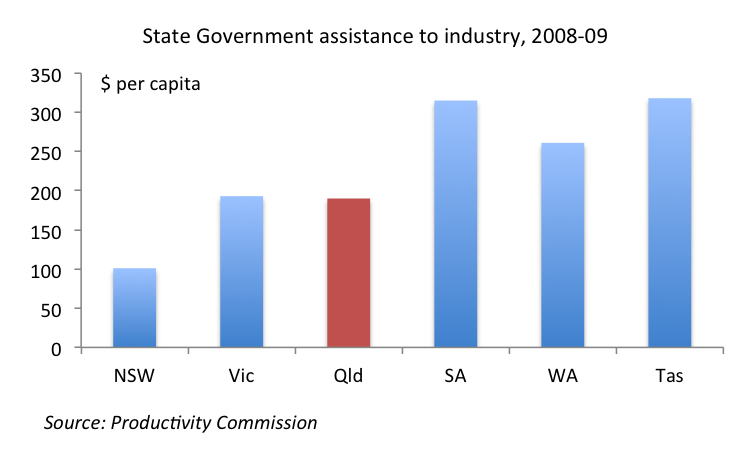
Qld Government provides $850 million of industry assistance ($190 per capita)

One of the easiest jobs I ever had in the Commonwealth Treasury was working in the Industry Policy Unit,  partly because the Productivity Commission had already compiled the hit list of wasteful corporate welfare programs in its annual Trade and Assistance Review (TAR). This year’s TAR, released last week, contains a very useful section on State Government industry assistance (e.g. to tourism and the wine and film industries), which should bring delight to bean counters in Treasury departments across Australia.

For instance, the TAR tells us that the Queensland Government provided $850 million of industry support in 2008-09, which is equivalent to around $190 per Queenslander. Clearly there must be some big savings possible here. If we could get industry assistance down to the per capita level of NSW (see chart below), we could save $400 million per annum.

Posted in Industry policy | Leave a comment

Is Screen Queensland assisting Deception and Bad Karma?

The Queensland Government provides over $13 million of assistance per annum to the film industry through Screen Queensland. Following a report in the Gold Coast Bulletin this morning with the headline Two new feature films to be shot on the Coast, I’m interested in whether the productions have received any State Government incentives, particularly given the high Australian dollar makes us an unattractive place to make movies at the moment. The Gold Coast Bulletin reports:

THE Gold Coast film industry is welcoming some Deception and Bad Karma.

The two multimillion-dollar feature films start production at Village Roadshow Studios, Movie World next month and will bring some much-needed life back into the Gold Coast industry.

Academy Award winner Cuba Gooding Jr (Jerry Maguire) will arrive in mid-July to begin filming Deception with Australian director Brian Trenchard-Smith (BMX Bandits).

The Brisbane-based producer of both films mentions Screen Australia, the Federal Government body responsible for assisting the film industry, but makes no mention of Screen Queensland. Hopefully this means that, in this time of reconstruction and fiscal restraint, the Queensland Government hasn’t committed precious funds to propping up the (arguably) unviable Gold Coast film industry.

I have no idea why we need both Screen Queensland and Screen Australia, other than that they provide different offices for the film industry to lobby the Queensland and Federal Governments for assistance.

Posted in Industry policy | Leave a comment

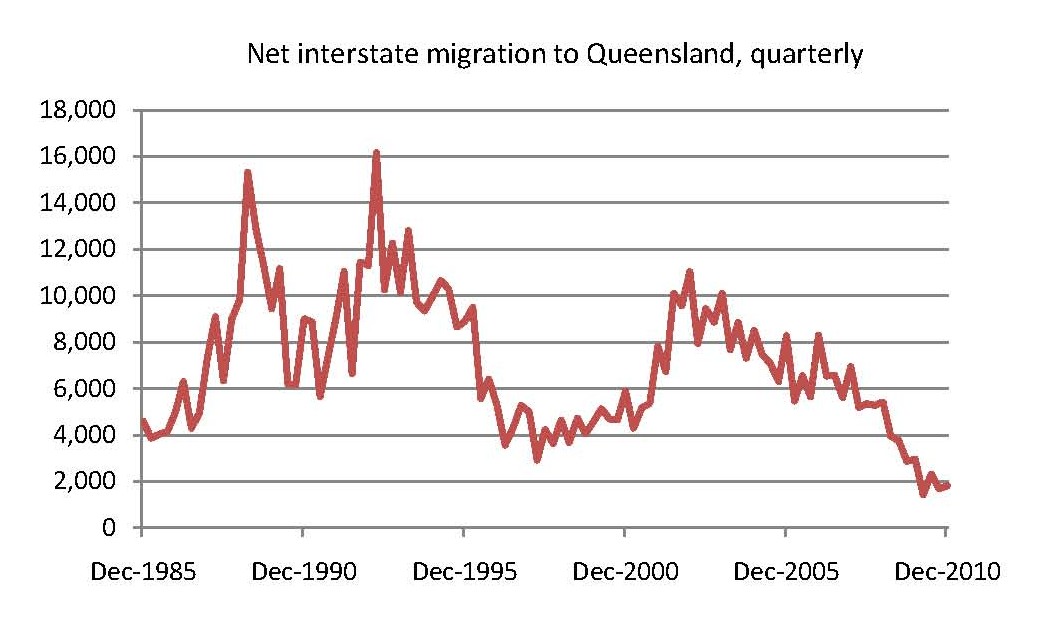
Queensland still struggling to attract interstate migrants

Here’s a chart based on yesterday’s ABS demographic data release:

Meanwhile, Fraser Coast residents aren’t waiting for the people to come. They’re busy creating their own people (Fraser Coast baby boom):

The number of babies born in the region has jumped by 35% per year since 2004.

In that year there were 850 births, now the number is closing in on 1200 every 12 months.

In the same period, the overall population grew just 20% – proving mums have been keeping the maternity ward busy.

Not only are more babies being born but they also have more siblings than in previous years.

The Fraser Coast’s fertility rate has risen from an average of 1.9 children per mother to 2.3, according to the Australian Bureau of Statistics.


Posted in Population | Leave a comment

Agricultural businesses cover 75% of Queensland – highest proportion in Australia

There are some interesting statistics in today’s ABS release Land Management and Farming in Australia:

In 2009-10, approximately 52% of Australia’s total land area was managed by agricultural businesses, a 4% decrease since 2007-08. On a state basis, the lowest proportion of land managed by agricultural businesses was in Tasmania (24% of state area) while the highest was in Queensland (75% of state area).

Posted in Agriculture | Leave a comment

Government right in rejecting northern economic zone

The Queensland Government was right in rejecting the northern economic zone proposal from the Institute of Public Affairs, as reported in the Brisbane Times:

The concept is intended to encourage investment through reducing fringe benefits and payroll tax, securing property rights and reducing regulatory duplication.

However the idea of an over-arching economic zone failed to win find favour with the state government.

Queensland Treasurer Andrew Fraser said he had not seen any research or proposal that convinced him a Special Economic Zone was necessary.

Mr Fraser backed the government’s economic record, saying Queensland had the policies in place to usher in a “prosperous future.”

“Already, Queensland’s tax per capita levels are $501 less that the average of the other states and territories,” he said.

Instead of carving out regions of Australia as low-tax, low-regulation zones, we should improve tax and regulatory policy settings across the whole country. There is a risk that, if we create a special economic zone, there would be a migration of investment and skilled labour to the zone, adversely affecting the rest of the country and our ability to pay for public services.

Posted in North Queensland | 1 Comment

Tradies know what it means to live in the 200km City

The downside of a 200km City (i.e. SEQ from Noosa to the Tweed) is that you can have a long commute to and from work. The upside is that, if there is a downturn in your local area, you can still find work elsewhere in the 200km City. The Gold Coast Bulletin reports that Gold Coast tradies are learning what it means to live in the 200km City:

From 4.30am, the sheer volume of tradies’ utes and trucks heading north along the M1 means they have now created their own early-morning rush hour.

“Mate, it’s just chockers. Every second car at this time of the morning is a tradie and they’re all heading one way,” says Shaun Schwarze, a licensed landscaper from Nerang who is happy to turn his hand as a builder’s labourer.

“I’ve been commuting for six years. You have to go where the work is. This week we’re working up at Goodna.”

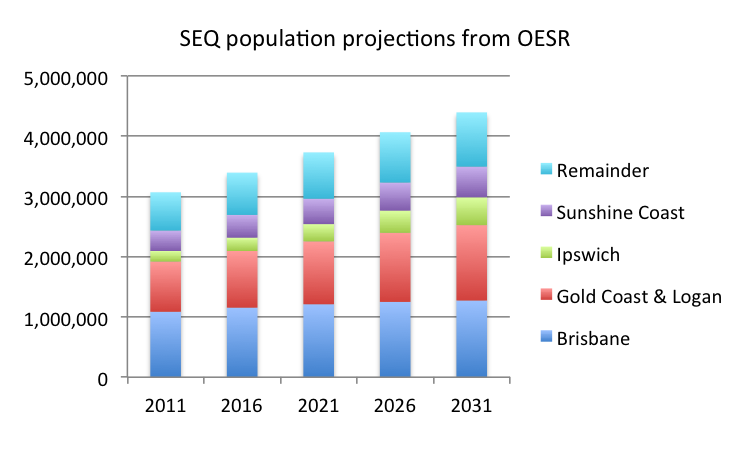
While population projections suggest there will be further growth on the Gold Coast that will mean jobs for tradies in the future, some Gold Coast tradies will have to get used to travelling to Brisbane and to Ipswich, in particular, where a significant chunk of the additional growth in SEQ is projected to occur (see chart below).

Posted in Brisbane, Gold Coast, Ipswich | 2 Comments

Cairns hoping for reconstruction boost

There is still no good news for Cairns and the Far North from the ABS, as reported by the Cairns Post (Far North Queensland’s unemployment rate tops Australia):

THE Far North’s jobless rate is again the highest in Australia after the number of unemployed people in the region rose nearly 3 per cent in May.

Official data released yesterday showed the region’s unemployment figure rose to 10.8 per cent last month, more than double the national average of 4.9 per cent.

Advance Cairns chief executive Stewart Christie said the figure was disappointing, especially since the jobless rate had recovered to 7.9 per cent in April after a post-Yasi slump in February and March.

But he said employment data was likely to improve in coming months as the reconstruction effort on the Cassowary Coast was boosted.

“It has taken longer to kick that off than everyone hoped but that work will absorb about 1000 local tradespeople when it starts,” Mr Christie said.

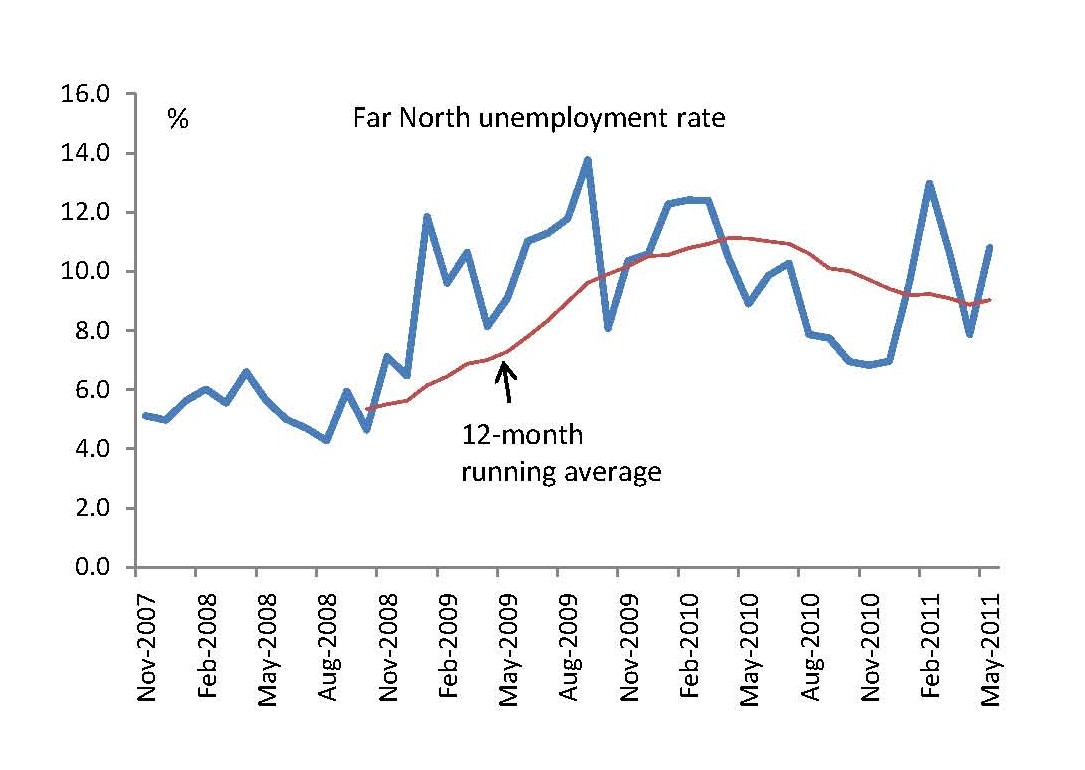
There’s no point getting too worried at this stage about the jump in the Far North unemployment rate back into double figures because the regional ABS labour force data are highly volatile (and they aren’t seasonally adjusted either although that’s more of an issue for months earlier in the year when new job seekers enter the labour force). The regional data are volatile because, although the Labour Force Survey has a large enough sample of households to give reliable statistics at a national level, the ABS has never given strong guarantees about the robustness of regional data.

My guess is that the Far North numbers are based on a sample of only a few hundred households in the region, meaning sampling error can be significant. You can see the volatility in the chart below of the Far North unemployment rate based on the ABS data. I’ve included a 12-month running average because I think it’s a good way to see through the sampling variability and seasonality in the figures.

The running-average Far North unemployment rate of 9% is an improvement over the 11-12% rate during the worst point of the slump, but it doesn’t appear to be improving any more.  Let’s hope that reconstruction spending helps out. Longer-term, the region may benefit from baby boomer retirees relocating to what is a very beautiful part of Australia.

Posted in Cairns, Macroeconomy | 1 Comment

State against State

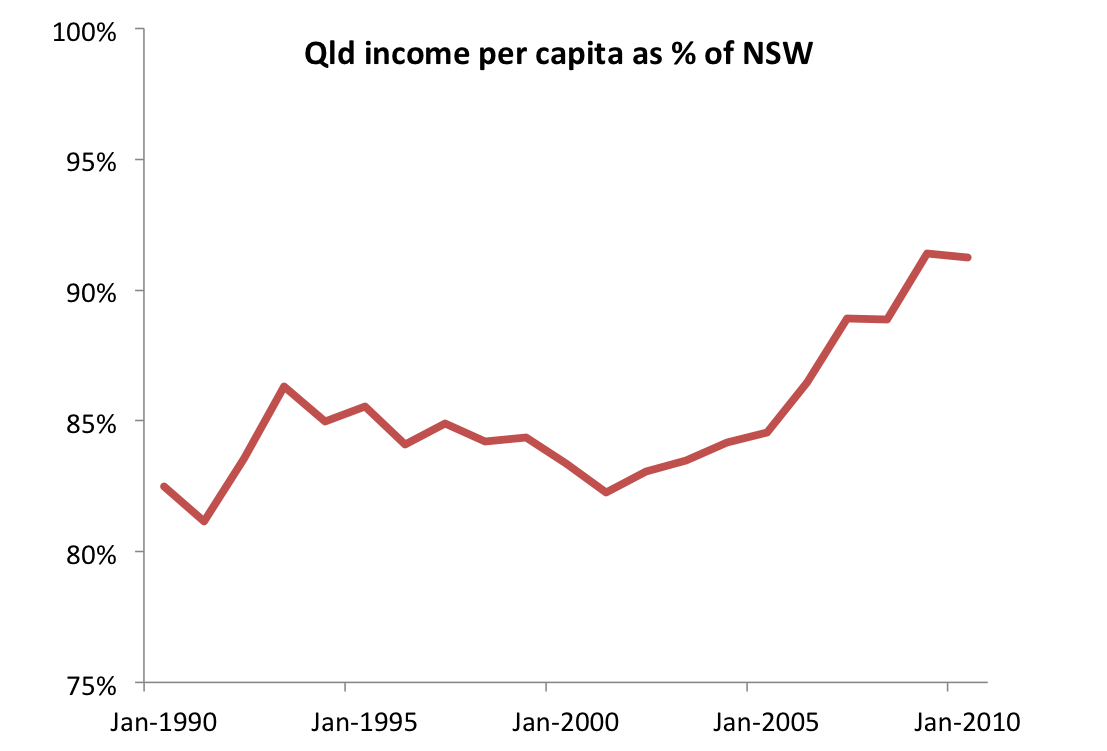
While NSW currently beats us in income per capita ($49,600 vs $45,300), we’re catching up…

Posted in Macroeconomy | Leave a comment

We should cut stamp duty, not increase it

While today’s Queensland Budget was broadly ok and economically responsible, I was surprised by the removal of the stamp duty concession for existing home owners who buy a new place of residence. The Brisbane Times reports (Property market tipped to worsen on stamp duty increase):

The government today announced two new measures in its State Budget that will have a direct effect on the property industry:

  • a $10,000 payout to people who sign home-building contracts or buy a new residence between August this year and January next year;
  • an increase of up to $7175 on stamp duty for existing home owners who buy a new residence to live in. Previously non-investors received a long-standing discount.

REIQ chairman Pamela Bennett this afternoon welcomed the incentive for new homebuyers but said the removal of the stamp duty concession for non-first home buyers would wreck havoc on the state’s property market.

Stamp duty is a really bad tax, as noted in Ken Henry’s tax review (p. 49 of the Overview):

Stamp duties on conveyances are inconsistent with the needs of a modern tax system. While a significant source of State tax revenue, they are volatile and highly inefficient and should be replaced with a more efficient means of raising revenue.

Conveyance stamp duty is highly inefficient and inequitable. It discourages transactions of commercial and residential property and, through this, its allocation to its most valuable use. Conveyance stamp duty can also discourage people from changing their place of residence as their personal circumstances change or discourage people from making lifestyle changes that involve a change in residence. It is also inequitable, as people who need to move more frequently bear more tax, irrespective of their income or wealth. 

I can understand the Government is short of cash after the floods and Cyclone Yasi, but this is not a good way to fix the Budget.

Posted in Budget, Housing, Queensland Government | 1 Comment

Possible High Court challenge against mining tax

Adele Ferguson in the Sydney Morning Herald (See you in Court) notes the Queensland Government may join a High Court challenge against the mining tax:

A letter from mining billionaire Andrew Forrest to the Prime Minister reveals continuing dissent about the mining tax may spill over into a High Court challenge, writes Adele Ferguson.

The Gillard government’s credibility is about to take another battering as one of its more complex and ad hoc tax reforms – the minerals and resources rent tax – faces the threat of a constitutional challenge in the High Court.

Billionaire Andrew Forrest’s Fortescue Metals is expected to be a party to mounting a constitutional challenge, with the West Australian, Queensland and recently elected NSW governments odds-on to join any claim.

A High Court challenge against the tax may well succeed, as the resources in the ground are technically owned by the State Governments who grant the mining leases, and arguably they have exclusive right to any royalties or taxes relating to the extraction of the resources.

On the other hand, over the last couple of decades the Hight Court has been reluctant to knock back Commonwealth legislation and has engaged in expansive readings of the Commonwealth’s powers, particularly the corporations power, which incidentally was used by the previous Government to implement Work Choices. In other words, it’s not a certain win for the miners, and no doubt the Commonwealth has some very good legal advice on its side.

While constitutionally the mining tax could be ok, whether it’s ok from a public policy point of view is another thing entirely. Twiggy Forrest, in his letter to the PM, accurately identifies one of the major problems with the tax:

“The tax base will be unreasonably narrow being focused on 320 taxpayers in two resource areas: coal and iron ore … It will be a volatile tax subject to huge fluctuations depending on international commodity prices (making it unsuitable to fund ongoing Budget commitments your government has made such as reducing company tax and funding increased superannuation).”

As a former Treasury officer, it pains me to say that the Treasury let the Government down when it sold it the original resources super profits tax, but didn’t give it the evidence or analysis it needed to nail the case.

Posted in Mining, Queensland Government, Tax | Leave a comment