Markets over-react as usual

The 2008 financial crisis shattered any illusions I had about the rationality of financial markets, which appear to consistently over-react to new information, even if it is trivial compared with the long-run trends that are at play. Hence I am bemused at the behaviour of the Australian sharemarket today, in response to weak retail sales data and ongoing anxiety about the global economy, and the expectation the RBA will cut rates (Shares dive amid global economic jitters). This makes no sense whatsoever.

Treasurer Wayne Swan notes the Australian economy is sound, which is somewhat under-stating the situation. To borrow a phrase from our former Treasurer and PM Paul Keating, the Australian economy is about to “go gangbusters.” This is obvious from the massive amount of resources sector investment that is due over the next few years (see this previous post). Clearly the market has over-reacted.

Posted in Macroeconomy, Mining | Leave a comment

High speed rail to cost $100 billion (meaning proposal is DOA)

At a cost of $30-40 billion, the National Broadband Network (NBN) appears cheap compared with the latest high speed rail proposal (High-speed eastern rail link to cost $100 billion):

A FEDERAL government report into high-speed rail along Australia’s eastern seaboard has identified a route between Brisbane and Melbourne, via Sydney and Canberra, that would cost almost $100 billion.

Phase one of the report is due to be released by the federal Transport Minister, Anthony Albanese, at an infrastructure conference on Thursday. Briefings for MPs, transport bureaucrats and industry representatives will be held tomorrow.

The Herald understands the report urges the federal government to secure a corridor for the train as soon as possible, with the most likely stops being Brisbane, the Gold Coast, Newcastle, Sydney, Goulburn-Southern Highlands, Canberra, Albury-Wodonga, Tullamarine Airport and central Melbourne.

Given the intense scrutiny the NBN received, and this proposal involves more than double that level of expenditure, I doubt we’ll ever see high speed rail in Australia. $100 billion is around $4,500 per Australian, and it’s slower than catching a plane. Even taking into account the greenhouse gas emissions, air travel is incredibly cost effective, and you don’t need to lay and maintain thousands of kilometres of track.

Posted in Transport | Leave a comment

Mining multiplier effect in Rocky

With tens of billions of dollars of investment projects on their way, the Queensland resources boom is set to transform our State over the coming years, and the wealth is sure to spread to many of our regional cities and towns. Expect to see many more stories like this one from Rockhampton (Industrial precincts in demand):

JOHN Kele has just spent $7.2 million building a massive food distribution centre at Parkhurst.

And he can’t wait to develop more of the booming industrial precinct north of Rockhampton which is benefiting from the mining boom.

The state-of-the-art building, which has room for more than 2000 pallets of food, is one of nine commercial sheds at Parkhurst that have either just been finished or are nearing completion.

Insiders say that level of activity is unprecedented in the Rockhampton region and proof that the investment by international companies in the Bowen and Surat basins is starting to have a positive impact on the local economy.

In other news today, the Floods Commission released its Interim Report, but it’s so underwhelming, with such conservative recommendations, that I don’t really think it warrants much comment.

Posted in Floods, Mining, Rockhampton | Leave a comment

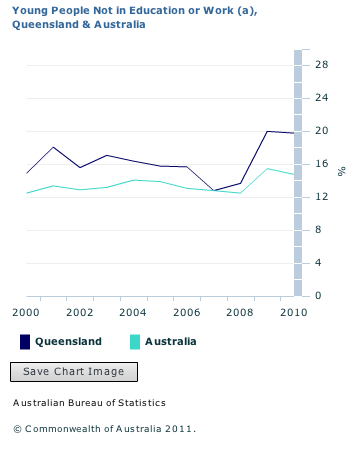
20% of Queensland youth not fully engaged (i.e. in full-time work or study)

The slowdown in Queensland’s economy since the financial crisis has disproportionately affected young people (aged 15-19), many of whom are obviously waiting for the good times to return rather than go to TAFE or university. The chart below is from the ABS’s very useful new web resource State and Territory Statistical Indicators.

Unfortunately the chart’s title is slightly misleading because the 20% figure will include a significant number of young people who are either working part-time or studying part-time. As the ABS notes on the website:

People who are not fully engaged in education or work fall into three main categories: those who are neither studying nor working; those who are studying part-time and not working; and those who are working part-time and not studying.

Posted in Education, Labour market, Macroeconomy | Leave a comment

Gold Coast and Cairns becoming FIFO hubs

Possibly in response to slowdowns in their local building industries, and a need for construction workers to look elsewhere for work, the Gold Coast and Cairns are emerging as hubs for fly-in, fly-out (FIFO) mine workers:

Terminal deal cut for fly-in, fly-out miners

Support for fly-in, fly-out families in Far North

Of course, this may also have something to do with the enviable lifestyles available in these centres and property prices in Brisbane and other capital cities that are increasingly unaffordable for many.


Posted in Cairns, Gold Coast, Mining | Leave a comment

Fitch’s negative outlook for Qld is bizarre

Fitch Ratings’s negative outlook for the Queensland economy would only make sense if the US really does have an economic armageddon following the possible (though unlikely) failure to lift the US Government’s debt ceiling and this depresses the global economy. In this case, Queensland shouldn’t be singled out for a negative outlook.  Fitch’s assessment is totally backward looking and is bizarrely ignoring the large amounts of evidence that there is a big investment boom on its way in the resources sector – for example:

Queensland investment boom on its way

Swan says relax about GDP fall, check out this pipeline

That said, there are grounds for some concern around some of our regions (e.g. Gold Coast, Cairns) that have been adversely impacted by the high Australian dollar, which may climb further in response to possible interest rate increases in response to today’s higher than expected inflation figure (Inflation rate jumps in June quarter). One courageous forecaster is suggesting the dollar could get to $US1.50 (More dollar dazzle to come). This is unlikely, but forecasts of this nature must make many tourism dependent businesses in our coastal regions very worried indeed.

Posted in Cairns, Gold Coast, Macroeconomy, Mining | 4 Comments

Milton Friedman was right, but that doesn’t excuse a lack of ethics

In a New York Times article in 1970, Milton Friedman – second only to Keynes in the ranking of 20th century economists  – declared that the social responsibility of business is to increase its profits (article reproduced here). This was an extremely controversial position, although it made sense from the perspective of economic logic, and it is much less disturbing when one appreciates that Friedman was distinguishing clearly between a business and the people within it, who do have responsibilities.

Business guru Seth Godin has just posted a brilliant piece echoing Friedman’s argument (No such thing as business ethics):

It comes down to this: only people can have ethics. Ethics, as in, doing the right thing for the community even though it might not benefit you or your company financially. Pointing to the numbers (or to the boss) is an easy refuge for someone who would like to duck the issue, but the fork in the road is really clear. You either do work you are proud of, or you work to make the maximum amount of money. (It would be nice if those overlapped every time, but they rarely do).

“I just work here” is the worst sort of ethical excuse. I’d rather work with a company filled with ethical people than try to find a company that’s ethical. In fact, companies we think of as ethical got that way because ethical people made it so.

I worry that we absolve ourselves of responsibility when we talk about business ethics and corporate social responsibility. Corporations are collections of people, and we ought to insist that those people (that would be us) do the right thing. Business is too powerful for us to leave our humanity at the door of the office. It’s not business, it’s personal.

Mr Godin is absolutely right. We can’t leave our ethics at the door when we go to work. A lack of personal ethics is clearly behind the UK phone hacking scandal and was a feature of a number of dubious transactions in the lead up to the 2008 financial crisis. Many of us need to re-learn what it means to act and live ethically. One of my favourite quotes about ethics and character – which is reproduced in Stephen Covey’s exceptional book “The 7 Habits of Highly Effective People” – is from David Starr Jordan:

There is no real excellence in all this world which can be separated from right living.

Posted in Uncategorized | Leave a comment

ABS Census history – Aboriginals originally not counted to deny Qld seats in parliament

In the lead up to the 2011 Census on Tuesday 9 August, the ABS has released a fascinating set of notes on the history of Australia’s Census (Reflecting a Nation). The notes reveal that a possible motivation for our founding fathers excluding Aboriginals from the Census was to limit Queensland’s political power:

The Constitution included a clause specifying that ‘aboriginal natives’ were not to be included in official population counts. This may have been partly because some states did not wish Queensland and Western Australia to gain seats in parliament on the strength of their larger Indigenous populations.

Originally Torres Strait Islanders were excluded, too, but as the article notes:

From 1947, Torres Strait Islander people were included in official Australian population totals from the Census, after lobbying by the Queensland State Government. They successfully argued that Torres Strait Islander peoples were not specifically listed for exclusion from population counts in the Constitution, which referred to ‘aboriginal natives’.

It was not until after the 1967 equal rights referendum, however, that all Aboriginal and Torres Strait Islander people were to be counted in the Census.

Posted in Uncategorized | Leave a comment

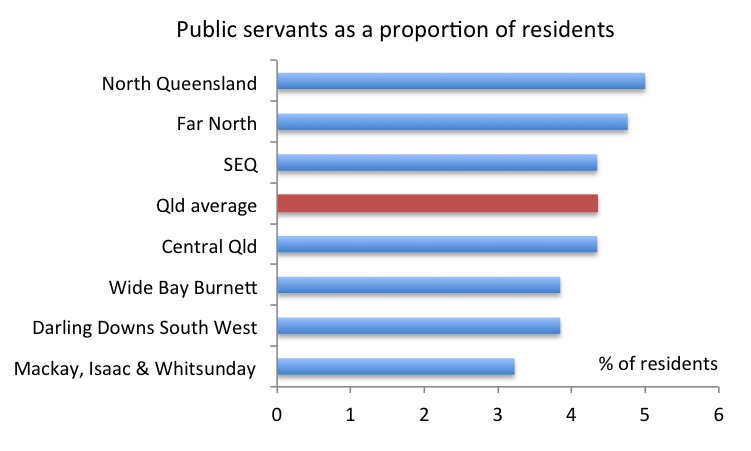
North Qld has the most public servants per capita

If Townsville truly does become the second (or vice) capital of Queensland, the disparity in public servants by region in the chart below (based on figures in the Qld Regionalisation Strategy) will increase:

Posted in Townsville | Leave a comment

QR should aim for value for money in train purchases and ignore pro-Maryborough lobbying

Train manufacturer Bombardier Transportation is a major contributor to Maryborough’s economy, employing around 300 people or 3% of Maryborough’s workforce. Hence there is a lot of interest in the outcome of a recent request for tenders to build 200 trains for Queensland Rail (QR), which is now being called on to consider the regional economic implications of its upcoming decision (WA contract should show Qld the way):

THE newly announced $160 million contract between Downer-Bombardier and the West Australian government should set an example for the State Government, Fraser Coast MPs say.

Queensland Rail is still deciding who will be awarded a $3.2 billion, 200-train contract, with two overseas consortiums pitted against Bombardier’s Australian operation.

“I’m calling on the State Government to act logically when it comes to awarding that tender,” Member for Maryborough Chris Foley said.

“Why, in this economy, would the State Government choose to send money overseas?” Mr Foley said.

Bombardier indicated it would proceed alone in the tender after Downer EDi pulled out of the running in March.

While it is not known when the tenders will be announced, Mr Foley said it was only logical for it to go to Bombardier, so Maryborough could benefit from the flow-on effects.

“Economically, logically and morally, it must go to Bombardier,” he said.

If Bombardier is competitive and offers value for money – which its recent success in WA suggests it is – then it has a good chance of wining the QR contract and may survive regardless. But, if it’s uncompetitive, and if it were awarded the QR contract partly because of the flow on effects to Maryborough, it will cost taxpayers signficantly, and the decision would send the wrong signal to Bombardier employees, who otherwise might re-train or investigate employment options in other areas.

Posted in Queensland Rail | Leave a comment