No sign of global economic turmoil in Gladstone

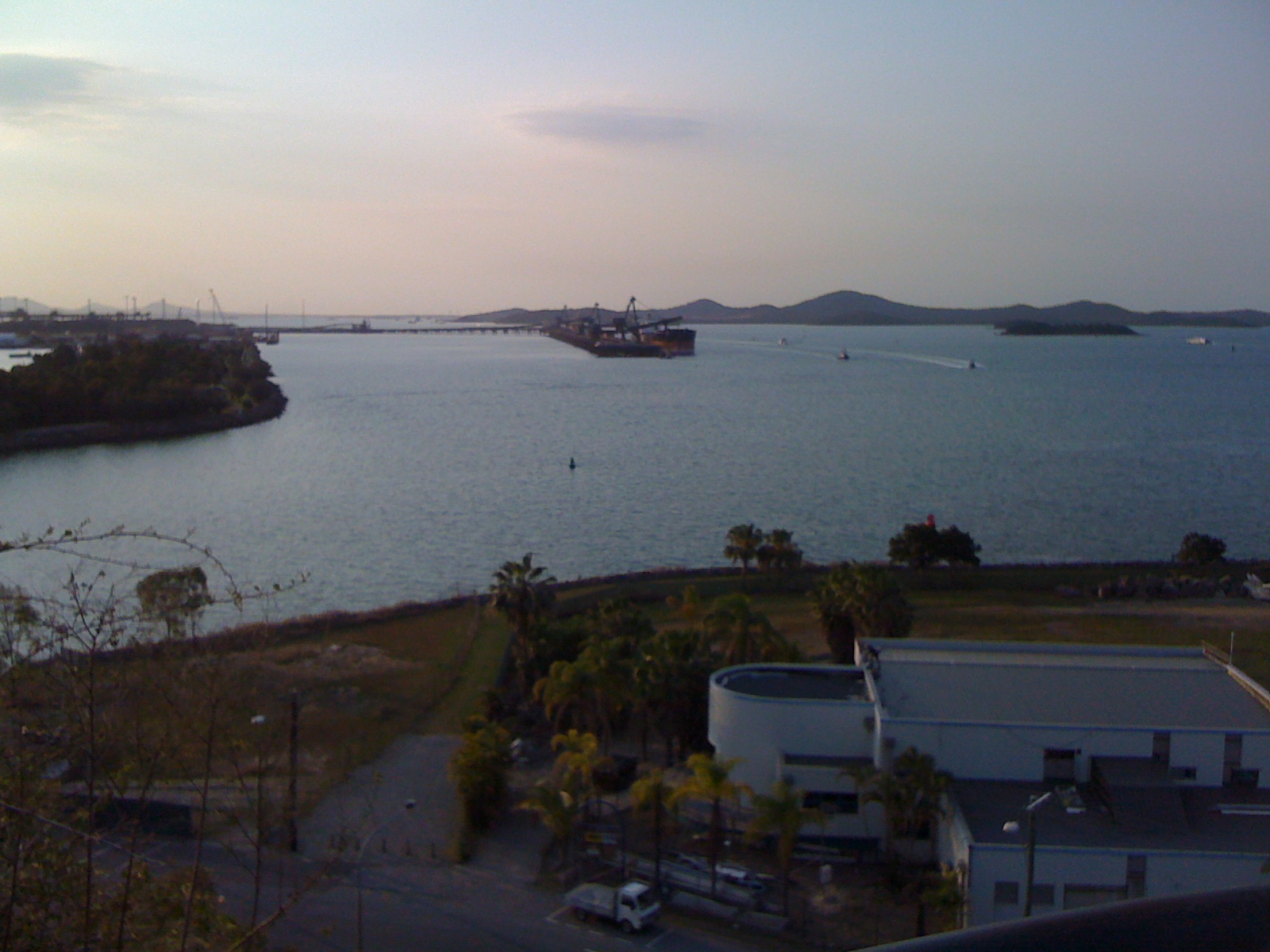
Visiting Gladstone today I was struck by the magnitude of the impacts of the resources boom on the city, including rows and rows of dongas lined up at the port ready for transport to Curtis Island and the unavailability of overnight accommodation due to all the hotel and motel rooms being booked out by the gas companies for their workers. I have no doubt the massive investment around CSG and LNG will protect Queensland’s economy from any new global economic turmoil. Curtis Island, in the background in the photo below, is where a lot of that investment is going:

Posted in Gladstone, Mining | Leave a comment

Why is Qld’s live music industry larger than Victoria’s?

Queensland’s live music industry is the second largest in Australia, as reported in the Brisbane Times today (Queensland’s music economy rocking):

Victoria may enjoy a reputation as a mecca for gigging musicians, but a new national industry report indicates live, venue-based musos might want to consider a move to Queensland.

The Australasian Performing Right Association’s report has valued the Australian live music industry at $1.2 billion, with a state-by-state breakdown suggesting Queensland was second only to New South Wales as the highest contributor in the financial year ending in 2010.

Authors Ernst and Young found Queensland was the second largest employer of the country’s estimated 14,866 full-time equivalent venue artists, followed by Victoria and Western Australia.

About 3514 FTE live musicians, earning an average salary of $43,409 a year, were booked by local venues, 97 per cent of which were hotels, bars and registered clubs.

I can think of two reasons why Queensland would come ahead of traditional second place getter Victoria, particularly that Queensland has:

  1. lots of pubs with beer gardens (e.g. RE, Normanby)
  2. a more dispersed and regional population that loves its country music (e.g. check out the Gympie Muster)

Any other reasons?

Posted in Arts | 2 Comments

Dr Doom’s depression remedy

NYU Professor Nouriel Roubini’s latest article in Slate (How to prevent a Depression) is worth a read. While I think the so-called Dr Doom is much too pessimistic about the global economy, he’s absolutely right about this:

…we must accept that austerity measures, necessary to avoid a fiscal train wreck, have recessionary effects on output. So, if countries in the Eurozone’s periphery such as Greece or Portugal are forced to undertake fiscal austerity, countries able to provide short-term stimulus should do so and postpone their own austerity efforts. These countries include the United States, the United Kingdom, Germany, the core of the Eurozone, and Japan.

Posted in Macroeconomy | Leave a comment

Treasurer’s “secret mine deal” shows real leadership

Treasurer Andrew Fraser has done the right thing in working around the Government’s proposed strategic cropping land (SCL) policy. As reported in today’s Rockhampton Morning Bulletin’s lead story, Treasurer’s secret mine deal:

QUEENSLAND Treasurer Andrew Fraser has struck a secret deal with a coal mining company to allow it to avoid proposed laws to protect the State’s best farm land.

The Morning Bulletin has obtained a letter revealing that Mr Fraser spoke on behalf of the State Government to negotiate a deal with Bandanna Energy over two mine proposals on the Central Highlands.

The deal would allow Bandanna Energy to go ahead with plans for a Central Queensland mine without being subject to the proposed strategic cropping land laws.

SCL is questionable policy given Queensland’s abundant agricultural land, with the real constraints on agriculture (it appears to me) being the availability of water and labour. For example, as reported in Queensland Country Life, there are not enough workers to fill ag void:

MANAGING Director of Global Agriculture Recruitment and Training firm Positive Perfection, Stuart Austin, says there’s an endless supply of agricultural jobs in Australia, not only for the horticultural industry, but not enough workers with suitable skills to fill the void.

Posted in Agriculture, Mining | Leave a comment

Move Labour Day, not Queen’s Birthday

I’m pleased to read the Government is reviewing Queensland’s productivity-sapping cluster of public holidays in the first half of the year:

Queen’s Birthday public holiday could be moved to later in year under controversial review of Qld public holiday system

It is the timing of Labour Day that is the problem, however, especially if there is a late Easter. The Easter-Anzac Day-Labour Day combination can then create an almost 10 day holiday, with minimal expenditure of annual leave, for those workers savvy enough to book leave early enough. So a number of organisations – it seems particularly prevalent among Government agencies – become difficult to deal with over this period, because so many people are away. Instead of moving the Queen’s Birthday holiday, we should move Labour Day to early October, so it lines up with Labour Day in NSW.

Posted in IR | 1 Comment

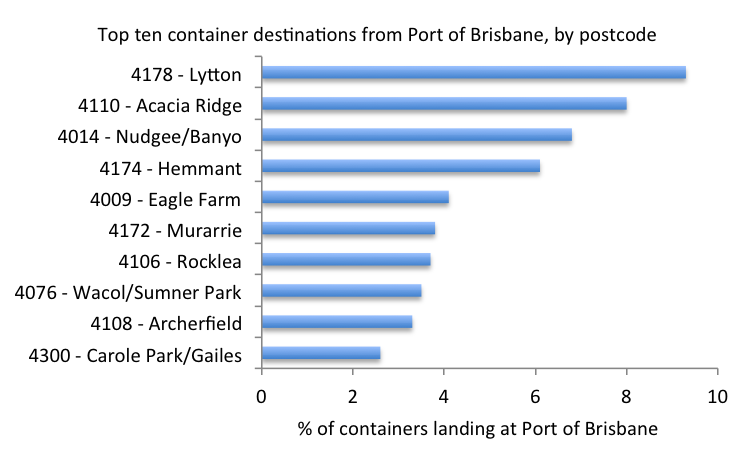
Where do containers landing at Port of Brisbane go?

The answer is in a great new data set from the ABS, Experimental Statistics on International Shipping Container Movements:

Posted in Brisbane, Transport | Leave a comment

ULDA is a financial risk for government

Previously I’ve asked “Does Queensland need an Urban Land Development Authority?” and it appears my concerns were well placed. Yesterday’s Townsville Bulletin reports Flood risk puts housing sales on hold:

A STATE Government housing project at Oonoonba has been taken off the market after it was revealed it is in the middle of a flood zone.

Lots in stage one of the State Government’s small-lot community, known as The Village, will now be built up between 200 to 400mm to protect against a one-in-100 year event flood.

The council’s recently released Ross River Flood Study appeared to show the project, which is overseen by the Urban Land Development Authority, would be badly affected by such a flood event.

The ULDA was able to blame advice from consultants regarding the risk of flooding, but I wonder if the ULDA is undertaking the same level of due diligence that private sector developers with their own money at stake would undertake?

Posted in Housing, Townsville | 2 Comments

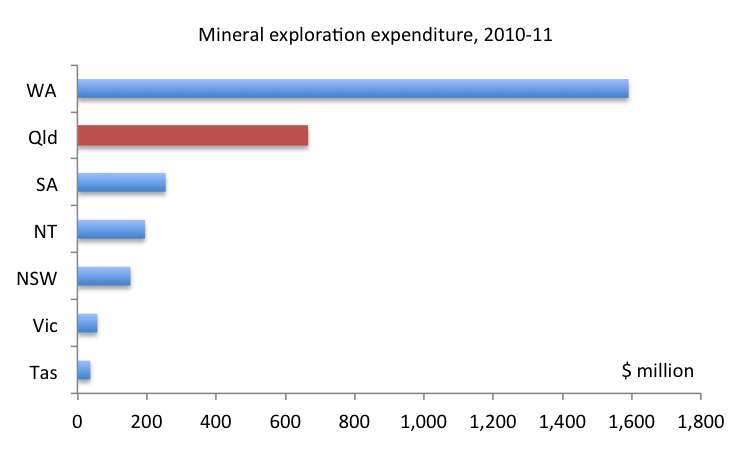
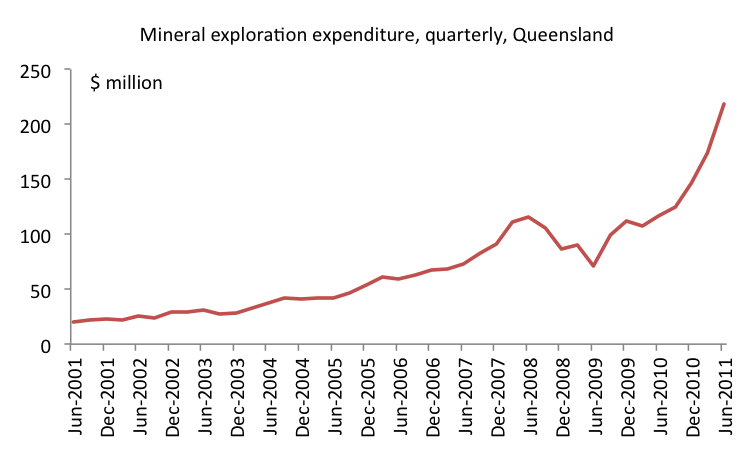
$660 million of mineral exploration expenditure in Qld in 2010-11

These charts are based on data from the latest ABS Mineral and Petroleum Exploration publication:

Posted in Mining | Leave a comment

Qld still set to boom

BIS Shrapnel has come to the same obvious conclusion as everyone else who has looked at the planned resources sector investment in Queensland (Growth years tipped for Queensland):

QUEENSLAND can look forward to booming growth in the next four or five years, according to economic forecaster BIS Shrapnel, with mining and infrastructure investment leading the way.

“You’ll wake up next year in a much stronger economy than the one you went to sleep in at Christmas,” the forecaster’s chief economist told an economic outlook briefing in Brisbane yesterday.

Frank Gelber said a post-global financial crisis hiatus in state government spending as its “drought-proofing” water grid program wound up and other major public works were completed had seen Queensland’s economy slide in the past two years, though the downturn had been cushioned by federal stimulus spending and projects such as Brisbane’s Airport Link toll road.

But growth in construction in the next two years would be higher than pre-GFC “when government spending boosted the economy following a decade in the 1990s when the state government did very little”, Dr Gelber said.

Posted in Macroeconomy, Mining | Leave a comment

Time to cut our losses on industry assistance

Michael Stutchbury has a great article in today’s Australian calling for some hard headed thinking on IR and government support for manufacturing (Old talk on tax and jobs). He notes:

The October 6 jobs forum announced by Julia Gillard and Swan on the weekend aims to head off Labor backbench and trade union demands for an inquiry into manufacturing after the mining boom’s strong dollar forced BlueScope Steel to mothball its export business.

The unions don’t mean a fair dinkum Productivity Commission inquiry into the costs of propping up uncompetitive industries or imposing new inflexibilities on how manufacturers can more productively employ their workforces in response to the strong dollar squeeze.

Instead, they mean the sort of inquiry Kevin Rudd got former Victorian premier Steve Bracks to do for the car industry in 2008. That predictably found reasons to extend heavy “transitional” government subsidies to Victoria’s car industry out to at least 2020, past the previous 2015 cut-off.

Coincidentally, I have an article coming out this week in Policy on car industry assistance. Unfortunately, the Centre for Independent Studies website currently links to the wrong article (I’ll find out what’s going on later today).

Posted in Industry policy, IR | 4 Comments