Resources sector investment driving State demand

The resources states of Queensland and WA were the heroes of the ABS National Accounts released on Wednesday, with very strong growth in State Final Demand recorded over 2011:
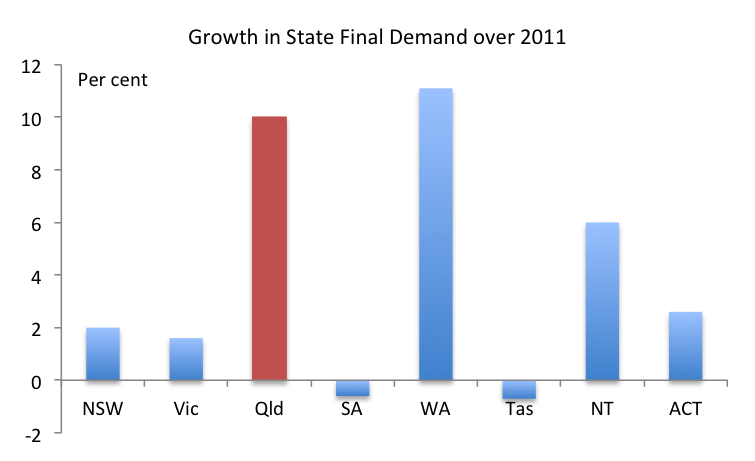
But nationally economic growth was lacklustre, and the two-speed economy continues, as noted in an interesting Sydney Morning Herald article by Malcolm Maiden that I missed on Thursday morning but which a reader alerted me to (hat tip to Toby). The article notes:

Two rivers indeed: if the four states hold their current growth rates, Queensland will overtake Victoria to take second place behind NSW in two years’ time, measured by final demand. It will get its nose in front of NSW in five years and in nine years, Queensland and WA will hold first and second spots. Their demand will exceed that of NSW and Victoria combined by about 40 per cent.

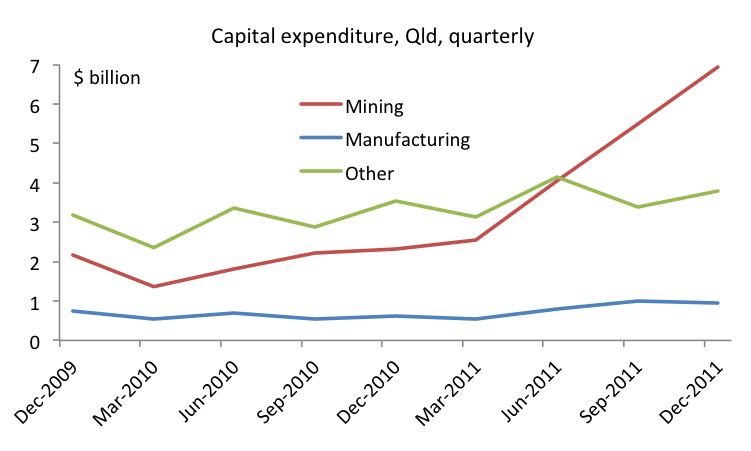
While an interesting thought experiment, this obviously won’t happen, because the huge growth in State Final Demand is related to the extraordinary surge in resources sector investment that Queensland has experienced. Private sector capital expenditure accounted for 89% of the increase in Queensland’s State Final Demand over 2011, and one component of this, new engineering construction (a lot of which will be resources sector-related), accounted for 62% of demand growth.

Now that new engineering investment has already more than doubled from $3.1 billion in December quarter 2010 to $7.2 billion in December quarter 2011, I doubt that we would be able to double it again. The current extraordinarily high level of investment is driven in part by the construction of the LNG plants at Gladstone, and the bulk of this investment will have to be completed by 2014-15, by which time all the plants will have started exporting LNG.
Posted in Infrastructure, Macroeconomy, Mining | Leave a comment

Government misses 100,000 jobs target

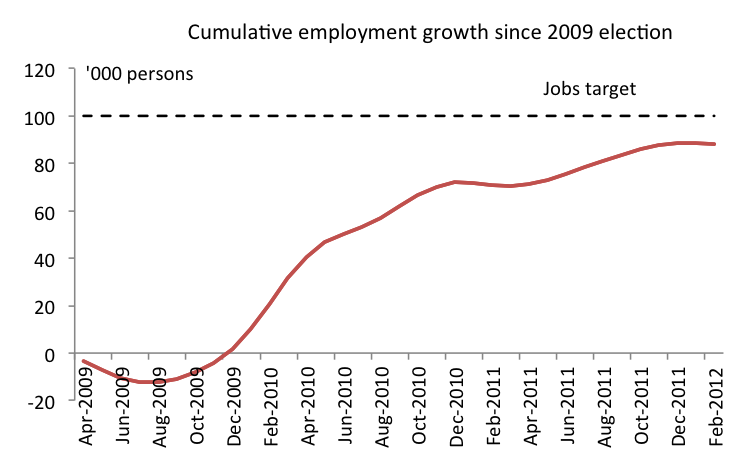
It’s undeniable the Queensland economy has been weak in recent years, and as a consequence the Government has been unable to hit its unambitious jobs target of 100,000 new jobs, which it announced during the 2009 election campaign:

I’m looking through the volatility in today’s ABS labour force data, which saw an increase in Queensland’s seasonally adjusted unemployment rate from 5.4% to 5.7%, and I remain very confident the Queensland economy will be strong in 2012 given the massive amounts of investment occurring in the resources sector.

Posted in Labour market | Leave a comment

Risk of dubious expenditures under Royalties for the Regions

I’ve found it odd that both the Government and Opposition have made election commitments to regional pork-barreling funds that have names based on Western Australia’s Royalties for Regions program. Today’s Australian reports:

ANNA Bligh has denied that her $300 million “Royalties for our Regions” scheme, unveiled yesterday, is a copycat of Campbell Newman’s $170m “Royalties for the Regions” program announced a day earlier.

Surely both the Government and Opposition were aware of the controversy around the WA Government’s scheme, as illustrated by this example (A $250,000 throne fit for Royalties in the Regions):

TAXPAYERS shelled out $250,000 for a talking-musical toilet under Royalties for Regions – while the West Australian Government has been trying to shave 3 per cent from state spending, including hospitals.

Whichever side gets into Government they will need to set up a sound process involving extensive local consultation, possibly through the Regional Development Australia Committees, to ensure worthwhile local projects are identified and funded. A major concern I have is that the funds will go to a lot of little projects of questionable economic merit, but of potentially significant political benefit.

Posted in Budget | 2 Comments

Huge surge in mining capital expenditure means healthy Qld economy

Yesterday’s new private sector capital expenditure data from the ABS shows the Queensland economy is in excellent health and will easily reach Queensland Treasury’s forecasts of economic growth of 4.25% and a 35% pick up in business investment in 2011-12. Indeed, business investment grew by 65% over calendar year 2011 (in nominal terms). The increase in mining-related capital expenditure is extraordinary:

David Uren has the national story in the Australian today (Mining crowds out economy with surge in investment):

THE gulf between the mining industry and the rest of the country is widening, with the resource sector planning an extraordinary surge in investment next year while all other business spending is at a standstill.

The crowding out is mainly impacting NSW and Victoria, although our tourism industry is of course suffering from the high dollar, and some parts of Queensland such as the Far North and Gold Coast remain sluggish.

Posted in Macroeconomy, Mining, Tourism | Leave a comment

Sovereign Wealth Fund not a priority

Former ANU economics professor and now Federal Labor MP Andrew Leigh spoke yesterday on the arguments for and against a Sovereign Wealth Fund for Australia (Wrong time for a Sovereign Wealth Fund). Andrew concluded:

…in the current economic environment it is hardly a high priority. If you are concerned about future generations, let us focus on the top priorities: a price on carbon pollution, shifting from the outdated mineral royalties scheme to a profits-based mining tax, and investing in skills. These are the sorts of long-term investments that future generations will thank us for. In my view, the notion of a sovereign wealth fund can go in the safety deposit box for now.

I agree it is not a priority. It is actually a bit silly we’re having this debate given the Commonwealth Government hasn’t run a budget surplus since 2007-08. While a modest surplus of $1.5 billion is expected next financial year, it will take a number of large surpluses over several financial years to pay down the forecast stock of debt at the end of 2011-12 ($253 billion) to the level necessary to keep the bond market liquid (possibly around $60-75 billion).

Posted in Budget | 1 Comment

Treasury will find diversity target hard to meet

Treasury Secretary Dr Martin Parkinson gave a speech in Canberra today setting out Treasury’s agenda to increase the diversity in its ranks, which is an admirable goal given line agencies joke they can tell Treasury officers by their dark suits and earnest looks. Dr Parkinson has set a goal of having 35 per cent female representation among Treasury Senior Executive Service (SES) officers by 2016. Currently 23 per cent of Treasury SES officers are women, compared with 37 per cent across the public service.

Treasury will find it hard to meet its aspiration, owing to its workaholic culture that makes it very difficult for women raising children to combine parental responsibilities with an SES position in the Department. In contemporary Australia, while some men make a large contribution to sharing parental responsibilities, it’s clear that many men get off relatively easily and traditional gender roles persist.

Unfortunately, the Treasury workaholic culture is a product of the Department’s responsibilities and I doubt it will change any time in the future. Given its role as the central coordinating agency for the Budget process, its broad policy responsibilities and the high profile of its Minister, the Treasurer, Treasury officers often have to work extremely long hours – to get the briefs and speeches delivered on time and fully correct so the Treasurer isn’t exposed. I recall one female SES officer worked 35 hours straight to prepare the FuelWatch bill for Parliament, and that this incredible effort reminded at least one or two Treasury officers (not me thankfully) of similar feats of endurance. Of course, this example shows an SES position can be combined with parental responsibilities, but it must be extremely difficult and may be unappealing to many.

Given the intense demands of the job it will always be difficult for people in Treasury who work part-time or have significant interests outside work to perform in an SES role. While I wish Dr Parkinson luck in achieving his aspiration, I have my doubts whether it will be achieved given that the key barrier to change, Treasury’s workaholic culture, is a product of the Department’s responsibilities and is probably immovable.

Posted in Labour market | Leave a comment

Resources sector jobs multiplier

Following my post last week on the Brisbane Economic Development Plan, an informed reader suggested that the source of the eyebrow-raising resources sector jobs multiplier of 19 may have been the Queensland Resources Council-sponsored study of the sector’s economic contribution that I blogged about last year (That sure is a mining boom).

It looks likely that the Resources Council-sponsored study, published in the March 2011 edition of Economic Analysis and Policy, is indeed the source as it identifies an “additional job multiplier” for Brisbane of 19.7 (see Table 7 reproduced below). You can’t calculate the multiplier of 19.7 from numbers in Table 7 as you need the estimate of people directly employed by the resources sector residing in Brisbane (6,940 people) from Table 5 earlier in the paper. Once you have this, you can work out the multiplier by taking the estimated total jobs in Brisbane due to the resources sector (direct and indirect) of 143,850, subtracting the number of people directly employed, that is 6,940, and then dividing by 6,940 to get how many jobs there are in Brisbane indirectly due to the resources sector for every job directly due to the sector.

While I now understand how the multiplier of 19 quoted in the Brisbane Economic Development Plan is calculated, I’m still skeptical about whether it makes any sense to calculate it on a regional rather than a Statewide basis. The almost 137,000 Brisbane-located jobs that are indirectly supported by the resources sector (according to the modelling presented in the paper) are related to resources sector activity across the whole State. Hence direct resources sector employment across the whole of Queensland would be the appropriate denominator, not the number of resources sector employees residing in Brisbane (i.e. only 6,940 people).

On a Statewide basis, the modelling in the paper finds there are an additional 6-7 jobs for every one job directly created by the resources sector in Queensland. But I still feel this is too high and the study may be over-estimating the sector’s indirect impacts. This is because it counts jobs indirectly created by jobs indirectly created by jobs directly created in the resources sector. For example, it may count a barista who has a job in a swanky Eagle St cafe serving consultants from Big 4 firms performing audit or due diligence work for mining companies. This is tracing the chain of causation one step further than many economists think is sensible.

Posted in Brisbane, Labour market, Mining | 2 Comments

Qld much more costly to run than other States

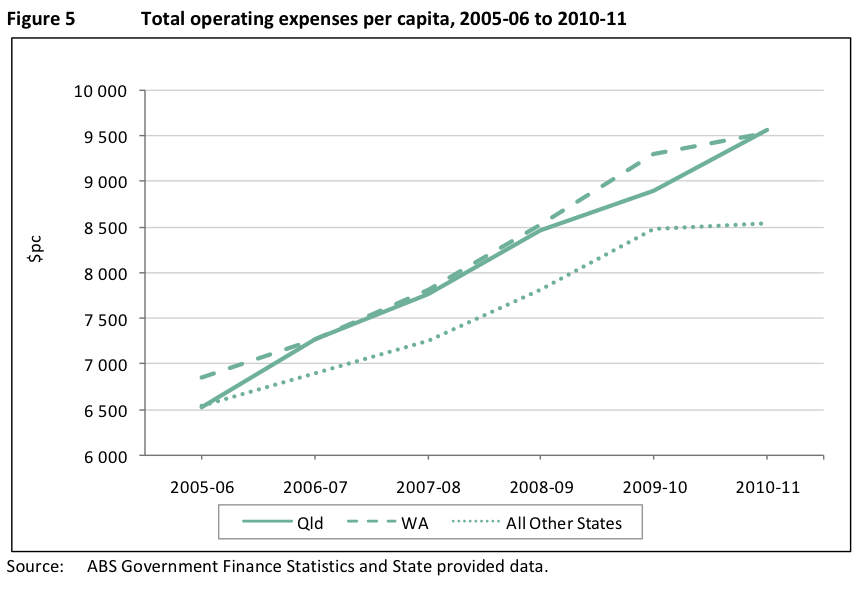
The Commonwealth Grants Commission announced yesterday that Queensland’s share of GST revenue will increase from around 19% in 2011-12 to 20% in 2012-13, largely reflecting increased costs due to natural disasters (see 2012 Update Report). In addition to its update report the Grants Commission released the State of the States report, which reveals the significantly higher ongoing cost of running vast, dispersed States such as Queensland and WA:

Figure 5 shows per capita expenses in the large, sparsely settled but fast growing States of Queensland and Western Australia have been approximately 7% above the average of the other six States since 2006-07…

…per capita expenses in [2010-11] increased by almost $670 (or 7.5%) in Queensland, due to well above average increases in spending on schools, hospitals, housing and welfare services, road maintenance and natural disaster relief.

Posted in Budget, Cyclones, Floods, Tax | Leave a comment

Qld Treasury expects recovery in interstate migration and building industry

Queenslanders can expect the State’s sluggish building industry and interstate migration to rebound this year, according to Queensland Treasury’s Office of Economic and Statistical Research (OESR). In its latest Queensland Economic Review, OESR notes:

…a number of factors should support the expected recovery in dwelling investment next financial year. These include the cuts to interest rates in late 2011 and the Queensland Government’s Building Boost Grant (which has been extended to 30 April 2012), as well as expected higher migration levels and stronger jobs growth next year.

Also of interest in the Economic Review is discussion of the resources sector investment boom:

The latest Deloitte Access Economics Investment Monitor data estimate the value of projects “under construction” in Queensland rose a further $20.9 billion in December quarter 2011, to $96.1 billion, the highest of any State. Queensland Curtis LNG project developers, the BG Group, recently announced they had spent US$4.3 billion on Australian LNG plant, pipelines and gas field development in 2011.

Not even a dysfunctional federal Government can stop this economic momentum.

Posted in Macroeconomy, Migration | 1 Comment

Public sector starts to show wage restraint

Given the budgetary challenges facing State Governments across Australia, it was good to see signs of public sector wage restraint in the latest ABS Labour Price Index data. This chart for Queensland shows private sector wages are now growing slightly faster than public sector wages:

Posted in Labour market | Leave a comment