Property industry confident Qld will out-perform other States

The latest Property Council of Australia-ANZ Property Industry Confidence Survey found the industry is confident Queensland’s economy will out-perform other States and the property market will improve over 2012 (ANZ analysis: Confidence survey):

As the latest PCA-ANZ survey results indicate, regions directly exposed to the investment boom will perform strongly, while other areas will be highly dependent on the associated demand for professional services. Queensland, Western Australian and the NT will be the clear out-performers while prospects for most other states remain relatively subdued…

…The PCA-ANZ survey continues to show an increasingly positive view of Queensland property, with the PCA-ANZ confidence index increasing to 127 (from 113 and 103 in the March quarter 2012 and December quarter 2011 respectively).

Other interesting material released today includes:

Malcolm Turnbull’s speech on a high exchange rate

Productivity Commission report on Australia’s productivity slump

Posted in Housing, Macroeconomy, Mining | Leave a comment

Government right to consider scrapping ULDA

I’m pleased to see the Government is following through with its election commitment to review the Urban Land Development Authority (ULDA), as reported in the Townsville Bulletin this morning (Development authority in Newman’s sights):

Mr Newman has committed to scrapping a range of government red tape and has indicated the ULDA will be reviewed.

“The Urban Land Development Authority … is an unaccountable, un-democratic organisation,” Mr Newman said on Sunday.

As Brisbane Lord Mayor, Mr Newman clashed with the authority on several developments.

Townsville developers and builders have long criticised the authority for competing with private developers, distorting the market and not being confined by restrictions including town planning laws and infrastructure charges.

My views on the ULDA are contained in these previous posts:

Newman Government to cut stamp duty and weaken ULDA

ULDA is a financial risk for Government

Does Queensland need an Urban Land Development Authority?

Posted in Housing | Leave a comment

UQ study confirms carbon tax will hit Qld the hardest

A new study from the University of Queensland’s Global Change Institute confirms previous modelling from the federal Treasury that Queensland will be hardest hit by the carbon tax and will experience the largest increase in electricity prices (Study sheds light on household impact of carbon price):

Tasmanians, with a relatively low carbon footprint, are set to gain significantly from the carbon price once tax and pension changes are factored in, while Queenslanders — heavily dependent on coal to generate electricity — will wear the biggest increase in power prices, according to economic models run on “supercomputers” at The University of Queensland.

Contrary to claims by many commentators that Federal Treasury has underestimated the impact of the carbon price on household budgets, the study’s estimate of an average 8.9 per cent increase for retail electricity prices in the five eastern states, due to the carbon price, is below the 10 per cent rise predicted by Treasury.

The Global Change Institute estimates that, at the starting carbon price of $23/tonne, electricity prices will increase 10.4% in Queensland, compared with the national average of 8.9%.

Brisbane Times coverage of the UQ study is here:

Carbon price to hit us hardest: study

Posted in Climate change | 1 Comment

Qld budget surplus timetable remains the same – how about something more ambitious?

Although the report that the Queensland Government is borrowing to meet recurrent expenses, including to meet public servants’ wages, was presented as something new and surprising, this has been set out clearly in recent budget papers, including the mid-year fiscal and economic review (see Table 11 on p. 29). In the language of the budget papers, Queensland is running a net operating deficit of around $2.9 billion in 2011-12 and is projected to run net operating deficits until 2013-14, with a small net operating surplus of $60 million in 2014-15. These figures relate of course to the previous Government’s fiscal strategy, but it surprised me that the Newman Government has not set a more ambitious timetable for a return to surplus. As the Courier-Mail reported yesterday, Treasurer Tim Nicholls noted:

“At the moment we’re looking at deficits up until about 2013/14 … we’re hopeful of being able to bring it back into a balanced or surplus position by 2014/15.”

So the new Government is expecting a return to surplus in the same financial year as the previous Government. Couldn’t the Government set itself a more ambitious target – say a return to surplus by 2013-14 or aim for a $1 billion surplus in 2014-15?

Posted in Budget | Leave a comment

COAG too slow in delivering reforms – national OHS system long overdue

It’s a pity we have to wait for politicians to become disgruntled before they tell us what they really think, but nonetheless it’s great to see former Defence Minister Joel Fitzgibbon speaking out about our dysfunctional federation, as reported by ABC News (Fitzgibbon renews call to abolish states):

Federal Labor MP Joel Fitzgibbon has renewed his calls for the abolition of state governments.

His comments come after the Prime Minister hailed this week’s Canberra negotiations with state and territory leaders a success…

…He has told Radio National he maintains his view that the blame game between different levels of government is damaging.

“We don’t need three tiers of government, I mean what is unique about our country is we have something like 15 chambers of legislature and God knows how many politicians to run a country with 22 million people in it,” he said.

“It’s just crazy and it’s inefficient.”

I couldn’t agree more. COAG is no substitute for a national Government that has responsibility and authority on all national policy issues.

A telling example of the glacial pace at which COAG works is national occupational health and safety (OHS) reform. It’s been obvious for over a decade that we’ve needed national consistency in OHS regulations and it’s one of the main demands of business lobby groups. The Productivity Commission undertook a major study of National Workers’ Compensation and OHS Frameworks in 2004 but we’re still waiting for full national consistency, because Victoria and WA have major concerns about the proposed framework – even though Governments have had around eight years since the time of the Productivity Commission’s report to get it right. The report card to COAG glosses over the major concerns Victoria and WA have – they view the proposed national regime as a lowest common denominator approach – and instead notes in typical bureaucratic language that the two States have “sought to extend the implementation milestone for this reform by 12 months”.

Posted in Labour market | Leave a comment

Increased train frequency unviable

With an already heavily subsidised public transport system, as reported on by the Courier-Mail this morning (Taxpayers in front line of fight to cut fares hike), it is clear Queensland cannot afford to either defer fare increases or to increase the frequency of train services. Unfortunately, in addition to its commitment to reduce fare increases, the Government made an election commitment to increase the frequency of services on the Ferny Grove line, and this has raised expectations regarding the frequency of services on the Ipswich line (Long wait for new rail services).

Creating a viable public transport system is a wicked policy problem, because we can’t turn around the pattern of urban development/sprawl that means it is costly to run public transport over such large areas.

There are no simple policy recommendations (certainly cuts to off-peak services would be inequitable and politically toxic), and a comprehensive review is required that looks at the whole transport system holistically. This would consider the wide range of benefits provided by public transport, including the avoided costs of road congestion, avoided/deferred road infrastructure spending, reduced greenhouse gas emissions and health benefits from people walking to train stations or bus stops.

While the heavily subsidised Gold Coast and Sunshine Coast rail services definitely require review, we would need to consider the costly increase in congestion on the M1 and Bruce Highway, as well as arterial roads in Brisbane, that would occur if fares were increased substantially or services cut back.

One policy the Government ought to consider is to stagger the starting and finishing times of public servants to reduce the pressure on peak hour services as there is plenty of public transport capacity in off-peak times. This would complement the existing policy push for greater decentralisation of public services.

Posted in Transport | 2 Comments

Temporary setback for Qld resources sector

Reports today (Mine shutdown a ‘kick in the guts’) about the closure of BMA’s Norwich Park coal mine in Dysart, Central Queensland clearly refute recent claims the mining sector is undergoing an out-of-control expansion. As reported on ABC News (Coal mine closure ‘presents $1b export threat’):

The BMA says the widespread belief in an Australian mining industry boom is misplaced.

BMA asset president Stephen Dumble says the company’s other mines remain profitable.

“Norwich Park, unfortunately for a range of circumstances, was the most exposed to some of those commercial pressures and in that sense is somewhat of an isolated case,” he said.

This comes at a bad time for the new Queensland Government, which will have to reduce its forecast coal royalties, but I expect the closure will have only a temporary, limited impact on the economy, given the large pipeline of resources sector projects that are planned or under construction.

Other recent news reports show the potential for even further growth in the Queensland resources sector:

Miner anticipates change in uranium policy

Far North’s mining industry hits $1 billion

Posted in Budget, Mining, North Queensland | 1 Comment

Laptops for school students may not be cost effective

A report today confirms the Federal Government’s laptops in schools program is a large burden on schools across Australia, which are struggling to find technical staff to maintain the laptops (Shortfall of information and communications technology technicians hits schools). As alluded to by Queensland’s Director-General of Education and Training, Julie Grantham, this is partly related to the resources boom which is creating skills shortages in regional areas.

This report and an article in the latest Economist (Error message) raise questions about the cost effectiveness of  laptops for students programs and whether money would have been better spent on other education initiatives. The Economist observes:

GIVING a child a computer does not seem to turn him or her into a future Bill Gates—indeed it does not accomplish anything in particular. That is the conclusion from Peru, site of the largest single programme involving One Laptop per Child, an American charity with backers from the computer industry and which is active in more than 30 developing countries around the world…

…An evaluation of the laptop programme by the Inter-American Development Bank (IDB) found that the children receiving the computers did not show any improvement in maths or reading. Nor did it find evidence that access to a laptop increased motivation, or time devoted to homework or reading.

In my view, given the strong evidence that exists regarding the impact of teacher quality on educational outcomes (see my previous post on performance pay), governments would be better off directing their scarce resources at improving the quality of teaching, perhaps through implementing a performance pay system. Indeed, by improving teacher quality, governments may improve the likelihood of success of future 1:1 laptops for students programs, as noted in a recent US literature review (Educational Outcomes and Research from 1:1 Computing Settings):

Across the four empirical studies, it is evident that teachers play an essential role in the effective implementation of 1:1 initiatives and that the onus of responsibility for implementation often falls to the teacher. For example, Bebell and Kay (2010) concluded that it is “impossible to overstate the power of individual teachers in the success or failure of 1:1 computing” (p. 47) and that “teachers nearly always control how and when students access and use technology during the school day” (p. 47).

Posted in Education, Labour market | Leave a comment

Qld Literary Awards going ahead anyway, meaning Govt’s decision is justified

With predictions that Queensland would become a cultural wasteland following the Government’s decision to cut funding for the Queensland Literary Awards, I’m relieved that organisers are confident they will go ahead regardless, as reported by the ABC yesterday (Qld Literary awards to go ahead, organisers say).

This actually justifies the Government’s decision to cut funding, because it is a basic principle of public policy that Government funding should encourage additional activity or behavioural change that wouldn’t otherwise have occurred. Recently economists have adopted the clumsy, ugly word “additionality” to describe this principle.

One of the organisers of the awards basically admits Government funding is unnecessary, so full credit to her for her honesty:

Ms Kneen says the publicity the September event attracts is more valuable than prize money.

“[Authors] do normally rely on prizes to kind just to give them that money to continue writing, but on the other hand they didn’t do it for the money in the first place,” she said.

“The recognition is the most important thing, and I know that writers getting awards – it just makes sure that people are aware of their work and the quality of their work.”

The scrapping of the Queensland Literary Awards has proven itself to be a valuable public policy experiment. Governments should identify a number of other prizes and grants to run similar experiments on – cutting funding and waiting to see if corporates or NGOs meet the shortfall.

Posted in Arts | Tagged | 3 Comments

How exposed is Qld to a downturn in southern States?

After reading Alan Kohler’s brilliant column at the Drum yesterday (Business panic at Government calm) I started thinking about how exposed the Queensland economy is to a downturn in the southern States. Typically Australian States go into recession together, but the two-speed economy raises the prospect of a recession in NSW and Victoria and reasonable economic growth in Queensland, with the southern downturn detracting from Queensland growth to an extent. This divergence between States has happened before, as noted in a 2006 Australian Conference of Economists paper, Business Cycles in Australia, by my old Treasury colleagues Rob Ewing and John Hawkins:

…in some recessions there are states that are almost completely unaffected, Queensland and Western Australia are a good example of this in the mid 1970s recession.

The major way that Queensland is exposed to the economies of the southern States is through our exports of goods and services to them, which accounts for around 9% of our gross state product (GSP), or around $6 billion per quarter (see Qld State Accounts, Table 1, p. 17). We are a net importer of goods and services from other States, however, so, in relative terms, we are not as reliant on their demand as they are on our demand (see interstate trade data chart I’ve copied  from the ABS website below, noting this includes goods only and not services).
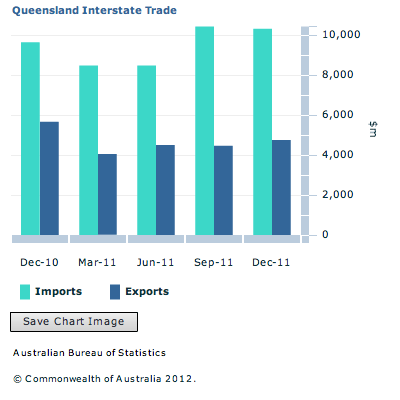
Nonetheless, with interstate exports accounting for around 9% of our GSP, a recession in the southern States could easily take 1-2 percentage points off economic growth in Queensland if it results in a drop in our interstate exports of 10-20%. This order of magnitude of a drop in interstate exports is possible, and indeed Queensland interstate exports dropped 10% in 2008-09 (see the 2009-10 Annual Economic Report, p. 12). So a downturn in southern States would certainly have an impact on the Queensland economy, potentially subtracting 1-2 percentage points off our forecast growth of 5% in 2012-13 (see the mid-year Budget update), but Queensland should still having a growing economy, thanks largely to the massive amount of resources sector investment that is occurring.

Posted in Macroeconomy, Mining | 2 Comments