Corporate welfare stabilises as Commonwealth responds to budgetary pressures

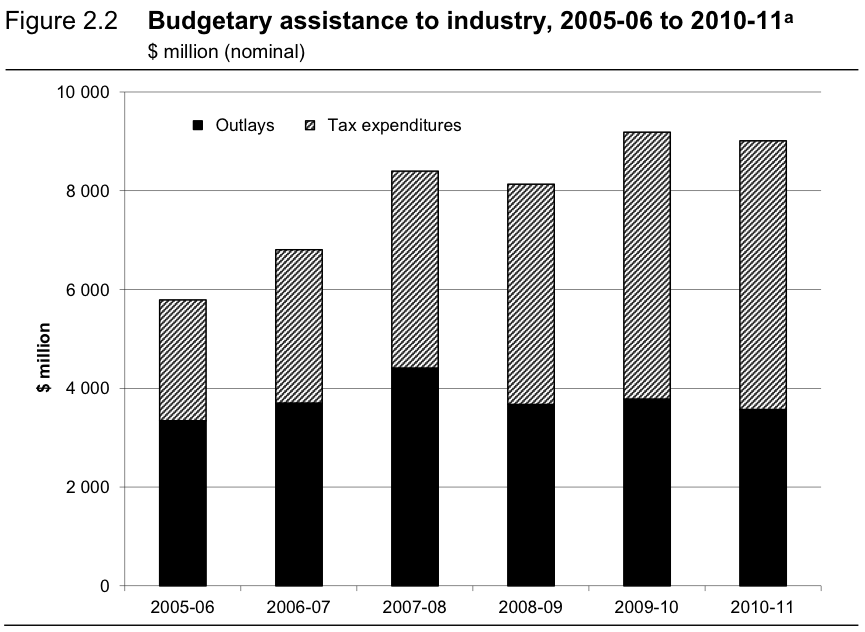
I was pleased to see in the Productivity Commission’s latest Trade and Assistance Review, released today, that industry assistance from the Commonwealth slightly fell in 2010-11, and no doubt this is a reflection of policy decisions taken in response to budgetary tightness, but full credit nonetheless. These policy decisions include less generous car industry assistance than over 2005-2010 (although more generous than if the previous Government’s car plan had been maintained). There is still more work to be done as assistance from the budget remains ridiculously high at around $9 billion, according to this chart from the Review:

Previous posts of mine on industry assistance include:

Recommended reading on the car industry

Time to cut our losses on industry assistance

Posted in Budget, Industry policy | Leave a comment

Rate cut looks very likely as markets panic

After spending a good part of late 2008 worrying about an economic crisis that didn’t occur, at least not in Australia, I find it hard to worry too much about the latest international news that is panicking markets across the world. China appears to be slowing down, but a stimulus package is likely (see Businessweek on Understanding the China slowdown). And the weaker than expected US jobs report everyone is worrying about merely tells us that the US recovery will take a bit longer than expected, not that the US is heading back into recession.

I expect the recent international data will spook the RBA Board tomorrow and a rate cut is very likely. In the Minutes of the April meeting the Board clearly signalled there was scope to cut rates even further, and the renewed anxiety in markets will give them justification to cut rates sooner rather than later, although probably only by 25 basis points – as another 50 basis points cut runs the risk of creating the perception that the RBA Board is panicking.

Hence I think former RBA official Paul Bloxham, now at HSBC, has called it right. As noted on ABC news (Economists divided on Reserve’s next move):

HSBC Australia’s chief economist Paul Bloxham changed his rate forecast this morning and said he is only expecting a 25 basis point move by the RBA tomorrow.

“Overall we still think the Australian economy looks as though it is in fairly good shape,” Mr Bloxham.

“The unemployment rate is low, we expect some solid GDP numbers this week.

“But clearly the risks of a more substantial global downturn have increased given the loss of momentum in some of the global indicators over the weekend.”

So we have reason to remain hopeful, but the RBA had better cut rates again just in case.

Posted in Macroeconomy | Leave a comment

CBA sees risks to Qld resources sector

My former Treasury colleague Lachlan Shaw, Commodity Analyst at the Commonwealth Bank, has made some interesting comments regarding the outlook for the Queensland resources sector, as reported in the Toowoomba Chronicle yesterday:

“Queensland is, on a range of estimates, one of the most expensive if not the most expensive jurisdiction in which to build a new coal mine, rail and port capacity in the world,” Mr Shaw told APN…

…This is made worse by thermal and metal-making coal prices sliding downhill with thermal – or heating coal – now falling below $100 a tonne.

They are prices not seen since the second half of 2010.

Metal-making coal prices reached beyond $300 per tonne after the 2011 Queensland floods when less coal could make it to export but has been steadily falling.

As Queensland returns to form, Mongolia, Mozambique and China have muscled in and brought prices down.

Mr Shaw said it was bad news for not just the mine companies but the state and federal governments.

“Lower coal prices mean lower export receipts, income growth, miner profits and state government royalties although the lower Australian dollar provides a substantial offsetting when US dollars are converted into Australian currency,” he said.

“Lower coal prices also call into question the viability of future coal projects.”

The high cost of mining coal in Queensland is likely due to both high labour costs and the protracted time taken to obtain the necessary environmental approvals. High labour costs are largely unavoidable, but, on the issue of approvals, it appears the new Government is favourably disposed towards new developments, and indeed environmental groups are already agitated, as reported in the Business Spectator on Friday:

Concerns Qld Government gave Alpha mine leg up

As to whether Queensland’s resources sector is under threat from mining in countries such as Mongolia and Mozambique, the great advantage Queensland has is the stability of its rules and regulations and the low risk of the arbitrary expropriation of gains by ruling elites. In their great new book, Why Nations Fail, Daron Acemoglu and James Robinson argue one of the main explanations for differences in economic performance between rich and poor countries is that poor countries often have ruling elites that extract all they can from the economy with little regard for the rule of law, obviously discouraging investment and effort.

So while I agree with Lachlan that there are definitely risks to the Queensland resources sector, I think its long-term future is secure, largely owing to our stable political and legal environment, at least compared with many other resource-rich regions.

Posted in Mining, Queensland Government | 1 Comment

Still waiting for a recovery in building approvals

Today’s new building approvals data from the ABS were disappointing, as the recovery in building approvals I thought was occurring a few months ago has not eventuated, and building approvals remain flat at a relatively low level:

It appears OESR were also expecting the turnaround to continue, and I wonder if they’d now revise the following forecast contained in the latest Queensland Economic Review, which was also released today:

A slight turnaround in overall dwelling approvals in Queensland in recent months suggests dwelling investment should recover somewhat in 2012–13…

I’d stick to that forecast, given the underlying strength of the Queensland economy, bolstered as it is by massive resources sector investment. In my view, it remains likely that building approvals and dwelling investment will experience a recovery later this year.

Posted in Housing, Macroeconomy | Leave a comment

To get cheaper electricity, charge a lot more during peak periods

While the Newman Government’s review into electricity prices announced yesterday is welcome, I suspect any savings it will identify through reduced duplication will be minor compared with the savings that are possible through discouraging electricity use during peak times through time-of-use pricing. I’m sure the review team, which includes top regulatory economist Matt Rennie, is aware of this, but I’m unsure if the Minister has been advised of this and knows what the Government has got itself in for. The Courier-Mail reports (Three-man Newman Government razor gang tasked with slashing power costs for Queenslanders):

Energy Minister Mark McArdle said the panel was the next stage of the Government’s plan to cut power bills, after freezing the standard domestic tariff. Its job would be to “drill down into the price drivers of electricity and identify long-term sustainable reforms to deliver ongoing savings”.

“Everything from executive numbers down to numbers of wires and power poles will be looked at to improve delivery and tackle rising consumer costs,” Mr McArdle said.

“Corporate structures, staffing, everything that drives prices will come under the microscope of the independent watchdog.”

But the big driver of rising electricity prices is the peak demand that occurs between 5-7pm when Queenslanders come home from work, switch on the plasma TV, cook dinner and turn on the air-conditioner on hot summer days. Meeting rising peak demand means the energy distributors Energex and Ergon need to invest a lot in maintaining and upgrading the electricity network and these costs are passed on to consumers.

Hence any long-term plan to limit electricity price rises needs to consider time-of-use pricing in a serious way (i.e. charging a lot more for electricity use around 6pm), so people are encouraged to use less power during peak periods and to shift their usage to non-peak periods. Unfortunately, Queensland’s limited trial of time-of-use pricing (scheduled to begin this year) received a setback with the Government’s electricity tariff freeze earlier in the year, as reported in the Courier-Mail in April (Power price cap cuts off new-age meters).

I hope the review team comes back with some strong recommendations relating to time-of-use pricing that encourage the Government to adopt this important (though potentially politically challenging) reform.

Posted in Energy | Leave a comment

Qld & WA the winners in the two-speed economy

Adam Creighton and David Uren have a nice summary of the latest data on the two-speed economy in the Australian this morning (Retail in reverse as resources power on):

THE divide between the over-heated, resource-rich sectors of the economy and those stuck in the slow lane has been laid bare by the latest reports on construction and retail sales.

Engineering construction is growing by unheard-of rates of almost 50 per cent a year in Western Australia and 20.7 per cent in Queensland as resource companies assemble their multi-billion-dollar projects.

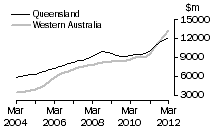
The impact of big resources projects on total construction work done is seen in these ABS charts from yesterday’s Construction Work Done publication, which show a boom in Queensland and WA and sluggishness in NSW and Victoria:

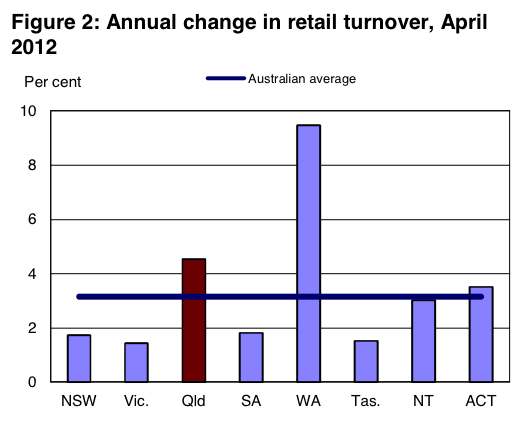
And the ever reliable OESR has some good charts on the diverging trends in retail trade between the resources-rich States and the others in its latest information brief published yesterday, including this one:

Posted in Macroeconomy, Mining, Retail trade | 1 Comment

Parliamentary precinct revival is a great idea

It is unnecessary for the Queensland Government to be a major owner of CBD property, as it can lease space as necessary, and it is possible that the Government has located public servants in CBD offices who may be more cost-effectively located in other areas. Hence I’m very pleased to read about the Government’s new master plan for the CBD in the Courier-Mail today (Newman’s plan for Brisbane CBD):

The first phase of the CBD masterplan could see one, and possibly two, major office towers built on Crown land in William St by private enterprise and leased back by the state.

Several rundown state buildings in George St and William St would be sold or demolished – including the Executive Building, the premier’s headquarters.

There would be a new pedestrian plaza in front of Parliament House on Alice St and a riverside boardwalk with leisure and entertainment facilities, plus a cultural hub built under and over the Southeast Freeway.

By selling CBD properties to the private sector, the Government will get much needed cash that it can use to pay off debt. I expect it will get a special deal from private sector developers on a rent-free period for the new office buildings that will push back the eventual budgetary cost of renting the office space.

My only concern regarding the plan is the potentially very costly riverside boardwalk, which is likely to be under-utilised. Being right next to the freeway, it would be in an unattractive location. And it will be a direct competitor to Southbank, which is now a well-established destination for families. The boardwalk will be smaller than Southbank and I doubt it will attract many people on the weekends.

Posted in Brisbane | Leave a comment

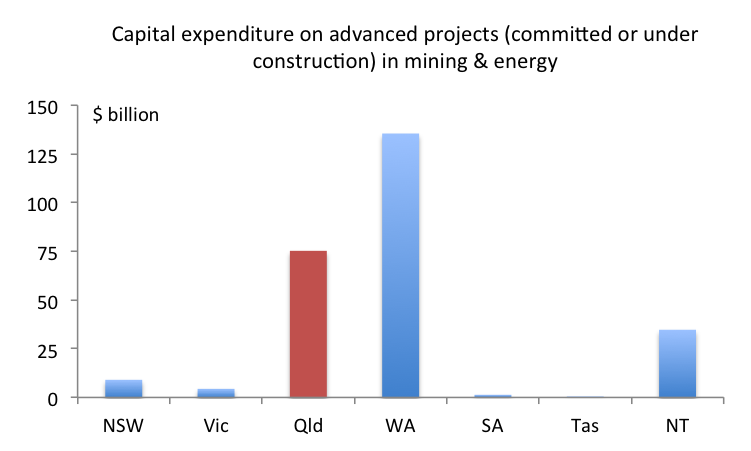
$75 billion of mining & energy projects in Qld at advanced stages of development

The Treasurer’s Economic Note yesterday alerted me to the Bureau of Resources and Energy Economics’ latest issue of Mining Industry Major Projects, released last Thursday.  The large investment in the development of LNG plants is noticeable in the billions of dollars of advanced projects, committed or under construction, in WA, Queensland and the NT:

Posted in Mining | Leave a comment

Bad news for renters, but drop in vacancy rates is good news for building industry

A friend of mine recently complained about how hard it is to find a suitable flat at the moment in inner city Brisbane, and data on residential vacancies released today by OESR back up this complaint. In inner Brisbane, the vacancy rate is now 1.9% compared with 2.6% one year ago, and vacancy rates have fallen in other regions, too:

This means that new demand is clearing the over-supply of housing that developed out of the pre-GFC building boom, particularly on the Gold Coast. OESR observes:

The vacancy rate for Queensland at 2.9% is the lowest since December 2008 quarter (2.8%).

This should please contractors and workers in the building industry who have experienced lean times in recent years.

Posted in Gold Coast, Housing, Macroeconomy | Leave a comment

AOFM looks on the bright side of a large debt – “deep liquidity”

Some clever chap at the Australian Office of Financial Management (AOFM) probably had a secret chuckle when the following advertising campaign was approved, which I noticed today but which may have been around for a while:

By deep liquidity, the AOFM means there are a lot of bonds on issue (i.e. the Australian Government owes a lot of money, around $230 billion) across a range of maturities from a few months for Treasury notes to 15 years for some Treasury bonds. While I admit this deep liquidity is attractive to investors, because they know there is an active market for the bonds, I still find it amusing the AOFM is using our large debt as a selling point. Very clever.

Posted in Budget | 1 Comment