Speech to UQ Economics School Scholarships and Awards night

I was honoured to address the University of Queensland School of Economics’s Scholarships and Awards Night tonight. Below are my prepared remarks. I varied them slightly in the delivery, and cut a couple of paragraphs, but this is more or less what I said.

I feel honoured to deliver this speech tonight for two reasons. First, because of my long-standing relationship with the School of Economics, and second because I’m speaking at a ceremony in which an award was given in memory of my late friend and colleague Dr Tony Hand, who I’d met while we were both research students in the School in the late-nineties.

My relationship with the School began in 1993, when I enrolled in an Economics and Law double degree. While at uni, I ended up enjoying economics so much that I eventually did an honours year in economics and gave up on the legal career I’d once aspired to.

Some of the audience members may remember economics was very prominent in the public debate in the early and mid-nineties. The 1993 election was a referendum on Fightback! and the GST, and Australia was struggling to recover from the deep recession of 1991. These issues certainly made me more passionate about economics, and I expect some of today’s economic issues, particularly the legacy of the 2008 financial crisis, will inspire a number of people here today.

This is my first major message to give you here tonight: do something you’re passionate about, something that makes you think and enthusiastic to get out of bed in the morning.

While I valued the law subjects I’d taken, I just could never get passionate about it. Whatever your chosen career – economics, finance, business, law – make sure you’re passionate about it, because it will help motivate you and help you push on through tough times. My passion for economics certainly helped me get a first class honours degree and a University Medal, which have always stood out on my CV and have no doubt benefited me in various ways over the years.

I won’t give you too many more messages tonight, because there are so many books and lectures out there already on the principles of success – a recent brilliant lecture by Tim Minchin at UWA comes to mind and can be viewed on Youtube.

I could tell you to work hard, be resilient and keep trying, but you’ll either know that already, or you’ll learn it soon enough when you get into the workforce – when you discover that many of the challenges you face aren’t as neatly packaged up as exam or term paper questions.

So I’ll only give you two more messages, which I’ll illustrate with examples from my career to date.

My second message is: find good people to work for and work with. Nothing will drive your career further than seeing what successful people do and learning from them. Find good role models, and do what they do.

To illustrate, one of the best moves I ever made was to a newly created research unit in the then Queensland Department of Employment, Training and IR, a unit which was led at the time by Professor John Mangan.  This was in 2000, after I’d spent a few years trying, unsuccessfully alas, to complete a PhD.

The research unit position was a good one, because it was involved in important policy debates within the Government on employment and IR policies. Some of you may recall Premier Beattie had promised to get Queensland’s unemployment rate down to 5%, and there were still around 2½ percentage points to go when I joined the Department.

The research unit was a stimulating intellectual environment – thanks in large part to John’s efforts and guidance, and also because we were located on the same floor of the Neville Bonner building as the most senior executives of the Department. Fortunately, for us, although I appreciated it less at the time due to the tricky questions we got, the Deputy Director General Peter Henneken took a personal interest in the unit’s work.

Working for someone like Peter extended me greatly, and I learned a lot about how a professional should behave and work. Peter remains one of the best public servants I’d ever known – dedicated to the job, hard working and trying to achieve things. His dedication meant that he sought the best information and analysis he could get to advise the Minister, which is why he valued the role of a research unit.

So I consider myself very lucky to have started my post-University career in such a stimulating environment, working with many good people, including many others in addition to the two I’ve singled out.

What this means for you is that, when you’re weighing up which jobs to apply for, think about where you’ll find the best people. For economists, I think that’s likely to be in places like Treasury Departments, the RBA, QCA and some professional services firms (although you need to choose the right one).

After the Queensland public service, the next major development in my career came with a move to the Federal Treasury in Canberra in 2005. I’d attended a networking breakfast in mid-2004 at which then Treasury Secretary Ken Henry spoke about the fiscal challenges arising from the ageing population. It was a fantastic speech, and I knew then I’d found another good person I wanted to work for. So I applied for a job at Treasury, told them how inspired I was by Ken’s speech, and managed to snare a mid-level job in Treasury’s Macroeconomic Group.

Macro Group was led by another person who has been influential in my career, the current Treasury Secretary Dr Martin Parkinson. The most important piece of advice I got from Martin was something he told us at a Macro Group Strategy Day, a piece of advice you might not expect from a senior bureaucrat. It’s stuck with me to this day, and is my final message. Be courageous and take risks. Sensible risks of course; just don’t let fear stop you from giving things a go. Don’t wait for things to happen. Make them happen.

My late friend and colleague Dr Tony Hand implicitly understood this piece of wisdom. Tony was the exemplar of courage. He had a great intellect and, as a number of you in this room will recall, fiercely prosecuted his views, and he was unafraid to take on big challenges.

I eventually returned to Brisbane from Canberra in mid-2009 to work with Tony at Marsden Jacob, where he was a Director, because I knew I could learn a lot from him. Natural resource economics was always a favourite topic of mine, and Tony was one of the leading economists in Australia in the field.

Tony had then recently completed a cost-benefit analysis of Traveston Dam and was in high demand as a consultant around Australia. He was another inspirational figure in my career, but sadly we lost him in tragic circumstances in June 2010.

Now, every year, with the presentation of the Marsden Jacob Prize in Memory of Dr Tony Hand, for the best Natural Resource Economics student, we honour him. To those who knew and loved Tony it is a fitting honour. I owe him a huge debt for his friendship and his role in shaping my career.

It was Tony who encouraged me to be courageous and abandon a comfortable Treasury job, with a well-laid out career path, for the less comfortable and more uncertain world of consulting. But I’m glad I rejected the fear now, because the job has personally extended me and the work has been very interesting and rewarding, involving lots of travel and meeting interesting and diverse people across the whole breadth of Australia, including Perth and Cape York.

I’ve also applied what I’ve learned about courage in smaller ways, too, through writing opinion pieces, blogging, and media commentary. All of these have helped raise my profile and have introduced me to many interesting people and opportunities I never otherwise would have encountered.

In conclusion, I hope I’ve emphasised and illustrated my three important messages:

  • do something you’re passionate about,
  • find good people to work for and work with, and
  • be courageous and take risks.

Your future is largely yours to determine, so go make something happen. I wish you good luck. Thank you.
Posted in Labour market | Tagged , , | 4 Comments

Qld Treasurer rightly rejects pessimism about mining industry

I’m pleased to see Queensland Treasurer Tim Nicholls has rejected the doom and gloom around the state of the mining industry in Queensland, as reported in the Brisbane Times this morning (Qld mining industry still strong), pointing to strong growth in coal exports:

“In the months of July and August the total volume of seaborne coal shipped out of Queensland ports was a record,” he told attendees at a Queensland Property Council lunch on Wednesday.

“We shipped over 34 million tonnes over those two months. Over 16.4 million tonnes in July alone.”

I’ve previously covered the pick up in coal exports over the last twelve months, and it’s good to see the trend continued in August 2013:

Good news on Qld coal exports and tourism

The Treasurer would also be pleased to see that an essential piece of infrastructure for the coming LNG-led boom is in place, with the Toowoomba Chronicle reporting:

Dalby to Curtis Island coal seam gas pipeline connected

I’ve previously rejected pessimism about the mining industry and have commented on the huge boost to the Queensland economy that will come from the commencement of LNG production and exports at Curtis Island off Gladstone in the next couple of years:

Qld’s economic future bright if we look beyond short-term

Other recent posts of mine on the resources sector include:

Mining employment in Qld continues to grow, but at slower rate

More on the mining slowdown

Posted in Mining | Tagged , , , , , , , , | 3 Comments

Why have a debt ceiling?

I have no problem with the Federal Government pushing to raise the debt ceiling to $500 billion (i.e. around one-third of the level of our GDP of $1.5 trillion), which on current projections is likely to be several tens of billions of dollars in excess of what it would actually need, as reported by the Australian. Given the uncertainty in budget projections, it’s a good idea to get a buffer in case the budgetary situation gets worse, although it’s now hard to see how it could deteriorate much further than it has over the last twelve months.

I recall from my time in Treasury’s Budget Policy Division that the current debt ceiling is a recent invention, the result of changes to Commonwealth financial management undertaken by the Howard Government. Prior to these changes, there was no limit on total Commonwealth debt, although approval to borrow sufficient money to cover the borrowing requirement was sought every year in a Loans Act as part of the package of Budget appropriation bills. Given the convention not to block supply (i.e. not to block the Budget appropriation bills), which has been almost always honoured (with one notable exception in 1975, of course), each Loans Act was approved along with the other Budget bills and there was no risk of the Government not being able to borrow.

But now we have a debt ceiling, and it may be asked whether it’s necessary or whether we’d be better off going back to the old system? My feeling is that the debt ceiling is a good idea, because it forces the Government to consider the cumulative, long-term consequences of its decisions, as I posted on earlier this year:

Debt ceiling is an important constraint on government expenditure

Posted in Budget | Tagged , , , | Leave a comment

Grattan joins fight against stamp duty

Leading Australian think tank the Grattan Institute has joined the fight against stamp duty on property transactions (see Renovating housing policy and Jessica Irvine’s article). Grattan notes (on p.32):

Stamp duty and pension asset tests create large disincentives to households moving. Australia imposes some of the highest transaction costs in the world on buyers and sellers of housing. As a result, home owners are less likely to move than renters. This has implications both for the matching of housing to needs and for the functioning of labour markets.

By placing a large additional cost on buying and selling a home, stamp  duty  distorts  households’  choices. To avoid future stamp duty, first time buyers may buy a larger house than they need. Similarly, older households may avoid downsizing. Both lead to the over-production of large houses, taking up more land than is necessary, limiting space for housing in the inner and middle ring suburbs and pushing cities outward.

I’ve written before about the large inefficiency associated with stamp duty and the desirability of replacing it with expanded GST revenue:

GST changes should be considered as part of wide-ranging tax and expenditure review

Inefficient State taxes

Productivity Commission study will highlight stamp duty impact on labour market

We should cut stamp duty, not increase it

Posted in Housing, Labour market, Tax | Tagged , , , , , , , , | 4 Comments

Qld Government should maximise revenue from casinos

It’s great news the Queensland Government is intending to increase the number of casino licences (see this ABC News report), given the boost this could give to tourism and the Queensland budget. I’ve previously commented that there is:

Scope to raise more revenue from gambling and cut bad taxes

Further, if it’s clever about the process of allocating the licences, the Government could extract a large share of the economic rents (i.e. super profits) that would accrue to the holders of the new licences. It could do this through a well-designed auction of the licences. Then Clive Palmer might not be frustrated in his bid to get a casino licence (see this Sunshine Coast Daily report on Mr Palmer’s bid: Maroochydore touted as Coast’s best casino option).

While concerns have been expressed about the possible adverse social impact of having more casinos (e.g. this Conversation piece: What are the odds new casinos lead to social harm?), I expect new casinos would have a negligible impact. Pokies are already so widely available at pubs and clubs I can’t see how the new casinos provide any significant addition to the opportunities for gambling-related harm.

Posted in Budget, Macroeconomy, Tax, Tourism | Tagged , , , , | 3 Comments

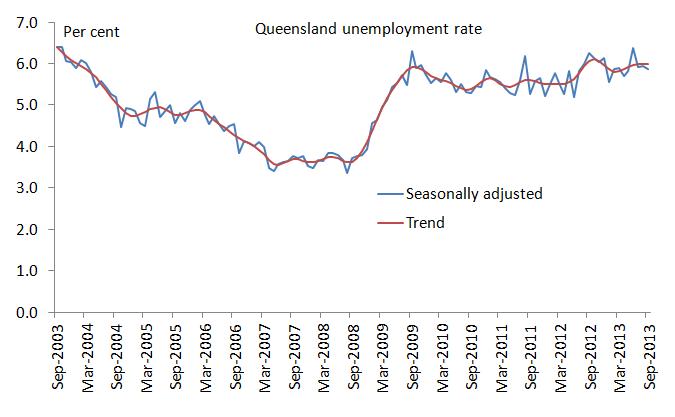
Qld unemployment rate stable at 6 per cent

The September 2013 labour force data are out, and they show the Queensland unemployment rate is stable at around 6 per cent (see chart below). While high relative to the pre-financial crisis period when unemployment fell below 4 per cent, a 6 per cent unemployment rate is low relative to double-digit unemployment rates seen in the early 1990s.

Unemployment_Sep13Pete Faulkner has a nice, quick analysis of today’s data:

Surprise fall in Aus unemployment rate

Posted in Labour market | Tagged , , , , , , | Leave a comment

Economic impact of mining can be over-stated, according to PC

The Productivity Commission released a very interesting research note earlier this month titled On input-output tables: Uses and abuses. Input-output tables are the matrices that show how all the industries of the economy are connected to each other – e.g. they show the dollar value of grains purchased by the food manufacturing industry, or business services purchased by the mining industry. These tables allow the calculation of multipliers which estimate the direct and indirect impacts of a change in output of a particular industry.

Recently this type of analysis has been used by the Queensland Resources Council (QRC) to argue that the resources sector is (directly or indirectly) supporting several hundreds of thousands of jobs in Queensland. While I believe the resources sector makes an important contribution to Queensland and will continue to do so, as I’ve previously commented on, the estimates presented by the QRC are very optimistic:

Resources sector jobs multiplier

Basically the problem with a lot of the analysis undertaken is that it assumes money and jobs generated by the mining industry, for example, wouldn’t otherwise exist if the industry wasn’t there. That is, it ignores the possibility that people could find other jobs and other ways to make money. In economics terms, it ignores the opportunity cost of using resources in a particular sector. This is particularly important in relation to mining, which because of its rapid expansion pulled a lot of workers out of other industries. And, if mining employment contracts substantially as expected, I expect former mining workers will, over time, find jobs in other sectors. Hence the economic impacts of mining (or any other sector) can be over-stated.

Richard Denniss of The Australia Institute has been highly critical of the very optimistic job creation claims of the resources sector and was basically backed up by the Productivity Commission in its new research note. Richard’s paper is worth a read:

The use and abuse of economic modelling in Australia

(Hat tip to Richard by the way, because I learned of this new PC note via a Facebook post of his.)

I also recommend this post at Loose Change:

War on Multipliers

Posted in Mining | Tagged , , , , , , , | 1 Comment

Qld Treasury Corporation sees improving economic outlook

The latest Weekly Market and Economics Review for 8 October from Queensland Treasury Corporation (QTC) nicely summarises recent data showing an improving economic outlook across Australia:

Last week’s dataflow was generally better than expected and consistent with the recent more upbeat picture, shown in improved consumer and business sentiment and the broadening recovery in housing.

Building approvals fell by 4.7 per cent in August, though this followed a 10.2 per cent rise in the previous month, leaving the uptrend intact. House prices have also risen further; the RP Rismark house price series rose by 1.6 per cent in September and by 5.5 per cent over the year. Retail sales rose by 0.4 per cent in August, and the latest credit data from the RBA shows modest acceleration in lending momentum. Finally, the performance of manufacturing index (PMI) and performance of services index (PSI) both recorded healthy gains in September.

The note which was sent out yesterday isn’t available from QTC’s website yet but when it becomes available you can download it from here:

Weekly Economics Review

QTC of course is the Government’s debt management office, which borrows billions of dollars on behalf of the Queensland Government and local councils.

Also worth checking out is Pete Faulkner’s latest post on the latest ABS overseas arrivals and departures data:

Strong arrivals data despite “Lions Tour effect” unwinding

I’m pleased that Chinese tourism to the Far North is looking healthy. As Pete observes:

Of particular interest to the tourism industry in FNQ are the Chinese arrivals. After 2 consecutive months of declines in June and July, August saw a return to (very modest) growth. Arrivals from China were up 400 for the month to 62,700. Over the past 12 months we have welcomed 712,500 Chinese, an increase of 16% from a year ago. The Chinese accounted for 11.2% of all arrivals in the past 12 months; another new record high.

Posted in Cairns, Macroeconomy, Tourism | Tagged , , , , , , , | Leave a comment

Qld’s economic future bright if we look beyond short-term

I agree with Deloitte’s analysis that Queensland’s medium to long-term economic outlook is strong, as reported at the Brisbane Times website this morning (Queensland’s economic future rests on five ‘super wave’ industries):

The combined economic power of five “super wave” industries are predicted to replace the mining sector in fuelling Queensland’s future prosperity.

Economic analysis company Deloitte, in its Positioning for prosperity? Catching the next wave report, released on Tuesday, said the gas, agribusiness, tourism, higher education and wealth management industries could together prove as lucrative to the Australian economy as the mining boom had been…

…The non-mining sector industries expected to experience the biggest growth in coming years, Professor Harper said, were health care and social assistance, education and training and professional, scientific and technical services.

Clearly health and community services will generate a lot of jobs in the future as the population ages and we all become wealthier and demand better health care. Also, I’ve previously posted on the large economic boost to the Queensland economy expected when LNG exports commence in the next couple of years (LNG the hero of the Budget).

As noted in the Queensland Budget Strategy and Outlook 2013-14 (p.31):

…the ramp up in LNG production by 2015-16 will lead to growth in overseas exports of 23¼% in 2015-16 which, combined with a stronger domestic sector, should boost economic growth to 6% in that year.

Royalties from LNG production will contribution significantly to Queensland Government revenue, with other royalties expected to increase from $479 million in 2013-14 to $924 million in 2016-17, largely due to LNG production.

Update: I was interviewed on Queensland’s economic future this morning by Steve Austin on 612 ABC Brisbane Radio. You can hear me at the link below, after Steve’s interview with Deloitte’s managing partner for Brisbane:

Queensland’s economic future

Posted in Health, Macroeconomy, Mining | Tagged , , , , , | Leave a comment

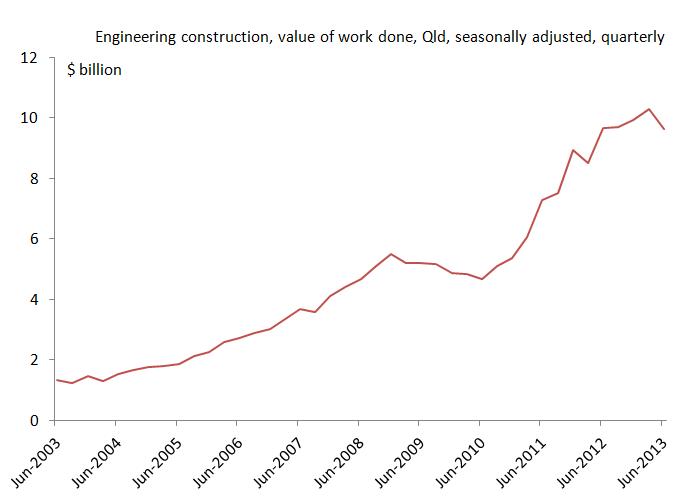
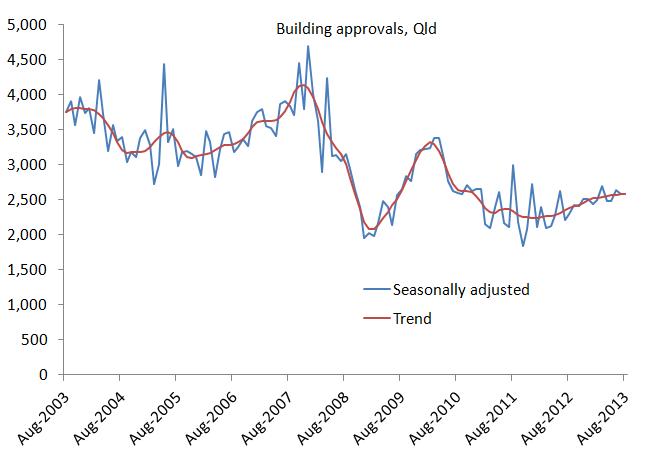
Recovery still on hold for Qld building industry, while mining construction work falls

New data from the ABS today on building approvals for August and engineering construction activity for the June quarter confirm economic conditions in Queensland remain below average and we won’t see much of a recovery in the short-term (see charts below). As Houses and Holes at MacroBusiness observed, “it’s another miss for the rebalancing project,” meaning the building industry isn’t rebounding to compensate for the decline in mining construction activity that we’re now seeing in Queensland and WA.

Buildingapprovals_Aug13

Engineeringconstruction_Jun13

On today’s data, also see:

August building approvals

Posted in Uncategorized | Leave a comment