
While containing reasonably good news for the national economy, today’s new National Accounts data from the ABS suggest the December quarter of last year was a lacklustre one for the Queensland economy, with the (albeit imperfect) measure of State Final Demand falling over the quarter:
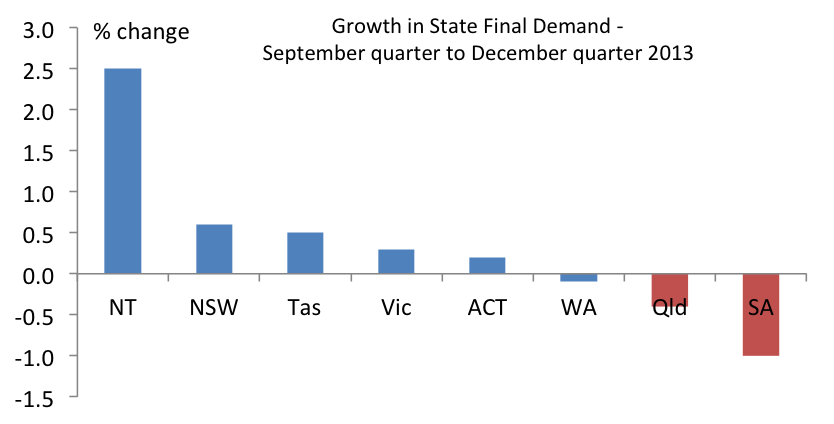 The decline was driven by falls in business investment and State and Local General Government investment, as shown in the chart below. Note that, in the National Accounts, the term investment refers to capital expenditure – i.e. expenditure on equipment, mines, roads, dams, etc. It doesn’t refer to investments in financial assets such as shares or bonds.
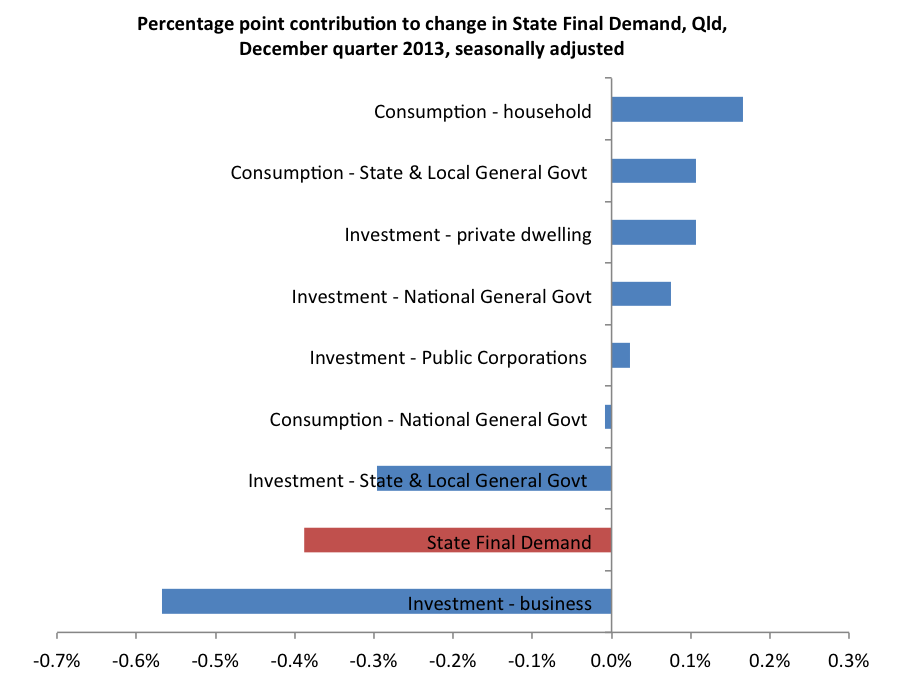 The decline in business investment is likely related to the slowing resources sector, while the decline in State and Local General Government investment is likely related to fiscal restraint aimed at addressing the State’s budget deficit and debt. Reduced expenditure (in real terms, adjusting for inflation) on roads is a likely suspect. The RACQ appears to have meekly accepted restraint in road spending, noting in its 2013-14 Budget Comment last year:
Budgeted capital and operating road expenditure for 2013-14 is $4.487 billion. This is less than the amount budgeted in 2012-13 but more than the 2012-13 estimated actual spend. RACQ considers that the 2013-14 road budget is acceptable, albeit not ideal, given the current fiscal environment.
Given the Government’s strong messaging around the need to pay down debt, I expect the public sector will continue to act as a restraint on demand for a while yet. Today’s data are another reason not to get too excited about the short-term prospects for the Queensland economy, despite yesterday’s strong building approvals data.
Good commentary on what today’s National Accounts data mean for the Queensland economy can be found at:
Queensland Treasury information brief
 Queensland Economy Watch