Courier-Mail’s big call on population boom hitting the wall

The Courier-Mail’s Patrick Lion went too far in his article on Queensland’s population growth this morning when he declared that:

AUSTRALIA’S love affair with Queensland is over, with migration from interstate crashing to its lowest level in almost 30 years.

And the state’s horror summer of cyclones and floods is threatening to scare thousands more would-be arrivals from moving to the Sunshine State.

The slowdown is a serious threat to Queensland’s ailing economy and the desperate need for skilled workers after years of booming interstate migration.

The number of people arriving from interstate has dropped from almost 30,000 three years ago to less than 10,000 last year.

The less than 10,000 interstate migrants figure relates to the 2009-10 financial year, when Queensland was still experiencing a temporary employment slowdown in the wake of the financial crisis. Fewer jobs meant fewer interstate migrants came here for work.

Even though interstate migration was low relative to recent history, Queensland’s population still grew by around 89,000 people in 2009-10. This was due largely to natural increase (births less deaths) of 39,800 and migration from overseas of 39,700. Queensland’s population growth rate remained respectable at 2.0% compared with 1.7% nationwide. Only WA had a higher growth rate at 2.2%.

Treasurer Andrew Fraser, quoted in Mr Lion’s article, makes the very good point that Queensland remains the number one destination for interstate migrants in Australia. In 2009-10, Queensland had net interstate migration of 9,576 people compared with 2,555 in Victoria, 1,962 in WA, and -10,540 in NSW (i.e. NSW lost over 10,000 people to interstate migration).

Sure, recent flooding and cyclones may deter some interstate migrants, but Queensland’s fundamental attractions – attractive jobs due to a resources sector that is massively expanding and a comfortable lifestyle with usually brilliant weather – will continue to draw people from interstate. And no doubt we’ll pick up a few interstate migrants who come up here to help in the reconstruction efforts.

Let’s wait for the 2010-11 figures before we make a call regarding Queensland’s population boom coming to an end. There’s every reason to suspect the pause in interstate migration is only temporary.

N.B. Figures used in this post are available from Queensland Treasury’s Office of Economic and Statistical Research and the ABS:

Information Brief – Australian Demographic Statistics June Quarter 2010
Australian Demographic Statistics June Quarter 2010

Posted in Cyclones, Floods, Migration, Population | 1 Comment

Yasi damages bill at around $1.5 billion

The Weekend Australian Financial Review (Feb 5-6, p. 13) contains the following tabulation of the costs of Cyclone Yasi:

  • Damage to sugar crop:                  $500m
  • Damage to banana crop:               $350m
  • Forgone mining production:        $300m
  • Other fruit and vegetable crops: $50m
  • Projected insurance claims:         $225m
  • Damage to leisure boats:              $1oom

This adds up to just over $1.5 billion, but there may be some double counting as the damage to leisure boats could partly be covered by insurance. Hence, it’s reasonable to conclude damages are around $1.4-1.5 billion.

This doesn’t include the cost to Government from disaster relief payments (possibly in the order of $100 million, if 100,000 people claim the $1,000 payment) or the costs of mobilising the army and emergency services and council workers to aid in the clean up. Hence, it’s possible Yasi could end up costing in the range of $1.5 billion to $2 billion.

Posted in Cyclones | Leave a comment

Grattan Institute appears afraid to champion labour market reform

When Australians go to work, on average, they only produce around 85% of what workers in the US produce. Academics and policy wonks have spent a lot of time debating whether this is due to our remoteness from the world economy, our proportionately smaller R&D effort, or our highly regulated industrial relations (IR) system, among other factors. This debate is reasonably well explored in a new report co-authored by Saul Eslake from the new Australian think tank, the Grattan Institute:

Australia’s productivity challenge

Technically, the report is very good, but it’s weak on policy discussion. Regrettably, the Grattan Institute appears afraid to champion reform of our highly regulated IR system. The Grattan Institute adopts a very peculiar reading of Gary Banks’s veiled criticism of Government IR policy in a December conference speech. The Productivity Commission Chairman observed (as quoted in the Grattan Institute report):

If we are to secure Australia’s productivity potential into the future, the regulation of labour markets cannot remain a no-go area for evidence-based policy making.

Regarding Gary Banks’s fairly clear hint that Australia needs labour market reform, the Grattan Institute comments:

We do not interpret this as a criticism of the present Government’s changes to workplace relations legislation. It is too early to ascertain what impact, if any, those changes have had on the flexibility and adaptability of workplaces to changing economic circumstances. However, we do endorse Banks’ intimation that the further changes to the workplace relations framework should be considered if it becomes apparent that the capacity of firms to cope with changing economic circumstances has been materially affected.

Huh? The final vague conditional statement lacks conviction. Does the Grattan Institute believe in labour market reform or not? Come on Grattan Institute, you can show more courage than this.

Posted in IR | Leave a comment

Full credit to Bligh and Emergency Management team for Cyclone preparations

Despite the devastation wrought by Cyclone Yasi, particularly in Mission Beach, Cardwell and Tully, there are no reported lives lost so far – an incredible achievement and a testament to the preparations of our authorities. The Telegraph newspaper from the UK is spot on:

Cyclone Yasi: preparation saved thousands of lives

Posted in Cyclones | Leave a comment

We’re living the worst case scenario

Cyclone Yasi is truly frightening and is certain to claim lives and inflict several more billions of dollars of damage to the already battered Queensland economy. Clearly it will disrupt the tourism sector, which is so vital to North Queensland’s economy, and many other industries as well. For example, with the cyclone expected to cross near Innisfail, 85% of Australia’s banana crop is under threat:

Banana crops in Queensland face another hit from cyclone as Yasi approaches

All the news we’re hearing is very bad, but even so this report from today’s Townsville Bulletin stands out:

Stay safe North Queenslanders.

Posted in Agriculture, Cairns, Townsville | Leave a comment

Cairns only just starting to recover from economic slump

Queensland’s cruel Summer continues with news that Cairns is at threat from the 500 km-wide monster Cyclone Yasi:

Thousands to be evacuated as Cairns is warned of flooding from powerful Cyclone Yasi

The Courier-Mail has produced a useful and frightening comparison of Cyclone Yasi with Cyclones Tracy and Larry, which were much smaller in area at 50 km and 100 km wide respectively:

29,000 face mandatory evacuation in Cairns as city braces for a pounding from Cyclone Yasi

Cyclone Yasi’s closest comparator is the 640 km-wide Hurricane Katrina – a natural disaster for which the Federal Government of the world’s richest and most powerful nation was completely unprepared. Let’s hope our own authorities have studied the lessons of that debacle.

In other news today, it appears Cairns is just starting to emerge from the economic slump it has experienced since the financial crisis, which brought a large decline in tourist numbers and an unemployment rate which got up around 14%. The Cairns Post reported this morning (Cairns’ economy a slow road to recovery):

THE economy of Cairns is recovering but it’s proving to be ‘a long slow haul’, a new report says.

The January 2011 CairnsWatch report says improving tourism industry conditions and the reduction in unemployment are taking a long time to filter through to rest of the city’s economy, with the construction sector, in particular, still weak.

Business leaders say the economy is stabilising but Chamber of Commerce and Industry Queensland Far North Queensland policy chairman Brett Moller called on the State and Federal governments to release their funding for promised projects so the work could get started, including the $150 million Bruce Highway upgrade.

Obviously, Cyclone Yasi is very bad news for Cairns and Queensland. It must now be a major concern of the Government’s that the rebuilding efforts – from the floods and what will be required from this cyclone – will be vigorously competing with each other for skilled tradespeople and engineers. With such strong competition for scarce skills, the economic cost of rebuilding Queensland could blow out massively. That temporary levy could be with us for some time yet.

Posted in Cairns, Floods | Leave a comment

Has paid parental leave affected birth numbers in Cairns?

In December last year, Commonwealth Families Minister Jenny Macklin warned obstetricians not to help women delay births so they are eligible for the new Paid Parental Leave scheme, which came into effect on 1 January. Judging by new statistics from Cairns Base Hospital, it appears some obstetricians didn’t listen. The Cairns Post reports (Cairns’ birth numbers are down):

IT wasn’t just tourist numbers that were down last year, it seems the baby blues hit Cairns as well.

Cairns Base Hospital recorded 2556 births in 2010, 49 fewer than the record 2605 babies born in 2009.

It was the first time since 2002 the yearly birth rate had dropped.

But last year’s figure still marked the fourth year in a row that births have topped the 2500 mark.

The hospital’s director of obstetrics and gynaecology, Paul Howat, said he believed the dip in births was the result of worries about the Cairns economy in 2010.

“But the dip in births has been a bit of good news for the hospital because it’s given the maternity ward a bit of a respite,” he said.

CAIRNSEYE editor Joelene Bettini’s five-week-old baby boy Darcy (pictured) made the 2010 birth count after he was born nearly three weeks early.

Ms Bettini said she believed birth numbers were down because mums were waiting for the new financial year.

“It was very quiet at the hospital when I had Darcy and the nurses were saying how busy they normally were at this time of the year,” she said.

Ms Bettini’s explanation makes a lot of sense (N.B. the Cairns Post report incorrectly refers to the new financial year instead of the new calendar year). Australian economists Joshua Gans and Andrew Leigh have long warned about the impact on birth rates of the timing of new family programs such as the Baby Bonus, and no doubt their work was the inspiration for Jenny Macklin’s warning last December:

Finally, some sense on birth timing

Posted in Cairns, Population | Leave a comment

Are there too many prosecutions in Queensland?

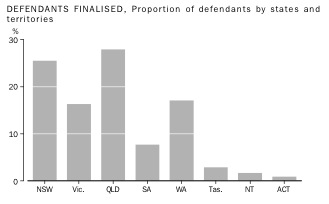
There were over 184,000 defendants whose cases were finalised in Queensland courts last financial year, compared with around 169,000 in NSW, as reported in the Australian Bureau of Statistics’s Criminal Courts publication released on Thursday. Given NSW’s population is much larger at 7.2 million compared with Queensland’s 4.5 million, this should raise a few eyebrows. The ABS reports on p. 7:

At the state and territory level, Queensland contributed the most to the defendant population with 28% (184,307), followed by New South Wales with 25% (168,758), then Western Australia with 17% (113,199) (Table 1.3).

Here’s the relevant chart:

This raises a question about the efficiency of our criminal justice system. Are we prosecuting too many people for minor offences that would be better dealt with via a fine? According to Table 1.3 on p. 13 of the ABS report, Queensland is a big outlier on public order offences and offences against justice procedures.  There were around 29,400 public order offences dealt with by courts in Queensland compared with 6,500 in NSW and 12,800 in Victoria. Also, there were around 14,700 “offences against justice procedures, government security and operation” in Queensland compared with 6,500 in NSW and 3,400 in Victoria.

Are our police officers highly sensitive souls compared with those in other states? Is Brendan Fevola a victim of this hyper-sensitivity?

Luckily this all doesn’t result in a massively higher rate of incarceration in Queensland, as the bulk of guilty offenders receive non-custodial sentences, and at a much higher rate in Queensland than in NSW and Victoria. Our much larger number of non-custodial sentences (155,900 vs 128,100 in NSW and 73,400 in Victoria) suggests Queensland is dealing with a large number of trivial offences in the courts system.

By the way, at least our criminal justice system appears reasonably effective in terms of the percentage of defendants who receive a guilty verdict, which is the highest in Australia. The ABS reports:

In Queensland 91% of defendants were proven guilty, while in the Australian Capital Territory 65% of defendants were proven guilty.

Around 1% of defendants in Queensland were acquitted, 2% were transferred to another court and 6% had their case withdrawn by the prosecution.

Anyone considering a life of crime would be wise to reconsider. If you get caught, there’s a good chance you will do time.

Posted in Crime | Leave a comment

Levy may help Government avoid debt limit increase

The Gillard Government must have known its flood levy would be hugely unpopular. The only plausible explanation for the levy is that the Government wants to avoid another debate about its debt limit, currently at $200 billion, as per the special circumstances provision (section 5A) of the Commonwealth Inscribed Stock Act 1911.

We won’t know for sure if this is correct until we get the Budget papers in May, but it’s possible the levy will keep the Government’s outstanding stock of Treasury Bonds at less than $200 billion, meaning it won’t have to go to Parliament to raise the debt limit again.

The Government no doubt remembers the bitter battle with the Turnbull-led Opposition in February 2009 (after the second stimulus package) over the raising of the debt limit from $75 billion to $200 billion. By introducing a levy, the Government is choosing to take some short-term political pain to avoid a potentially protracted debate about debt in the lead up to the next election, which is due by mid-2013.

In other flood-related news, Treasurer Wayne Swan gave an informative speech today outlining the likely economic costs of the floods:

The impact of the floods on our patchwork economy

Also, Queensland Treasurer Andrew Fraser released his mid-year budget update. From the Government’s budget website:

The Mid Year Fiscal and Economic Review 2010-11 outlines the financial cost of the floods at $5 billion with almost 2 percentage points taken off economic growth as a result of this disaster.

Posted in Floods | Leave a comment

Flood relief arrangements are inequitable

Centrelink offices across Queensland have been busy lately, accepting applications for $1,000 payments for disaster relief following the floods. While most applications for relief will be genuine, it’s hard not to conclude there will be a significant number of rorters or undeserving claimants, given the low eligibility requirements (e.g. power off for 48 hours), which mean that many people claiming the $1,000 will be over-compensated for any financial losses they actually incurred. This money would be better spent on the truly deserving, such as those battlers in Grantham, North Ipswich and Goodna who have lost everything.

Evidence of rorting has begun to emerge, as highlighted by the Cairns Post (Flood relief money ‘drunk away at pub’):

NEW claims of Far Northerners cashing in on flood relief payments have surfaced, amid calls for cheats to be prosecuted.

In the latest report, a dozen families allegedly bragged about their windfall at the local pub.

Before Australia experiences its next natural disaster, our Governments, State and Federal, need to reform our inequitable disaster relief arrangements. There is currently too much money available through Centrelink and too little available for more suitable mechanisms, such as the Premier’s flood relief fund, which appears to be better directed at cases of genuine hardship than Centrelink’s efforts. The small size of the Premier’s fund relative to the scale of the disaster is evident from comments by former Treasurer David Hamill (reported in Bligh eyes $100,000 cut-off for relief recipients):

Earlier, former treasurer David Hamill, who chairs the committee overseeing the disaster relief fund, said that while the $145 million collection was still growing, it wouldn’t go close to covering a possible $4 billion of uninsured damage.

Many people in the community recognise the inequity of our current relief arrangements. For example, I have heard the encouraging story that residents of one Paddington Street, close to Suncorp Stadium, will donate the bulk of their Commonwealth relief payments to the Premier’s fund. While these residents are genuinely eligible for the payments, having lost their power for several days, they recognise that $1,000 is greatly in excess of the value of the spoiled goods in their fridges and freezers. Their donations will only go so far, however, and it would be much better for the Commonwealth to be more discriminating with our money, and to direct it to cases of genuine hardship.

Posted in Brisbane, Floods, Ipswich | 2 Comments