Carbon tax impacts on tourism and construction sectors

Queensland Tourism boss Daniel Gschwind is worried about the impact of the carbon tax on the State’s tourism industry, as reported in the Gold Coast Bulletin this morning:

THE carbon tax is another challenge for the Gold Coast tourism industry in a climate where the Australian dollar is through the roof and people are already cutting back.

Daniel Gschwind, CEO of the Queensland Tourism Industry Council, said the new tax meant the cost of doing business was going to go up and a big part of tourism’s market was going to be hit — the international visitor.

“Government compensation for consumers only works in the domestic market,” he said.

That’s true, although I think the carbon tax impact is minor compared with the impact of the high Australian dollar, and the carbon tax actually might reduce the exchange rate by making our coal industry less competitive and reducing coal exports (see my post from yesterday).

Mr Gschwind is also concerned about the impact of the carbon tax on domestic airfares, particularly relative to international airfares. This is more of an issue for the long-term, as the carbon tax ramps up. In the short-term, the impact should be modest, relative to the total cost of an airfare. Earlier this year the ABC reported that Qantas CEO Alan Joyce said:

…if the carbon price is between $20 and $30 a ton it could take $100 million off the airline’s annual profit.

He says the cost would be passed on to customers and estimates it would be around $6 extra per domestic flight.

There are also concerns about the impact of the carbon tax on the building industry:

Far North’s building industry says carbon tax will push up new home costs

Clearly the Government faces a tough challenge in selling this tax.
Posted in Cairns, Climate change, Gold Coast, Mining, North Queensland, Tourism | 1 Comment

Queensland has to make the biggest adjustment to carbon price

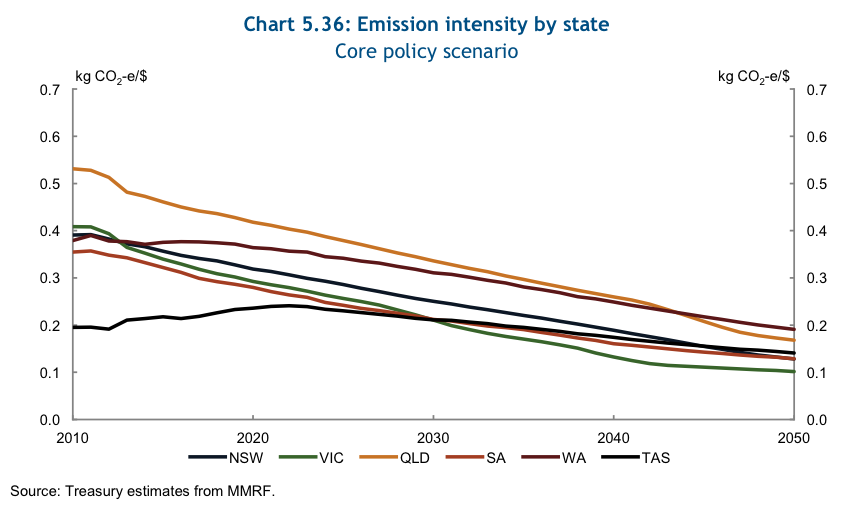
Queensland will have to endure a much larger economic adjustment in response to the carbon price than other States, in large part because of the need to reduce fugitive emissions from coal mining and emissions relating to aluminium smelting, which uses huge amounts of electricity. The Treasury carbon price modelling report contains this chart projecting the emission intensities (i.e. greenhouse gas emissions per dollar of Gross State Product) of the Australian States over the next few decades:

Part of this adjustment will involve a loss of competitiveness of Queensland’s coal industry, due to the taxing of fugitive emissions, but this could have a beneficial side effect for Queensland’s tourism industry and our tourism-dependent regions, such as the Gold Coast and the Far North, through a reduction in the exchange rate. The Treasury modelling report notes (p. 99):

…pricing of fugitive emissions in coal and gas production slows their output and export growth. This tends to lower Australia’s exchange rate, making other trade-exposed industries more competitive.

The Queensland Government will now have to consider the impacts of the carbon price on the competitiveness of our coal mining sector and the implications for coal royalties over the longer-term. My gut feeling is that this will only have a small impact, but Queensland coal miners are clearly concerned about it (e.g. see p. 16 of this presentation from former Queensland Treasurer Keith De Lacy).

Posted in Climate change, Macroeconomy, Mining | 2 Comments

School halls taskforce gives tick of approval to Qld Govt

While the Building the Education Revolution (BER) Implementation Taskforce has come down hard on NSW and Victoria (BER waste blows out to $1.1bn), Queensland has received a good report from the Taskforce:

The only state government that can claim to have all the attributes of an informed buyer of capital works projects currently is the Queensland Government.

In large part, this relates to Queensland’s retention of a significant Public Works department, which other States once had, too, up until the 1980s, as the Taskforce explains:

Progressively from 1980 this situation changed with an increasing proportion of construction contracts and design being outsourced. This trend accelerated in the 1990s. Internal staff numbers in public works departments were significantly reduced and the public works day labour workforce was severely reduced in all jurisdictions other than Queensland.

The last decade has witnessed some restitution of capacity, especially in road design and construction via graduate recruitment and increased emphasis on ensuring in-house professional staff gain ‘hands on’ experience. The Taskforce conducted interviews with a wide range of stakeholders including current and former senior public works executives and this together with our research informs our view that today the only government with a full range of public works expertise is Queensland.

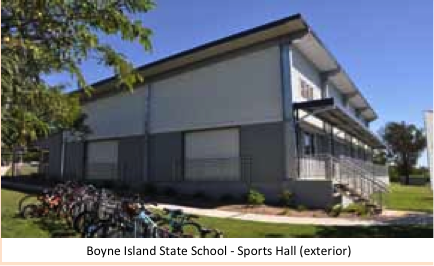
The Taskforce did fail one Queensland project on value for money grounds, however: the Multi-purpose Hall at Boyne Island State School (pictured below), which cost $1.89M compared with the benchmark cost of $1.35M.

The Queensland Education department is disputing the Taskforce’s assessment, however, noting that the $1.89M also includes the costs of sports and AV equipment, landscaping and other improvements, which are not included in the benchmark cost.

Posted in Education | Leave a comment

Townsville Futures Plan

The Queensland Government released the Townsville Futures Plan today, and it includes the rather meaningless designation of Townsville as the second capital of Queensland -hey, if you’re not first, you’re last – as well as acknowledging the city as the defence hub of North Queensland. The Government is also hoping the National Broadband Network, a State Development Precinct and a CBD revitalisation contribute to Townsville’s ongoing prosperity. And a Farmers Market appears reasonably important, too, at least according to this word cloud that was central to the development of the vision for Townsville contained in the Futures Plan (see p. 18):

This is a great graphic, but I’m concerned about any vision for a city that had its origin in a jumbled mess of ideas without any logical structure.

Posted in Townsville | Leave a comment

Increasing links with India great news for Qld economy

India is expected to overtake China in population by around 2025 (What the world will look like in 2050), so it’s great news that Queensland is expanding its links with the country, as reported in today’s Brisbane Times:

A massive growth in Indian shopping malls means hundreds of thousands of training dollars for Brisbane and Ipswich retail experts.

Brisbane and Ipswich have agreed to teach young Indians the secrets of business management success in a new Sister City agreement.

The agreement comes as new shopping malls and shopping centres boom in India.

Queensland retail experts report India’s retail sector will have a shortfall of 17 million retail management positions in the next 10 years.

Posted in India, Retail trade | Leave a comment

Media over-reacts to jobs data

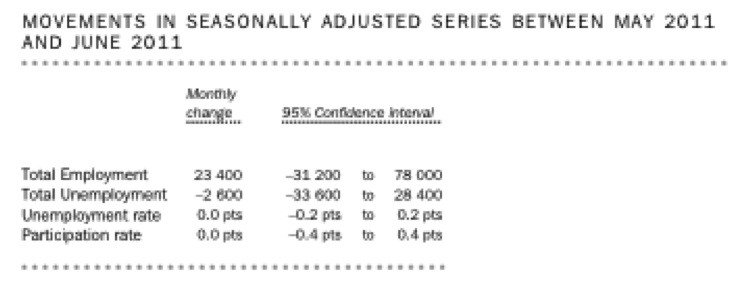
Media reports such as “Robust jobs growth in June shows economy in ‘reasonable health'” that are based on monthly movements in the ABS Labour Force Survey employment estimates are often meaningless. This is clear from the wide confidence intervals surrounding monthly movements in the seasonally adjusted labour force figures, as reported on p. 2 of the publication, just above the sign off from the Australian Statistician:

The ABS is 95% confident that the change in total employment over May to June was somewhere between a fall of 31,200 and an increase of 78,000. This means there is a reasonable chance employment actually fell, remained constant or hardly increased at all in June. So it’s best not to read too much into monthly movements in labour force data. Savvy commentators instead look at trends over a number of months (e.g. see What’s happened to Australia’s unemployment rate since last year).

Posted in Labour market, Macroeconomy | 2 Comments

Country Australia not happy with carbon tax

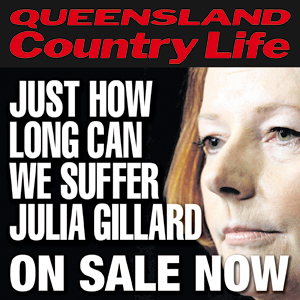
Country Australia is not happy with the carbon tax. Recent frustrations include the exemption of petrol but not diesel from the carbon tax and the impact of the carbon tax on the cost of irrigated agriculture, particularly cotton. These concerns, combined with frustration over the temporary live cattle exports ban, have prompted Queensland Country Life to run with this over-the-top and arguably partisan headline:

 Extraordinary. It’s hard to see how the Government recovers from the political damage it has received over the carbon tax. Will the release of the package on Sunday calm everybody down, or will the release of the details simply provide clearer data for both sides to argue with? The latter is most likely, as the package is expected to generate both winners and losers.

It is likely that the winners will include over-compensated low and middle-income families and pensioners, while losers will include high-income families, singles, small business people and farmers. A vigorous debate about who is most deserving of compensation will no doubt follow.

Posted in Climate change | Leave a comment

Macarthur Coal’s new logo

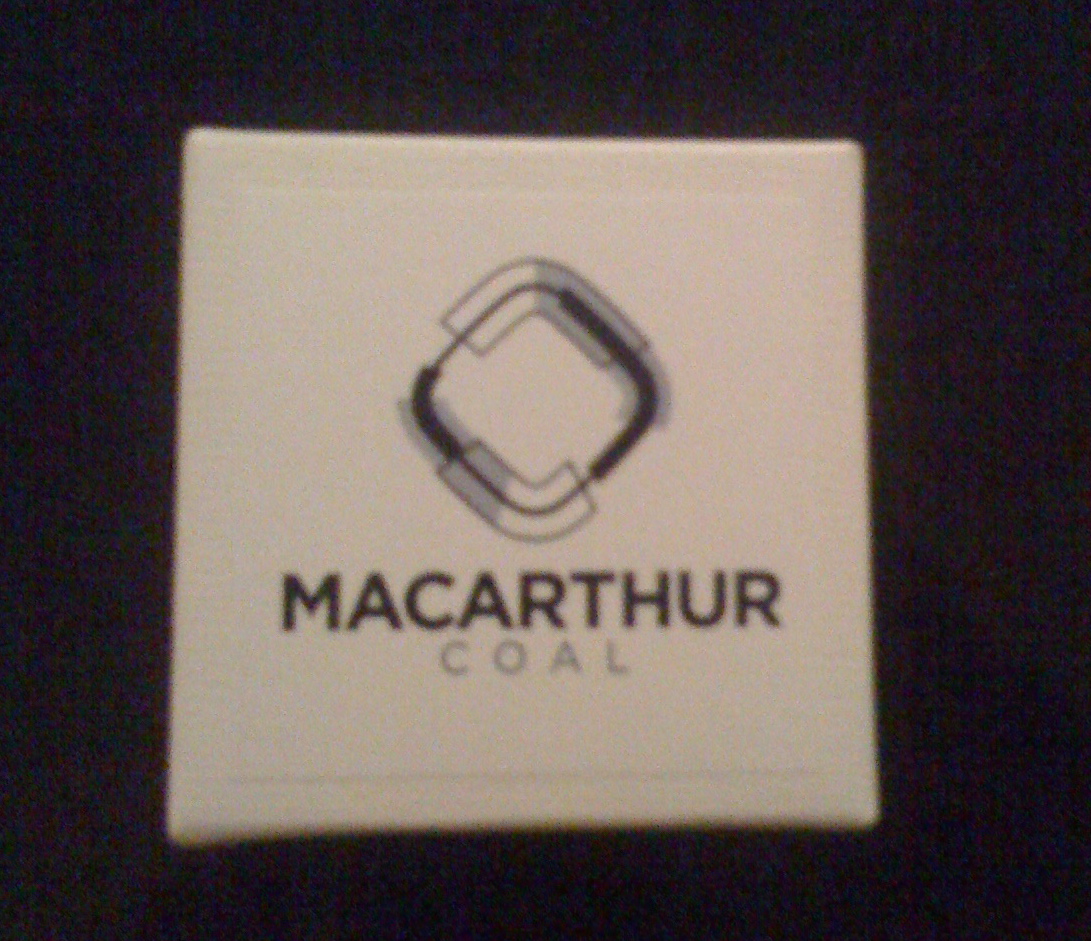
Yesterday was the tenth anniversary of the sharemarket listing of Queensland’s emerging mining giant Macarthur Coal, which I’ve heard was the third best performer among ASX 300 companies over the last decade. At its tenth anniversary celebration at the Queensland Art Gallery in South Brisbane last night, the company took the opportunity to reveal its new logo, which apparently is meant to represent, appropriately, a coal seam:

This photo is of a box which contained a delicious chocolate brownie from another growing Queensland business, Dello Mano.

Disclosure: I ate two of the brownies. Yum.

Posted in Mining | Leave a comment

Infrastructure Australia criticises State Governments for slow progress on reforms

Infrastructure Australia’s latest report to the Council of Australian Governments (COAG) won’t give much comfort to people who hope our governments actually know what they’re doing when it comes to building the roads, railways and ports we need for the future. In a departure from the usual boring bureaucratic language that characterises Government reports, Infrastructure Australia notes:

This report is also quite deliberately expressed in stronger terms than previous reports. Whilst governments have invested a significant amount on infrastructure, they have made little progress in responding to a number of issues raised in previous reports, e.g. the need for improved planning, and the need for reforms in the areas of pricing, demand management and funding.

Public transport is one area where governments across Australia have historically performed poorly:

Australians experience the consequences of poor or inadequate infrastructure planning, investment and regulation in their daily lives. They experience the frustration of congestion in our cities, and the absence of effective public transport leaves people stranded, both figuratively and literally.

The report is titled Communicating the Imperative for Action. It certainly does that. It’s time for our politicians and bureaucrats to act. Well done to Infrastructure Australia.

Posted in Infrastructure | Leave a comment

Yes, closing coal industry would cost lots of jobs, but is that likely to happen?

The Queensland Government is expecting to earn $2.8 billion in coal royalties in 2011-12 (Budget Strategy and Outlook, p. 94). Shutting down the coal industry would obviously have a large impact on Queensland’s Budget and economy, as well as the federal Budget and the Australian economy more broadly. But I don’t think there is any chance of that happening, and the PM, Treasurer and Resources Minister all support Australia maintaining a coal industry. Hence I am a little surprised at this recent study speculating as to what might happen if Australia shut down its coal industry:

Push to can coal puts 200,000 jobs at risk

The study’s findings may be reasonable, given the research question, but the research question didn’t make sense in the first place.

Posted in Climate change, Mining, Queensland Government | Leave a comment