Is this innovative or a little bit creepy?

The Brisbane Innovation Scorecard which was launched today finds that Brisbane is a thriving centre of innovation:

Brisbane emerges from this survey as a world-class enabler of business innovation, with an innovation footprint which is comparable nationally. The majority of Brisbane firms – across all industry sectors and sizes – are actively innovating, with 65 per cent applying at least one innovation in the past three years.

It contains some great case studies of innovative businesses and organisations with operations in Brisbane, including the Eidos Institute, Rio Tinto and Restaurant Two, which may have revealed a little too much about its innovative methods:

The restaurant places a great emphasis on training and briefing its wait staff to deliver that exceptional customer experience. Further to developing a training program, systems also have been developed for dealing with confrontational situations while every customer’s likes and dislikes are recorded in a comprehensive database. This information is used to brief wait staff before each sitting, so that a customer’s desires are anticipated – from their preferred drink to their favourite meal. If a customer is new, they are ‘Googled’.

How about some good old-fashioned conversation to learn what people like and what they’re interested in? Googling your customers is probably smart business practice – you’ll quickly figure out who the cashed up ones deserving special attention are – but it does sound kind of creepy.

Posted in Brisbane | Leave a comment

Is upgrading regional racecourses a priority for Government investment?

Given the need to reduce State government debt and to restore our AAA credit rating, as well as the far more worthwhile infrastructure investment opportunities that are available, I’m surprised the Government has advanced Racing Queensland $20 million for a number of projects, including an upgrade to Cluden racecourse in Townsville (Cluden’s $6m revamp). Private sector investors are quick to back winners, so governments typically end up backing only losers.

Posted in Industry policy, Infrastructure, Townsville | Tagged | Leave a comment

SEQ mayors’ infrastructure wish list

The South East Queensland (SEQ) Council of Mayors released its infrastructure wish list today. Two proposed projects stood out to me as representing great value. My favourite proposed project is the:

Darra to Springfield Rail Extension (to Redbank Plains)

ESTIMATED COST: $180 million DELIVERY DATE: 2013

This would enhance the availability of public transport to a region which is currently under-serviced and which will be home to an increasing number of commuters as the development of Greater Brisbane’s western corridor continues.

My second favourite proposed project is the:

Moreton Bay Cycleway

ESTIMATED COST: $16 million DELIVERY DATE: 2018

PURPOSE OF PROJECT

The Moreton Bay Cycleway is a project that will ultimately connect 150km of Greater Brisbane’s coastline via cycle facilities connecting Bribie Island to Redland Bay (via the new Gateway Bridge facilities) and will become the longest cycleway on the eastern coast of Australia. This project will deliver the missing links of the regionally significant cycleway.

This will deliver major recreational and health benefits to Queenslanders and may end up as a significant tourist attraction, which Brisbane needs more of, according to recent reports (Brisbane ‘needs more tourist attractions’ to keep visitors coming).

Posted in Brisbane, Infrastructure, Ipswich, Queensland Rail, Tourism | Leave a comment

Tales of the two-speed economy

Cashed up miners are pushing up rents in Mackay, with some prepared to pay $700+ per week for a house:

450 join already long queue

Meanwhile the Fraser Coast economy remains in a slump, due to a drop in international visitor numbers associated with the high Australian dollar. Although the unemployment rate is not in double figures, as Employment Minister Stirling Hinchliffe notes, at around 7% it is still significantly above the State average of just over 5%:

Jobs news gloomier

Posted in Mackay, Mining, Tourism, Wide Bay-Burnett | Leave a comment

Top economists against carbon tax

University of Melbourne Economics Professor Stephen King questions whether the carbon tax is in the national interest and essentially concludes it is based on wishful thinking that our actions alone will influence the world to act:

The objectives of the carbon tax

Also, in today’s Australian (Picking winners hits the budget), Access Economics co-founder Geoff Carmody questions the logic of the current design of the carbon tax, the Emissions Trading Scheme it morphs into after 2015, and complementary measures such as the renewable energy target and Clean Energy Finance Corporation:

This highly regulated ETS market is subject to large internal contradictions. For example, the government needs revenue from the carbon tax or permit sales to help finance household and industry compensation. But the more the policy reduces emissions, the less revenue it raises, and revenue is also lost if permits are purchased overseas. And if the offshore permit price is lower than in Australia, arbitrage may lower revenue from local sales of permits as well…

…Measures such as renewable energy targets magnify threats of “carbon leakage” and job losses offshore from Australian trade-exposed sectors. They thereby magnify the global cost-ineffectiveness of the Greens-government policy. It would be ironic if the government’s policy, ostensibly promoting a sustainable climate, proves financially unsustainable, just like the raft of existing state-based household rooftop “feed-in tariff” incentives, now being wound back.

For example, the “commercially oriented” Clean Energy Finance Corporation has funding of $10 billion spread evenly across five years from 2013-14. But if it is really commercial, why is the taxpayer involved? The whole point of governments setting an emissions price is to give the private sector an incentive to deliver emissions-reducing innovations.

The current Clean Energy Future policy package is far from first best and may not be in the national interest. The unpopularity of the carbon tax suggests that deep down many Australians understand this, even if they cannot articulate the problems with the package as clearly as King or Carmody.

Posted in Climate change, Energy | Leave a comment

Qld Treasury remains optimistic about economy

Despite the bad economic news coming out of the US (i.e. the potential for a double-dip recession), and the ongoing  troubles in Europe, Queensland Treasury, rightly in my view, remains optimistic about Queensland’s economic prospects in its latest Queensland Economic Review released on Friday:

Looking ahead, jobs growth is expected to strengthen later in 2011, as agricultural employment recovers and growth in business investment, led by resource sector activity, gains momentum. The ABS Job Vacancies series for Queensland recorded the strongest growth of any state over the year to June quarter 2011.

The Review highlights our two-speed/patchwork economy:

Jobs growth has been very industry specific, with professional, scientific and technical services (which includes roles such as scientific research, engineering design and consulting, and legal and accounting services), along with mining and exploration driving employment growth over the year to June quarter 2011. This likely reflects strong demand for labour related to resource sector investment activity. In contrast, there were falls in employment in the agriculture, discretionary retailing, public administration and manufacturing sectors.

The Review also has an informative chart on building approvals illustrating the plight of Queensland’s building industry at the moment:

Posted in Macroeconomy | Leave a comment

Heritage protection could hold back Townsville CBD revitalisation

Townsville City Council has a stated objective of revitalising the CBD, but the move to create character precincts, in older suburbs close to the CBD such as South Townsville (as reported in the Townsville Bulletin), is contrary to this objective. This is because it may prevent the construction of the apartment blocks that are necessary to generate the inner city population density that I would aim for as part of a CBD revitalisation strategy.

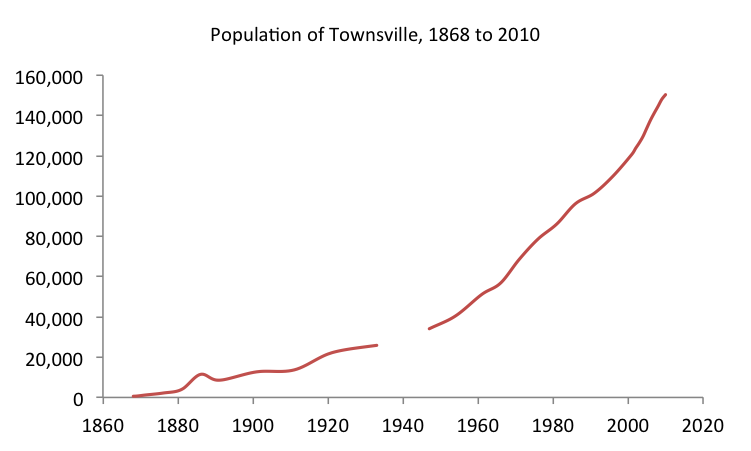
Townsville’s population is growing steadily (see chart for recent and historical trends) and I would urge the Council to attempt to channel a lot of future population growth into the inner city suburbs if it really wants to revitalise the CBD.

The decline of Townsville’s CBD since the 1980s has a lot to do with the weight of Townsville’s population shifting to outer suburbs, and the growing importance of Aitkenvale and Kirwan as commercial centres. If the Council wants the CBD to thrive, it needs to encourage more people to live in South Townsville, West End and North Ward, for example, as inner city residents would be more likely to shop in the CBD. But the Council won’t be able to do this if it constrains development through inappropriate heritage protection.

Posted in Townsville | 1 Comment

Ipswich apartment tower based on misunderstanding of what makes Ipswich attractive

Over the 15 years from 2006 to 2021, Ipswich’s population is set to grow from 142,500 to 286,400 (OESR projections). Hence the developers of Ipswich’s first high-rise apartment tower probably thought they were on a winner, but that turned out not to be so, as reported in the Queensland Times today:

A LOW point for Ipswich’s first high-rise residential tower augurs well for bargain hunters at an apartment fire sale.

More than 40 residential apartments and three commercial units at Aspire Apartments will go on sale next month.

With 104 single-level units and four dual-level penthouse apartments in a 15-storey building, Aspire became the first high-rise development in the Ipswich region when it was built in 2008.

Ray White Commercial Ipswich CBD’s Trent Quinn and Warren Ramsey are marketing the remaining development stock at Aspire Apartments on behalf of receivers and managers Jamie Harris and John Cronin, of McGrathNicol.

Mr Harris said the developer of Aspire, Dore Property Corporation, was forced into receivership after only selling about half the units.

Aspire was meant to usher in a new era of inner-city living for Ipswich but it opened as the Global Financial Crisis (GFC) hit.

Obviously the GFC would have had an impact, but I see a larger failure to understand the nature of Ipswich’s growth. Ipswich isn’t attracting more people because they want to live close to the Ipswich CBD. Instead, Ipswich is attracting more people because they want to live close to the Brisbane CBD. That explains the strong growth in Ipswich’s eastern suburbs, particularly in the Springfield area, which outside of peak hour is within half an hour’s drive of Brisbane CBD. Apartment towers make sense in inner city Brisbane, but they won’t make sense in Ipswich for another couple of decades at least.

Posted in Brisbane, Housing, Ipswich | Leave a comment

Queensland investment boom on its way

From this great chart in the new Queensland Infrastructure Plan (p. 23) it appears that around $40 billion of investment projects were committed to over January to March this year:

The Queensland economy is set for strong growth over the next few years (at least).

The Government today also released its Regionalisation Strategy, which is pretty light on specific actions and probably won’t live up to the expectations of regional community leaders.

Posted in Macroeconomy, Mining, Queensland Government | 1 Comment

Carbon tax creates uncertainty for regional Qld businesses

Premier Anna Bligh today will launch the Queensland Regionalisation Strategy (see Bligh plugs Downs future), but the ultimate success of the Strategy may depend on the impacts of the carbon tax on our regional economies. Many regional businesses remain concerned about the application of the carbon tax to their operations and whether they are eligible for assistance. For example:

  • the Yabulu nickel refinery near Townsville awaits advice from the Commonwealth Government on whether its carbon tax bill is $1.5 million or up to $10 million (Refineries facing uncertain future)
  • Bundaberg Fruit and Vegetable Growers chairman Geoff Chivers is worried about the impact of the carbon tax on horticulture (Farmers fear impact of carbon tax)

Regional Queensland appears highly exposed to the impacts of the carbon tax, which may significantly compromise the Government’s Regionalisation Strategy.

Posted in Agriculture, Climate change, Mining, Queensland Government, Tourism | Leave a comment