Drunk walking increase suggests need for taxi industry reform

This story in today’s Brisbane Times on the staggering rise in drunken accidents reminded me of the US finding in Levitt and Dubner’s SuperFreakonomics that:

Doing the math, you find that, on a per-mile basis, a drunk walker is eight times more likely to get killed than a drunk driver.

My impression is that a lot of drunk walking would be avoided if it were easier to get a taxi, and the Government should consider deregulating the industry, as argued in my previous post:

Time for taxi industry deregulation?

Posted in Health, Transport | Leave a comment

How can Brisbane get into the top 25 liveable cities?

Monocle’s 2011 list of top 25 liveable cities includes Melbourne at number 5 and Sydney at number 7, but does not include Brisbane. At the very least, if we want a chance of getting on to this list, we need to reform our antiquated retail trading hours. According to Monocle (July/August 2011 edition, p. 21), as part of its ranking of cities:

…we considered each city’s 24-hour metabolism for quality of life. Try buying your groceries in Munich, last year’s winner, after 20.00. Convenience is surely a fundamental right in any decent city.

Due to its poor retail trading hours, Munich was downgraded from first to fourth position in this year’s ranking.

While reforming retail trading hours won’t necessarily get Brisbane noticed by international magazines like Monocle, Queensland’s current restrictive regulations are another mark against Brisbane and may confirm the prejudices of many that Brisbane is a sleepy, boring, big country town.

My previous posts on these topics include:

Retail trading hours restrictions holding back retailers

Queensland’s retail trading hours are perplexing

Push to deregulate retail trading hours deserves support

Brisbane not yet one of Monocle’s 25 most liveable cities in the world

Posted in Brisbane, Retail trade | 1 Comment

Economic Potential of Senior Australians

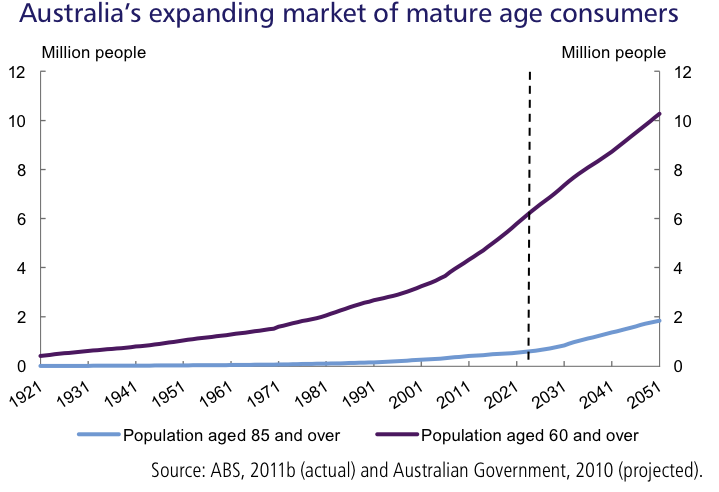
Yesterday the Advisory Panel on the Economic Potential of Senior Australians delivered its first report to Deputy PM-Treasurer Wayne Swan. While I think the Panel is unlikely to yield much of substance – i.e. beyond feel-good recommendations such as governments should promote the value of older workers to employers – the Panel’s first report is a quality document analysing demographic trends, prepared by a secretariat within the Treasury. This striking chart from the report suggests to me the need to invest heavily in accessible and comfortable public transport over the next few decades, assuming we don’t want a massive increase in retired, elderly drivers taking to our roads:

Posted in Population, Transport | Leave a comment

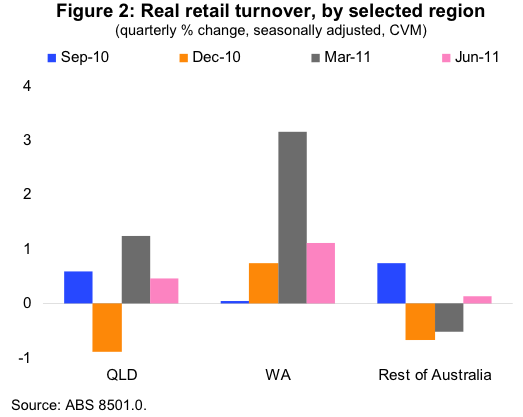
Retail trade has held up better in Qld than in rest of Australia

Retail turnover has held up better in Queensland than in the rest of Australia (excluding WA) according to this chart in OESR’s latest Queensland Economic Review:

Again, while the resources boom is delivering Queensland much good fortune, WA still leads Australia.

Posted in Mining, Retail trade | Leave a comment

Qld agriculture reliant on 457 visas

At the end of July, there were 920 temporary, business-sponsored migrants holding 457 visas working in agriculture in Queensland, compared with 300 in NSW and smaller numbers in other States (see Table 1.22 in this Immigration department report). While over 50% of the holders of 457 visas working in agriculture are in Queensland, only 24% of 457 visa holders working in the mining sector are (over 60% of 457 visa holders in the mining sector are located in WA).

Hence, Queensland agriculture – which is losing skilled workers to the resources sector – appears to be disproportionately reliant on temporary migration, particularly of young people from East Asia, as discussed in a Queensland Country Life article today about the rapidly growing Brisbane-based recruitment agency Labour Solutions:

 While overseas workers filing shortages in the mining sector is commonplace, it is not widely reported that people overseas are also looking for an agriculture sector job in Australia.Yet Mr Northcott said his business provides workers to both small family owned properties and large agriculture corporations.

“We haven’t seen anything yet in the mining industry – they haven’t even scraped the surface with the number of projects they have going ahead,” he said.

“Mining can afford to pay much higher wages than agriculture and it is sustainable for them. There is very limited opportunity for agriculture other than to source overseas.”

With high unemployment in the 18-30 age bracket across Taiwan and South Korea and constant economic woes throughout Europe, many young people are leaving their family owned farms and applying for two years work on Australian properties.

Labour Solutions can even help out farmers with the provision of dongas for their temporary migrants:

If a farm does not have the accommodation to support a workforce, Labour Solutions provides dongas and sometimes even a cook, similar to the work camp structure already widely used by mining companies.

Posted in Agriculture, Mining | Leave a comment

Buy local policy would be costly in the long-term

With the two-speed (a.k.a. patchwork) economy driven by the resources boom – and associated high exchange rate – Australia was always going to see more job losses in manufacturing, such as the 1,000 jobs lost at BlueScope Steel. The Government is right to stress the need to provide assistance to re-train and re-locate workers, but should avoid instituting a buy local policy (Gillard pushes the ‘buy local’ barrow), which could be costly in the long-term. There is no point Australia making things we can procure more cheaply overseas. That would represent an inefficient use of our resources, and hence a buy local policy, while providing some short-term relief to struggling sectors, would make us poorer in the long-term.

As the Government crafts its industry jobs package it should consider that it already provides $1.8 billion of financial assistance to the manufacturing sector each year (see p. 15 of the Productivity Commission’s Trade and Assistance Review 2009-10).

Posted in Labour market, Macroeconomy, Mining | Leave a comment

BBC ten iconic travel experiences – how can Qld get on the list?

BBC Travel’s ten iconic travel experiences include surfing in Hawaii, cooking in Hanoi and learning bush survival skills in the wilderness of Kenya, but doesn’t include anything from Queensland. Given our State’s incredible environmental attributes, including the Great Barrier Reef and the Daintree, this is somewhat disappointing, and may suggest we need to rethink our tourism strategy. One investment project that is worthy of consideration is the Cape York Dreaming Track (which I co-authored a cost-benefit study of last year). This would certainly capture international attention, and while surfing opportunities may be limited on the Track, it could offer traditional cooking and education in bush survival skills.

Posted in Tourism | Leave a comment

Push for national plastic bag ban

Banning plastic bags wouldn’t be sensible policy (see my earlier post Should Queensland ban plastic shopping bags?), and the Federal Government appears to realise this, but still environmental groups persist in pushing for a ban. As reported in today’s Sydney Morning Herald (Cutting plastics no longer in bag):

PLASTIC bag use is again on the rise and green campaigners are pushing for a national ban.

In 2008, then environment minister Peter Garrett pledged to phase out the bags by the end of that year. However, The Sun-Herald can reveal that, since then, the federal government has stopped tallying the number of plastic bags used.

Environmental groups claim that supermarkets have told them that the number of bags they are distributing has increased, suggesting that earlier initiatives to cut their use are no longer effective.

Posted in Environment, Retail trade | Leave a comment

Don’t expect Cape York coal mining any time soon

Cairns-based economics/finance commentator KS has a great post questioning the Cape York coal rush reported in the Australian today. KS notes:

Many in the Far North may not be aware that there are coal deposits on Cape York mostly in the Laura Basin. Coal exploration here is not new and at one time exploration permits were held by BHP, which had been acquired in the takeover of Utah. Waratah Coal and MCIhave held exploration leases for a few years now…

…Apart from environmental and logistical constraints there is a long queue of proposed coal mining developments elsewhere, and I doubt these are a high enough priority to see much actual mining anytime soon even if  approval could be obtained.

Hence, the Wilderness Society, which is claiming Huge dirty coal mine planned for Cape York, doesn’t really have anything to worry about. My guess is that approving coal mines on Cape York wouldn’t just be politically courageous, but politically suicidal.

Posted in Cairns, Mining, North Queensland | Leave a comment

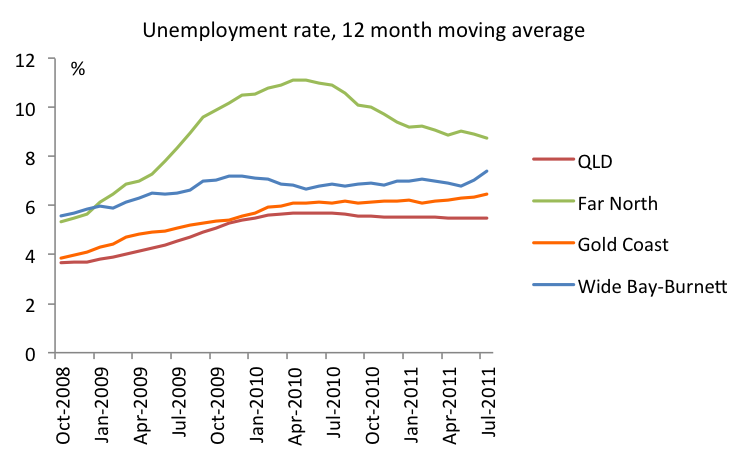
Far North labour market steadily improving, Wide Bay-Burnett getting worse

Here’s a chart of the 12 month moving averages of unemployment rates in the Queensland regions that are most under pressure due to the high exchange rate:

This is based on today’s detailed labour force data release from the ABS.

Posted in Cairns, Labour market, Wide Bay-Burnett | Leave a comment