QR will need to upgrade Central Station

Anyone commuting into Brisbane CBD by train can attest to the crowded platforms and the long queues to get on to the escalators during peak times at Central Station, which is simply not large enough to cope with commuter numbers as the metropolitan population approaches two million. I am even more convinced of the need to upgrade Central, despite the significant cost and the disruption to city traffic it will cause, after reading this article in the Courier-Mail this morning (Extra 100 million trips expected to be made on southeast Queensland public transport by 2018):

GETTING up close and personal with fellow public transport commuters is only going to get worse in coming years with an extra 100 million trips expected to be made in southeast Queensland by 2018.

The annual TransLink report tabled in State Parliament last week predicts 288 million trips will be taken annually seven years from now – up from 178.6 million in 2010-11.

“The majority of these new journeys will occur on what are already our busiest peak routes, particularly those leading in and out of Brisbane City,” read the report.

Already 86 buses a day in Brisbane are forced to ignore waiting passengers because they are full and commuter group Back on Track fears the daily crush will soon be unbearable.

“It would seem this ambitious patronage target is quite unachievable on present policies,” said Robert Dow from Back on Track.

“Firstly it would need Cross River Rail to be expedited to have the capacity in the rail system to support the growth.”

I agree that Cross River Rail or a light rail system are needed, too. Otherwise we may need to consider widening the price differential between public transport fares in peak and off-peak hours to encourage people to travel in off-peak times if they are able to do so.

Posted in Transport | Leave a comment

Signs of recovery in building approvals

Yesterday’s new ABS data show that building approvals, while still relatively low, are at least moving in the right direction:

Posted in Macroeconomy | Leave a comment

Now we’re talking about real tax reform

The late Kerry Packer’s riposte at the 1991 Print Media Inquiry is unfortunately still relevant today:

…if anybody in this country doesn’t minimize their tax they want their heads read because as a government I can tell you you’re not spending it that well that we should be donating extra.

The Tax Forum in Canberra today and tomorrow is unfortunately focussed only on a limited number of taxation issues (don’t mention the GST, alcohol excise, etc), rather than on the bigger question of whether the Government is delivering the right services and whether it’s appropriate to tax the community to fund those services.

Thankfully the Victorian Government is pushing to expand the Tax Forum debate to expenditure issues. Perhaps because it’s in its first year and it’s yet to be jaded by the burdens of office, the new Victorian Government is proposing some bold reforms. It’s calling for a review of spending overlaps between the Commonwealth and States and says it would like to see taxes abolished rather than simply replaced with more efficient taxes. Now that would be real tax reform. Michelle Grattan in today’s Age reports (State push to reduce duplicated spending):

THE Baillieu government has called for a national plan to cut spending by reducing duplication between federal and state governments.

As Treasurer Wayne Swan warned participants in today’s tax summit that proposals for cutting tax must be funded, Victorian Treasurer Kim Wells said the focus of national tax reform ”should be to reduce the overall tax burden on businesses and households”.

Taxes should be eliminated or cut, rather than just having one tax replace another. A national agenda to reduce administrative duplication ”could significantly cut government expenditure requirements”, Mr Wells said. Duplication should be reduced and data sharing increased in areas such as water policy, transport, health, and secondary and vocational education.

”Eliminating overlaps across state and federal bureaucracy represents a real opportunity to cut government costs and reduce pressure on government budgets,” he said.

Posted in Tax | Leave a comment

Rocky apartment tower aimed at Gladstone DIDO workers

The one-and-one-quarter hour drive from Rockhampton to the LNG boom town of Gladstone is comparable to a commute from the Gold Coast to Brisbane, which many people do every day. Hence it makes sense that Rockhampton is being used as a base for drive in-drive out (DIDO) workers in Gladstone. This morning’s Rockhampton Morning Bulletin (Solly backs $20 million high-rise) reports on a new apartment tower aimed at Gladstone DIDO workers:

WORK on a $20 million, high-rise serviced apartment complex on the banks of the Fitzroy River will start this month…

…The Victoria Pde development is being developed by Queensland Property Developers, a company backed by Rockhampton identity Solly Stanton (of the former Silly Solly’s discount store chain), and George Callianiotis…

…Mr Callianiotis jnr said the development was the beginning of an investment overflow from Gladstone for the coming boom in liquified natural gas projects…

…Mr Callianiotis said: “I really think 2013 is going to be a big year for property all over Central Queensland.

“We are already seeing lower vacancy rates in Rockhampton, and Gladstone is full.

“Despite what some people think about fly-in fly-out workers or drive-in drive-out workers, the reality is that it’s going to happen.

“We are already seeing some people like high-income Santos engineers fly in and out of Gladstone to and from Brisbane.

“This project will cater to those workers in Gladstone running these projects to drive in and out from Rockhampton.”

Posted in Gladstone, Mining, Rockhampton | 2 Comments

CEDA’s sovereign wealth fund call assumes budget surplus we don’t have

Given that Australia hasn’t run a budget surplus since 2007-08, and it appears likely the current Treasurer Wayne Swan won’t ever deliver one (Swan resolute as budget bleeds its forecast surplus), CEDA’s call for a sovereign wealth fund is pointless (see coverage in the Australian).

If the Government is eventually in the position where it has surplus cash to invest, it would be better off either repaying its $100 billion+ debt or cutting taxes on business, which would very directly assist businesses that are struggling in the patchwork economy. If, however, the Government starts running embarrassingly large surpluses, then it could always park money in the Future Fund.

In my view, CEDA should call for cuts in wasteful government spending (e.g. industry assistance), which would create fiscal space for tax cuts, rather than for a sovereign wealth fund that assumes a budget surplus we don’t currently have.

Posted in Budget | Leave a comment

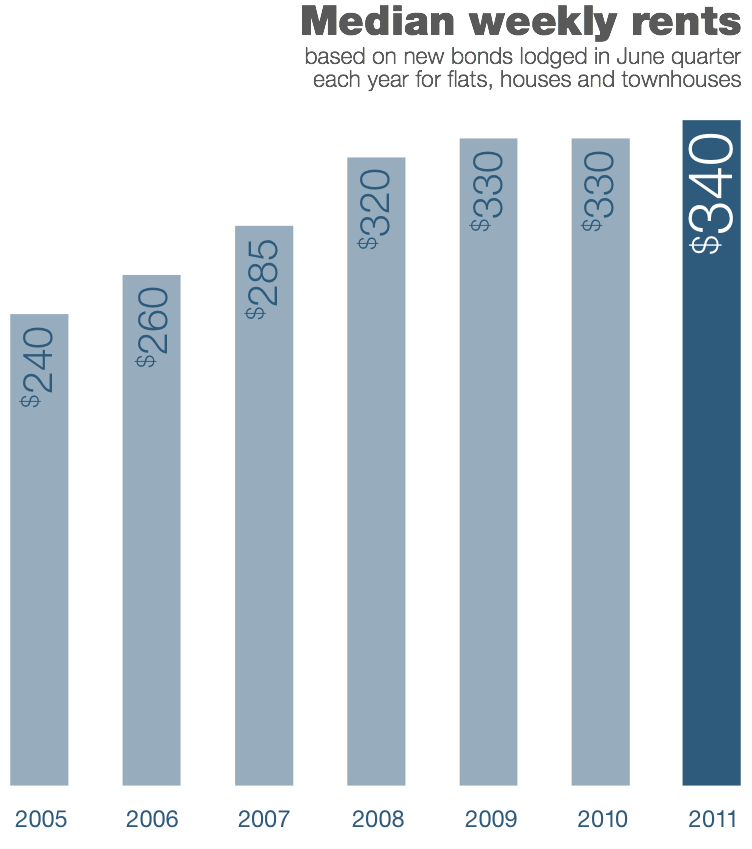
Rents growing again (modestly) after post-GFC stability

The 2010-11 Annual Report of the Residential Tenancies Authority, released earlier this week, includes a wealth of interesting data relating to Queensland’s rental sector. While we know rents in some parts of Queensland (e.g. Gladstone) are soaring due to the resources boom, in other parts (e.g. Gold Coast) over-supply has kept rents down. Across Queensland, on average, rents have only just started to increase again (and only modestly) after a post-GFC pause:

Posted in Housing, Macroeconomy, Mining | Leave a comment

Inefficient State taxes

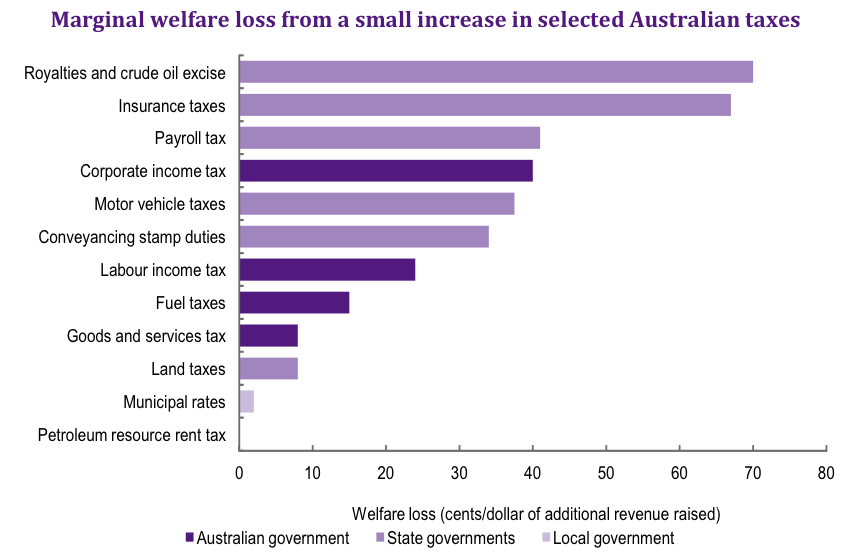
In its position statement for the upcoming Tax Forum (available here) the AI Group has called for an abolition of inefficient State Government taxes such as stamp duty and a hike in the GST to pay for it.  The position statement reproduces this great chart from the Henry Review which is based on modelling by KPMG-Econtech:

The chart shows the additional loss to the economy – e.g. through discouraging transactions such as selling a house that may have occurred in the absence of a tax – due to the raising of one dollar by a particular tax. So, for example, the cost of raising one dollar through stamp duty is one dollar plus the efficiency loss to the economy of around 35 cents. The GST, however, is much more efficient and we would be better off if there were a change in the tax mix.

Posted in Tax | 3 Comments

NBN must have a big carbon footprint

A report on the National Broadband Network (NBN) trial in Ipswich’s eastern suburbs (NBN revolution dawns) suggests the rollout of the NBN will be more difficult than expected. And it appears the network demands a lot of electricity, which means it will have a big carbon footprint. The Queensland Times reports on the switch in the site of the pilot from Springfield Lakes, a new suburb developed in the last decade, to Goodna, a well established suburb:

Springfield Lakes was initially earmarked for the first NBN trial in the Ipswich region, but Mr Rudd [from NBN Co] said that had to be changed after they discovered the Telstra infrastructure there could not support it.

He said that region’s fibre area network (FAN) site, which is “essentially a Telstra exchange”, wasn’t large enough with the right equipment and power supply.But to keep the program on track and start building in this area, Mr Rudd said they chose Goodna because of its favourable FAN site.

For the rest of region, the NBN Co expects to table info on when other areas in Ipswich will have their infrastructure installed.

It’s unclear whether this means Springfield Lakes will never get the NBN or whether it’s just unsuitable for the trial. It’s also unclear whether there will need to be unexpected equipment and power supply upgrades of networks across Australia to accommodate the NBN and what this means for the cost of the already $30-40 billion project.

Posted in Infrastructure, Ipswich | Leave a comment

5,000 FIFO/DIDO workers forecast for Surat Basin

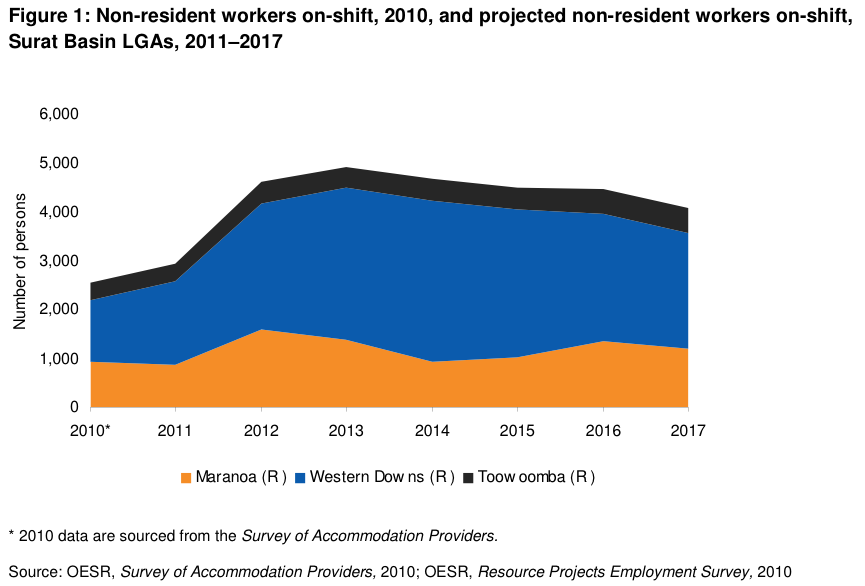
OESR released its latest Surat Basin Population report on Friday, and it shows a big expected jump in fly in-fly out (FIFO) and drive in-drive out (DIDO) workers in the region in 2012 (see figure below).

OESR notes:

The projected number of non-resident workers on-shift are likely to increase sharply in 2012 as large- scale construction activity begins on CSG and coal projects (Table 6, Figure 1). Numbers are expected to peak at around 4,930 in 2013 and then decline steadily as large construction workforces are reduced and smaller operational workforces take over completed mining and gas projects.

Posted in Mining, Population | Leave a comment

Procrastinating on international climate change action

Someone in the Federal Government ought to read Brian Tracey’s Eat that Frog! The latest development in our international efforts on climate change strikes me as a massive case of procrastination. As reported this morning (Joint emissions plan to UN):

AUSTRALIA says a new legally binding global deal on climate change should not be finalised until 2015 so measures strengthening global action to reduce emissions can be put in place.

In a joint submission with Norway to the United Nations, Australia proposes the 2015 timetable in a plan to ”scale-up” international efforts on climate change to meet a global goal of limiting temperature rises below 2 degrees.

The Australia-Norway submission argues a 2015 timetable ”will provide time and space for countries to build confidence and capacity, and ensure a robust outcome over time”.

A spokesman for the Climate Change Minister, Greg Combet, said yesterday ”existing commitments under the Kyoto Protocol end in December 2012 and Australia supports a binding agreement of all major emitters as soon as practicable after that”.

The 2015 timetable is likely to bolster domestic critics of the government’s carbon tax plans, who argue slow global progress on climate change puts Australia ahead of the world by introducing the scheme in mid-2012.

Climate change is either a threat to humanity, in which case we should press for an immediate international agreement, or it isn’t, in which case we should scrap the proposed carbon tax. I am very confused about the Government’s position on this issue.

Posted in Climate change | Leave a comment