FIFO no good for Fido

While fly-in, fly-out (FIFO) workforces make economic sense (given the temporary nature of much of the resources sector drilling and construction activity and due to the impact of fringe benefits tax) there are possibly some adverse social impacts requiring management. Unfortunately, man’s best friend may be suffering as a result of the big increase in FIFO labour, as reported in the Sunshine Coast Daily (Mine boom the pits for dogs):

SUNSHINE Coast dogs are being abandoned as their owners head to the mines to cash in on the resources boom.

Sippy Downs Animal Refuge has launched the Needy November Nine campaign in an attempt to find the pooches a new “forever” home.

Volunteer carer Rosalie Symons said owners were struggling to find a pet-friendly home in the tight rental market in the Bowen Basin.

Others struggled to find a carer on the Coast to match with their fly-in, fly-out rosters.

Last month, in a submission to the Federal Parliamentary Inquiry into FIFO, the Queensland Government called for a review of fringe benefits tax:

Fringe benefits tax arrangements currently benefit companies providing temporary accommodation in special purpose on-site or off-site workers villages in contrast to providing or subsidising permanent housing for workers in towns and centres near mining operations. The Commonwealth could consider tax arrangements that encourage the provision of housing in resource towns through better tax policy neutrality.

While I can see some merit in this argument, given that the workers would be unlikely to live in the towns if it weren’t for the job, there is no doubt workers are being provided a benefit that should be taxed like income. Hence, on balance, I don’t think a fringe benefits tax exemption would be a good idea.
Posted in Mining | 1 Comment

Too early to assess Qantas dispute impacts

The Qantas dispute should have minimal impacts on the Queensland economy so long as it is resolved quickly and we don’t have another grounding of the fleet. But, as Saturday’s bold move by Qantas showed, the situation is highly unpredictable.

Tourism Queensland, which is avoiding the over-the-top claims of some other industry players and politicians, appears to have a sound grasp of the situation, as reported in today’s Cairns Post:

Tourism Queensland’s destination director for the Tropics and Great Barrier Reef, Jeff Gillies, said it was too early to compare the Qantas decision with the pilots’ strike of 1989.

The strike, waged by pilots from Ansett, Australian Airlines and others, crippled the Far North’s economy to the tune of $1 million a day.

Mr Gillies said it would be “silly not to say that the industry would fear” an impact similar to the pilots’ strike, but there was no cause for alarm yet.

“It is not doomsday, but it is certainly something we could do without,” he said.

Posted in Macroeconomy, Tourism, Transport | Leave a comment

Investment pipeline begins – wrong time to cut interest rates

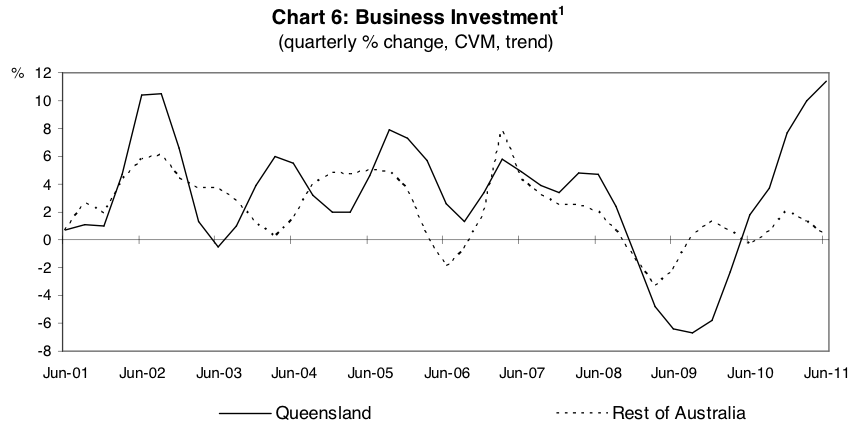
From the OESR Queensland State Accounts released earlier this week:

Let’s hope the RBA saw this chart before it finalised the Board papers for the Cup day meeting. Cutting rates now would add to demand pressures and lead to higher inflation in the future. I have no doubt the Queensland economy is about to take off.

Posted in Macroeconomy | Leave a comment

Occupy Brisbane anarchists struggle to draft mission statement

Occupy Brisbane at Post Office Square is fascinating but will ultimately turn out to be futile. Unlike protestors against the Vietnam war or apartheid, the movement isn’t advancing a specific and potentially achievable policy position, but instead calling for some unrealistic anarchism. This is clear from their website blurb:

We will ALWAYS remain peaceful and respectful of all political persuasions, working with Police & the people of Brisbane. We simply propose a directly democratic and non-hierarchical social situation where neither capital nor the state determine the way we live or how society functions – that is what would be ideal. In other words, a real democracy in which we consciously and collectively determine social life. This is incompatible with both capitalism and state socialism – both of which produce economic and political monopolies.

Given their clearly anarchistic leanings, it’s probably unsurprising that, after nearly two weeks of occupation, they still can’t agree on a mission statement. Clicking on the Mission Statement button on the website produces:

The mission statement is currently being drafted and voted on in the General Assembly each day. Once this document is finalised it will be posted here.

Posted in Brisbane, Uncategorized | 1 Comment

Will the RBA cut interest rates on Cup day?

Following yesterday’s lower than expected inflation data, and concerns about the Euro zone, there is speculation the RBA board will cut interest rates on Melbourne Cup day (Low inflation raises case for RBA rate cut). I doubt the board will cut rates, however, as they would be moving against the general upward trajectory that they know interest rates have to go over the next few years as the economy returns to long-term trend growth rates.

And as observed by noted Australian financial economist Chris Joye here “The fact is 25bps here or there is not going to make a world of difference to anything”, although Mr Joye is forecasting a one-off cut on Cup day.

Partly for the sake of appearing to know what it’s doing, in my view, the RBA won’t cut. The cash rate (the short-term interest rate the RBA controls) is currently at 4.75%. I expect the RBA would have in mind eventually increasing this to somewhere in the 5.5-6.0% range – traditionally viewed as the neutral cash rate range – as the economy picks up in response to the big pipeline of resources sector investment.

There is, however, a large debate on the level of Australia’s neutral cash rate, which I’ll try to cover in a future post. On this topic, this note from Shane Oliver is a good read:

How high will the Australian cash rate go?

Posted in Macroeconomy | Leave a comment

OESR expects Qld population growth to recover

In the latest Queensland Economic Review, released today, Queensland Treasury’s Office of Economic and Statistical Research (OESR) expects a turnaround in Queensland’s population growth, which in recent years has been lacklustre, partly due to a decline in overseas student numbers associated with a higher Australian dollar. OESR notes:

More recently though, there have been some positive signs for Queensland’s population growth. Over the past year, arrivals from New Zealand have improved, while 457 visas grants have increased so far in 2011–12. After falling in each consecutive quarter since June 2007, annual net interstate migration has appeared to stabilise, a better than expected result given the possibility that the floods may have delayed moving decisions somewhat in the March quarter.

Looking ahead, the Federal Government’s planned policy changes to the student visa program, made in response to the Knight report on the overseas education sector, should see an improvement in both the attractiveness and accessibility of Australian education for international students.

Posted in Migration, Population | Leave a comment

Mining companies poaching Bundy tradies

Back in the 1980s, when there was a massive increase in university enrolments and attainment, the folk wisdom was that a trade was a good thing to fall back on, if your professional career or business failed, and hence it was probably still worth getting one.  The idea that a trade is only something to fall back on seems silly now, with the massive demand for trade skills caused by the resources boom. It will become even harder to find tradies, particularly electricians, and no doubt their rates will substantially increase, as similar stories to this one in Bundaberg emerge across Queensland cities and towns (Hands off our tradies):

A BUNDABERG tradesman has called on mining companies to train their own apprentices, saying their poaching of skilled workers will push Bundaberg into a trades shortage.

In the past six to eight weeks, Laser electrical Bundaberg has lost about half of its workforce to the attraction of mining pay packets.

Managing director Matthew Kummerow said despite having no staff retention problems previously, in the past few weeks two qualified electricians and two apprentices had left for jobs with the mines.

“In the last few months (the mining companies) have been extremely actively recruiting,” he said.

Posted in Mining | Leave a comment

Stamp duty volatility a risk to the Qld Budget

RP Data’s Cameron Kusher makes some good points regarding the risk to the budget from relying on stamp duty revenue, which varies with the total value of property sales, as reported in the Townsville Bulletin yesterday (Governments facing stamp duty shortfall):

GOVERNMENTS are likely to seek new ways to raise revenue following a major drop in the value of property sales across the nation in the 2010/11 financial year, according to RP Data.

RP Data says the value of home sales across Australia fell by 18.2 per cent in the 2010/11 financial year, the largest annual fall in more than a decade, with Queensland recording the largest drop of 27.5 per cent…

…RP Data’s Cameron Kusher says state and local governments are heavily reliant on property transactions as a source of revenue, with stamp duty, council rates and land tax calculated off either the unimproved value of land or the value of a property transaction.

“With the total value of sales down by 18.2 per cent over the 2010-11 year, there will be substantial holes in state and local government budgets,” he says.

To an extent, Queensland Treasury has already taken this into account in its budgetary estimates. At the time of the 2010-11 Budget in June 2010, Treasury was forecasting total stamp duty revenue of $2.2 billion in 2010-11. But at the time of the 2011-12 Budget in June 2011, Treasury had revised this forecast to $2.0 billion (i.e. a reduction of around 9%). RP Data’s figures suggest a further revision is possible and this could increase the 2010-11 deficit by several hundreds of millions of dollars.

I expect the property market (and stamp duty revenue) will rebound strongly over the current financial year as the full impact of the resources boom starts to flow through the Queensland and broader Australian economies. Stamp duty revenue is also being bolstered in 2011-12 by the removal of the principal place of residence concession. On this issue, see my previous post:

We should cut stamp duty, not increase it

Posted in Budget, Tax, Uncategorized | Leave a comment

Far North economy gradually improving, but Gold Coast still weak

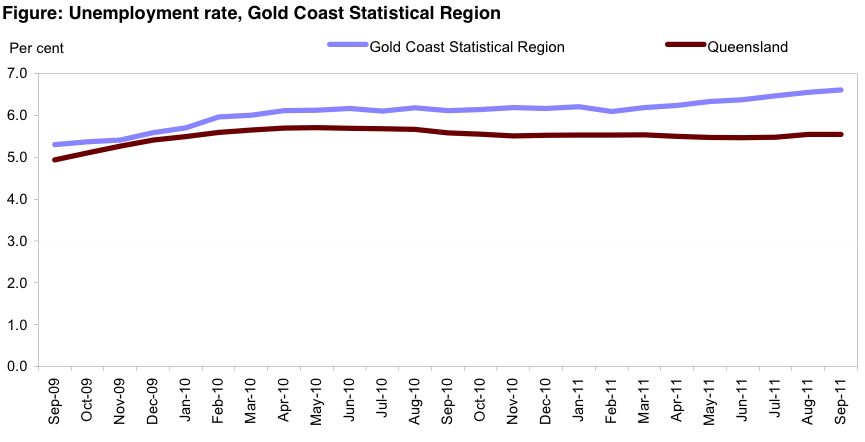
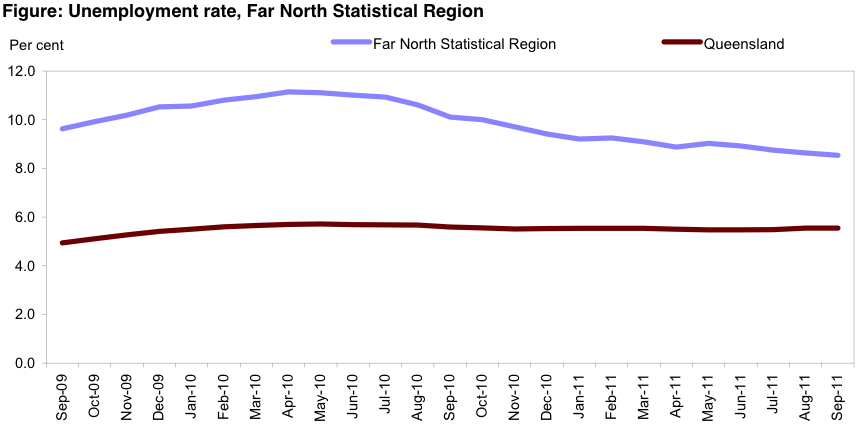
The latest ABS regional labour force data released yesterday show different trends for two of the Queensland regions hardest hit by the higher Australia dollar. While the Far North’s economy is gradually improving, the Gold Coast’s economy remains weak. Charts from the OESR information briefs based on 12-month averages are below, and Loose Change has coverage here: Lowest unemployment rate in three years!

Posted in Gold Coast, Labour market, North Queensland | 1 Comment

Treasury chief’s nuanced optimism on China

Treasury Secretary Dr Martin Parkinson delivered a highly informative speech to a Goldman Sachs conference yesterday, in which he noted:

…Treasury has often been portrayed as eternally optimistic on the Chinese economy – in fact, our analysis is far more nuanced than that.

In the short-term, while there are certainly risks – not least the vulnerable international outlook – we believe that the outlook for China is strong and that a “hard landing” is unlikely. Domestic demand continues to grow strongly and China has much policy space should there be a major slowdown in global growth.

Posted in Macroeconomy, Uncategorized | Leave a comment