Best charts from the State Growth Outlook Study

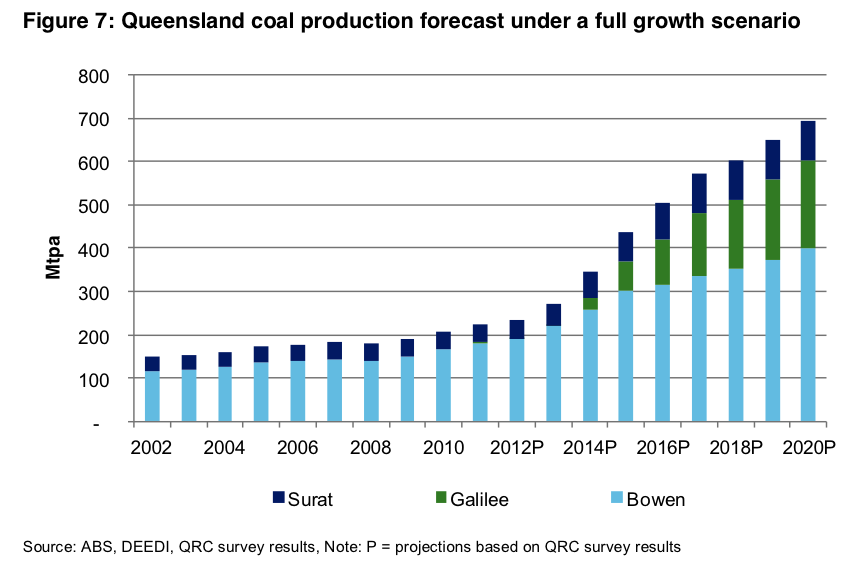
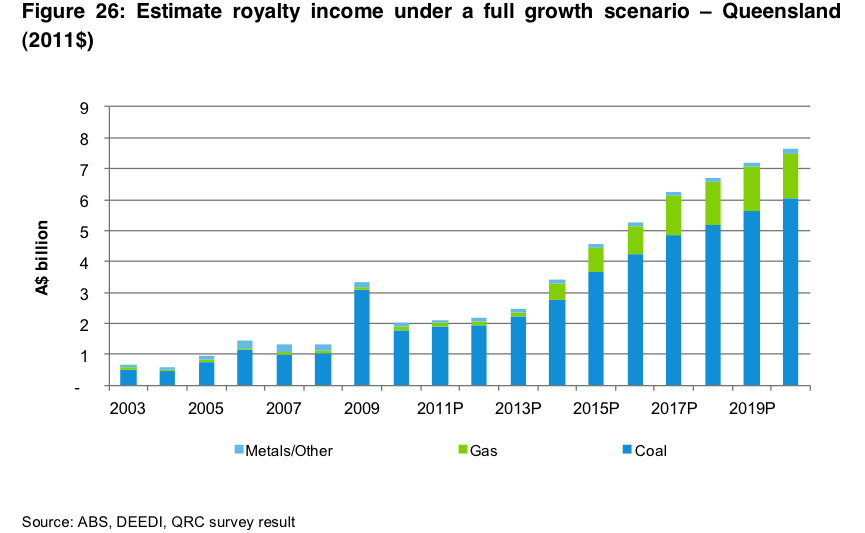
Whoever wins the State election next year will have a lot of money to play with thanks to the projected big increase in royalties associated with the resources boom, as charted in the Queensland Resources Council’s State Growth Outlook Study:

But let’s not ask what this chart means for global greenhouse gas emissions:

Posted in Mining | Leave a comment

FIFO Coordinator will be very busy

Last week Australia’s first FIFO (i.e. fly-in, fly-out) Coordinator was appointed in Cairns, with the task of matching locals to FIFO job opportunities in the resources sector (FIFO Coordinator based in Cairns). Based on the ongoing sluggishness in the Far North’s labour market, and projections of massive jobs growth in the resources sector, the FIFO Coordinator is likely to be very busy. Regarding projections of massive jobs growth, today’s Mackay Daily Mercury reports on a new Queensland Resources Council study (Demand for workers to soar):

GET ready for Boom Mark II – Queensland’s resource sector will need 40,000 workers as $142 billion worth of projects come on line in the next nine years.

However, almost 32,000 of the workers will be non-residents, according to a Queensland Resource Council (QRC) Growth Outlook Study.

QRC chief executive Michael Roche said those workers would be sourced from regions around Queensland; however, that shouldn’t detract from the growth pressures mining towns would face.

He said resource communities were still feeling the strain of the last growth surge and there was limited, if any, appetite for another round given lagging infrastructure and social service funding from governments.

“However, Bowen Basin resource project developers are currently factoring in an almost 25% increase in their residential workforce from the current 17,700 to an estimated 21,900 by 2020,” he said.

“Over the same period, the number of non-resident resource industry workers in the Bowen Basin could rise from 7300 to 20,000 under a full growth scenario. By 2020, just over half the Bowen Basin resources workforce is forecast to be locally based. However, that should not detract from the fact that few regions anywhere in the country are likely to face population growth pressures of the magnitude projected for towns in that region.”

Posted in Cairns, Mining, North Queensland | Leave a comment

Education Dept will need to build a lot of new classrooms

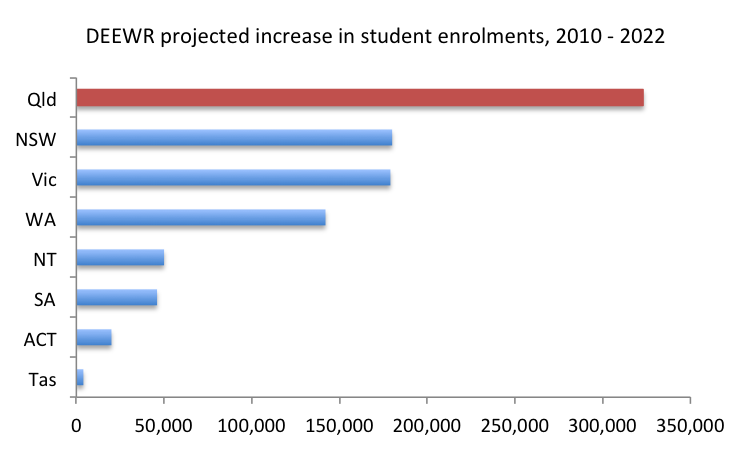
If there is a new Campbell Newman-led Government in Queensland next year, as the polls are suggesting, it will need to assess the budgetary implications of a large increase in the number of school students, before it commits funds to building tunnels, bridges or roads.  In a draft report on the Schools Workforce (p. 21), the Productivity Commission presented these interesting figures from the Commonwealth Department of Education, Employment, and Workplace Relations:

The big increase in projected student enrolments for Queensland is most likely due to both high numbers of interstate migrants (until recently) who were disproportionately of child-bearing age and the recent surge in our fertility rate.

Posted in Budget, Education, Infrastructure | Leave a comment

Talking sense about the Commonwealth Games

Sunland chairman Soheil Abedian is absolutely right that the Gold Coast’s major problem is its inability to control drunks and criminals, and hence the Commonwealth Games won’t itself save the Coast’s economy (as reported in today’s Gold Coast Bulletin):

At the Urban Development Institute of Australia hosted [mayoral candidates] debate yesterday, Mr Abedian said the candidates were relying too heavily on the Games, not what had to be done immediately to clean up the city.

“None of you has given any solution on how to go forward,” he said.

“Everyone points to 2018 as that is when the return of Christ will come.”

“Let’s start with very small steps. We know the problem. It’s not Coomera or Nerang, it’s the heart of the city.

“It’s in the heart of the city (Surfers Paradise) where my family are afraid to walk.”

Sensible (although possibly too negative) views on the Commonwealth Games were also made earlier this week by Chris Berg of the Institute of Public Affairs at the Drum website:

Commonwealth Games bad news for the Gold Coast

I anticipate the Games will bring some economic stimulus to the Gold Coast, but it will be much lower than Gold Coast business and community leaders expect. Hence the need to get the basics right, as argued by Mr Abedian.

Posted in Gold Coast | Leave a comment

Queensland wages growth trailing other States

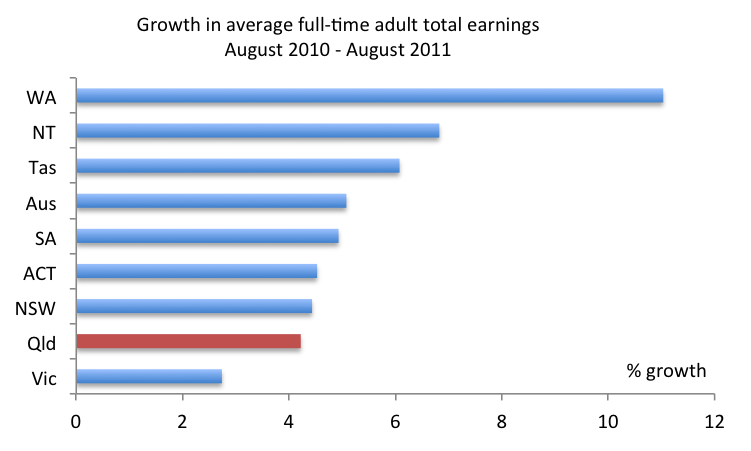
Peter Martin has a solid column in the Fairfax papers this morning on the ABS’s new average weekly earnings data, highlighting the strong growth in mining sector earnings and the very strong growth in earnings in Western Australia (Boom times in West deliver pay bonanza to miners):

AUSTRALIA’S earnings landscape is shifting. Ten years ago the average full-time adult male worker in NSW took home $70 a week more than his counterpart in Western Australia.

These days West Australian men outpace NSW men by $335 a week. Western Australia eclipsed the ACT as the highest earning state or territory more than a year ago.

For women the margins between states are little changed, suggesting Western Australia’s earnings growth is being driven by the male-dominated mining and construction industries.

Martin makes no reference to Queensland figures in his article for good reason, as Queensland’s average weekly earnings growth has been unremarkable in recent times:

This is related to Queensland’s recent economic sluggishness and our average earnings growth should improve significantly as the economy recovers strongly over the next few years. That said, there may be regional differences in the recovery.

Regarding other labour market news, there is a post at Loose Change on how the Far North’s labour market still appears to be struggling:

October unemployment bounces back up

Posted in Cairns, Labour market, Macroeconomy, Mining | Leave a comment

Has Brisbane City Council been skimping on maintenance?

Following today’s report on the crumbling Story Bridge, I’m worried that Brisbane City Council may not have proper plans for managing its assets and undertaking regular maintenance. I found this fact unsettling:

It is the fifth large piece of Brisbane City Council-owned infrastructure to face major repairs in the past three years, following on from City Hall, the William Jolly Bridge, the Victoria Bridge and the Walter Taylor Bridge.

Is this bad luck or bad management?

Posted in Brisbane, Infrastructure, Transport | Leave a comment

Sales of new motor vehicles continue to trend upwards

The continuing upward trend in new motor vehicle sales (see chart below based on new ABS data) is indicative of the economy’s underlying strength and improving confidence of households.

It’s probably unsurprising that the SUV share of new motor vehicle sales has increased significantly in recent years:

Posted in Macroeconomy | Leave a comment

Teacher performance pay

Last night in Melbourne, where I’m based for the next few weeks, I attended a Grattan Institute event on the economics and politics of teacher merit (i.e. performance) pay, which featured former ANU economics professor, now federal MP Andrew Leigh in conversation with Grattan CEO John Daley. While Andrew is a supporter of performance pay for teachers, he noted there is limited evidence on the effectiveness of such schemes. Partly this is because the existing evaluations tend to focus on the incentive effect of performance pay (i.e. making existing teachers work harder/smarter) rather than the selection effect (i.e. attracting better people into the profession or retaining the better teachers), which is much more important.  Andrew’s latest views on teacher performance pay are presented in this paper:

Economics and politics of teacher merit pay

I am a big supporter of performance pay for teachers, as discussed in this previous post:

Teacher bonus scheme a worthwhile experiment

Posted in Education | Leave a comment

Economic benefits of Games usually over-stated

There is no doubt the Commonwealth Games will provide an economic boost to the Gold Coast and support job creation in the region, but I’m skeptical about the estimated 30,000 jobs figure, given that the economic impacts and net benefits of major events are typically over-stated (see my previous post on the Games bid). Further, it’s unclear to what extent the jobs are ongoing, rather than temporary jobs in the construction phase or during the Games themselves.

The estimated jobs figure reported in the Sunday Mail (Gold Coast’s Commonwealth Games win set to bring a jobs revolution) appears to have come from a feasibility study undertaken by the Queensland Government. I can’t find a copy of it online, and it may not be publicly available. If so, I’d urge the Government to release the study so the community can understand the likely timing and magnitude of the economic impacts of the Games.

Posted in Gold Coast, Labour market | Leave a comment

Surge in residential lot development approvals in Townsville, small recovery in Cairns

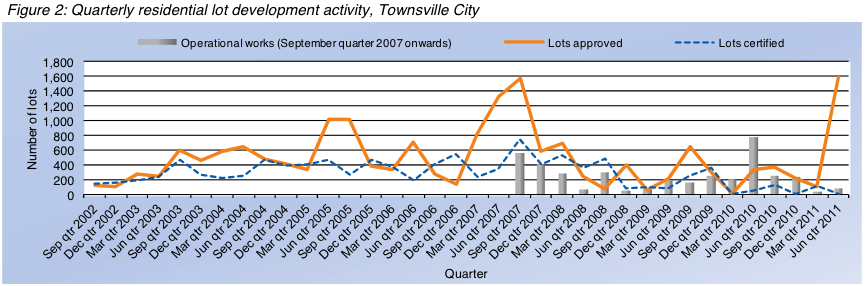
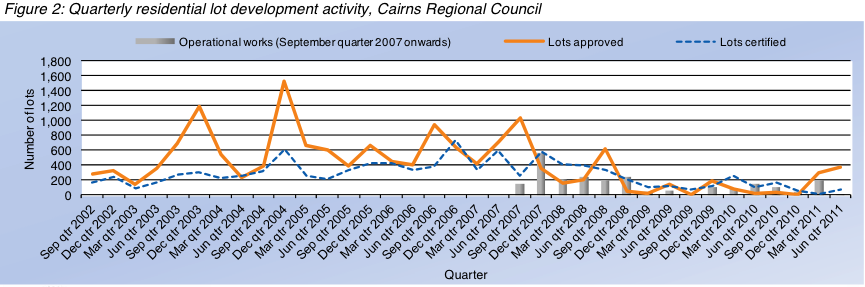
Back in the 1980s, there was concern in the Townsville community about how Cairns, then experiencing rapid growth, would over-take Townsville to become the so-called capital of North Queensland. Obviously, that is no longer a possibility as Townsville appears to be surging while Cairns struggles to recover economically, as confirmed by residential lot development data released by OESR yesterday. I’ve copied and pasted the most interesting charts below:

Posted in Cairns, Housing, North Queensland, Townsville | 2 Comments