
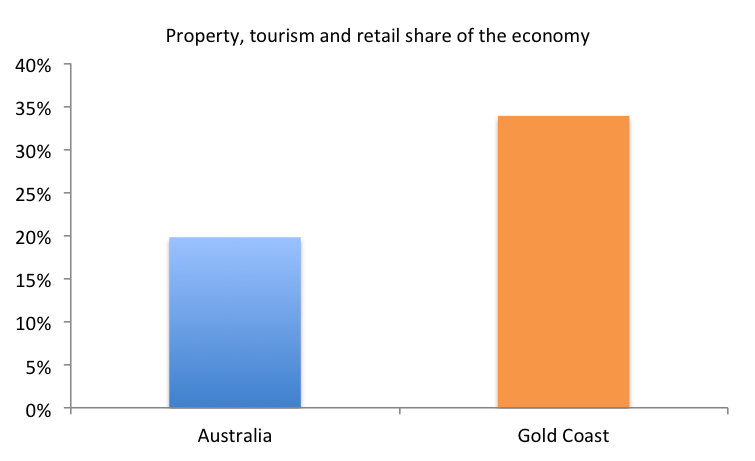
The Gold Coast Draft Economic Development Strategy 2013-2023 expresses concern over the Gold Coast’s reliance on its traditional sectors of property, tourism and retail (see chart above based on data from the Strategy), noting:
The cyclical nature of these industries has left the city vulnerable to boom and bust cycles and has been evident over the past few years with the city impacted by national and global economic shocks.
While it is true that more diverse regional economies have better economic performance on average (see this great article by my former colleagues Bernard Trendle and Gianna Shorney), it’s unclear whether the Gold Coast should deliberately promote the development of particular industries to diversify its economy. The two main points I’d make are:
- a region’s industry mix will largely be the outcome of decisions made by private businesses about where to locate and invest, based on their understanding of economic opportunities, and it’s unwise for governments and councils to think they know any better and to pick winners; and
- increasingly, the Gold Coast should be viewed as part of a broader South East Queensland economy – the so-called 200km City – rather than as an individual regional economy that should be worried about its own economic structure independent of the whole region.
Regarding the 200km City, a report by Bernard Salt released yesterday highlights the importance of commuter flows from the Gold Coast to Brisbane and other regions (see Gold Coast Bulletin coverage, Gold Coasters among biggest commuters). Many people live on the Gold Coast for lifestyle reasons and are quite prepared to commute to other local government areas to work.
I’ve previously posted on the 200km City:
 Queensland Economy Watch