
Excluding petrol from the carbon tax is good news for people who drive a lot, but means we will all have to pay even higher electricity prices. The Australian reports:
“Families, tradies, small business people do not have to worry about a petrol price increase,” Ms Gillard said on ABC’s Insiders program this morning.
If we’re going to have a carbon tax, it must be broad-based, and it should cover petrol because the transport sector is responsible for 15% of greenhouse gas emissions (see chart below from the 2008 Treasury climate change modelling report). Exempting petrol means that to obtain a targeted reduction in greenhouse gas emissions we must reduce emissions in other areas, e.g. electricity generation, more than otherwise. To do this, the carbon tax will have to be higher and power bills will have to rise more than they would otherwise.
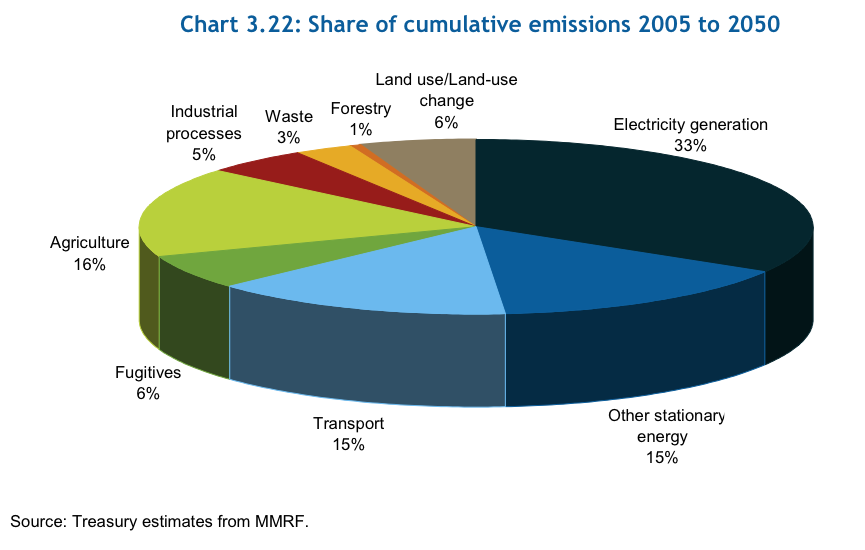 The Government may resort to higher fuel efficiency standards for motor vehicles to bring down transport emissions, but we know from the Henry Review this is not as cost-effective as including fuel in a carbon pricing scheme:
…targeting vehicle fuel efficiency as a means of achieving reduced emissions is a blunt instrument compared to targeting emissions directly by reflecting the cost of carbon emissions in fuel prices. Individual emissions levels depend not only on the efficiency of the vehicle, but also on other factors, particularly distance travelled, weight carried and driver behaviour. Proposed subsidy schemes would reward people who purchase a fuel-efficient vehicle yet travel large distances, and penalise people who purchases a less expensive, less fuel-efficient vehicle, but travel rarely. Such instruments are less cost-effective than relying on a pollution charge alone.
That’s from Part 2, Volume 2, page 363 of the Final Report of the Henry Review. That report is going to have a long shelf-life.
 Queensland Economy Watch