Should we repeal the compulsory bike helmet law?

Brisbane City Council’s plan to turn Brisbane into a cycling haven, akin to say Copenhagen or Amsterdam, looks like it may be frustrated by Queensland’s compulsory helmet law. The Council’s inner city bike hire scheme will be less attractive if potential users (e.g., office workers, students or tourists) have to either carry around a helmet or hire one from a participating local shop.  It’s enough of a friction and additional cost to make people consider walking the distance instead.  This realisation probably underlies the Council’s plan to give away 2,000 free bike helmets:

Helmet giveaway for bike hire scheme

Queensland’s compulsory bike helmet law risks the viability of the Council’s bike hire scheme.  Moreover, it’s unclear whether it’s even good public policy.  See, for example:

Bicycle helmet laws are “failed public policy” says public health expert

From a public health point of view, when you make helmets compulsory, you may save the lives of a number of people who crash and land on their heads, but there are offsetting effects because helmet laws discourage a lot of people from cycling, due to the cost and inconvenience of helmets.  Also, people will start to think, if you have to wear a helmet, cycling must be risky.

Discouraging cycling is bad because, on balance, cycling is very good for us.  With fewer people cycling, people are less healthy on average and more likely to die from heart attacks.  Also, having fewer people cycling makes it more dangerous for those who continue to cycle, because car drivers don’t see cyclists on the road as much.  Thus, drivers come to view cyclists as a nuisance rather than legitimate sharers of the road, and don’t take as much care in looking out for cyclists.

So it’s possible we’d be better off if we repealed the compulsory bike helmet law.  And, if we can encourage cycling in Brisbane to reach continental European levels, we may have a shot at making Monocle’s top 25 most liveable cities.
Posted in Uncategorized | 3 Comments

Sustainable and ethical jeans

Do you know if your jeans were produced in sustainable and ethical ways?  Increasingly consumers will demand to know if they were, according to an interesting panel discussion at the second day (11 August, 2010) of the Australian Cotton Conference on the Gold Coast.

There is a strong interest among consumers in the sustainability and ethics of products, and emerging demands for the traceability of a product’s sustainability and ethical soundness through the entire supply chain.

Traceability would mean that, when you go to buy a pair of jeans, there would be a label certifying the jeans weren’t manufactured in a sweatshop and that the cotton was grown according to environmentally sound practices.  For further discussion, see for example:

Traceability program keeps cotton on track

There is definitely a buck to be made in helping companies trace their sustainability and ethical soundness, and judging from the interest in this topic at the conference, there are already a few people setting themselves up to fill this emerging market need.

Posted in Uncategorized | Leave a comment

Australian Cotton Conference, Gold Coast, 10-12 August – first day highlights

The Australian Cotton Conference features a fascinating combination of agronomy, politics, farm machinery (with big tractors displayed in the trades hall) and fashion (including a runway show of the work of young designers).

Murray Darling Basin Authority (MDBA) chairperson Mike Taylor received the bulk of the questions, mainly from irrigators and their representatives, in the Conference’s first session yesterday.

In addition to defending the MDBA’s delay in releasing the Basin Plan, due to the caretaker conventions in play for the federal election, Mr Taylor repeatedly stressed the process the MDBA adopted in developing the Plan is prescribed by legislation, the Water Act 2007, which was twice passed by the Commonwealth Parliament.  In determining sustainable diversion limits (of water for communities in the Basin), regard first has to be given to the needs of the environment.

Clearly this means there would have to be significant reductions in water availability in some regions, with consequent flow on economic and social impacts to regional communities.  Mr Taylor observed that the MDBA would present the incoming Commonwealth Government with an Incoming Government Brief containing some strong messages about the likely socio-economic impacts of the Basin Plan.

Andrew Gregson from the NSW Irrigators Council asked Mr Taylor whether the Basin Plan, which has to give prime consideration to the environment, is consistent with the 2004 National Water Initiative agreed by the Council of Australian Governments (COAG), which gives equal standing to economic, social and environmental criteria.  In responding to Mr Gregson, Mr Taylor again noted the prescriptive nature of the Water Act, which, owing to its status as legislation, overrides any agreement reached by COAG.

Mr Gregson is a very effective speaker and no doubt will feature prominently in any campaign by irrigators against the Basin Plan.  In a later session yesterday, Mr Gregson forecast that it was very unlikely irrigators would be able to live with the Basin Plan developed under the current process, given the primacy of the environment in the Plan’s development.  He told irrigators the messages they need to hammer home to the public include: “Everyone loses, not just farmers” and “Family farms will be forced to close” – farms which have been owned and operated by the same families for generations.

Posted in Uncategorized | 1 Comment

Resources sector investment spending critical for growth

Yesterday’s Reserve Bank Statement on Monetary Policy confirms that the Australian economy is heading back towards a strong GDP growth rate of around 4%, but highlights that the strength of the Australian economy depends critically on investments by the resources sector (and the timing of those investments).  The Bank observes:

The capital expenditure (Capex) survey’s second estimate of firms’ spending plans in 2010/11 points to a significant rise in buildings and structures investment, led by the mining sector. In particular, with work on the $43 billion Gorgon LNG project having commenced in late 2009, there is a significant pipeline of engineering work yet to be done.

Coal seam gas projects in Queensland are an important part of the upcoming investment spending by the resources sector:

Further out, there are a number of significant projects in the advanced stages of planning, including additional LNG projects on the North-West Shelf off the coast of Western Australia and coal-seam methane projects in Queensland.

Regarding the risks relating to the timing of resources sector investments, the Bank notes:

Given the uncertainty about the timing of a number of planned large investment projects in the resources sector, it is possible that overall growth over the next few quarters could be a little weaker than in the central forecast [i.e. GDP growth of 3.25% over 2010 and 3.75% over 2011].

The Bank notes the weakness in other sectors of the economy, and highlights the role of the Government’s school building stimulus program in supporting non-residential building activity:

In contrast to the mining sector, private non-residential building activity remains weak. Outside of public spending on private schools, the value of non-residential building approvals has remained at a low level since early 2009.

Posted in Uncategorized | 1 Comment

Sky beats ABC News 24 on election coverage

To justify taxpayer support, ABC News 24 needs to at least match, if not better, Sky News’s coverage of important issues.  But, as reported in the Fairfax papers (Sky high on Rudd as ABC protects its saucers), the channel is failing to cover important breaking news stories – i.e., it is failing in the role that would justify its existence.  For further information, see my previous post:

Do we need ABC News 24?

Posted in Media | Leave a comment

Brisbane not yet one of Monocle’s 25 most liveable cities in the world

In today’s Courier-Mail, columnist Robert MacDonald laments that Brisbane isn’t one of Monocle Magazine’s top 25 most liveable cities in the world (Munich is no. 1, Melbourne is 9th, Sydney is 12th, and Auckland is 20th).  Mr MacDonald comments:

We probably didn’t  stand a chance anyway.  Lists by definition are in the eyes of the compilers and Monocle, which provides “a briefing on global affairs, business, culture and design”, exudes an inner-urban sensibility of the type that judges cities by their approach to architecture, sustainability and ease of bicycling rather than, say, how casually people dress, how slowly they dawdle or how exuberant and overgrown the local foliage.

I’m sure the Monocle editors would appreciate the cosmopolitan charms of Brisbane’s West End, however, which is why it’s a shame the State Government has blocked the Council’s push for 12 storey high rises in the area, restricting building heights to seven storeys:

State Government reduces building heights at West End

It would be good for the Queensland economy if we could have more people living in diverse, edgy areas like West End, as this would help foster a more creative and innovative society.  (On this topic, I recommend Richard Florida’s great paper on Bohemia and Economic Geography.)

Posted in Uncategorized | 3 Comments

Reserve Bank decision sensible given economic uncertainty

While the consensus among economists appears to be that interest rates will increase by another 1-1.5% over the next year or so, the Reserve Bank’s decision to leave the cash rate at 4.5% today was sensible, given the uncertainty out there in the economy.

The economic news hasn’t been good for Queensland in recent days.  Today we recorded another monthly decline (for the fourth consecutive month) in building approvals, a leading indicator of activity.  Partly this is a natural response to the artificially high building approvals that were induced by the Commonwealth’s temporary boost to the first home owners grant.  But given some signs of softness in retail trade (Retailers slash prices to stay afloat in tough times) and tourism, we will have to keep a close eye on the health of the Queensland economy over the coming months.

Posted in Uncategorized | Leave a comment

Time to deregulate retail trading hours

It’s pleasing to see the recently introduced Sunday trading in Mackay (bringing Mackay into line with other coastal centres) is popular with local residents:

Sunday trading a hit in Mackay

It’s time for the Government to go further and consider further deregulation of trading hours across the State.  Why should Coles close at 6pm on a Sunday, for example?  Why should people have to race back from the Coast or leave afternoon barbeques early so they can squeeze in a trip to the supermarket?  There would be big gains in convenience to consumers if we allowed supermarkets to open longer hours.

All the traditional arguments in support of regulated trading hours seem to have less force nowadays.  It’s hard to argue that regulated trading hours prevent unsocial working hours when so many jobs nowadays are outside of ordinary hours and there are plenty of people, particularly students, who are willing to work at odd hours.  And the argument that we need to protect all the corner stores run by Mums and Dads is a lot weaker now that there are a lot fewer corner stores, with most of them replaced by IGAs at which we never see the Mums and Dads running them.

If there are any low hanging fruit out there for politicians interested in reform, deregulating trading hours is clearly one juicy piece.

Posted in Uncategorized | 1 Comment

Sir Richard Branson would really help us move forward

Sir Richard Branson is right to point out the downside of Australia’s small population, given the sheer size of Australia, which is a continent after all (Sir Richard Branson advocates big Australia):

A bigger population would create a much bigger economy without negatively affecting the people’s way of life.

Sir Richard’s call for policies to attract the wealthy from other countries probably doesn’t follow logically from this observation, however.  Given our large current account deficit, Australia isn’t lacking in capital coming in from overseas to finance Australian investment projects, so there’s probably not much benefit in having many more wealthy people here.

In the future, Australia is most likely to need low and medium skilled workers from overseas to perform service jobs, particularly in the aged care sector, as labour force growth slows down due to mass retirements of baby boomers.

That said, Sir Richard’s intervention in the national population debate is welcomed.  The Commonwealth Treasury, which is advising our Sustainable Population Minister Tony Burke, most likely agrees with Sir Richard’s view.  In a 2006 Treasury working paper on Australia’s Productivity Prospects, Treasury economists observed:

Partly as a result of nineteenth century history, Australia’s population is concentrated in a few large cities situated hundreds of kilometres apart. Cities are much more closely situated in the US. As a result, while average citizens in the two countries live in cities of similar sizes, the US has nearly eight times as many cities of substantial size as Australia in a given area.

These differences in geography and history mean that Australia misses many of the benefits of proximity that accrue to the US. Such benefits include the economies of scale, intensity of competition, and low transportation costs that are available in more densely populated markets.

Posted in Uncategorized | Leave a comment

A chart we’re bound to see again before election day

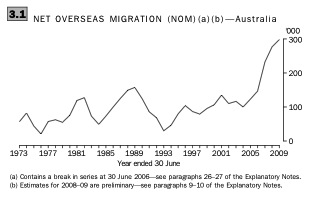
The ABS today released an impressive compendium of migration data, featuring this striking chart showing the surge in net overseas migration (NOM) – i.e., people coming here from overseas less those leaving for overseas:

The ABS observes:

Over the past three years, NOM has more than doubled from 146,800 persons in 2005–06 to a preliminary NOM estimate of 298,900 persons in 2008–09, the highest on record.

As the ABS notes in its report, this surge is largely driven by temporary migration of students and skilled workers on 457 (business long-stay) visas.  This is why any attempts to bring down the immigration numbers will be politically fraught, with the potential to upset education providers and businesses, particularly in the resources sector, which need skilled labour.

Posted in Migration | Leave a comment