Proposed Wacol development should be welcomed

Wacol, on the western outskirts of Brisbane City, has not had a salubrious history.  Its name derives from a weighbridge which weighed coal at the railway station – “weigh coal” became Wacol.  Today it is best known for its prison, and there is a local joke that drivers taking the rat run down Wacol Station Road are well advised to look out for kangaroos and escaped prisoners (which have included postcard bandit Brenden Abbott).

With this history, it is great news that Wacol’s prospects for economic development are looking up.  The Queensland Times reports (Wacol development given new hope):

A CONTENTIOUS $1.5 billion commercial development at Wacol has been given new hope.

A lengthy legal saga over the proposed Metroplex on Westgate development resulted in the Court of Appeal yesterday overturning the decision of the Planning and Environment Court (PEC) last November to refuse the application.

The developer Metroplex took Brisbane City Council to court in 2007 over its failure to approve the development at the former Wacol Army Barracks.

When Metroplex unveiled its $1.5 billion master plan, its vision was for industrial facilities, warehouses, 98,000 square metres of office space and retail outlets.

Metroplex said up to 7000 construction jobs would be created, with 15,000 ongoing jobs.

However the plan was vigorously opposed by Ipswich City Council, Springfield Land Corporation and nearby major shopping centres.

They argued it would draw people away from 10 other major centres in the region and exacerbate traffic problems on the Ipswich Motorway.

Ipswich City Council planning boss Paul Tully said the development would destroy the town centres of Goodna, Redbank and Springfield.

Well it’s not surprising that local shopping centres have opposed the development as it directly competes with them and will keep a lid on their rents.  Less clear is why Ipswich City Council is opposing it.  A new development at Wacol could force other regional shopping centres to spruce up their centres and give people a reason to shop at them.

It would also undoubtedly provide many retail jobs for local Ipswich residents, especially teenagers, as Wacol is only a short train ride from Gailes, Goodna, Redbank, and other eastern Ipswich suburbs.  Furthermore a large shopping precinct at Wacol may attract many people who would otherwise go to Indooroopilly Shoppingtown, where there is a lower likelihood of positive economic flow-ons to the Ipswich region than at Wacol.
Posted in Uncategorized | Leave a comment

QR investors make a tidy profit

It’s reassuring news for the Queensland economy that QR National didn’t tank on its sharemarket debut yesterday.  As reported in the Sydney Morning Herald (QRN float defies doubters by not sinking):

Retail investors who paid $2.45 a share made a paper profit of 17 cents on each share within 15 minutes of listing, while institutional investors made 7 cents, putting to rest fears that the stock would tank on the first day of listing.

The shares rose even higher to $2.68, before closing at $2.65, up 10 cents or 3.9 per cent for the day. Turnover topped $1.2 billion, with 476.3 million shares changing hands.

This doesn’t mean the Queensland Government gets any extra cash out of the float – it’s the retail and institutional investors who are profiting from the trading – but it will be of some relief to the Government, as it affects the value of the 34% of the stock it holds on its balance sheet.  It also makes it less likely the float will be seen as a complete failure:

The Bligh Government, which has 33.7 per cent of the stock, will be hoping like hell that the stock stays around these prices for the next 30 days so that it doesn’t need to trigger a so-called greenshoe option to stabilise the share price.

In the QR float, the government included the greenshoe option, which allows the float’s promoters to go into the market and trade as much as 6 per cent of the stock for 30 days if it looks like it might fall below the issue price.

Of course, the market can be volatile and fickle.  It’s going to be a nervous 30 days for the Premier and Treasurer as they wait for the greenshoe clause to expire.

Posted in Queensland Rail | Leave a comment

Queensland remains fattest State

The latest Fitness First Magazine (Nov 2010, p. 127) reports that 60% of adults in Queensland are overweight or obese (i.e. with a Body Mass Index of 25 or over), based on new research conducted by Galaxy Research.  The full results were:

  • Qld:    60% overweight or obese
  • WA:    59%
  • SA:      58%
  • NSW:  55%
  • Vic:     44%
  • Tas:    44%

This confirms Queensland’s status as the fattest State, as noted in this previous Queensland Economy Watch post:

Outdoor culture makes Coloradans skinny, but not Queenslanders

Posted in Uncategorized | 1 Comment

Disappointing QR float likely to inspire move against Bligh

A persistent rumour around Brisbane in 2010 has been that, once the asset sales were out of the way, the Labor caucus would oust Bligh and replace her with Attorney-General Cameron Dick, clearly Labor’s best performer in recent times.  With the disappointing news that QR National will list at $2.55 per share, near the bottom of the expected range of $2.50 to $3.00, it’s even more likely caucus will revolt.  A lot of old timers will be angry that the Government betrayed what they see as traditional Labor values and didn’t even get the full thirty pieces of silver in return.

If Bligh gets replaced with Dick and Labor’s polling improves, that must increase the chances of Tim Nicholls taking over the LNP in the medium term, meaning the election will be a face off between two Churchie Old Boys.  Queensland’s other GPS schools will have to lift their game.

The Brisbane Times has good coverage of the float here:

QRN float hauls in $4.6b for Bligh government

Also, Prof. John Quiggin wrote a hard-hitting post yesterday in which he questioned some of the reported financial gains from the float:

Smoke and mirrors yet again

Posted in Queensland Rail | Leave a comment

Fat cats getting fatter – by over 6% per annum

Given the pretty ordinary performance of governments across Australia in recent years (e.g. killer home insulation programs, loans being granted without proper approval, never-ending buck passing on our inadequate health system), you might expect some restraint among our pollies and public servants.  Instead we see pollies getting a pay rise (good on Bob Brown though for opposing it) and public servants continuing to receive big wage increases – 6.3% through-the-year to August 2010 compared with 4.0% for the private sector (see today’s Average Weekly Earnings release).

And in no way can this be considered as public servants experiencing some catch up pay rises.  Public sector full-time adult ordinary time earnings are an average $1,359.60 per week (i.e. $70,699 p.a.), or 11% higher than average private sector earnings of $1,229.50 per week (i.e. $63,934 p.a.).

Sure, public servants tend to be better educated on average than private sector workers, but if their wages were tied to performance then, based on recent experience, there’s no justification for that wage premium.  Moreover it’s doubtful whether a university degree is essential for many public service jobs.  Do you need a B.A. to draft a brush off letter to a member of the public telling him or her how the Government values their concerns but is already spending $XX million to make the state/country strong, green, sustainable, fair, innovative, yadda, yadda, yadda…

Posted in Uncategorized | Leave a comment

Does Queensland need an Urban Land Development Authority?

Throughout Queensland’s history, the State Government has, at times, over-reached and intervened excessively in the economy – with one memorable example being the 90 or so State-run butcher shops which operated between 1915 and 1929 (see this heritage register entry for the story).  Hence it’s important for the Queensland community to question and thoroughly assess new measures the Government takes to intervene in the economy.

In this regard, the Government’s Urban Land Development Authority (ULDA) would be a good candidate for review, particularly following this news article, which raises questions about the ULDA’s Northshore Hamilton development:

Northshore Hamilton affordable housing development to choke Kingsford Smith Drive

The merits and demerits of the Government effectively partnering with the private sector in property development should be investigated, particularly given the less stringent development assessment process for ULDA developments.  This less stringent process runs the risk that some adverse impacts on the community (e.g. choking Kingsford Smith Drive) aren’t fully considered in the decision-making process.

The ULDA’s objective of promoting affordable housing is a noble one, but it needs to be asked whether there are more cost-effective ways of promoting affordable housing.  How about cutting stamp duty, for example?

Posted in Uncategorized | 3 Comments

Improving teacher effectiveness

Melbourne-based think tank the Grattan Institute has just released a great paper on teacher effectiveness, which it argues is critical to boosting our educational outcomes and productivity:

Investing in our teachers, investing in our economy

The paper argues in favour of measures to improve the quality and effectiveness of teachers, including recognising and rewarding effective teachers.  It notes that government efforts to reduce class sizes have not yielded improved educational outcomes.  This makes sense.  If you have mediocre teachers, giving them more one-on-one time with individual students isn’t going to benefit those students much.

Related Queensland Economy Watch post:

Performance pay for teachers

Posted in Education | 3 Comments

Should Queensland ban plastic shopping bags?

There is a risk that plastic shopping bags will be banned nationwide in a token, feel good effort to look after the environment.  Friday’s Sydney Morning Herald (Ban on plastic bags spreads to Tasmania) reported:

MOMENTUM appears to be growing nationally for a ban on plastic checkout bags, as Tasmania joins three other jurisdictions to outlaw them.

A legislated ban is expected in Tasmania within a year following confirmation of all-party support yesterday. The state would join South Australia, the ACT and Northern Territory.

Luckily the Queensland Government has so far resisted pressures to ban plastic bags. Banning plastic bags would create inconvenience for shoppers, who would have to always make sure they’re carrying around enough reusable shopping bags to take home any groceries.  A ban would create a lot of inconvenience for miniscule environmental gains, given that plastic bags are a very small part of the total amount of litter in Australia.   This was made clear in a 2006 Productivity Commission report on Waste Management:

…based on evidence available to the Commission, the case for proceeding with the phase out of plastic bags appears particularly weak. A more cost-effective approach to addressing the underlying issues of concern would be to target plastic-bag litter directly.

The Commission made the great point that we should target the underlying behaviour that causes the environmental damage attributable to plastic bags – i.e. littering. Banning plastic bags would make us feel good when it’s announced, but we’d regret it every time we needed to pick up our stir fry ingredients on the way home from work, and we’d forgotten our bulky green reusable shopping bag.

Posted in Uncategorized | 3 Comments

Why is QIC government owned anyway?

This week’s sale of Port of Brisbane for $2.3 billion to a consortium including QIC (a government-owned corporation) generated a few laughs.  For example, Professor John Quiggin of Queensland University observed:

Bligh and Fraser sell Port of Brisbane … to themselves

While I wouldn’t question the integrity of the process or the participants, it’s undeniable that the optics are terrible.

Regarding QIC, one may ask what the Government is doing owning an investment house anyway?

QIC isn’t essential for any policy purpose of the Government.  Queensland Treasury Corporation looks after the Government’s balance sheet, particularly borrowing and re-financing of debt, and is the Government’s key adviser on financial risk management.

QIC is in competition with investment banks and fund managers across Australia, including Colonial First State, UBS and Deutsche Bank, to name only a few.  Let’s privatise QIC and avoid any future doubts regarding the integrity of the Government’s financial dealings.

Posted in Uncategorized | 2 Comments

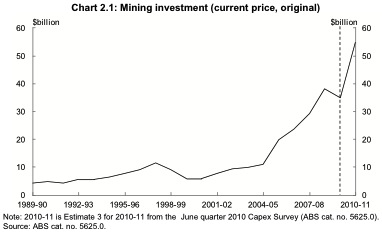
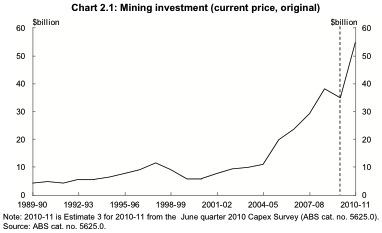
Mining sector investment to soar to $55 billion in 2010-11

The Australian mining industry’s planned $55 billion of investment spending in 2010-11 (in conjunction with high export prices) is likely to more than offset the adverse economic impacts arising from recent declines in building approvals.

According to the Government’s latest economic forecasts, released in today’s Mid-Year Economic and Fiscal Outlook (MYEFO):

Australia’s GDP is forecast to grow by 3 1⁄4 per cent in 2010-11 and 3 3⁄4 per cent in 2011-12, reflecting strong business investment, rising commodity exports and robust income growth supporting household consumption.

The massive surge in mining sector investment is seen clearly in the following MYEFO chart:

And the good news on mining sector investment keeps coming:

Third LNG project approved for Gladstone

Posted in Mining | 1 Comment