Let in those cheap second-hand Japanese cars

Australia’s $12,000 tariff on used cars came into my mind the other day when I read a Monocle story on Vladivostok, which highlighted that in 2008 Russia had brought in huge tariffs on cars to protect its domestic automotive industry. This unfortunately had a large adverse impact on Vladivostok’s economy, as reported in the February edition of Monocle (pp. 32-33):

For years, one of the city’s main economic drivers was the import of second-hand cars from Japan. It was big business for criminal gangs who controlled the shipping routes and customs offices, and also provided jobs for tens of thousands of locals who would drive the cars to other parts of Russia and sell them on. Then, in late 2008, in a move to stimulate the domestic car industry, Russia imposed huge import taxes on cars. Overnight, it seemed, the entire business would be killed. “Cars suddenly cost about $5,000 more, and it ruined a whole way of life,” says Kalachinsky [of the Vladivostok State University of Economics & Service].

Unfortunately, like Russia, Australia is also protecting its domestic car industry through tariffs. While the general automotive tariff rate has fallen to 5%, there remains a $12,000 tariff on second-hand cars, which effectively prevents the importation of cheap second-hand cars. There are only limited exemptions from the $12,000 tariff for specialist and enthusiast vehicles (e.g. a 1966 Ford Mustang).

Many people travelling to New Zealand would have noticed that used cars are significantly cheaper there in real terms – e.g. around $A9,000 for a 5-year old Corolla with 100,000 kilometres on the odometer compared with around $A12,000 in Australia (based on a quick look at Australian and NZ car sales websites).

The $12,000 used car tariff is bad policy with a regressive impact. Think of all the struggling students trying to scrape together the cash to buy a used car, and how much easier that would be if there were an influx of cheap second-hand Japanese cars.
Posted in Industry policy | Leave a comment

Townsville’s Flinders St to re-open for traffic by June

In great news for businesses in Townsville’s city centre, the sorry tale of the Flinders St Mall will be over by June, when Flinders St re-opens for traffic for the first time in 30 years. City traders are hoping that bringing traffic back to Flinders St will re-establish it as a high street and make their shops visible and their wares enticing to passing motorists. The Townsville Bulletin reports:

THE new-look Flinders St will open to traffic by June.
Despite battling some of the worst weather the North has seen in years, construction workers have moved ahead in leaps and bounds on the project, with the bitumen seal finally laid at the western end.

Flinders Central redevelopment project manager Danny Lynch said the asphalt surface laying was a real achievement by workers.

“We’ll be able to soon see traffic back for the first time in 30 years,” he said.

The Flinders St Mall always struggled to be viable. Employment in Townsville is not as concentrated in the CBD as it is in Brisbane, so there was never a large population of city workers to sustain a concentration of retail businesses in the mall. Also Townsville’s oppressive heat and humidity meant that an open air mall was always at a disadvantage compared with the big air-conditioned shopping centres at Aitkenvale and the Willows. These centres were also much closer than the mall to the burgeoning population in the outer suburbs of Kirwan, Condon and Rasmussen.

Posted in Townsville | Leave a comment

Queensland’s retail trading hours are perplexing

Ex-Productivity Commissioner Judith Sloan has a great post over at Catallaxy Files in which she criticises Queensland’s antiquated regulations around retail trading hours (Beautiful one day, closed the next). She also notices a perverse outcome of the simplification of awards applying to the hospitality sector:

We are in Queensland for Easter and feel quite perplexed about the trading hours: shops/supermarkets are closed for most of the break (Friday, Sunday and Monday) but I guess this is the result of the state government’s trading laws.

When I was buying coffee this morning, however, I read an article in the Courier Mail (OK, but that was the only newspaper there) about the impact of ‘modern’ awards on the ability of some restaurants to open during the break: evidently, the relevant ‘modern’ award specifies two-and-half-times normal rates for public holiday work.  As a result, some very well-known and large restaurants in Brisbane will not be open – in some cases, for the first time.

Posted in IR, Retail trade | 1 Comment

Is Queensland’s uranium mining ban under threat?

According to a report in today’s Cairns Post, it appears at least one mining company is expecting an end to Queensland’s ban on uranium mining:

IT might be half a world away but a uranium mine in western Russia is about to help an Australian company uncover the viability of uranium deposits in the Far North.

Callabonna Uranium has announced it has started field studies at its Oak River project near Georgetown, about 400km southwest of Cairns.

Although uranium mining is illegal in Queensland, exploration is allowed and with a lead time of five to 10 years, companies are investigating future prospects.

On the edge of the Undara lava field that was created by volcanic eruptions 190,000 years ago, the area is a gold mine for mineral and gem-hunters who fossick for topaz, sapphires and garnets.

Callabonna started its exploration this month at cattle stations in the area, finding the tell-tale green streaks of uranium deposits in quartz mica sandstone.

The Wirra Cauldron is similar in formation to the Streltsovskoye basin in Russia, where high levels of uranium are found in the central crater area.

Callabonna managing director Stephen McCaughey said although it was early stages, “all the signs stack positively”.

Given the passionate opposition of the ALP Left to uranium mining, and only meek support for it among the ALP Right, it’s unlikely a Labor Government would ever lift the uranium mining ban. So this mining company is obviously expecting an LNP Government will assume power sometime in the next decade and lift the ban. Given the opinion polls, it’s a reasonable expectation that Queensland will get an LNP Government, but new Opposition Leader Campbell Newman’s stance on uranium mining is unclear (based on a quick google search of “Campbell Newman uranium mining”).

While in March 2009 Mr Newman abstained from a Council vote to confirm Brisbane as a nuclear-free city (Campbell Newman spurns nuke-free vote), he was probably within his rights to, given that the ALP-initiated motion was highly political. It was designed to create a split between Mr Newman and Lawrence Springborg, the then State LNP leader, who hinted that the LNP would lift the uranium mining ban if it won the 2009 election.

I expect, however, that Mr Newman would be more sensitive to the environmental concerns of metropolitan voters than Mr Springborg, and may actually support maintaining the ban. Hopefully Mr Newman will clarify his position on this important public policy issue in the near future.

Related Queensland Economy Watch post (in which I’m skeptical about the merits of uranium mining):

AWU pushes to end ban on uranium mining in Queensland

Posted in Mining | Leave a comment

Does the Gold Coast need to compete with Vegas and Macau?

At the risk of upsetting a large conservative chunk of his electorate, Gold Coast-based federal MP Steve Ciobo has suggested that the Gold Coast needs to turn on the razzle dazzle so it can compete with Las Vegas and Macau as a global entertainment hotspot. The Gold Coast Bulletin reports (More casinos and glitz the cure for Coast):

TURNING Surfers Paradise into a world-class entertainment precinct to rival Las Vegas and Macau has been touted as a way to save the Gold Coast from rising unemployment and economic doom.

Federal LNP MP Steve Ciobo has called for a radical rethink of the direction the Gold Coast is heading as the city struggles with massive job losses and a desperate tourism industry.

Mr Ciobo, whose Moncrieff electorate includes Surfers Paradise, said the city was in a stupor and needed to develop a new vision of itself so it could compete for tourists on a global level.

“Our problem is we are directionless. This city needs to be able to compete against places like Ibiza, Bali, Las Vegas and Macau,” he said.

“If we are going to be serious as a city about attracting not only domestic tourists but international tourists then they are the cities we have to measure up against.

“We need to be so much better and bigger than we are.”

Taking the low road and competing with Vegas and Macau is probably unnecessary. The Gold Coast may be in a slump at the moment, but that’s partly due to over-investment in property prior to the financial crisis. Eventually the over-supply of property – especially office accommodation – will be corrected, and the Coast construction sector will get moving again.

Obviously the high Australian dollar and events in Japan have had a depressing effect on tourism on the Gold Coast. But the Gold Coast may have to get used to it. Given the possibility of an extended resources boom and a high Aussie dollar – as long as China doesn’t crash – it may be that tourism will never again be the big driver of growth on the Coast, and the Coast needs to experience a prolonged period of adjustment to a new industry mix. This may involve an increase in the number of Gold Coasters who commute to and from work in Brisbane every day.

After all, given the emergence of the 200-kilometre city, as Peter Spearritt calls it, stretching from Noosa to the Tweed, the Gold Coast economy is much more heavily integrated with the economies of Brisbane, Logan, Ipswich and the Sunshine Coast than ever before.

With an enviable lifestyle and beautiful beaches, the Gold Coast has advantages compared with other SEQ council areas, and may attract households and businesses away from other areas if the slump keeps Gold Coast property prices down, making relocation to the Coast more attractive. Plus we’d anticipate that significant numbers of baby boomer retirees will find their way to the Gold Coast.

For these reasons I don’t think the Gold Coast should aim to compete with Vegas and Macau, and I doubt many Gold Coast residents would think it should either. My impression from the furore over the so-called party houses is that Gold Coasters can be pretty conservative folk. As such, it’s pleasing that Mr Ciobo was willing to float an idea that he believed to be in the Coast’s best interests, but which he probably knew would be unpopular.

Posted in Gold Coast | 3 Comments

Dr Doom forecasts China crash

Nouriel Roubini, the New York economics professor who predicted the financial crisis –  and who is also known as Dr Doom – is forecasting a sharp slowdown in China in a few years’ time, because it is currently over-investing in infrastructure and  property (Beijing’s empty bullet trains):

China’s economy is overheating now, but, over time, its current overinvestment will prove deflationary both domestically and globally. Once increasing fixed investment becomes impossible—most likely after 2013—China is poised for a sharp slowdown. Instead of focusing on securing a soft landing today, Chinese policymakers should be worrying about the brick wall that economic growth may hit in the second half of the quinquennium.

According to Prof. Roubini:

The problem, of course, is that no country can be productive enough to reinvest 50 percent of GDP in new capital stock without eventually facing immense overcapacity and a staggering nonperforming loan problem. China is rife with overinvestment in physical capital, infrastructure, and property. To a visitor, this is evident in sleek but empty airports and bullet trains (which will reduce the need for the 45 planned airports), highways to nowhere, thousands of colossal new central and provincial government buildings, ghost towns, and brand-new aluminum smelters kept closed to prevent global prices from plunging.

The possibility of a China crash makes the task of repairing Australian Government budgets even more urgent, and hence it’s encouraging that the Gillard Government is considering the means testing of childcare assistance:

Parents face childcare rebate cuts under tougher work test

The Government could also cut back the generous $8bn of subsidies and tax concessions it grants to industry each year (see Gillard says no more corporate welfare). There is a lot of fat in the Commonwealth budget.

Posted in Budget, Industry policy, Macroeconomy | Leave a comment

Rocky NRL stadium would be waste of taxpayers’ money

It’s disappointing that Queensland taxpayers will likely have to pay for a stadium in Rockhampton to host a new Central Queensland NRL team:

Rocky to get footy stadium: Newman

It’s disappointing because I doubt that the Queensland Government body Stadiums Queensland is fully recovering the costs of operating its stadiums. It’s highly likely, in my view, that the new Rocky stadium would involve a significant ongoing subsidy from Queensland taxpayers to the NRL.

Stadiums Queensland owns and operates a $1.3bn portfolio of stadiums and other venues – including Suncorp Stadium, the Gabba, the Brisbane Entertainment Centre and Dairy Farmers Stadium – but could only generate an operating profit of $35 million in 2009-10 (see pages 60-61 of the Stadiums Queensland Annual Report).

This return on assets of less than 3% is very low and suggests Stadiums Queensland isn’t fully recovering its costs. So it’s very likely Queensland taxpayers will subsidise the NRL’s venture into Central Queensland.

Posted in Queensland Government, Rockhampton | Leave a comment

Rates to rise $60 p.a. due to infrastructure charges cap

As reported in today’s Townsville Bulletin (State subsidy threat):

The Local Government Association said the Government had handed developers a concession and rates would likely rise by $60 a year because councils would have to borrow more money to cover infrastructure costs.

“The capping of the infrastructure charges in a perverse way will stifle development, not help it,” LGAQ acting chief executive Greg Hoffman told reporters. He said a similar cap failed in NSW.

Posted in Infrastructure | Leave a comment

Infrastructure charges reform good for developers, bad for ratepayers

The Queensland Government will set maximum standard charges (e.g. $28,000 for a 3+ bedroom house) that Councils can levy on developers for the provision of infrastructure to new developments. This is good for developers and new homebuyers, but potentially bad for the existing ratepayers, who will wear the risk of cost blowouts in the provision of new infrastructure:

Developers costs to be slashed

The infrastructure charges cap gives the impression that the Government is doing something about a lack of affordable housing, but may have perverse consequences as ratepayers may be forced to pay for the cost of expensive new infrastructure.

Also it may discourage some development, if councils don’t approve developments where infrastructure costs would be very high, and they would usually have to charge more than the infrastructure charges cap.

Hence this is probably misguided policy and it’s a shame the Government didn’t provide a detailed justification for its decision in its response to the Infrastructure Charges Taskforce report from last month.

Posted in Infrastructure | Leave a comment

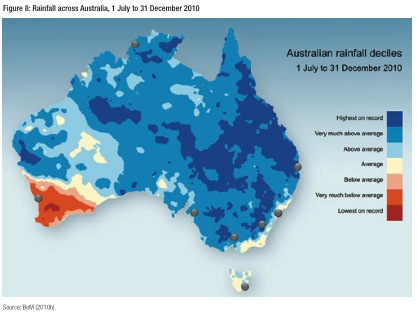
In case you didn’t appreciate how much rain we had…

…check out this chart from page 16 of the National Water Commission’s interesting new report on Future Directions for Urban Water:

The dark blue shading stands for “highest on record”.

There are other very interesting charts in the report (e.g. the chart on p. 15 which illustrates the large climatic shift that has occurred in Perth, which now receives much less rainfall than it did historically).

The image on the cover of the report is a strange choice. Surely fountains are a poor use of urban water?

Posted in Water | Leave a comment