Flegg recommends $50 spending cap during natural disasters

After the flood waters had receded on the afternoon of Thursday 13 January, I made it to Indooroopilly Shoppingtown and was surprised to see 3 police officers outside the Woolworths. Obviously there had been an incident there earlier that day or the day before, possibly people fighting over the last loaf of bread. Unfortunately, we can no longer rely on good manners, common sense or the golden rule to regulate our everyday behaviour.

As such, while I am philosophically opposed to placing a spending limit on people in emergency situations, I see some merit in examining whether there are any measures that can prevent panic buying. There will no doubt be a significant debate on this issue following proceedings in the flood inquiry today, as the Gold Coast Bulletin reports:

SUPERMARKETS and petrol stations need to impose a spending limit during disasters to prevent “food riots” and panic buying, the Queensland Floods Commission of Inquiry will be told today.

Moggill MP Bruce Flegg will recommend a $50 spending cap in the event of a natural disaster similar to the January floods in Brisbane.

Mr Flegg said police had to be called to Coles Supermarket at Kenmore village on January 12 after “punch-ups” took place in what he described as a food riot at the check-out.

“A $50 limit would appear appropriate and would allow people to stock up on basic essentials without going `stupid’,” he said in a written submission ahead of his appearance at the inquiry.

Mr Flegg was critical of the information available to residents as the floods rose, and the seemingly unco-ordinated approach of government departments. Instead, disaster planning should be left to local communities, which had performed so well in January, he said.

Mr Flegg is correct to highlight there was an information problem, and it may have been an information problem pre-dating the floods themselves. At least in my apartment building at Toowong, so few people – especially the Gen Y’ers – were prepared for an emergency. People didn’t have matches, candles, torches, tinned food, etc. We have come to expect that we can pick up what we need from the shops just in time. It may be that the Government or Councils should develop a public information campaign that informs people how to stock up for an emergency.

Posted in Floods, Retail trade | Leave a comment

Good times ahead for Queen City of the North

Long-time Townsville residents sometimes fondly refer to their hometown as the “Queen City of the North”, which it is, in a way, being the most populous Australian city north of the Tropic of Capricorn, with around 170,000 residents compared with Cairns’s 164,000 and Darwin’s 125,000. Residents of the Queen City must be very happy to read all the good economic news relating to their city that has been appearing recently.

Continue reading

Posted in Mining, Population, Townsville | 1 Comment

Teacher bonus scheme a worthwhile experiment

PM Julia Gillard’s announcement today of a bonus pay scheme for teachers is good news, as it signals the Government’s commitment to improving teacher quality, which is a very important contributor to the educational outcomes of Australian children. The ABC reports (Top teachers to get financial rewards):

The Federal Government says next week’s budget will lay the groundwork for rewarding Australia’s best teachers with bonuses of up to $8,100 starting in 2014.

One in ten, or 25,000 primary and secondary teachers, will benefit from the plan which will cost $1.3 billion to 2018.

Teachers will be assessed through student performance data, lesson observations, parental feedback and teacher qualifications.

The compulsory NAPLAN literacy and numeracy tests will form part of the assessment.

After a few years of operation, it will be important for the Government to undertake a rigorous evaluation of the effectiveness of the bonus scheme to determine if it’s improving educational outcomes. A major US study last year reported that performance pay for teachers wasn’t effective in improving student outcomes (see my post on Performance pay for teachers).

Hence the Government should view the bonus scheme as a policy experiment and, if it is unsuccessful, consider other options, such as working with the States to improve salary progression for teachers, so experienced senior teachers don’t reach a pay ceiling and leave for betting paying jobs in education bureaucracies or elsewhere.

The Government would also do well to investigate what drives the superior educational outcomes occurring in Finland, as reported in this Time Magazine article (hat tip to Gavin Nicholson for alerting me to it):

Finland’s Educational Success? The Anti–Tiger Mother Approach

For some reason – perhaps due to a greater commitment to public service among the Finnish population, which may be related to lingering socialist sentiments – teaching is a very high status profession in Finland, and it has no difficulty in attracting the best and brightest. Given Australia’s greater acceptance of free market principles, I doubt the attractiveness of teaching as a profession can be increased without boosting salaries.

Related posts:

Improving teacher effectiveness

Reading performance of Australian students deteriorating

Posted in Education | 1 Comment

Self-employed tradies and freelance consultants logging long hours

According to Dr Phil, “there’s a lot of dogs after them bones.” Independent contractors, such as self-employed tradies and freelance consultants, instinctively know this and often take on whatever work becomes available regardless of their capacity to undertake it, because they know lean times could be coming up. Also many contractors believe that the key to ongoing success is to always deliver greater service than for what you are paid. The end result is that many independent contractors end up working very long hours. The ABS’s Forms of Employment report, released on Friday, provides some useful national data:

There were 1.1 million persons who were independent contractors in their main job in November 2010, the majority (74%) of these were males. Almost half (47%) of all independent contractors actually worked 40 hours or more in their main job (56% of males and 22% of females).

Around 28% of independent contractors work 6 or 7 days per week compared with less than 11% of employees (see chart below).

Posted in IR | Leave a comment

Terrible name, but senior Australians advisory panel could be useful

While checking out the Treasury website the other day, I noticed the Gillard Government has established an Advisory Panel on the Economic Potential of Senior Australians. The panel’s awkward name briefly made me wonder if the budgetary situation was so bad the Government was considering creating work gangs of seniors in a work-for-the-pension scheme.

But then I read more closely, and it’s all about investigating options for getting seniors connected with their communities (e.g. via the NBN), improving workforce participation (so senior Australians can work to 67 at least, I suppose, if not longer), and getting seniors involved in the fight against environmental degradation and climate change (pretty vague at the moment). There are a few other issues for the panel to investigate, as specified in the scope of works.

Obviously there is a huge potential for senior Australians to contribute to the nation, whether that is through the workforce, business or volunteering. With our culture’s possibly unhealthy obsession with youth, it’s easy to forget that arguably the three most influential leaders of the last century made their greatest contributions when they were seniors. Winston Churchill led wartime Britain to resist Nazi Germany while in his late sixties, Gandhi fought for Indian independence while in his sixties and seventies, and Ronald Reagan defeated Soviet Communism while in his seventies.

Posted in Population | Leave a comment

Sunshine Coast Coles given massive renewable energy target

For the sake of our grocery bills – as no doubt the higher cost of renewable energy will be passed on to consumers – let’s hope this strange condition put on Coles by Sunshine Coast Council doesn’t set an example that other Councils will follow (Supermarket told to use renewable energy):

A national supermarket chain is being asked to use at least 50 per cent renewable energy for a development on Queensland’s Sunshine Coast.

The Sunshine Coast Regional Council has approved a two-storey supermarket, retail and office complex in Nambour.

Councillor Vivien Griffin says the supermarket will have to provide six-monthly reports showing it is meeting the renewable energy target.

“It’s an opportunity for Coles to show they’re a terrific corporate citizen and care about the Sunshine Coast region,” she said.

“The 50 per cent can be supplied either through green energy or on site renewables, so I think it’ll actually be a wonderful flag bearer for Nambour and for the Sunshine Coast.”

The Commonwealth Government has only set a target of 20% of total energy coming from renewables by 2020. It’s unclear why this Sunshine Coast Coles is being asked to bear a disproportionate burden. Of course, it looks good politically for the Council to take on a supermarket giant. We may need a national carbon tax to avoid more over-the-top and inefficient measures of this nature.

Posted in Climate change, Energy | Leave a comment

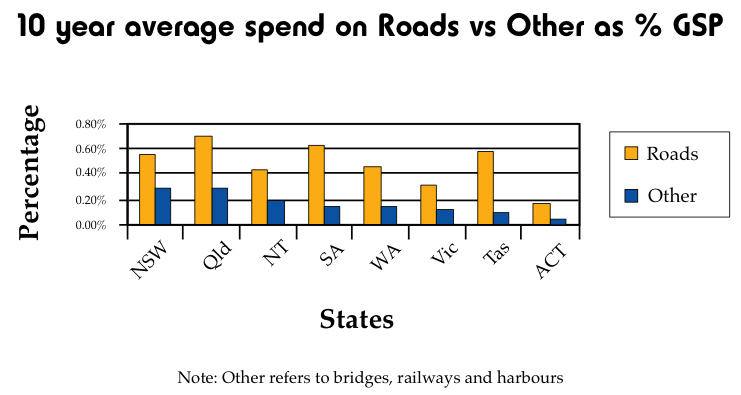
Queensland is top spender on roads

Here’s a handy chart from the new Australian Conservation Foundation (ACF) report Australia’s Public Transport: Investment for a Clean Transport Future.

Of course, the ACF doesn’t want you driving, but taking the train, bus or ferry, or riding or walking instead. The ACF gives Queensland a big tick for investment in public transport, but notes more can be done, especially in our outer metropolitan areas:

Brisbane has also invested in urban rail and a Bus Rapid Transit system that is recognised as world class. This investment by State and local government has resulted in a doubling of bus passengers in the last 11 years. Seven-and-a-half additional lanes of highway would be needed if the South East Busway did not run. Train patronage has also grown in that time.

These public transport projects are helping to serve the rapidly expanding urban population. From satellite images one can see the massive development right down to the Gold Coast – once thriving rural areas are now a conurbation from Brisbane to the border. This spread of population without incorporation of alternatives to private vehicle mobility means it is going to be difficult for people to afford to get around by car when the price of petrol really starts to hurt. If there is to be a significant reduction in car dependency in South East Queensland, more public and active transport projects must be built.

The ACF is spot on we should invest more in public transport and active transport (i.e. cycling and walking) projects. They are a much better use of public funds than NRL stadiums, Commonwealth Games bids, regional parliamentary sittings, convention centres, etc.

Posted in Transport | Leave a comment

Flood and cyclone relief money wasted on pokies

With increasing evidence that a lot of flood and cyclone relief money ended up going through pokie machines, welfare and problem gambling support groups are trying to rationalise the spike in gambling as stress relief, ignoring the possibility that the relief money was poorly targeted and many recipients were undeserving. The Courier-Mail reports:

QUEENSLAND disaster victims who turned to pubs and clubs for meals and other support contributed to record poker machine losses of almost half a billion dollars in the first three months of the year.

Welfare and problem gambling support groups are convinced flood and cyclone victims were drawn to pokies to relieve stress.

The big jump in gambling losses also coincides with millions being handed out in Federal Government support to victims of the summer disasters.

Gamblers at hotels and clubs lost a whopping $4.9 million on the pokies every day between January and March an increase of 8.2 per cent on the same period last year.

Queensland Council of Social Services president Karyn Walsh said she was concerned.

“Lots of people have been relying on their clubs and local infrastructure while they haven’t been at home,” she said.

There may be some truth to the story about people turning to gambling for stress relief, but a big part of the spike in gambling is probably due to some people having received much more relief money than they actually needed. Our disaster relief arrangements clearly need reform:

Flood relief arrangements are inequitable

My previous post on the impact of relief payments on pokies spending is here:

Was spending on the pokies boosted by flood and cyclone relief payments?

Posted in Cyclones, Floods | Leave a comment

Positive signs for Queensland economy

The extended Easter break has seen a boost in tourism and retail spending, reinforcing expectations that Queensland’s economy will rebound after recent sluggishness:

Tourists returning to Queensland after floods

Easter Saturday trading boom

Tourism rebound in Fraser Coast

Posted in Macroeconomy, Retail trade, Tourism | Leave a comment

That sure is a mining boom

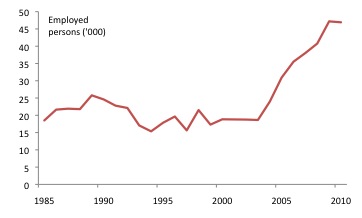
While reading a recent informative article on the Economic Contribution of the Resources Sector in Queensland, I was struck by a chart that shows employment in Queensland’s mining sector has more than doubled since 2003 to around 50,000 employed persons. I’ve reproduced the chart below with slightly more recent data.

Using expenditure data from mining companies, the authors were able to trace the impacts of the mining boom through to particular regions. The Brisbane local government area (LGA) is the major beneficiary, largely through spending by mining companies on the supply chain. The authors note:

The results show that the resources industry has the highest overall impact on output and jobs in the Brisbane LGA, indicating that much of the stimulus flows through to south-east Queensland. There were substantial additions to the business supply chain in many LGAs, including Brisbane ($8.4 billion), Mackay ($1.4 billion), Gladstone ($0.65 billion), Mt Isa ($0.69 billion), and Townsville ($0.42 billion). The largest total additions to Gross regional Product were made in the following LGAs: Brisbane ($24.1 billion), Mackay ($5.0 billion), Gladstone ($2.5 billion), Mt Isa ($2.2 billion), Central Highlands ($2.1 billion), and Isaac ($2.0 billion).

Posted in Mining | 3 Comments