Sustainable population growth put in too hard basket

While I disagree with his anti-migration stance, Monash University’s Bob Birrell makes some good points in his commentary on Australia’s sustainable population strategy, which rejected Kevin Rudd’s vision of a big Australia by electing not to nominate a population target. The Australian  (Population strategy ‘of little relevance’, says top demographer) reports:

JULIA Gillard’s new population strategy makes it clear the needs of the economy are more important than her “sustainable Australia” mantra, one of Australia’s leading demographers says.

Monash University’s Dr Bob Birrell said the document, released today, was “of very little relevance” to addressing the problems facing Australian cities.

The strategy, which declines to nominate a population target, also makes no attempt to predict how Australia’s major cities will grow over coming decades.

Dr Birrell is right to argue the report is light on analysis of Australian population issues:

Dr Birrell said Population Minister Tony Burke’s report had failed to analyse Australia’s current population settings.

“Burke has obviously had to accept the government’s decision that higher skilled migration is the number one priority,” he said.

“And they’ve put in place rules which ensure that we are likely to go above net 180,000 (migrants) a year, at least in the foreseeable future.

“So Burke is left basically mouthing platitudes, saying `wouldn’t it be nice if we had sustainable communities, wouldn’t it be nice if we had outer-suburban cities, and so on.”

The Government’s population strategy contains an illogical justification for the lack of a population target that can easily be read as a concession to the short-term demands of business for more skilled migrants:

The adoption of a population target would also limit the use of the migration program as a policy lever to address emerging skills gaps and labour shortages.

Why are we responding to what are possibly only short-term skills gaps and labour shortages with higher migration, which can result in a permanently higher Australian population? If the additional migrants test our ability to grow in a sustainable fashion, that doesn’t sound like a good idea. The Government would solve a short-term problem at a potentially high cost in the long-term.

If the Government considers the shortage of skilled labour is a long-term phenomenon, then we should review appropriate migration levels within the context of the full set of long-term challenges facing Australia – particularly those environmental and urban development challenges that heightened public concern about our population growth in the first place. Unfortunately, the Government has put this all in the too hard basket, rather than making a clear case – which I, optimistically, believe can be made – for the larger population that will inevitably flow from current migration policies.

Posted in Population | Leave a comment

Wayne Swan on Queensland’s recovery from cruel Summer

The Deputy PM-Treasurer Wayne Swan gave a good speech in Brisbane today on The Story of Budget, in which he included some useful info detailing Queensland’s recovery from the floods and Cyclone Yasi:

The rebuilding process will also be a long one – coal, sugarcane and cotton have a long road in front of them. It’s been encouraging to see some great signs of progress in recent months:

  • About 99.5 per cent of homes and businesses of the nearly half a million to lose power have had power restored;
  • 6,156 kilometres of state road network recovered (two-thirds of what was damaged);
  • 4,298 kilometres of rail network returned to operation (90 per cent of what was damaged);
  • 65 of the 89 damaged bridges and culverts restored; and
  • All 11 ports that were closed returned to full operation.
Posted in Cyclones, Floods | Leave a comment

Gold Coast development rules unfair on pole dancing studios

Last month Gold Coast-based MP Steve Ciobo argued that the Gold Coast needed to put on the razzle dazzle so it could compete with Las Vegas and Macau (read about it here). If Mr Ciobo is serious about his vision for the Gold Coast, he’d better get behind the pole dancing studios which are being hit with onerous Council charges. The Gold Coast Bulletin reports (Council fees cripple pole dancing studios):

GOLD Coast pole dancing studios are being forced to shut down or open illegally due to crippling council charges.

At least eight studios have closed in the past five years, while remaining legal businesses are hanging on by the skin of their teeth because council is charging them the same as big-budget gyms.

One Ashmore business is looking at fees of $50,000 to apply and $400,000 if approved just to have their studio zoned.

Councillors say the problem is the sport is so new it doesn’t have its own classification and must be assessed under the same rules as large gyms, which occur hefty fees.

Posted in Gold Coast | Leave a comment

Best economics book of the year so far – Tim Harford’s Adapt

The Undercover Economist Tim Harford’s latest book Adapt lucidly explains the virtues of a free market economy, which allows a wide range of businesses to try their luck, with only the fittest surviving, meaning the economy adapts in a similar way to populations subject to Darwinian evolution.

While adaptations to better business models through the Darwinian effects of competition can occur in the private sector, adaptations don’t necessarily occur in the public sector. Bad projects can continue in the public sector, unlike in the private sector where commercial realities quickly become apparent. Mr Harford notes the sorry history of nation-building government projects which aren’t rigorously assessed beforehand because decision makers are convinced of the merits of the projects and aren’t open to opposing views.

It’s a pity this book didn’t come out a few years earlier and end up on ex-PM Kevin Rudd’s reading pile. The National Broadband Network, for example, is possibly the type of grand scheme that Mr Harford warns us about.

Highly recommended.

Posted in Uncategorized | Leave a comment

Budget losers

Despite the federal Government committing $365 million last year for the Gold Coast’s new light rail system, Ken Robinson of the Gold Coast Bulletin is asking the Government “what have you done for us lately?”

Gold Coast invisible in Federal Budget

Mackay-based Member for Dawson George Christensen isn’t happy (What the Budget means for Dawson):

Member for Dawson George Christensen said the Budget was a “failure” for Dawson and the Mackay region, with no new dedicated funding for the Bruce Highway or key local projects.

Of course, as a member of the Opposition it would be a surprise if he supported the Budget.

Farmers aren’t happy either, although they recognise they were spared major cuts to rural R&D funding:

Posted in Agriculture, Budget, Gold Coast, Mackay | Leave a comment

Government tells Logan and Rocky “You’re poor and we’re here to help”

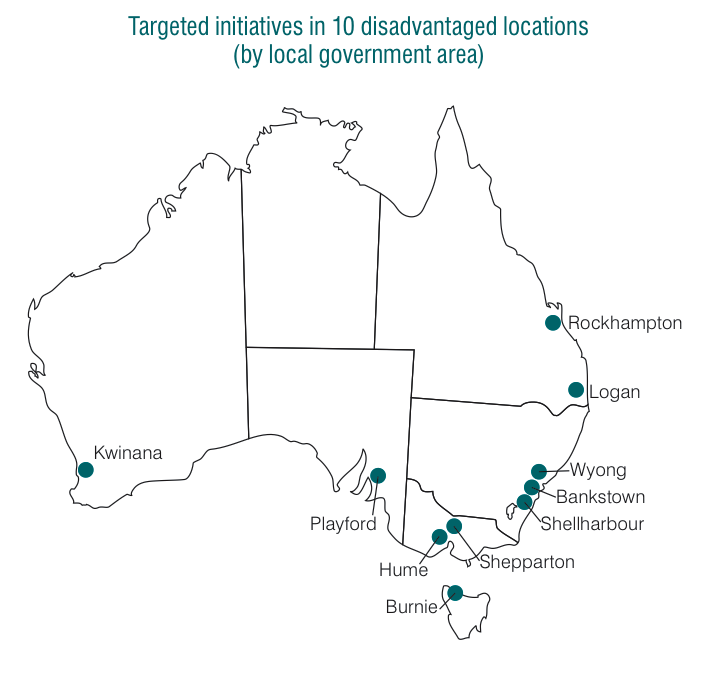
In the Budget papers released last night, the Gillard Government identified Logan and Rockhampton as among 10 disadvantaged locations across Australia eligible for intensive assistance:

In the usual unclear bureaucratic language of Government documents, here is how the Government’s plans are described in the Budget papers:

An intensive approach is needed in some communities to break the cycle of ongoing disadvantage. The Government will provide $38 million to deliver integrated local services and a Local Solutions Fund for innovative projects that provide new services and models to boost engagement and participation in ten disadvantaged areas.

Across 10 areas, $38 million is only $3.8 million per area, which is not a lot relative to the scale of the social problems in these areas. We probably should wait for further details, but there is a risk that this is simply a feel good initiative that won’t achieve any real change.

Posted in Budget, Rockhampton | Leave a comment

Mining sector dominates investment spending

At the RBA briefing on its monetary policy statement in Melbourne yesterday, the RBA’s head of economic analysis, Dr Tony Richards, stunned some audience members when he mentioned that mining sector investment would increase to around 6% of GDP in 2011-12. Given that it’s currently around 4%, and historically runs at around 2%, this is a huge deal. The federal Budget papers show this historic development in this useful chart:

There is no question that the impacts to Australia’s economy and society of the mining boom will continue unabated and may intensify (although it’s hard to imagine Perth awash with any more money than it is currently).

Posted in Budget, Macroeconomy, Mining | Leave a comment

Budget shows $6bn loss of coal production

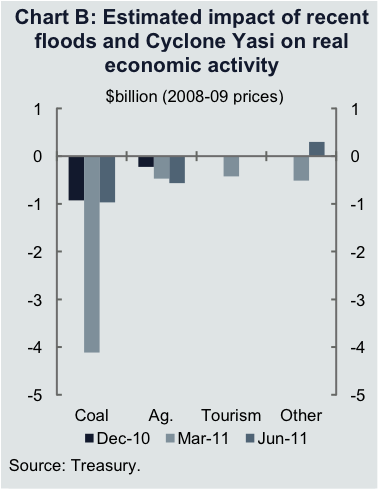
One chart in the 2011-12 federal Budget papers that caught my eye shows the big hit to coal production caused by our Summer of natural disasters:

The Treasury explains:

The direct negative impact of the recent natural disasters is expected to be largely confined to the first half of 2011— reducing real production by $9 billion and real GDP growth by 1⁄2 of a percentage point in 2010-11, and leading to temporary price rises for affected rural and non-rural commodities.

Reduced coal production from Queensland is the largest direct impact, with production losses estimated to be around 25 million tonnes (around $6 billion in real terms — Chart B).

The Budget itself was ok, and it was good to see $3.4 billion in cuts to the bloated defence and federal public service budgets (Swan aims for budget surplus by a thousand cuts). And the boost in funding for mental health services was long overdue.

Posted in Budget, Mining | Leave a comment

Gold Coast students will be able to surf in between lectures

Installing surfboard racks on the Gold Coast light rail system is an inspired and innovative idea, which is consistent with the brand the Gold Coast wishes to project internationally. It will surely be a talking point among visitors and generate much needed word-of-mouth for Gold Coast tourism. The surfboard racks should have a high rate of usage, with Gold Coast Griffith University students heading down to the beach for a surf to kill time waiting between classes. The Gold Coast Bulletin (Surfboards allowed on Coast light rail) has the story:

IN an Australian first surfboard racks have been specially designed to cater to Gold Coast surfers wanting to ride the city’s new Rapid Transit system.

Premier Anna Bligh told the Bulletin exclusively yesterday that a group of Gold Coast locals  who are part of GoldLinQ, the new company announced to build and run the system  had felt the rare design was needed to cater to the city’s large surfing culture.

The news has been given the ultimate tick of approval by the surfing industry, who believe it will attract more people to our beaches and relieve parking congestion.

Premier Bligh also revealed yesterday that the 13km ride, from Griffth University to Broadbeach, would cost $3.11.

Posted in Gold Coast, Tourism, Transport | Leave a comment

OECD admits it stuffed up in lead up to crisis, and blames IMF, too

Her Majesty the Queen was not impressed with the failure of economists to foresee the 2008 financial crisis, as noted in this just released OECD working paper on Surveillance by International Institutions. The paper contains some interesting self-criticism from the OECD on its failure, along with the International Monetary Fund (IMF) and Bank for International Settlements (BIS), to foresee the looming financial crisis and to provide sufficient warning to national authorities and the public. From the paper’s abstract:

The review finds that the institutions did not recognize the need for monetary tightening in a timely way for either the US or the UK, two epicentres of the global crisis. While some concerns were expressed at early stages regarding financial market policies and developments, generally when risks seemed abstract or remote, warnings were too few, received too little emphasis in key editorial sections likely to attract attention and were rarely followed up. Important issues, notably the weak capital base and lack of resilience of the banking systems in the two countries, were missed almost entirely.

The OECD, IMF and BIS should know better next time, unless, like in the lead up to 2008, they think this time it’s different. Given the recurrence of financial crises in the last few hundred years, there’s little reason to think this would be the case.

Posted in Macroeconomy | Leave a comment