Families, tradies and small businesses can keep on polluting

Excluding petrol from the carbon tax is good news for people who drive a lot, but means we will all have to pay even higher electricity prices. The Australian reports:

“Families, tradies, small business people do not have to worry about a petrol price increase,” Ms Gillard said on ABC’s Insiders program this morning.

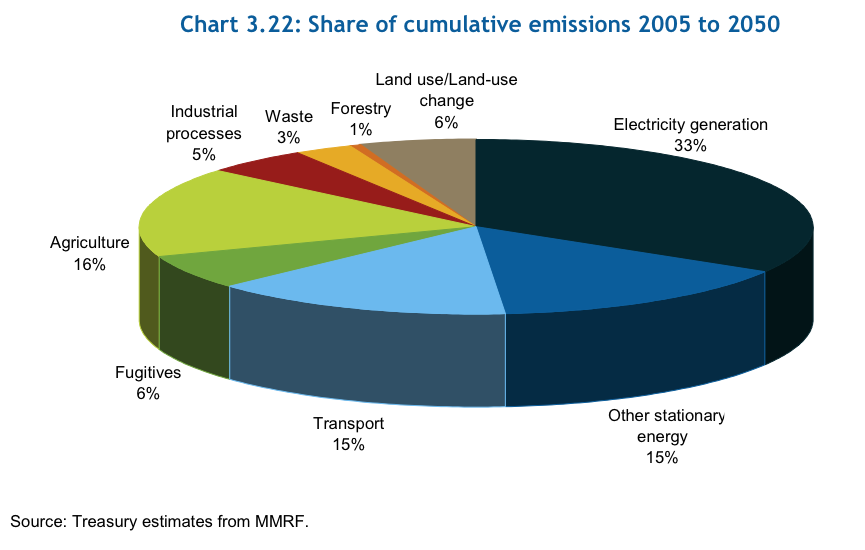
If we’re going to have a carbon tax, it must be broad-based, and it should cover petrol because the transport sector is responsible for 15% of greenhouse gas emissions (see chart below from the 2008 Treasury climate change modelling report). Exempting petrol means that to obtain a targeted reduction in greenhouse gas emissions we must reduce emissions in other areas, e.g. electricity generation, more than otherwise. To do this, the carbon tax will have to be higher and power bills will have to rise more than they would otherwise. 
The Government may resort to higher fuel efficiency standards for motor vehicles to bring down transport emissions, but we know from the Henry Review this is not as cost-effective as including fuel in a carbon pricing scheme:

…targeting vehicle fuel efficiency as a means of achieving reduced emissions is a blunt instrument compared to targeting emissions directly by reflecting the cost of carbon emissions in fuel prices. Individual emissions levels depend not only on the efficiency of the vehicle, but also on other factors, particularly distance travelled, weight carried and driver behaviour. Proposed subsidy schemes would reward people who purchase a fuel-efficient vehicle yet travel large distances, and penalise people who purchases a less expensive, less fuel-efficient vehicle, but travel rarely. Such instruments are less cost-effective than relying on a pollution charge alone.

That’s from Part 2, Volume 2, page 363 of the Final Report of the Henry Review. That report is going to have a long shelf-life.

Posted in Climate change, Tax, Transport | Leave a comment

Recommended reading for delegates to the Gold Coast Turning Point Summit

I am currently reading Harvard Economics Professor Edward Glaeser’s masterpiece Triumph of the City, published earlier this year.

I’d recommend it to anyone attending the upcoming Gold Coast Turning Point Summit. It contains very useful advice from the leading international economist working on urban policy issues, including:

…all successful cities do have something in common. To thrive cities must attract smart people and enable them to work collaboratively. There is no such thing as a successful city without human capital.

I especially recommend and concur with the following passage:

Too many officials in troubled cities wrongly imagine that they can lead their city back to its former glories with some massive construction project – a new stadium or light rail system, a convention centre, or a housing project. With very few exceptions, no public policy can stem the tidal forces of urban change.

That’s no reason to be defeatist, but rather suggests that urban planners should, as Dale Carnegie would say, “cooperate with the inevitable.” Gold Coast community leaders should be careful not to over-react to what may only be temporary economic weakness. There are good reasons to be confident about the city’s long-term prospects, as I’ve written here:

Does the Gold Coast need to compete with Vegas and Macau?

Posted in Gold Coast | 3 Comments

To boost productivity, Government should first cut wasteful spending

Treasury Secretary Dr Martin Parkinson is right to argue for a new wave of reform to boost productivity. Hopefully he also recognises that one of the best things governments can do to boost productivity is to cut wasteful spending and to lower taxes, which will transfer resources to more productive uses in the private sector. Given that Treasury couldn’t stop the home insulation program, Green Loans and the National Broadband Network, Treasury clearly needs to perform much better in its traditional bean counting role.

At the same conference at which Dr Parkinson spoke, the head of the Productivity Commission Gary Banks noted that regarding potential budget savings:

…no doubt there is more low-hanging fruit waiting to be picked. For example, the case for Australia spending $36 billion or so on another dozen homemade submarines, when imported alternatives could be purchased for a fraction of the cost (and risk) has never been adequately explained publicly — notwithstanding the generally acknowledged failure of the Collins Class precedent. The whole area of defence procurement seems ripe for a thorough independent review.

One of the great failings of the Australian public service is that a lot of the service’s most talented micro-economists are locked away in the independent Productivity Commission, rather than being in the Treasury, where their analytical skills are greatly needed if Treasury is to successfully prosecute the case for productivity-enhancing spending cuts.

Posted in Budget, Macroeconomy | 1 Comment

Magistrate refuses Bubblewrap Bandit bail based on cost of living forecast

The Gold Coast’s Bubblewrap Bandit should have thought a bit more about his defence before he blamed the state of the economy at his bail hearing, as reported in the Courier-Mail earlier today:

“The defendant stated he committed the offence due to the cost of living being so high,” Sergeant Pedlow told the court.

Magistrate George Wilkie refused bail, saying Rogers could commit more robberies because of the economy.

“There’s a very reasonable expectation that it’s likely to occur again, because I don’t expect the cost of living to reduce in the foreseeable near future,” Mr Wilkie said.

Posted in Gold Coast | Leave a comment

No mass relocation of public servants to NQ

North Queensland community and business leaders were disappointed yesterday when the Treasurer Andrew Fraser and Deputy Premier Paul Lucas both shattered expectations of a mass migration of public servants to the region:

Push to relocate services stymied

Queensland State Government backflips on public service move to Far North

This is a sensible decision (my previous thoughts on this issue are here). In making his case for a greater reliance by North Queensland on private sector development, the Treasurer provided this interesting set of facts:

…there was one public servant for every 21 people in Townsville against a state ratio of one for every 23 and ratios at the Gold and Sunshine Coasts of one to 36.

The Treasurer has however run the risk of the Gold and Sunshine Coasts pushing for their fair share of public servants.

Posted in Cairns, North Queensland, Queensland Government, Townsville | Leave a comment

Are you working too hard? Are you sure?

The ABS’s annual Australian Social Trends report released today contains an interesting article on overemployment, which notes:

Between April and July 2007, the ABS surveyed Australian workers aged 15 years and older about their employment arrangements. At that time, around two-thirds (65%) felt they were working close to their preferred number of hours. While 1.4 million workers (14%) wanted to work more hours, about 2.2 million (21%) preferred to be working fewer hours.

The ABS article made me think of a great book I read recently by US sales guru Grant Cardone, The 10X Rule. Even if you’re logging 50-60 hours a week, Mr Cardone probably wouldn’t be impressed. He wants you to have 10 times the ambition and expect to work 10 times as hard to achieve your dreams. Mr Cardone’s wisdom includes:

Success is your duty…

Average is a failing formula…

Competition is for sissies…domination is immunity!

Obsession isn’t a disease; it’s a gift…

Pure gold. Mr Cardone’s book is either a recipe for massive success or total burnout. Either way, it’s a great read, and I highly recommend it.

Posted in Labour market | 1 Comment

Meatworks shut down is bad news for Toowoomba

Toowoomba has just over 50,000 employed persons, so the potential loss of over 1,000 jobs through the indefinite closure of the Beef City meatworks is really bad news. If 1,000 people end up unemployed in the short-term, that will drive up Toowoomba’s unemployment rate from 4.2% to around 6.1%, compared with a State average of just over 5%. Furthermore, my rough guess is that the shut down could result in an additional 500+ jobs lost over the next year or two through flow on impacts. Media coverage is here:

More than 1000 Queensland meatworks jobs in limbo

Beef City to shut down

Some research by a past colleague of mine in the early 2000s found Queensland’s regions adjust to labour market shocks through migration (see Regional unemployment: Some aspects and policy issues). Consistent with this finding, ultimately I expect many of the displaced workers will have to migrate out of Toowoomba to find new employment.

While the shut down is bad news for Toowoomba’s economy in the short-term, over the medium to longer-term Toowoomba’s prospects remain reasonable. The university campuses provide steady streams of income into the city, and some observers expect many retiring farmers from smaller Queensland Murray-Darling basin communities will move to the city to retire.


Posted in Labour market, Migration, Toowoomba | Leave a comment

Australia ties with NZ for second in digital literacy in OECD – Korea on top

From the OECD today:

28/06/2011 – Korea tops a new OECD PISA survey that tests how 15-year olds use computers and the Internet to learn. The next best performers were New Zealand, Australia, Japan, Hong-Kong China and Iceland.

PISA 2009 Results: Students On Line tasked students with evaluating information on the Internet, assessing its credibility and navigating webpages to test their digital reading performance.

Students from 16 OECD countries took part – Australia, Austria, Belgium, Chile, Denmark, France, Hungary, Iceland, Ireland, Japan, Korea, New Zealand, Norway, Poland, Spain and Sweden – as well as three non-member economies – Colombia, Hong Kong – China, and Macao – China.

In most countries, students’ results in digitial reading were broadly in line with their performance in the PISA 2009 print reading tests. But in Korea, Australia, New Zealand, Sweden, Iceland and Macao-China, students performed significantly better in digital reading than print, while the opposite was true of students in Poland, Hungary, Chile, Austria, Denmark, Hong-Kong China and Colombia.

Posted in Education | Leave a comment

Swan rightly dismisses GFC II talk

Deputy PM/Treasurer Wayne Swan was in fine form today when he cut off Sky News’s Kieran Gilbert’s talk about a second global financial crisis (GFC):

I don’t like that sort of talk about a second GFC. Yes, there are challenges in Europe. Yes, the economy is soft in the United States, but our region remains strong. There is strong growth and there are strong fundamentals here. People can be confident they’re in the best place in the world here at the moment.

Swan is absolutely right (see transcript here). Greece is too small a player in the world economy for its troubles to cause another GFC, and I’m confident the EU and IMF will sort it out.

Regarding the other possible cause of GFC II, a potential US default, the US simply won’t default on its debt because it would suffer a massive loss of prestige and influence, at a time when it is worried about losing its hegemony to China. While there are definitely some crazies in US politics, there aren’t enough of them in positions of power in Washington to allow that to ever eventuate. So instead of talking about GFC II, as our former PM would say, it’s time for everyone to pop a Mogadon.

Posted in Macroeconomy | Leave a comment

Cairns pushing for expanded naval base

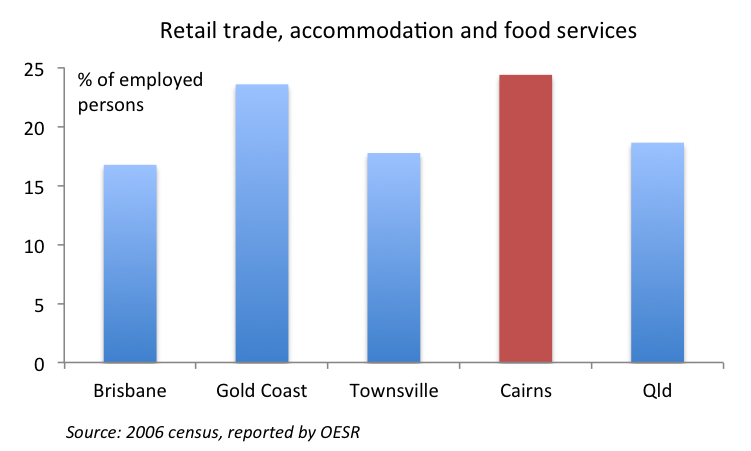
With the Cairns economy sluggish at the moment due to a slowdown in tourism and the construction sector, Cairns community leaders are lobbying hard for an expansion of the HMAS Cairns naval base, as reported in yesterday’s Cairns Post. An expansion of the naval base would undoubtedly be good news for Cairns, which is much more dependent than Brisbane or Townsville on industries that benefit from tourism, such as retail trade and accommodation and food services (i.e. restaurants, cafes) (see chart below).

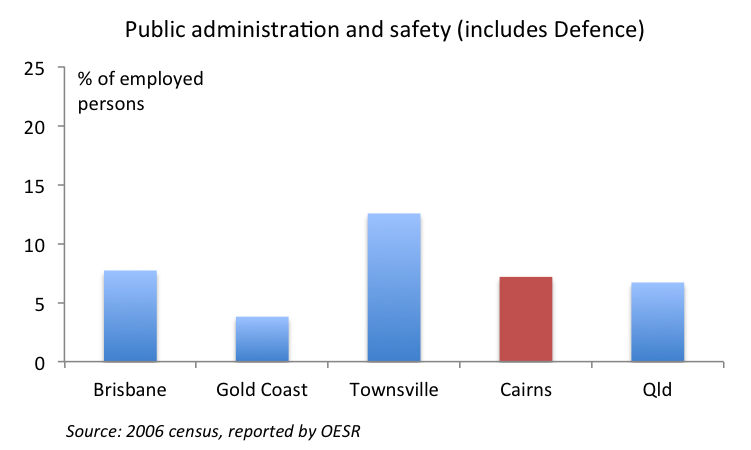
As noted in the article, Cairns community leaders see the benefits to Townsville from having a large defence force base at Lavarack Barracks, which ensures a steady stream of income into the region. The heavy reliance of the Townsville economy on the public administration and safety sector, which includes defence, is striking (see chart below).

Posted in Cairns, Tourism, Townsville | Leave a comment