Newman Government to cut stamp duty and weaken ULDA

A change in Government in Queensland now appears inevitable. Opposition Leader Campbell Newman is treated almost everywhere he goes as if he is the Premier-in-waiting, with business and community leaders listening intently to him, to discern how Newman Government policies will affect them. I noticed this at the Property Council breakfast I attended at the Brisbane Hilton this morning, at which Mr Newman was warmly embraced by the Queensland property and construction industry, presumably because they expect him to build lots of things, as he did while Lord Mayor of Brisbane.

Mr Newman was at the breakfast to launch his property and construction industry strategy, which has attracted some criticism for being full of motherhood statements, as if that makes it different from any other election policy document either side of politics has ever released. The Brisbane Times reports:

Queensland’s Urban Land Development Authority and South Bank Corporation would have their powers wound down and state planning laws may be overhauled under a Liberal National Party government.

LNP leader Campbell Newman today released his property and construction industry strategy, a document he denied was full of vague “motherhood statements”.

Mr Newman used much of his speech to the Property Council breakfast to repeat key LNP campaign messages and previously announced promises, including cuts to home stamp duty and the axing of the waste levy.

Mr Newman, a critic of the ULDA during his time as Brisbane lord mayor, also repeated his March 2011 pledge to curtail the organisation’s powers and instead empower local councils to make planning and development decisions.

Cutting stamp duty and curtailing the ULDA’s powers are good policies. Stamp duty is a bad tax because it discourages people from moving house, possibly to a new location with better employment prospects. And the ULDA creates a lot of risks for the Government, which really shouldn’t be in the property development business. My previous thoughts on these issues are here:

ULDA is a financial risk for Government

Inefficient state taxes

We should cut stamp duty, not increase it


Posted in Housing, Tax | 1 Comment

Recommended reading – Time Bomb: Work, rest and play in Australia today

While my free market bias means I don’t share all the policy views of the authors, I still think Time Bomb: Work, rest and play in Australia today is a terrific book with lots of interesting facts about the work-life imbalance many of us suffer. Data from the Australian Work and Life Index Survey (AWALI) on workers who would prefer to work fewer hours shows that it’s the Gen Xers who are really suffering, presumably because many of them are raising children:

For readers in Brisbane, Mary Ryan’s at Park Rd, Milton has a few copies of the book left.

Posted in Labour market | 1 Comment

Bond traders bet on US recovery – great news for world economy

Despite all the anxiety over the global economy, including from the World Bank earlier this week, I remain optimistic, and recent news out of the US gives hope for a much better 2012 than originally expected. Bloomberg Businessweek reports:

Treasuries are off to their worst start in nine years amid signs the U.S. economy is strengthening and Europe is moving closer to resolving its sovereign-debt crisis.

Yields on benchmark 10-year notes climbed 16 basis points, or 0.16 percentage point, the biggest weekly increase since the five days ended Dec. 23, as reports showed fewer Americans than forecast filed for unemployment benefits and home sales rose for a third month in December. The refuge appeal of Treasuries eased as Greek officials held debt-swap talks and European bond sales saw increased demand.

It’s good news that demand for US Treasury bonds is falling, because it means the fear that has prolonged the Great Recession has ended, and investors are now less willing to invest in low yielding, but safe Treasuries and are willing to risk investing their money elsewhere. Recovery in the US will allay any concerns about China and hence will be great for business and consumer confidence in Australia.

Posted in Macroeconomy | Leave a comment

Two-speed sharemarket – Qld companies winning

A very interesting finding from Deloitte, reported by the Brisbane Times (Resources skew Queensland Growth):

On average last year Queensland’s 213 ASX listed companies increased their market capitalisation by 14.7 per cent.

By comparison the ASX All Ordinaries [which lists approximately 2200 companies] decreased by 15.2 per cent.

Financial analyst firm Deloitte released their annual findings this week and attributed the Queensland ASX performance to top five listed companies, QR National, New Hope Corporation Limited [independent coal company] and Campbell Brothers Limited [laboratory group with strong exposure to the resource boom].

Posted in Mining | Leave a comment

Employment data no cause for concern – although Bligh’s jobs target harder to hit

Given the high degree of volatility from month-to-month in the ABS’s employment estimates, I tend not to worry too much about unfavourable monthly movements, as I outlined in my previous post Media over-reacts to jobs data. Of course, the media has over-reacted again today. The Courier-Mail reports:

THE Bligh Government’s 100,000 jobs promise has suffered a brutal blow on the back of the worst employment performance for Australia since 1992.

To meet her 2009 election promise, Premier Anna Bligh now has to find an additional 10,500 jobs before Queensland goes to the polls.

The latest figures certainly make it more difficult for the Premier’s 100,000 new jobs since the last election target to be reached, and as I discussed last month this may influence the election timing (Bligh’s 100,000 jobs target complicates election timing).

But overall there is no reason for concern about the state of the economy yet. Chris Joye has great coverage of today’s labour market developments over at Aussie Macro Moments:

Dept of Employment’s jobs “leading indicator” increases for 5th month straight (chart)…

Unemployment rate *FALLS* from 5.3% to 5.2% (same as where it was in January 2010)

Posted in Labour market | Leave a comment

Newman’s jobs pledge – checking the arithmetic

Queensland Opposition Leader Campbell Newman has made a bold jobs pledge today which has drawn strong criticism from Treasurer Andrew Fraser. The Brisbane Times reports:

Queensland’s Liberal National Party is vowing to create 420,000 jobs over the next six years as it seeks to reduce the state’s unemployment rate to 4 per cent after two terms in office.

But Treasurer Andrew Fraser hit back at the election-eve pledge, questioning the modelling behind it and declaring that 420,000 jobs had been created in the past seven years under Labor…

…“Only by making wild presumptions about the labour force participation rate and a collapse in population growth could Mr Newman conclude his 4 per cent target can be delivered with 420 000 jobs.

I think the Treasurer has received some questionable advice on this issue. By my calculations Queensland could achieve 4% unemployment with significantly fewer new jobs than 420,000, so Mr Newman’s jobs pledge actually appears larger than necessary. Let’s step it out:

1. Take the November 2012 employed persons estimate (trend) of 2,351,000 and grow it at the average monthly growth rate over the last 12 months of 0.07% to get to employment of 2,357,900 by March 2012 (i.e. around election time).

2. Now take the current civilian population aged 15+ in Queensland of 3,690,800 and grow it out to March 2018 (i.e. six years after the Newman Government gets in) by the growth rate implied by the official OESR population projections (around 2% per annum or 0.17% per month) to get a civilian population 15+ of 4,193,500 in March 2018.

3. Assume the labour force participation rate (67.6%) remains constant, which implies a labour force of 2,836,600 in March 2018.

4. An unemployment rate of 4% (Mr Newman’s target) would therefore mean there would be 113,500 unemployed persons in March 2018.

5. Subtracting this from the size of the labour force means total employment would have to be 2,723,200 persons.

6. Subtract the March 2012 employed persons estimate of 2,357,900 (see Step 1) from the March 2018 estimate of 2,723,200 persons (see Step 5) to get required employment growth of 365,300 over the period, which is less than Mr Newman’s pledge of 420,000.

Posted in Labour market | Leave a comment

Tender for coal exploration permits a good way to help repair budget

The new Henry-Review-inspired tender system for coal exploration permits, announced by Treasurer Fraser on Friday, is a clever, low cost way to raise much needed revenue to help fix the Queensland budget. The Mid Year Fiscal and Economic Review has a nice write up of this measure, which will raise around $220 million over the next few years:

Due to the tightly held nature of coal and petroleum (including coal seam gas) tenure and tenements, highly prospective areas are known to attract strong investor interest, for which the State receives no revenue. It is therefore proposed that a relatively small number of such prospective areas will be subject to a competitive cash bidding process. This is also in keeping with Recommendation 49 of the Henry Tax Review which recommended that “..state governments should consider using a cash bidding system to allocate exploration permits”

Of course, it may disadvantage small miners, as noted in the Brisbane Times this morning (Bligh angers lobby groups with $370m slug before election), but I doubt the economy as a whole will be worse off, as whoever gets the permits would have an incentive to make good use of them. Miners aren’t forced to bid more than they are willing to pay, and the tender will allow the State Government to capture some of the rents/super profits that mining can generate.

That said, one of the other budget measures affecting miners, the new duty on the transfer of exploration permits that will raise $100 million over the next few years, is less defensible on tax policy grounds. The resources sector lobby probably has good reasons to grumble about this measure.

Posted in Budget, Mining, Tax | Leave a comment

Boom town on the Range

Anyone who has traveled through Toowoomba on the congested Warrego Highway in  recent times would agree that the city is booming, with signs of activity everywhere. The town is a major service centre for the Surat Basin, being the base for drilling contractors such as Savanna, for example.  Hence I wasn’t surprised to see this story in the Toowoomba Chronicle today (Surat basin drives property boom):

INVESTORS have their eyes glued on the gateway to the Surat Basin, driving record property sales in Toowoomba over the past week.

Realpoint Property owner Lynn McLean has sold four of the 12 half-built units in a McGregor St complex since last Thursday…

…Ms McLean last week led a delegation of interstate and overseas investors on a tour of the city’s real estate.

“I showed them millions of dollars worth of homes,” she said.

“These are serious investors who know what the market wants, and they’re all looking at Toowoomba.

“It’s the western side of town that they’re interested in, so miners can hop into the car and go straight to Chinchilla or Dalby without going through the city.

Mining of course isn’t the whole story, as the city is fortunate to have a broadly-based economy, with the University of Southern Queensland and major State Government regional administration centres, such as the Environment and Primary Industries Departments’ large campus on Tor Street.

Given the city is likely to continue to grow, and the traffic out to the Surat Basin will grow even faster, the Toowoomba bypass needs to be built promptly.

Posted in Toowoomba | Leave a comment

Rebound in building approvals, but still at low levels

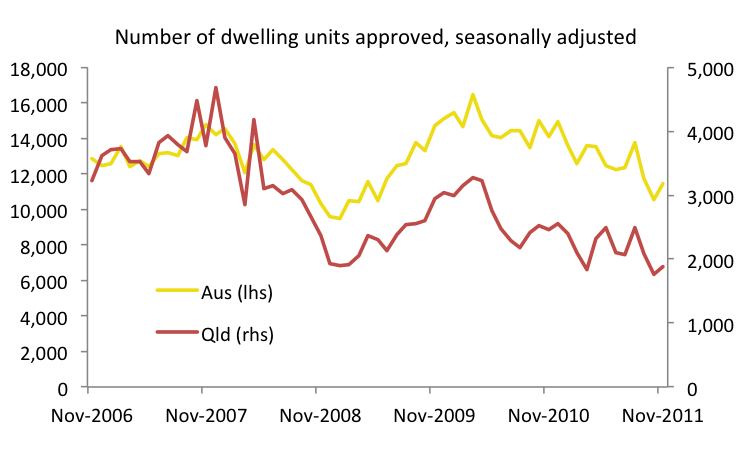
Building approvals are a useful leading indicator of economic activity so it was good to see the rebound in the ABS’s building approvals data for November (see chart below), possibly due to the Melbourne Cup day rate cut.

But, given approvals remain at relatively low levels, some commentators are pessimistic, as the Courier-Mail reports:

“The broad story here is that housing construction is still in trend decline,” said Paul Bloxham, chief economist at HSBC.

“We’d seen some strong declines in September and October and today’s result was a bit of a tick back after those declines, but looking through the volatility.”

Mr Bloxham said further interest rate cuts from the Reserve Bank of Australia might provide a boost for the housing industry.

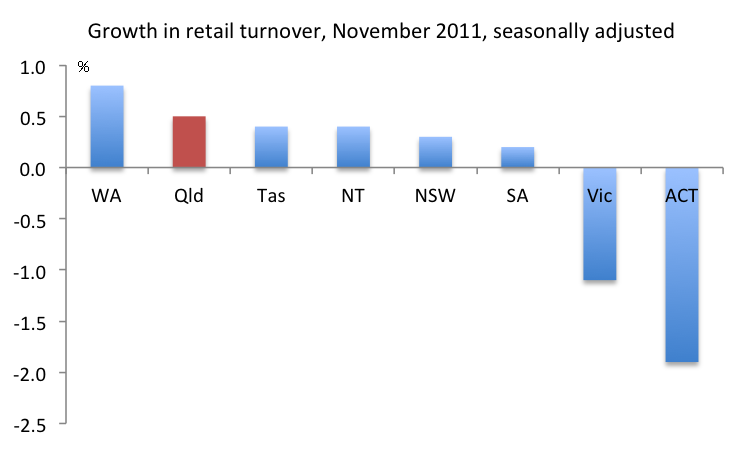
I’m more optimistic than Mr Bloxham, particularly regarding the Queensland economy. Given these data today, and the retail trade data yesterday, I’m very confident Queensland will grow strongly over 2012 even if NSW and Victoria are flat.

Posted in Macroeconomy | Leave a comment

Retail data show Qld and WA healthy, Victoria and ACT sick

The markets didn’t like today’s flat retail trade data from the ABS (Dollar falls on disappointing retail data), but at least Queensland retail trade grew reasonably in November. In terms of monthly growth in retail turnover, Queensland is second only to WA which has many more cashed-up miners than we do:

Posted in Retail trade | Leave a comment