GST slump will cost Qld Government hundreds of millions

There is some bad news for the Queensland Government in the Federal Budget released tonight (from p. 6 of Budget Statement 3):

GST paid to the States is also forecast to be lower than previous estimates. GST expected to be paid to the States in 2012-13 has been revised down by 5.6 per cent since the 2011-12 Mid-Year Economic and Fiscal Outlook as a result of continued wide-spread caution amongst consumers in the aftermath of the global recession.

Given that Queensland is expected to receive around $10 billion of GST revenue in 2012-13, this implies a loss of expected revenue of the order of $600 million. This wipes out any expected gains coming to Queensland as a result of the Grants Commission’s most recent review, according to which Queensland was expected to receive $10.27 billion in GST revenue in 2012-13 (see Table 2 of the Update Report). Instead, as reported in tonight’s budget, Queensland will now receive $9.67 billion – a downward revision of $600 million.

Posted in Budget, Tax | Leave a comment

Tiny surplus only 0.1% of GDP

The expected surplus for 2012-13 of $1.5 billion to be announced by Deputy PM-Treasurer Wayne Swan tonight is pretty insignificant in a $1.5 trillion economy – i.e. it’s only one-tenth of 1% of GDP (see Inspector Budget). Being fairer to the Government, it’s around 0.4% of total Government revenue, so for every $100 the Government receives it will save around 40 cents.

However, in terms of economic impact, what matters isn’t the size of the surplus, but the change in the budget balance from year-to-year, and the Government is forecasting the largest turnaround in the budget balance ever. As discussed in my previous post Budget turnaround looks implausible, I doubt it will achieve this, but if it does it will certainly give the RBA room to move on interest rates because it will impose a significant negative shock on the economy.

It’s difficult to gauge at the moment without knowing all the budgetary details how large the shock will be, however. To the extent savings are achieved by cutting/delaying payments on imports (e.g. spending on the Joint Strike Fighter) or by reducing tax concessions on super (which won’t have a large impact on current consumption expenditure), the expected contractionary impact of the budget will be lessened.

Posted in Budget | Leave a comment

ACCC inquiry should investigate why Brisbane has fewer petrol stations per capita than Toowoomba

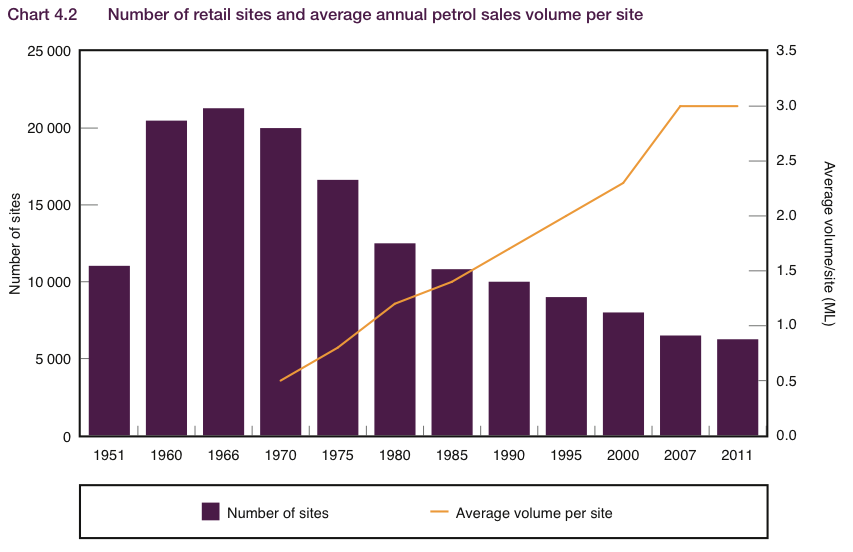
With the closure of the Caltex on Benson St and the BP on Jephson St in Toowong in recent years, there are now only three petrol stations in a short drive from my flat compared with five around a decade ago. This is consistent with the historical consolidation of the petrol industry across Australia – from over 20,000 sites in the mid-1960s to under 7,000 sites today (see the chart below from the ACCC’s 2011 Petrol Monitoring Report).

No doubt the rising value of land is the major factor driving this consolidation, but I believe the factors underlying this consolidation require a thorough analysis in the new ACCC petrol price inquiry announced earlier in the week (see ACCC fuel probe promising: Hockey).

The ACCC should especially look at why the Brisbane market appears less competitive than other markets, including, somewhat surprisingly, the Toowoomba market – a point which earned some commentary in the 2011 Monitoring Report from the ACCC (pp. 179-180):

Monthly average prices in Toowoomba were always lower than those in Brisbane. The average differential over the period was 6.3 cpl, and it ranged from a low of 1.6 cpl in August 2010 to a high of 11.3 cpl in March 2011.

On the basis of the factors discussed in section 10.3.1, one would expect that retail petrol prices in Toowoomba would be higher than those in Brisbane. However, Toowoomba has a greater number of retail sites relative to its population than Brisbane.

In Toowoomba, on average there is one retail site for around every 1900 people, whereas in Brisbane on average there is one retail site for around every 4300 people. The greater number of retail sites relative to population in Toowoomba compared with Brisbane may lead to a higher level of competition—and hence lower prices—in Toowoomba.

This observation is consistent with comments provided by some major retailers to the ACCC in the last year about the intense nature of competition in the Toowoomba retail petrol market.

The Brisbane and Toowoomba petrol markets may provide interesting case studies for the ACCC to test its hypotheses regarding petrol pricing. I am particularly interested in whether the lack of petrol stations in Brisbane is due to high land values or issues in obtaining development approvals.

Posted in Brisbane, Industry policy, Toowoomba | Leave a comment

Cashed-up miners mean big difference in retail turnover in mining and non-mining States

OESR has finally released its April 2012 Economic Review (obviously it’s taken a while to clear through the new Treasurer’s office), and it contains this interesting chart showing the stark difference in retail trade performance between the mining and non-mining States:

The latest Economic Review also contains informative commentary on tourism, noting the recent pick up in overnight intra-state tourism (see p. 2).

Posted in Macroeconomy, Mining, Retail trade | Leave a comment

Qld has strong pulse, but rate cut needed to revive southern states

The Reserve Bank is widely expected to cut interest rates by 0.25 per cent (or 25 basis points) today. The rate cut is probably necessary to revive the economies of southern states, which Queensland businesses have declining confidence in, according to new data from the Commonwealth Bank-CCIQ Pulse Survey report (from p. 2):

So, according to this survey, Queensland businesses expect economic conditions to improve in Queensland while worsening in the rest of Australia over the next 12 months.

The survey has particularly good news for North and Far North Queensland:

Of particular note, the North and Far North Queensland regions are enjoying their highest levels of business confidence for over 3 years, suggesting businesses are significantly rallied by State Government commitments for major infrastructure and industry development programs in these regions.

This confidence means businesses are more likely to invest and hire new staff in these regions.

Posted in Macroeconomy | Leave a comment

Could you imagine Brisbane without the Story Bridge?

Neil Wiseman’s final Way We Were column in the Sunday Mail today is on the history of the Story Bridge, which encountered some opposition at the time of its construction, both because traffic may not have justified it at the time and the usual NIMBYism. Mr Wiseman writes:

The Story Bridge? Who needs it? Certainly not a retired Brisbane Town Clerk, Frederick Annand, who “considered that an efficient system of ferries would be much sounder economically and would be more convenient than the proposed Kangaroo Point bridge”, according to the Courier-Mail in 1933…

…A Kangaroo Point resident was equally opposed to the proposed “central bridge” in a letter to the paper…“The proposed bridge would bring dust, incessant noise, and an unending stream of hawkers and mendicants, besides making the place [Kangaroo Point] easier of access for undesirables.”

While maintaining a ferry service would have been cheaper, and there were already bridges up-river, the Victoria and William Jolly Bridges, given the large volume of traffic we now see over the Story Bridge, there is no doubt the construction of the Bridge would pass any cost-benefit analysis. It has undoubted benefits in terms of the reduction of travel times for residents and delivery drivers, no doubt benefiting businesses across the metropolis in increased productivity.

Also, the construction of the bridge, at a cost of around 1.6 million pounds over 1935-40, provided an economic stimulus to the Queensland economy during the Depression, when unemployment had reached around 20% of the labour force. Indeed, the economic stimulus benefits appear to have been the major rationale for the construction of the bridge at the time (see this useful article by Advance Mercantile & Investigations). Nonetheless the Bridge quickly proved its usefulness, as noted by Advance Mercantile & Investigations:

…the final cost of 1.6 million pounds was recuperated within seven years, and in 1947 the bridge was transferred to the Brisbane City Council and the toll was removed.

Clearly the Story Bridge was a worthwhile investment, and the Way We Were article makes one wonder what Brisbane would be like today if the Bridge weren’t built at the time? I assume that a bridge, probably in the same location as the Story Bridge, would have been built sometime in the 1950s or 1960s as the congestion that would have occurred on the Victoria and William Jolly bridges would have been intolerable. In the meantime, Brisbane may have had a slower pace of urban development, and it’s likely the southern and eastern suburbs, such as Salisbury and Morningside, would have been slower to develop.

Brisbane would not have functioned as well economically and to an extent this would have limited its attractiveness to post-war migrants. So I expect Brisbane’s population would have been slightly lower in the 1950s if the Bridge weren’t built in the 1930s, and this slightly lower population back then would be reflected in a lower population today, but it would be almost impossible to estimate by how much.

In summary, I expect the construction of the Story Bridge in the late 1930s significantly shaped Brisbane’s economic development in the early years of the post-war boom, and had an impact on our population and pattern of urban development that persists to this day.

Posted in Brisbane, Transport | Leave a comment

Growth forecasts believable, particularly given Can Do attitude to mining (even on Cape York)

A couple of recent economic forecasts, from the Treasury and my former Treasury colleague Peter Downes, suggest the Australian economy will remain resilient and may even surprise us with stronger than expected performance:

Treasury forecasts of 3.25pc growth to put budget in black

Boom could see unemployment hit 4.5%

Both these forecasts will have factored in the expected interest rate cut in May. Treasury’s forecast is for respectable growth, but at 3.25% growth we probably won’t see as substantial a drop in the unemployment rate (currently at 5.2% nationally) as in Downes’s forecast, which has unemployment dropping to 4.5%. Downes’s justification for the significant drop in unemployment is the mining boom, as reported in regional newspapers yesterday:

AUSTRALIA’S unemployment rate could hit 4.5 per cent by next year if the mining boom continues its relentless growth, says former Treasury official Peter Downes.

The Australian Bureau of Statistics (ABS) has forecast the mining sector to reach a record level of growth, moving from 6 per cent of gross domestic product to some 9 per cent of GDP in the 2010-11 financial year.

Mr Downes, former Treasury official and now an Outlook Economics director, said recent economic modelling showed that the growth in the mining sector could see more people picking up jobs across the board.

“The forecast that the unemployment rate gets down to 4.5 per cent next year is contingent on the mining boom,” he said.

“A lot of the coming investment, particularly in plant and equipment, has a fairly high leakage with a lot of that feeding back into the rest of the economy.”

Obviously, Queensland will play a large role in the national economic growth story. Our new Queensland Government has signalled a strong commitment to economic development with its fast-tracking of a coal mine on Cape York, opposed by environmentalists but supported by the local Indigenous economic development organisation, Balkanu (which I have consulted to but not on this project). The Courier-Mail has coverage here:

Wilderness Society spokesman Gavan McFadzean claims proposed $500 million Wongai coal mine near Cooktown is being fast-tracked before region is declared a World Heritage area

Posted in Labour market, Macroeconomy, Mining | Leave a comment

Mining sector already making a large contribution to Governments

While the Interim Report of the GST Distribution Review was fairly unsurprising (see the Australian coverage at Big States fall short in bid to ‘fix’ GST), it contains some useful and interesting pieces of analysis, including this chart showing the big increase in government revenue coming from the mining sector over the last decade (i.e. even before we had a super profits tax):

Posted in Budget, Mining | Leave a comment

CommSec’s State of the States misleading on Qld’s economic performance

The latest edition of CommSec’s State of the States is out today, and it has WA ranked number one, a long way ahead of all other States, including Queensland, based on comparisons of eight economic indicators including economic growth, retail trade and new housing construction. WA Today has the best coverage here:

There’s no comparison to WA

I’ve previously posted on how CommSec’s methodology gives a misleading impression of Queensland’s economic performance, given that it is comparing current activity levels with Queensland’s outstanding economic performance last decade:

Ask a silly question, get a silly answer

While I agree with CommSec that WA is leading Australia in economic performance at the moment, I disagree that Queensland’s current economic performance places us in the same grouping as NSW and SA and behind Victoria and the ACT (see WA economy outperforms the rest). CommSec needs to look more closely at the most recent figures for State Final Demand (which is booming) and building approvals (Queensland was the only State to record growth in building approvals in February). Luckily OESR produces these useful briefs:

State Details

Building approvals

Posted in Macroeconomy | Leave a comment

Should Governments promote the development of tropical cities such as Townsville?

I am both proud and somewhat bewildered to read that Townsville, where I was born and spent my first fifteen years, is approaching a population of 200,000 people, as reported in the Townsville Bulletin this morning (Welcome to Townsville: population 200,000). While Townsville has many attractions, including the Strand, Castle Hill, and the nearby Magnetic Island and Crystal Creek, the tropical climate and the risk of cyclones significantly reduce its attractiveness. Any migrants from southern parts of Australia would find the place unbearable unless they have air-conditioning, and it appears that air-conditioning use must now be substantial in Townsville. The Bulletin reports:

…Mr Dwyer [a Townsville economist] said if North Queensland were to turbo-charge its economic growth, it needed a base load power station.

Townsville residents use 18 per cent more power than the national average while businesses use 50 per cent more.

“We use more power than the average Ergon customer and pay a higher price because we receive it from Calide (Gladstone) and therefore pay more for our power,” he said.

Both the Federal and State Governments are actively promoting the development of Townsville through the expansion of Lavarack Barracks and the designation of Townsville as the second capital of Queensland. But given concerns about climate change and the rising cost of electricity (which is due largely to the need to build capacity to meet the peak demand that air-conditioners contribute to), Governments should reconsider whether it’s sensible to promote the development of major population centres in the tropics.

Posted in Climate change, Energy, Townsville | 3 Comments