Strong recovery in Qld domestic tourism – particularly Queenslanders holidaying in Qld

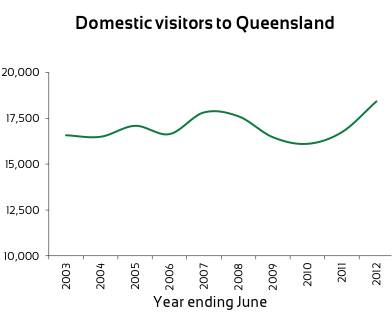
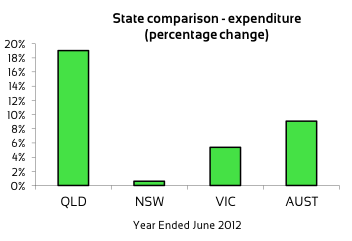
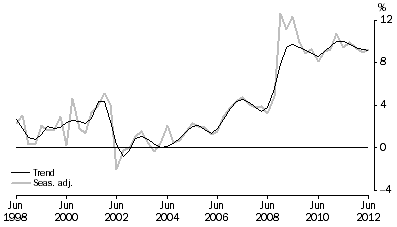
Tourism Queensland yesterday released a snapshot of Tourism Australia National Visitor Survey data for 2011-12, which contains some nice charts showing a strong recovery in domestic tourism in Queensland (i.e. intra-state or interstate tourism):

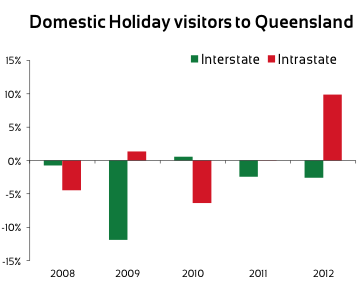
The recovery is solely due to Queenslanders holidaying in Queensland, as the number of total interstate visitors (including people holidaying, visiting friends and relatives and business travelers) was practically unchanged over 2011-12, and interstate holiday visitors actually slightly fell:

Pete Faulkner at Conus Consulting has coverage here:

National Visitors Survey shows good growth for TNQ

Posted in Tourism | Leave a comment

My favourite Budget measure: the Public Sector Renewal Program

When I first read in the Budget that the Government is spending $15 million over the next four years to help it identify savings, I remembered the Yes Minister episode when the Minister challenges Sir Humphrey on departmental spending on an efficiency review, which Sir Humphrey noted was absolutely essential and actually recommended increased spending!

While I doubt the Public Sector Renewal Program would recommend new spending measures, some may question whether it’s worthwhile spending an additional $15 million to identify savings. After all, isn’t that what Treasury should already be doing? Well of course Treasury should already be doing this, but from my experience Treasury officials are typically over-worked and lack the time to generate the detailed evidence that is required to produce winning briefs prosecuting savings measures. Thus some extra Government funding to produce the evidence for efficiency and savings measures is welcome. I expect this money would be used mainly to fund consultancies reviewing Government programs.

You can read about the Public Sector Renewal Program on p. 70 of Budget Measures 2012-13 and in this media release from June.

Posted in Budget | Leave a comment

LNG the hero of the Budget

Queensland Treasury isn’t worried about large job losses in mining (see p. 42 of the Budget Strategy and Outlook):

Notwithstanding announced cuts to operations by some companies, mining-related employment is expected to rise further, as large-scale LNG and coal projects move into their most labour intensive phase of construction.

LNG royalties will start adding several hundreds of millions of dollars to consolidated revenue from 2014-15, when LNG exports start boosting the Queensland economy. As noted by Treasury in the Budget (p. 40):

With first gas exports targeted for 2014, LNG exports are projected to become Queensland’s second largest export after coal by 2015-16, surpassing $10 billion in that year.

With a third LNG processing plant coming on-line after the end of the budget forward estimates in 2015-16, the Government potentially will have several billion dollars in LNG royalties from 2016-17 to the end of the decade that it can use to fund its commitments at the next election. Hence I expect the fiscal austerity will only be temporary.

Posted in Mining | Leave a comment

There will still be plenty of mining jobs in Queensland

I’m reasonably confident there won’t be a precipitous fall in mining sector employment in Queensland, despite the news of 900 job losses across the Australian mining sector, with a large proportion of those job losses occurring in Queensland (Mining giants axe 900 jobs).

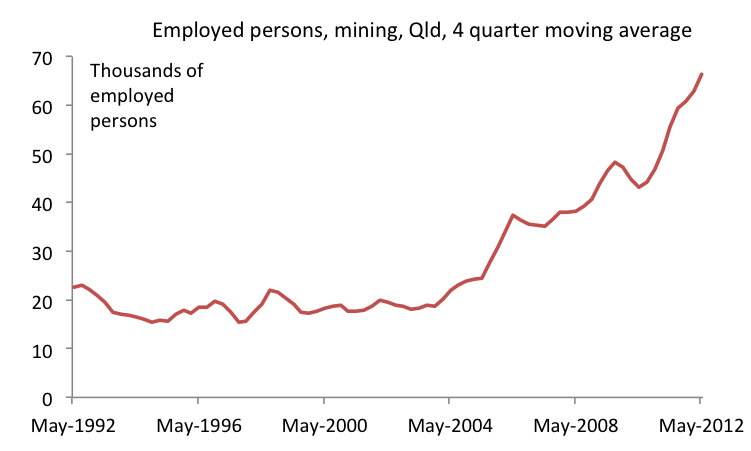
Total employment in the Queensland mining industry has trebled in the last eight years (see chart below). While some of this increase will reflect irrational exuberance about the resources super cycle, I expect much of the increase in employment will have followed rational investment decision-making processes that took into account the probabilities of commodity price declines. Hence I expect that a lot of the jobs that have been gained in the Queensland mining sector in recent years are reasonably secure.

Posted in Labour market, Mining | 1 Comment

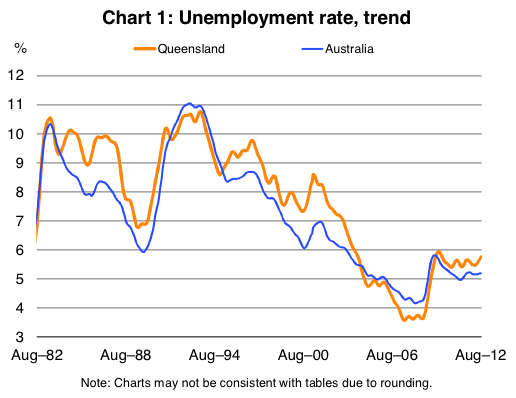
Public sector job cuts may be showing up in unemployment data

The Queensland unemployment rate slightly increased in August (see the nice OESR chart below), and the public sector job cuts (and hiring freeze) we’ve seen so far are a likely contributor, although again I’d caution not to read too much into one month’s figures, given the sampling error associated with the labour force survey.

The Queensland budget is released next Tuesday and we’ll finally know the magnitude of the cuts and the likely short-term impact on the Queensland economy.

Posted in Budget, Labour market, Macroeconomy | Leave a comment

Chinese tourism expected to boost Far North economy

The forecast doubling of numbers may sound overly optimistic, but let’s hope there is some truth to expectations of a boom in Chinese tourism in the Far North, as reported this morning in the Cairns Post:

THE number of Chinese travelling to the Far North is expected to double to nearly 190,000 a year within 12 months of three new services coming on stream from next month.

That’s the prediction of Cairns Airport chief executive officer Kevin Brown after Cathay Pacific Airlines yesterday announced changes to its arrival and departure times from Hong Kong to link to its flights from mainland China.

It comes as Chinese visitor numbers to the Far North continue to soar with the latest figures showing a 27 per cent jump on 2011 figures to 94,000 in the year ended June 30.

The tourism sector appears very hopeful there will be a China-led tourism revival. The Tourism Minister’s press release yesterday was very optimistic (Chinese tourists ‘cheque-in’ to Queensland). The Minister noted:

“While many of Queensland’s traditional markets out of Europe and the UK continue to feel the effects of the global financial crisis, Chinese tourists are developing a love affair with Queensland and are now our second largest international market.”

A record breaking 238,000 Chinese tourists visited in the year to June 30 – a jump of more than 21 per cent.

The Far North economy certainly needs the boost that Chinese tourism would bring. Rick Carr of Herron Todd White Cairns has observed that the likely boost in tourism is already bolstering confidence through the whole economy (Cairns Watch August 2012):

…the game changer during the last month has been the China Eastern and China Southern announcements of direct flights into China, which combined with reports of a much busier tourist season this year, have inspired extra confidence in the future of Cairns economy.

Hat tip to KS at Loose Change for alerting me to Rick Carr’s report.

Posted in Cairns, Tourism | Leave a comment

Retail trade restrained by stubbornly high saving rate

Yesterday’s ABS National Accounts data were good news, showing a continuation of strong growth in demand in Queensland at 3.6% over the June quarter. One of the most interesting pieces of data in the National Accounts is the household saving ratio, which remains stubbornly high as a result of the uncertainty that has persisted since the 2008 financial crisis:

The high household saving ratio is a major reason that, although the economy is performing reasonably well, many retailers continue to struggle.

Posted in Macroeconomy, Retail trade | 5 Comments

Government was right to cut funding to Literary Awards

Given that the Literary Awards went ahead without government assistance, and that a number of awards went to authors from outside Queensland such as Frank Moorhouse (as reported in the Courier-Mail this morning), the Government’s decision earlier this year to cut funding was justified. It’s hard to see how giving prizes to non-Queenslanders helps encourage literary pursuits in Queensland.

I’ve previously posted on the Literary Awards:

Qld Literary Awards going ahead anyway, meaning Govt’s decision is justified

Posted in Arts | Leave a comment

CIS on Australia’s Asia Literacy Non-Problem

There is a great new paper from the Centre for Independent Studies that challenges concerns about our ability to communicate with our Asian neighbours, and hence in part questions the usefulness of the job the PM gave Ken Henry to investigate opportunities and challenges for Australia in responding to the Asian century.

Australia’s Asia Literacy Non-Problem

Key points from the paper are:

  • Australia’s language education policies: The most populous states and territories already teach LOTE, including key Asian languages, on a compulsory basis at some levels of schooling.
  • English is the pre-eminent world language: With approximately 2 billion speakers globally, English remains the world’s lingua franca and the language of globalisation.
  • English is an Asian language: English is spoken by about 800 million people in Asia and is widely used as an official language in the region.
  • Australia speaks the languages of Asia: Australia’s multicultural composition means there are 2.2 million or so speakers of Asian languages in Australia, including approximately 650,000 speakers of Chinese languages.
  • Asian cultural literacy acquisition by osmosis: With extensive interaction between diverse groups, Asian cultural literacy is being naturally spread throughout Australian society.
Posted in Population | Leave a comment

Historically Queensland has lacked transparency on analysis of regulatory impacts

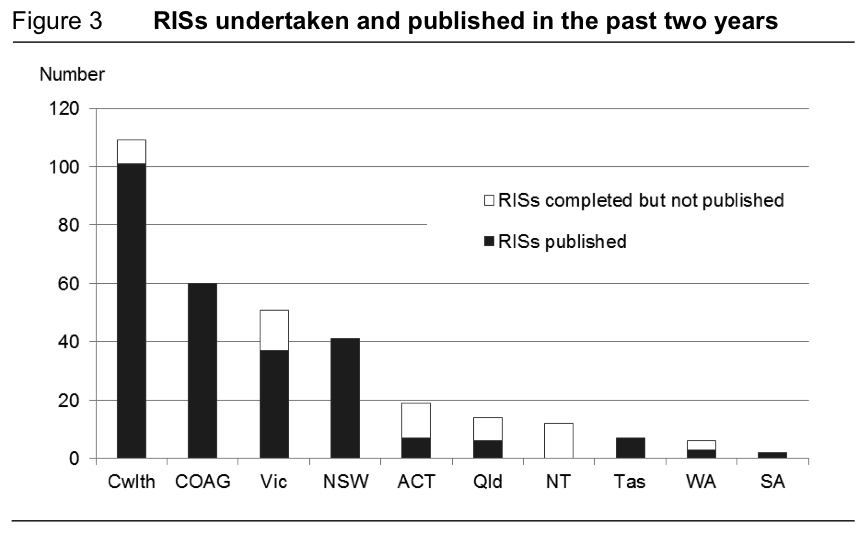
I was pleased to learn from a new Productivity Commission report on Regulatory Impact Analysis that the new Queensland Office of Best Practice Regulation is intending to require the publication of all final regulation impact statements (RISs), which for some odd reason we now call regulatory assessment statements (RASs) (see p. 221). This will be a large improvement on the historical record, as revealed by this chart from the Commission’s report:

Obviously publication of RISs is important so the public can judge the merits of studies informing Government decision making.

Posted in Industry policy | Leave a comment