A mobile phone tower in the palm of your hand – what could it mean for the NBN?

If it’s not too late to abandon the $30 billion+ National Broadband Network (NBN), it may be worth doing so, given the rapid technological advances in ICT we’re seeing, such as lightRadio, which must significantly increase the risk that the NBN is a big white elephant. From CNNMoney:

NEW YORK (CNNMoney) — As mobile data usage skyrockets, wireless companies are spending billions each year to maximize capacity, and consumers end up footing the cost in the form of higher cell phone bills.

But a cube that fits in the palm of your hand could help solve that problem.

It’s called lightRadio, a Rubik’s cube-sized device made by Alcatel-Lucent (ALU) that takes all of the components of a cell phone tower and compresses them down into a 2.3-inch block. Unlike today’s cell towers and antennas, which are large, inefficient and expensive to maintain, lightRadio is tiny, capacious and power-sipping.

The future is wireless. The case for building the NBN is looking increasingly shaky.

Posted in Infrastructure | Leave a comment

Was spending on the pokies boosted by flood and cyclone relief payments?

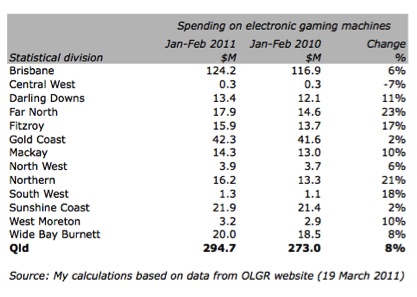
A significant number of people who claimed flood and cyclone relief assistance from Centrelink may not have really needed the $1,000 they received, and it’s likely that a good chunk of any undeserved assistance was spent on leisure activities, including gambling. This may explain the surge in spending on poker machines in January and February this year, as reported yesterday in the Courier-Mail ($3,500 every minute):

QUEENSLANDERS blew an unprecedented $3500 a minute on poker machines in the first two months of 2011.

The massive spending has set gamblers up for the worst year of losses on record. In January and February, hotels and clubs took $294 million from pokies.

The splurge is up 8 per cent on the corresponding period last year, revealing a worrying rise in pokie losses since last June, when the global financial crisis had hit home. And it does not include gambling on casino machines.

The official figures from the Office of Liquor and Gaming Regulation (OLGR) record big increases in spending on pokies in regions affected by the disasters – particularly in North Queensland, Far North Queensland and the Fitzroy region (which includes Rockhampton) – suggesting the disaster relief money is a signficant contributor (see table below). Brisbane doesn’t stand out despite the January flood, which is probably because it’s a big region, so the proportion of people directly affected by natural disaster was a smaller proportion than in North Queensland or Far North Queensland.

Our disaster relief policies require reform so that next time they better target those people genuinely in need.

Related Queensland Economy Watch post:

Flood relief arrangements are inequitable

Posted in Cyclones, Floods, Uncategorized | 1 Comment

Cross River Rail or a Brisbane Metro?

Brisbane Lord Mayor Campbell Newman may have a good idea in recommending that the Government scrap the Cross River Rail project and consider a new Brisbane subway system instead:

Brisbane’s stalled $8 billion cross river rail project should be scrapped and replaced with a Barcelona or Paris-style metro system, Lord Mayor Campbell Newman has demanded.

The state government in January delayed its cross-river rail plans, which would involve construction of a new 18-kilometre north-south railway line, 9.8 kilometres of which would be in a tunnel.

Arguably, Mr Newman’s proposed subway would better target Brisbane’s high density inner city suburbs than Cross River Rail.

Cr Newman said the existing project was designed to provide more capacity to run trains from the Gold Coast through to the Sunshine Coast and tackle a bottleneck at the Brisbane River.

“A different way of looking at this is to say to QR, settle down, we’re going to have it run two semi-separate systems,” he said.

“Instead of putting $8 billion into cross river rail we could for between $3 and $4 billion total, get 40 kilometres of inner-city subway in Brisbane, with probably at least 25 to 30 stations, using the technology that was put forward in Barcelona.

“We can have that to service the CBD and the high growth areas of the inner six or seven kilometres of Brisbane, the high growth urban renewal areas.”

The Lord Mayor’s proposal is worth consideration by the Government, as it could potentially encourage more people to use public transport. In the interests of improving public health and reducing obesity – which is very costly to our community – it is worth investing in public transport facilities within walking distance of significant population clusters.

For example, as noted in this October 2010 US Treasury report on infrastructure, a new light rail system in Charlotte, North Carolina resulted in a reduction in obesity in the local community, partly because people walked further each day if they caught public transport. As summarised by US Treasury:

…the use of light rail to commute to work is associated with a nearly 1.2 point reduction in body mass index as well as an 81 percent reduction in the odds of becoming obese over time.

While a subway is different from light rail, we’d nonetheless expect similar health benefits, as subway riders in Brisbane’s inner city would likely walk to and from the subway each day. Of course, it could be a lot more costly than the Lord Mayor expects (his $3-4 billion estimate seems low to me), but his proposal is certainly worthy of a feasibility study.

Posted in Health, Transport | 2 Comments

9.1 million Queenslanders in 2056 – over 1 million more than expected

The Queensland Government yesterday released revised population projections which project a Queensland population of 9.14 million in 2056, compared with a previous projection (from 2008) of 7.98 million in 2056. If fertility, migration, or longevity turn out to be at the upper end of expectations, Queensland’s 2056 population could exceed 11 million.

The revision to Queensland’s projected population is due to increases in the fertility rate and net overseas migration compared with the rates prevailing at the time of the 2008 projections. The increase is consistent with the Commonwealth Treasury’s big revision to Australia’s projected mid-century population, projected to be 36 million, according to the 2010 Intergenerational Report (IGR), compared with 29 million, according to the 2007 IGR.

The Queensland Government should have plenty of time to prepare for the previously unexpected additional 1 million people in 2056. For the next couple of decades, at least, the projected population has not been greatly revised. The projected population in 2031 was only revised up to 6.59 million from the previous projection of 6.27 million. This suggests that a big chunk of the revision for 2056 is due to the enduring and cumulative impact of higher fertility rates – so-called demographic momentum – as larger cohorts today breed larger cohorts in the future. This cumulative impact would not be fully apparent by 2031, but will have major implications by mid-century.

Posted in Migration, Population | Leave a comment

Talking about GoMA

Brisbane’s impressive Gallery of Modern Art (GoMA) was built at a cost of around $290M – i.e. over $60 for every Queenslander – so it is important to consider its role in our community and who it is targeted at. Given its high cost, for the sake of equity, one hopes that GoMA strives to serve as many Queenslanders as possible, and not just the arts community. The large crowds at GoMA’s recent 21st century exhibition, including many young families attracted by the slippery slides and the opportunity to help build a 21st century Lego city, suggest that GoMA is indeed striving for broad appeal.

The issues of the design and intended audience of a 21st century art museum, such as GoMA, are to be discussed at an event this Thursday night at GoMA (see below). Judging by the previous GoMA Talks event on the 21st century city, which was held two weeks ago, this week’s event is likely to be interesting and thought-provoking.

From the GoMA website:

GoMA Talks 21st Century

17 March 2011 | GoMA TALKS Design | What does a 21st Century art museum look like and who is it for? Hosted by Janne Ryan, Producer, By Design | 6.15 for 6.30pm | GoMA

Engage in the issues that defined the first decade of the 21st Century during this entertaining fortnightly series of free evening discussions at GoMA as part of the ’21st Century: Art in the First Decade’ exhibition. Taking a panel discussion format, favourite presenters from ABC Radio National will host discussions with visiting guests from a range of fields.

Free. No bookings required, however seating is limited. Refreshments available to purchase from 5.30pm at the Meme Lounge, Level 1 GoMA. View live webcasts of GoMA Talks at www.21Cblog.com and tweet your questions to the panel using hash tag #GoMAtalks.

Posted in Arts | Leave a comment

Risks to Queensland economy from tragedy in Japan

With the terrible disaster in Japan still unfolding, it is too early to forecast the impacts on the Queensland and broader Australian economies (See e.g. Impact is ‘unknowable’). The Queensland economy is clearly vulnerable, however, as Japan is our largest trading partner, buying around $10 billion of our merchandise exports each year:

Queensland’s trade with Japan

Our already depressed tourism sector is also vulnerable:

Japan quake could impact Coast tourism

The Japanese disaster will hence add to the negative economic shock Queensland is already experiencing in the first half of 2011, reinforcing the economy’s sluggishness, although the shock shouldn’t be large enough to drive us into a recession.

Economic history shows economies can recover rapidly from disasters – as was indeed shown by Japan’s recovery after WWII – so it’s expected that any drop off in Japanese demand for our goods would only be temporary. See, for example:

Recovery from natural disasters

Japanese demand for our coking coal may actually increase over the medium-term, as steel will be required for the reconstruction of damaged infrastructure and buildings. But it is far too early to know for certain, and we must pray that the nuclear reactors don’t melt down and bring much greater tragedy.

Posted in Macroeconomy, Mining | Leave a comment

Don’t be surprised if your removalist chats about Proust

In another sign there is a large over-supply of university graduates in Australia, the commuters’ afternoon newspaper, mX, reports today:

University graduates struggling to find jobs in their field are knocking down the doors at blue-collar workplaces.

The February jobs figures released by the ABS today showed the unemployment rate remained steady at 5.6 per cent for Queensland and 5 per cent nationally.

But despite the relatively low rate, it seems not all job seekers are satisfied, with Brisbane removalist business owner Mike O’Hagan, of MiniMovers, saying he has been inundated with job applications from overqualified uni graduates looking for work.

This is a legitimate story and not some A-Current-Affair-style beat up. Prominent Australian uni watcher Andrew Norton (of the University of Melbourne and Centre for Independent Studies) has long observed that Australia is producing too many university graduates relative to the available jobs requiring tertiary qualifications – with over 25% of graduates over-qualified for their jobs. See, for example, this blog post from Mr Norton:

Over-qualified workers

Regarding today’s labour market figures, the temporarily weak jobs market is expected to last for a few months more, before rebounding later in the year, as observed by the Queensland Treasury in a briefing note today:

Employment outcomes are likely to be weak in coming months reflecting modest domestic activity as well as the impacts of flooding in some regions. However, employment growth is expected to strengthen into late 2011, reflecting improving business investment and the rebuilding process following multiple natural disasters.

Posted in Education, Macroeconomy | Leave a comment

Mineral exploration growing nicely, but carbon tax may have spooked consumers

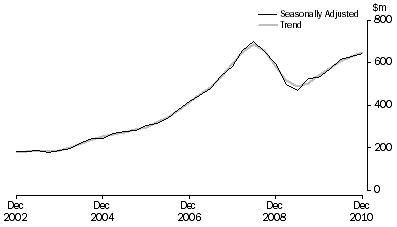
There’s little doubt the mining sector will underpin Australia’s economic growth and prosperity over the coming years, and hence it’s good to see mineral exploration rose 2.5% in December quarter 2010, and is getting back up near pre-GFC levels (as reported by the ABS today). Here’s the relevant ABS chart on mineral exploration expenditure:

In other economic news today, consumer confidence has declined and some economists are blaming the proposed carbon tax. The Australian reports:

PLANS for a carbon tax appear to have shaken consumer confidence, contributing to a slide in the latest Westpac-Melbourne Institute measure of consumer sentiment.

Pessimists now outnumber optimists in their outlook on family finances over the next 12 months for the first time since March 2009, when Australia risked falling into recession.

Westpac chief economist Bill Evans said the key factors behind the unexpectedly large fall in the index – down 2.4 per cent in March from a month earlier – seemed to be concerns over budget and tax issues, and petrol prices.

“While there is no specific evidence, we expect that the key negative for households … relates to the government’s commitment to introducing a price on carbon by July next year,” Mr Evans said.

Consumers may not need to worry about the carbon tax coming in next year, however. The Government is bleeding heavily over this issue, and it’s unclear whether it will be able to implement the carbon tax by mid-2012.

My gut feeling is that there’s less than a 50% chance of the carbon tax getting up. There are just too many random elements, including the rural independent MPs, who could withdraw their support for the Government, and the potential for a Labor leadership challenge, most likely from Bill Shorten, if the Government’s poll numbers don’t improve.

If the proposed carbon tax remains unpopular over the next few months, consumers may well come to conclude that it will never get up and think, right ho, let’s start spending again. Whatever happens, at least Australia has a robust mining sector that will keep the economy growing while the carbon tax uncertainty persists.

Posted in Climate change, Environment, Mining | Leave a comment

Just what are the aliens supposed to be looking for in Maryborough?

Maryborough residents concerned about UFOs should ask what possible motive would aliens have for visiting the town – is the Fraser Coast attracting intergalactic retirees? Perhaps due to a dearth of real local news, the Fraser Coast Chronicle is obsessed with recent UFO sightings around Maryborough:

Maryborough UFOs caught on video

Hot air and rubbish or alien UFO?

UFO mystery deepens

Clearly the Fraser Coast is an attractive lifestyle and retirement destination and will continue to grow strongly in the future (see 16,000 people move to Fraser Coast), but I doubt it would be the number one destination in Queensland for alien visitors. Given the major expansion of Lavarack Barracks, you’d expect Townsville would be experiencing the UFO sightings instead.

Maryborough does look like an interesting place to visit, though, particularly during the Mary Poppins festival in July, which is in honour of the Maryborough born creator of Mary Poppins, P.L. Travers.

Posted in Wide Bay-Burnett | 1 Comment

My School identifies heavily subsidised regional schools

My School identifies the poorly attended and, hence, high cost per student schools that, arguably, are being over-subsidised by taxpayers, such as the Irvinebank State School on the Tablelands in Far North Queensland, which received over $70,000 for each of its five students in 2009. At this rate of funding per student, it’s worth considering whether it may be worthwhile paying Irvinebank families to relocate to Cairns so their children can attend a cheaper school there. Also, subsidising boarding school attendance may be an option.

The Cairns Post reports:

PRIVATE schools in Far North Queensland are calling for an increase in government funding after revelations they have less spending capacity per student than their public counterparts.

First-time access to financial data on the new My School website has dispelled perceptions that the independent and Catholic school sectors were financially better off than state schools.

According to data on the relaunched site yesterday, students at independent schools in the Far North receive thousands of dollars less funding each year than those in the state system.

The site, based on 2009 data, reveals Irvinebank State School on the Tableland receives $72,399 annually for each student, while pupils at St Therese’s Catholic School at Edmonton receive $6929 for each student.

Obviously it’s silly to compare the Catholic School at Edmonton with Irvinebank, given that with only 5-6 students Irvinebank’s a special case. But My School does reveal that Catholic schools, on average, make do on $1,100 less per student than State Schools, which may have slightly higher costs due to a number of students with special needs (see this Australian article for details).

So My School will spark a much-needed debate at barbeques and dinner parties around Australia on how we fund our schools. Hopefully this will result in better policy in the long term.

Posted in Education | Leave a comment