Queenslanders not meeting mortgage repayments

In his speech on Recent Financial Developments, Ric Battellino, Deputy Governor of the Reserve Bank of Australia (RBA), observed:

Recently, it has been parts of Queensland and Western Australia that have shown a deterioration in loan arrears, albeit from low levels. As had been the case in Sydney earlier in the decade, the recent increase in loan arrears in these states followed a sharp increase in housing loans and unusually strong rises in house prices between 2006 and 2008. Some part of this was justified by the emerging resources boom but, as had occurred earlier in Sydney, this was accompanied by some lowering of credit standards and increased speculative activity, with the result that some households over-extended themselves. Adding to the stress on household finances was the fact that both these states experienced larger-than-average increases in unemployment during the 2009 downturn, though again from relatively low levels.

See also:

RBA warns many first home owners who used government grants may now be vulnerable
Posted in Housing, Macroeconomy | Leave a comment

Australia Institute on the future of retail – no more 142% mark ups

The Australia Institute’s Executive Director Richard Denniss made some insightful comments on Australia’s retail trade sector today, recognising that a significant proportion of bricks-and-mortar retailers may no longer be economically viable (Retailers guilty of 142% mark ups: Report):

According to the institute’s executive director Dr Richard Denniss, frugal shoppers are increasingly heading online at the expense of bricks-and-mortar retailers.

“The fact is, traditional retail is a very expensive way of delivering products to customers and – just as digital cameras have decimated photo development labs – so too will online retail transform the way Australians shop,” he says.

“Given the huge disparity between people’s perceptions of what is a fair mark-up and what they are being charged in bricks-and-mortar shops, it’s not surprising that they are choosing clicks over bricks.”

Richard is probably right that the rise of online retail will lead to a transformation of the retail trade sector in Australia, a transformation that will likely involve the closure of many stores and a relative decline in retail sector employment. As long as it occurs gradually, any displaced workers should be absorbed by other industries.

The transformation may have the largest impact on teenagers, who have typically worked in part-time jobs in retail. While Coles and Woolworths don’t have much to worry about with respect to online competition from overseas, Myer, David Jones, K-Mart, Big W and Target, for example, do, and they are major employers of teenagers. Hence it may be a lot tougher for young people to find part-time jobs in the future. Of course, there may be new job opportunities – with the rise of online retail, there may be demand for many more couriers in the future.

Posted in Retail trade | 1 Comment

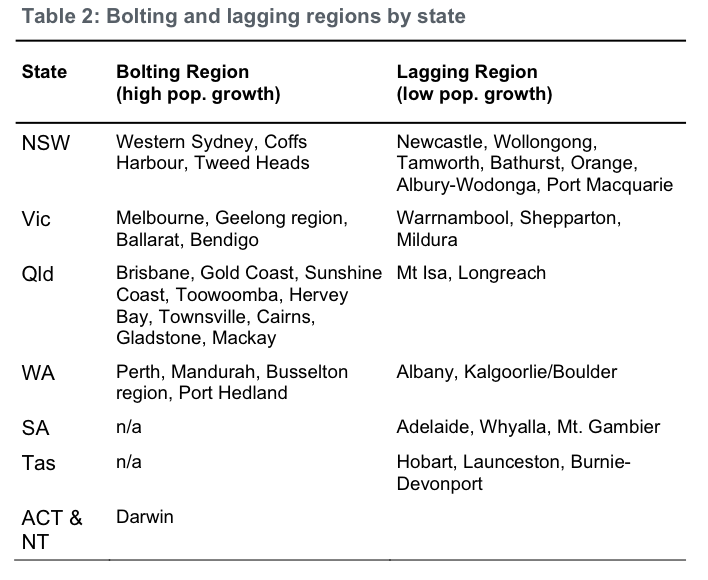
Queensland full of bolters

Queensland is leading the country in the number of bolting regions – including SEQ, Hervey Bay, Townsville and Cairns – with only Mt Isa and Longreach lagging behind. Check out this table in the excellent new Grattan Institute report Investing in Regions: Making a Difference:

The Fraser Coast Chronicle is excited:

Hervey Bay: fastest growing city

In recognition of Townsville’s status as a bolting city, I think the Queensland Industrial Relations Commission should allow Woolies and Coles to open at 9am on Sundays (see Trading Bid).

Posted in Brisbane, Cairns, Retail trade, Townsville | Leave a comment

Climate Commission says SEQ floods-climate change link plausible, but not discernible

The Climate Commission report (The Critical Decade) is a reasonably good and well-balanced summary of the science around climate change, clearly noting the uncertainties that exist – uncertainties which make climate change a diabolical policy problem. The Climate Commission’s summary of a possible climate change-SEQ floods link illustrates the uncertainties in our understanding of the possible impacts of climate change:

The bottom line is that although a conclusive link between the southeast Queensland rainfall events and climate change cannot be made, such a link is plausible even if it is not discernible yet. From a risk perspective, this is useful knowledge, and suggests that it would be prudent to factor in a climate change-induced increase in intense rainfall events in urban and regional planning, the design of flood mitigation works, and any reviews of emergency management procedures.

It’s hard to disagree with the Commission’s conclusion that it’s best to be prudent with respect to the possibility of a link between climate change and extreme weather events.

Posted in Climate change | Leave a comment

Now they have a decent shopping centre, Ipswich residents are shopping locally

For many years, dedicated Ipswich Mayor Paul Pisasale has pleaded with Ipswich residents to shop locally instead of driving into Brisbane to shop. Mr Pisasale would often cast Indooroopilly Shoppingtown as the villain, noting that Myer could probably justify opening an Ipswich store based on the money Ipswich residents spent in the Indooroopilly store. But, of course, they wouldn’t, given that Ipswich residents are quite happy to drive or catch the train to Indooroopilly. Although Myer hasn’t opened up in Ipswich, the city’s retail sector has recently picked up, as reported in the Queensland Times (Ipswich shoppers staying local):

RIVERLINK has defied all economic trends and posted an extraordinary 14% annual growth in sales for the month of April.

The result relates to sales figures from the more than 110 stores in the Riverlink complex in April, 2011 compared to those made in April, 2010.

Ipswich Mayor Paul Pisasale said the result was a sign that the city was bouncing back with greater vigour after the January floods.

“This is fantastic news for Ipswich because the retail average of increase for the same period was 1% across Australia,” Cr Pisasale said.

“But Riverlink is 14% up. It tells me that we are starting to attract all that leakage expenditure that was going to Indooroopilly and Brisbane.

Anyone who recalls the depressing sight of all the vacant shops in the Ipswich CBD during the 1991 recession would be very pleased with this news.

Posted in Ipswich, Retail trade | Leave a comment

Copper refinery closure is bad news, but Townsville’s economic prospects are good

One of my most vivid memories from my time at Kirwan High in Townsville is of the visit my grade 8 manual arts class made to the copper refinery. Proud refinery staff tried to explain in simple terms the science behind electrolytic copper refining, regarding which the Townsville refinery was apparently a world leader (see Xstrata copper refinery celebrates 50 years). I remember I was very impressed by the mighty cathode stripping machines, which separated the deposited copper from the stainless steel cathode plates to which it had become affixed.

Hence I was disappointed to learn of Xstrata’s decision to close the copper refinery (City reels after refinery closure), but its impact on Townsville’s economy is likely only to be temporary. Even though it directly and indirectly affects up to 260 workers, their prospects are good, as the Bulletin reports, with Xstrata committing to redeploying workers and the current skills shortages meaning any unemployment among workers indirectly affected should be temporary.

Despite the refinery closure, Townsville’s economic prospects are very sound indeed, with an expansion of Lavarack Barracks and a Queensland Government commitment to boost its presence in the city. My previous post on Townsville’s economic prospects is here:

Good times ahead for Queen City of the North

Posted in Townsville | Leave a comment

Mining boom is truly huge – $380 billion of planned investment

The Deputy PM and Treasurer Wayne Swan gave another informative budget roadshow speech today (The story behind the Budget: An inclusive Budget). Highlights include:

For the first time in our history we are situated in the right part of the world, with global economic weight moving towards us. Importantly, Asia’s re-emergence this century is not a short-run thing – it has been a long time coming, and will play out for many years to come. And it’s not just a China and India story. It’s as much about countries like Vietnam, Indonesia, and Korea. This has very big implications for our economy and brings very big opportunities for our businesses.

We’ve already seen our terms of trade reach their highest sustained level in 140 years. This is boosting incomes and driving an unprecedented investment boom. ABARES projects an extraordinary pipeline of $380 billion in resources investment – the biggest mining investment boom in our history. Right here in South Australia, BHP Billiton are looking at a dramatic expansion of Olympic Dam which would result in billions of dollars being invested in the state’s economy.

Posted in Budget, Mining | Leave a comment

Move public servants to regions only if cost-effective

There is a major risk that Opposition Leader Campbell Newman’s decentralisation plan to move Queensland public servants out of Brisbane CBD and into the regions – particularly Cairns, Maryborough, and Gympie – would eventually result in an overweight and inefficient public service. With public servants underpinning regional economies, Governments would be very reluctant to cut the public service fat that accumulates from time-to-time.

Hence, if he becomes Premier, Mr Newman would be well advised to commission an assessment of the cost-effectiveness of relocating the public service to the regions. My intuition is that there may be gains from relocating public servants out of Brisbane CBD and to suburban hubs such as Toowong and Mt Gravatt, but that mass relocations to the regions would not be cost-efffective.

Posted in Brisbane, Cairns, Queensland Government | 4 Comments

$28 per week minimum wage increase would come at bad time

Bundaberg business owners are rightly concerned about the $28 per week increase in the minimum wage sought by the ACTU. From the Bundaberg News Mail:

BUNDABERG business owners fear a proposed minimum wage rise of $28 a week could be the last straw, following a tough few months of floods and tourism downturns.

The Australian Council of Trade Unions is pushing for the rise from the current $569.90 a week at a hearing that started yesterday before the Fair Work Australia Minimum Wage Panel.

By raising the cost of labour, this could result in lower levels of employment, particularly in businesses already under pressure:

…restaurateur Ralph Reali said the ACTU’s proposal would force many businesses to cut staff and reduce hours.

Mr Reali, who owns Italian eatery Pappar’Delles, in Woongarra St, fears the bid will mean more hours spent over saucepans and less time with his family.

“I think people out there really underestimate how difficult it is to operate a profitable small business these days,” he said.

Let’s hope the Fair Work Australia Minimum Wage Panel comes to a sensible compromise between the ACTU’s $28 per week claim and the $9.50 per week increase sought by ACCI, which would only amount to a 1.7% pay rise (i.e. less than the expected rate of inflation at 2-3%).

The Gillard Government will be hoping for wage restraint, too, as a large increase in the minimum wage is the last thing it needs when it’s trying to encourage welfare recipients, many of whom will be low-skilled, back into work.

Posted in IR, Macroeconomy | Leave a comment

Australian soccer on government life support

In its first Budget presented in May 2008, the Rudd Government wisely cancelled Commonwealth funding promised by the Howard Government for a Rugby League Hall of Fame and a National Rugby Academy. They were luxuries and hardly essentials for a Government needing to exercise fiscal restraint. Unfortunately, in the 2011-12 Budget, the Government has committed to supporting football (i.e. soccer) in the lead up to the 2015 Asian Cup (from Budget Paper no. 2, p. 287):

The Government will provide up to $38.0 million to the organisation and staging of the 2015 Asian Football Confederation Asian Cup and to ensure the sustainability of football in the lead up to the event.

A taskforce will also be established within the Department of the Prime Minister and Cabinet at a cost of $4.6 million over five years to coordinate the Commonwealth’s role in supporting the 2015 Asian Cup and to work with the Football Federation Australia (FFA), the LOC, Commonwealth agencies and state and territory governments.

This raised eyebrows at the Adelaide Advertiser, which linked the funding to concerns about the viability of the A-League:

The Gillard Government did not elaborate how the sport was to become sustainable, but soccer has struggled financially in recent years with successful A-League teams such as Adelaide United and Brisbane being taken over as club owners by the governing body because new investors could not be found.

The Federal Government’s generosity towards soccer has caused consternation among rival bodies such as the Australian Football League and the National Rugby League.

It’s a pity this funding measure got through the Government’s Expenditure Review Committee, the so-called razor gang. The Commonwealth Government should keep out of sport and focus on the big issues of managing the mining boom, population growth, water and the environment.

Posted in Budget | Leave a comment