$430bn investment pipeline

The scale of the resources boom is staggering, as noted in Deputy PM-Treasurer Wayne Swan’s speech to federal parliament yesterday:

We have an unprecedented investment pipeline that is continuing to build, with a staggering $430 billion planned in resource investment alone…In fact, 40 per cent of our resource investment pipeline is already under construction or scheduled to commence. Projects like Gorgon, Gladstone LNG, Queensland Curtis LNG and Australia Pacific LNG are already making a significant contribution to our resources investment. Together, these will account for around $90 billion in capital expenditure over the coming years and will lead to a stream of exports.

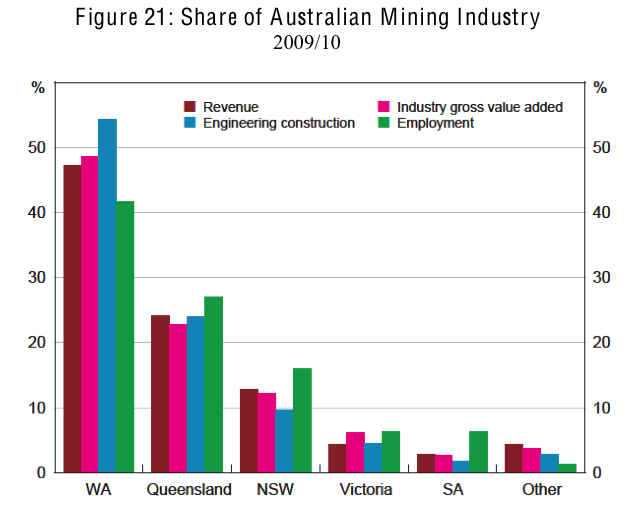
Queensland is obviously playing a major role, though WA gets the star billing:

That chart is from a paper by RBA economists Ellis Connolly and David Orsmond released yesterday which was presented at the recent Australian Economy in the 2000s conference.

Posted in Macroeconomy, Mining | 1 Comment

Donga contract provides jobs for Toowoomba builders

Coal seam gas (CGS) extraction, which the Government’s announcement yesterday should only have a marginal/negligible impact on (Mining buffer ‘doesn’t go far enough’) will be one of the big drivers of Queensland’s economic growth in the next few years. And the prosperity will be shared around the State with flow-on impacts to other industries, such as the building industry in Toowoomba ($57m deal boost to job market):

A $57million contract that will create 230 Toowoomba jobs has come at a perfect time for Cambooya carpenter Jason White.

The Hutchinson Builders Toowoomba carpentry supervisor said the announcement of the contract between his employers and gas company QGC came as a huge relief to him and his partner Naomi Davidson.

Under the deal, 1286 accommodation units will be constructed to house workers at Surat Basin sites Ruby and Woleebee Ck.

The single person accommodation unit, colloquially known as a donga, is a defining feature of the current resources boom. With all the new development in the Surat basin, the number of fly-in, fly-out (FIFO) or drive-in, drive-out (DIDO) workers must soon be approaching 5,000 people or around 10% of the region’s population (i.e. somewhere near the proportion in the Bowen basin). These FIFO/DIDO workers include not only miners but people in other industries benefiting from the boom (e.g. Mine sex work a hot bed of controversy). It’s time for OESR to update its Surat Basin Population Report so we can fully understand the economic and social impacts of these important developments.

Posted in Mining | Leave a comment

Public service entitlement culture

As a former public servant for both State and Commonwealth Governments, I remember it was acceptable practice in some agencies to take a “mental health day” off in response to a variety of circumstances, including breaking up with your boyfriend/girlfriend, fighting with a co-worker, and getting called out by your boss for slacking off. These absences are generally tolerated because a) public service management often lack the courage and genuine interest to discipline workers who are skiving off and b) public service regulations make it difficult to sack people. In the private sector, however, workers who abuse the system are typically dealt with because they affect the firm’s bottom line, and managers will hence take the necessary steps to resolve the situation.

I was reminded of the large difference in workplace cultures between the public and private sectors when I read the interesting piece buried on the bottom of page 24 of today’s Sunday Mail entitled “Public servant sick leave rate ‘chronic'”, which notes:

Public servants are taking more than twice as much sick leave as the average Aussie worker, costing the nation billions in lost productivity…The Australian Public Service Commission State of the Service Report revealed 30 per cent of federal agencies had an average absence rate above 12 days in 2009-10, while the average Australian took only 9.8 days in that period.

This is not a new problem, and the Australian Public Service Commission has previously issued Australian Government agencies a guide to Fostering an Attendance Culture, which apparently hasn’t had much of an impact. Nonetheless, it’s actually a good report which identifies the core problem – the public service’s entitlement culture. The report notes (p. 10):

A number of APS agencies have indicated that there is a strong entitlement culture in at least some sections of their organisation. Anecdotally, it appears that there are employees who use all their sick leave, with the view that it is their right to do so.

The solutions are obvious: reforms to industrial relations and public service regulations, as well as greater contracting out of public services.

Posted in IR | Leave a comment

Qld Treasury still expects jobs rebound

While the weak labour force data released on Thursday were a bit of a surprise, I remain confident the Queensland economy will pick up considerably over the next year, and I broadly agree with Queensland Treasury’s assessment here (Labour Force: July 2011):

Leading indicators, such as ABS Job Vacancies, suggested jobs growth will strengthen later in 2011. This should be supported by a recovery in agricultural employment following the floods and continued momentum in business investment, led by resource sector activity in particular. However, recent heightened financial market volatility may weigh on business confidence and hiring intentions in the short-term.

I disagree a little about the heightened financial market volatility as weighing on business confidence. Anyone working in Brisbane CBD is well aware of the massive influx of money associated with the resources boom and would quickly discount the recent fits of irrationality our financial markets have displayed. Ultimately, the real economy drives the financial markets. The late, eminent North American economist John Kenneth Galbraith said it best in the context of the 1929 stockmarket crash (in his superb The Great Crash 1929):

…the stockmarket is but a mirror, which, perhaps as in this instance, somewhat belated, provides an image of the fundamental economic situation. Cause and effect run from the economy to the stockmarket, never the reverse.

Posted in Labour market, Macroeconomy | Leave a comment

Why has Ipswich Council become a property developer?

Ipswich ratepayers should ask their Council some hard questions about Council’s involvement in a joint venture to re-develop the Ipswich CBD through the Council-owned Ipswich City Properties (Ipswich’s retail revolution):

Mayor Paul Pisasale said the shopping centre precinct, like the rest of the CBD redevelopment, would give Ipswich a world-class city heart.

“People used to say ‘Why aren’t we getting a Myers’, but there was nowhere to put them,” he said.

“If we build projects like this they will come, because of the growth and the loyalty of Ipswich residents.”

Cr Pisasale said the developments would work in with the city’s existing heritage buildings.

The shopping centre EOI campaign follows the lodgement of a development application for the redevelopment’s first commercial tower in June.

Work on the 10-storey tower, which is tipped to be the future home of 1200 state public service jobs, is expected to begin after sections of the Ipswich City Square building are bulldozed before December.

Mayor Pisasale’s faith in the loyalty of Ipswich residents is touching, but his belief that “if we build projects like this they will come” strikes me as involving a little wishful thinking. That said, Ipswich is growing strongly and it may turn out to be a good investment. Time will tell, but in the meantime I’d recommend the Queensland Times investigate the potential exposure of Ipswich ratepayers if things don’t work out.

In particular, will the 1,200 public service jobs come to Ipswich if there is a change in Government next year (which is almost a certainty)? While Campbell Newman has expressed support for relocating public servants to the regions, he has so far talked about Cairns, Gympie and Maryborough (Campbell Newman aims to move public servants to regions). And, given their past dealings, Mr Pisasale probably can’t expect any favours from Mr Newman (Standoff over ‘smear’).

Posted in Ipswich, Queensland Government | Leave a comment

Forget about that fancy book learning

Virgin Australia CEO John Borghetti gave a great talk at Brisbane’s Customs House today to UQ business, economics and law alumni on the company’s recent re-branding, which is aimed at capturing a large chunk of the high margin business and government travel market. During the Q&A session, he observed frankly that he doesn’t pay much attention to what is written on people’s CVs or their qualifications, and he instead prefers to get a sense of a person’s ability, character and drive from a face-to-face interview.

Earlier today, the National Centre for Vocational Education and Research (NCVER) released a fascinating new paper (Which paths work for which young people?) which found:

…although the university path is best for females, the picture is far less clear for males. It is still the best path in terms of leading to a high-status occupation, but an apprenticeship after completing Year 12 offers the best pay at age 25 years, and paths involving apprenticeships or traineeships lead to greater levels of satisfaction with life than does university study.

While I’d never discount the value of a university education, clearly it is not essential for success in life, and it may not be the best option for many young people.

Posted in Education | 2 Comments

Brisbane’s identity – centre of the 200km City

With the emergence of Springfield and the growth of the western corridor, and the large commuter flows from the Sunshine Coast and Gold Coast every day, it doesn’t make much sense to talk about Brisbane’s identity – or an economic strategy for Brisbane – that is independent of its role as the centre of the 200km City (from Noosa to the Tweed). Nonetheless, it appears the Brisbane Lord Mayor is focussing solely on Brisbane City in his current inquiry into Brisbane’s identity (Who are we? Mayor wants answers):

Brisbane’s Lord Mayor wants the city to settle its identity issues and push ahead more aggressively with a five-year economic development plan by November.

Graham Quirk said Brisbane had to come to terms with its identity and ask itself what made the city “different”.

“I think we still have a way to go in terms of identifying Brisbane,” he said.

“If I can talk perhaps in tourism terms for a moment; what is it that Brisbane really is about?.

“We know we have a great river here, we have great conditions for people to visit our city, but we also need to differentiate, in terms of tourism and economic growth, what it is that we stand for.

“And then individually and collectively, business and the citizens of this city have to sell this city.”

As much as I love Brisbane and think it’s a great place to live, I can’t see it ever being a major tourist destination – there’s no beach and parts of it, such as upper Roma St and Woolloongabba, are ugly – but luckily other parts of the 200km City (i.e. the Sunshine and Gold Coasts) are major tourist attractions. Hence, I don’t think tourism should be a major focus of an economic development plan for Brisbane.

Given the strong linkages across SEQ regional economies, and the differing strengths and opportunities of different regions, Brisbane needs to coordinate its economic development plan with other SEQ councils, which it should be doing through the SEQ Council of Mayors. Indeed, instead of economic development plans for each council, there could be one SEQ-wide plan. This could include the promotion of tourism to the whole region and policies to enhance Brisbane’s role as the service/administration centre of the 200km City – e.g. through:

  • improving Brisbane’s public transport links with Ipswich, Logan and the Gold and Sunshine Coasts; and
  • policies that make Brisbane more attractive to creative professionals, such as free wi-fi in public areas.

My previous posts on the 200km City and urban policy include:

Tradies know what it means to live in the 20okm City

Recommended reading for delegates to the Gold Coast Turning Point Summit

Mall activation – T minus 10 and counting

Brisbane not yet one of Monocle’s 25 most liveable cities in the world


Posted in Brisbane, Gold Coast, Ipswich | Leave a comment

No reason to panic yet

Our sharemarket has over-reacted to news of the US downgrade and continuing fears about European sovereign debt (Sharemarket closes almost 3pc down). As pointed out by financial economist Chris Joye, Australia’s economy is now largely tied to China and India and is not as exposed to the US and Europe as it once was:

 Why the US and Europe are actually not that important

I also wouldn’t expect the Australian dollar to continue falling, as Australian Government bonds will look increasingly attractive to investors across the world, and this will boost the demand for our currency. As reported by Bloomberg (Commodity currencies become a refuge):

“You want to stay away from the euro and dollar because this is really an ugly pair and there are alternatives,” Christoph Kind, the head of asset allocation in Frankfurt at Frankfurt Trustsaid in a telephone interview last week. “I like currencies like the Australian and New Zealand dollars, the Swedish krona and the Norwegian krone. They are AAA-rated countries with a currency they can manage and handle, and they have pretty liquid markets.”

While we should expect the markets to remain volatile in the short-term, over the next year, due to the resources boom, we can expect strong economic growth, particularly in Queensland and WA, and the Australian dollar to remain high. Of course, as noted by many market observers, the continuing global economic uncertainty should keep a lid on interest rates, which the developers of inner-city Brisbane apartments, projected to be in massive over-supply, will be very happy about (Two thousand new apartments, but no glut?).

Posted in Housing, Macroeconomy, Mining | Leave a comment

Krugman slams S&P over US downgrade

Rating agencies such as S&P and Fitch, which issued a bizarre negative outlook for Queensland not long ago, really have no idea about macroeconomics or public finance. Nobel prize winning economist Paul Krugman has a brilliant piece slamming S&P over the just announced downgrade of the US from AAA to AA+ (S&P and the USA). Choice excerpts include:

…it’s hard to think of anyone less qualified to pass judgment on America than the rating agencies. The people who rated subprime-backed securities are now declaring that they are the judges of fiscal policy? Really?

Just to make it perfect, it turns out that S&P got the math wrong by $2 trillion, and after much discussion conceded the point — then went ahead with the downgrade.

…S&P is just making stuff up — and after the mortgage debacle, they really don’t have that right.

So this is an outrage — not because America is A-OK, but because these people are in no position to pass judgment.

Krugman is absolutely right. The US remains the world’s most productive and innovative economy and will no doubt bounce back from its current malaise. Certainly the inevitable plunge in the US dollar will help it boost its exports.

It’s very likely the US downgrade will increase demand for Australian Government bonds and could well see the Australian dollar soar to new heights.

Posted in Macroeconomy | 1 Comment

Retail trading hours restrictions holding back retailers

The Productivity Commission’s report on online retailing, released today, finds the $1,000 GST threshold is only a minor issue and the bigger issues are over-regulation in industrial relations and retail trading hours. The Commission identifies Queensland, SA and WA as having the most restrictive trading hours, and notes there is nothing to fear from deregulation:

The experience with deregulated trading hours is that many
retailers do not trade for more hours in total than prior to deregulation. Instead they open at times when consumers are most likely to want to shop for the goods they sell. This means that many retailers, for example, remain closed on traditional public holidays such as Christmas Day, Good Friday and Anzac Day.

In fact, retail trading hours deregulation is essential for the future prosperity of the retail sector:

In today’s more competitive retail trading environment, where consumers have greater access to goods from all over the world and can order those goods any time of day, there is a greater imperative for retailers to have the ability to respond to
changing consumer tastes and preferences.

The deregulation of retail trading hours in all states should be progressed.

The Queensland Industrial Relations Commission, which is required to rule on a current dispute regarding retail trading hours in Bundaberg (David and Goliath in seven-day war), should pay close attention to the Commission’s report.

Posted in Retail trade, Tax | 3 Comments