Torres Strait autonomy very unlikely

I’m surprised our political leaders haven’t firmly rejected calls for Torres Strait autonomy (see PM looks at Torres Strait islands’ autonomy), given that creating a new Territory, a new parliament and more politicians anywhere in Australia would be highly unpopular. Furthermore the economic basis of an autonomous Torres Strait is questionable, as the islands lack a strong economic base on which a Territory Government could levy its own taxes. Hence the Territory Government would be almost totally dependent on transfers from the Commonwealth.

Posted in North Queensland | Leave a comment

Smaller rebound in business borrowing in Qld than in other States

The rebound in commercial and personal financing commitments reported by the ABS yesterday (Lending Finance, Aug 2011) is good news for the economy, as it suggests businesses and households are confident about the future. Based on the ABS data, Queensland businesses are a bit more hesitant in borrowing money than those in other States (see chart below). I expect this to change rapidly over the next few months as the economic benefits of the resources boom become even more apparent.

Posted in Macroeconomy | Leave a comment

Carbon tax petrol exemption requires rethink

As the owner of a V8 Jag with pretty ordinary fuel economy, I’m personally happy that petrol is exempt from the carbon tax, but, as an economist, I can see that it’s bad policy and potentially inequitable. The carbon tax won’t apply to petrol, but it will apply to public transport because it applies to diesel (and hence buses) and electricity generation (and hence electric trains). Perversely, the carbon tax increases the price of public transport relative to car travel. In today’s Queensland Times, Rail Back on Track spokesman Robert Dow makes the frank and fearless observation that:

“A policy that promotes car use but penalises public and active transport is idiotic.”

It’s hard to disagree.

An informative piece on the illogical petrol exemption by University of Sydney Professor John Stanley is available here:

Public transport – collateral damage of our new carbon price

Posted in Climate change, Transport | 1 Comment

Government on track to hit 100,000 new jobs target

Yesterday’s positive labour force numbers confirm that the Bligh Government should be able to meet its 100,000 new jobs election commitment, which I’ve discussed in a previous post.

Posted in Uncategorized | Leave a comment

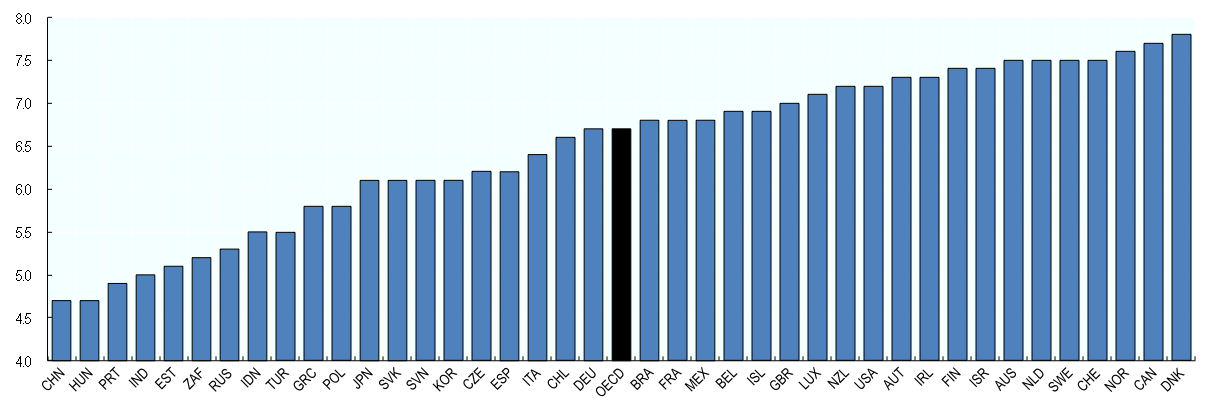
Australian life satisfaction 7th highest in OECD

Australians are much more satisfied with their lives than Americans, New Zealanders and the British, but we fall short of the levels of satisfaction experienced in Denmark, Canada and Norway. From the new OECD publication How’s Life?:

Posted in Population | Leave a comment

Resources boom forces rethink on immigration policy

The resources boom may force Australia to take in even greater numbers of skilled temporary migrants, and possibly at lower skill levels (and for shorter durations) than those migrants who currently come in on 457 visas for up to four years. I’m unsure if this is what the Chairman of Skills Queensland, Greg Kempton, has in mind, but he is clearly calling for a rethink of our current immigration policy. The Townsville Bulletin has reported this morning:

Mr Kempton said modifying the current immigration policy to employ short-term workers from other countries when local options had been exhausted was also required.

“The issue is that if we’re filling peaks, we probably don’t want the permanent population increases associated with that when demand declines and we still have the people but no jobs.

“We’re better to have a situation that allows for temporary skilled set solutions, then those people can move elsewhere.”

Yesterday Mr Kempton also noted that there are a projected 38,000 new jobs over the next few years associated with the resources boom:

AN unprecedented 38,000 jobs are expected to be created in Queensland in the next five years as the mining and resources boom takes hold.

The board of Skills Queensland yesterday met in Townsville to discuss ways to best tackle a predicted skills shortage born from the boom, that could threaten to undermine the region’s opportunities.

Skills Queensland chairman Greg Kempton said 38,000 jobs would be created predominantly in the resource sector by 2015, with the majority in central to North Queensland.

He forecast about half of the jobs would be in the construction sector, with drillers, miners, plant operators, concreters, truck drivers and machinists making up the bulk of the in-demand trades.

Posted in Labour market, Migration, Mining | Leave a comment

Contracting out could reduce Govt costs 20% says ex-NSW top bureaucrat

Gary Sturgess, former NSW top bureaucrat and a driving force behind national competition policy, has published a muscular critique of last week’s tax forum in this morning’s Australian:

WE have just had a tax forum largely debating how to raise revenue. Yet the government could save up to 20 per cent of its expenditure by overhauling traditional policy-making and accountability processes in the delivery of public services.

If we think of schools, hospitals and prisons as firms, then the regimes that regulate them amount to the worst red tape imposed on any sector of the economy, resulting in billions of dollars of lost productivity each year.

I totally agree with the sentiment, although the 20% figure is probably too ambitious. The studies I’ve read of the Thatcher reforms in the UK certainly suggest savings in the order of 10-20%, but there is a large part of government expenditure (i.e. pensions, other welfare payments) that couldn’t be cut. Hence a 20% saving is unlikely to be achievable across the whole range of government expenditures. Regardless, even a 5-10% saving in total government expenditure would amount to tens of billions of dollars.

Mr Sturgess’s conclusion is spot on:

Governments need to make more use of contractual models in delivering public services, without necessarily using the private sector. They also must appoint quality people to front-line management and learn to trust them. They must change the risk-reward ratio, identifying and honouring those who succeed, while protecting those who take measured risks and fail. We must encourage innovation in front-line services that is systemic rather than heroic.

Posted in Tax | Leave a comment

Restoring the ideal of a vocation

A new discussion paper from the NCVER reminded me of George Eliot’s great novel Middlemarch, which has as its theme the ideal of having a vocation in life – something more than a job, something more akin to a calling. The NCVER paper The Role of VET in Workforce Development argues that our current training system is too focussed on the acquisition of competencies or abilities to complete tasks. Instead the training system needs to promote the development of vocations, which encompass the acquisition of deep conceptual understanding and problem solving skills.

The author, Tanya Bretherton, discusses how this concept is applicable to childcare:

In child care, the best-practice centres considered by the analysis focused on the need to adopt non-hierarchical structures, in which every worker, regardless of their qualification level, could be involved and participate in decision-making processes (through team-based sessions and mentoring). In one case, a centre had adopted the policy of referring to all staff at the centre as ‘teachers’, regardless of whether they were certificate III, IV, diploma or degree-trained. While this may represent a controversial approach to some, it does re-cast the notion of skill around a ‘vocational area of practice’ and away from narrow and procedural notions of competency.

The NCVER paper is a valuable addition to the debate around the training system, especially given the competitive pressures that are driving increasing demands on workers and requiring higher-level problem solving skills.

Posted in VET | Leave a comment

Xstrata rejects CopperString renewable energy pipe dream

The CopperString renewable energy corridor, from Townsville to Mt Isa, always appeared to be a pipe dream, with fantastic expectations about the reliability of renewable energy generators (wind farms and solar & geothermal power stations). The big problem with renewable energy, of course, is that the supply of power is intermittent as it’s heavily dependent on the weather. It’s simply too big a risk for major industrial power customers. Hence it’s unsurprising that Xstrata has rejected CopperString, as reported in today’s Townsville Bulletin:

THE viability of the $1.5 billion CopperString project is under threat after Xstrata Mount Isa Mines yesterday opted out of the project.

The mine, which is the largest consumer of electricity in Mount Isa, yesterday announced it had agreed to a 17-year electricity and gas supply project.

The CopperString project, which involves constructing a 1000km high-voltage transmission line between Townsville and Mount Isa, was expected to create 5000 jobs and generate $6.5 billion for the region.

But the viability of the project is now under a cloud with Xstrata opting to purchase their electricity supply from Diamantina Power Station consortium from 2013 to 2030, with gas supply and pricing fixed until 2023.

CopperString project director Glenn Stockton said the project was now being reviewed to determine whether it would proceed.

Posted in Energy, North Queensland, Townsville | 1 Comment

The Gold Coast as an adolescent city

I highly recommend this fascinating discussion on Alan Saunders’s By Design program:

Professor Paul Burton is working on an intriguing project – looking at the urbanisation of the Gold Coast in the way one would look at the characteristics of adolescence. So things like rapid growth, developing sexuality, growing analytical capacity and ego-centrism. And just as a city grows, it can die. Paul Burton is fascinating and provocative. Listen here.

Conversation: Adolescent cities and why the Gold Coast is one

One of the highlights to me was Prof. Burton’s comparison of the Gold Coast, an adolescent city, with Canberra, which was born middle-aged.

Meanwhile, Gold Coasters are hopeful about the recent drop in the Australian dollar:

Lower dollar a relief for Coast tourism

Posted in Gold Coast | Leave a comment