Government still expected to hit jobs target

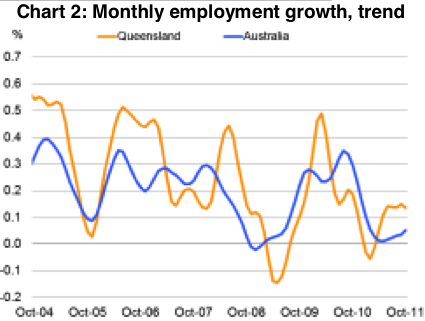
The Bligh Government remains likely to reach its 100,000 new jobs target, according to the latest ABS Labour Force data released yesterday, even though trend employment growth remains unspectacular (see the OESR brief):

Employment in Queensland has risen by 90,000 employed persons since March 2009, when the last Queensland election was held, so it only has to increase by another 10,000 over the next few months for the Government to be able to enter the next election campaign claiming it has met its promise. This is consistent with the recent rate of employment growth, so I see no problems with achieving this.

Posted in Labour market | Leave a comment

Treasury Secretary on FIFO

In a speech today to the American Chamber of Commerce in Australia, Treasury Secretary Dr Martin Parkinson noted the role of fly-in, fly-out (FIFO) work arrangements in spreading the benefits of the resources boom across Australia:

The increasing accessibility and cheaper cost of air travel has seen a proliferation of fly-in fly-out commuting arrangements between mining sites and cities. This has enabled the incomes earned in the sector to be spent in areas which do not have an immediate exposure to the mining boom.

In mining booms of the past, people would relocate to the mining sites creating towns and communities in the process but then these settlements would be hit severely when the boom ended and the lifeblood of the area disappeared.

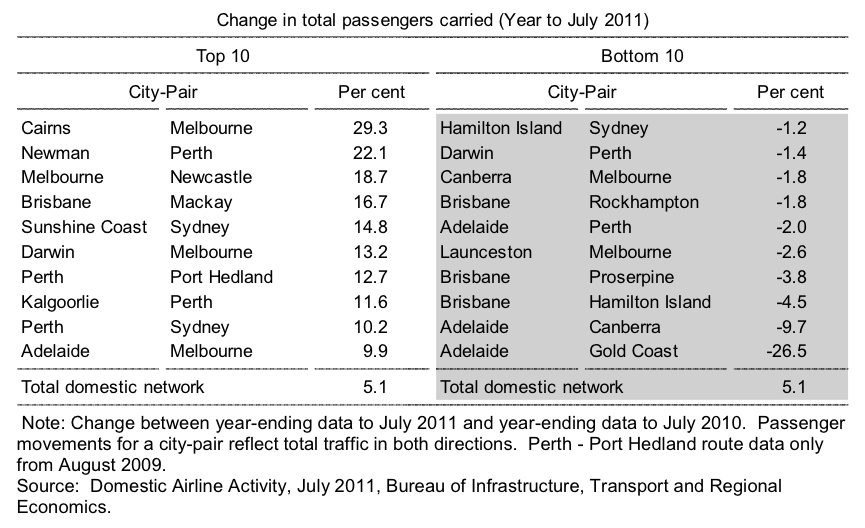
Dr Parkinson also highlighted that the air routes experiencing the strongest growth in traffic over the year to July 2011 were predominantly those involving a destination close to resources sector operations (see table reproduced below). The high growth rate on the Cairns-Melbourne route is unlikely to be mainly related to the resources boom and must be a rebound from a big drop in domestic tourism visits and flights to Cairns in 2009-10.

Posted in Cairns, Mining | Leave a comment

Flow-on impacts of the resources boom

Ross Gittins has an excellent column in the Age & SMH today on how the benefits of the resources boom flow through the economy:

It’s boom time for everyone

Gittins points out that NSW and Victoria benefit through the reallocation of Grants Commission funding toward them and away from WA and Queensland due to the improvement in WA and Queensland’s taxable capacity associated with the resources boom:

n 2004-05, NSW got just 83 per cent of the national average GST paid per person, while Victoria received 84 per cent. WA’s share was 104 per cent of the national average and Queensland took 107 per cent, with SA getting 123 per cent and Tasmania 171 per cent.

But the huge increase in the resource states’ taxable capacity thanks to booming mining royalties has changed all that. This financial year, NSW’s cut has risen to 96 per cent and Victoria’s to 90 per cent, whereas Queensland’s cut has fallen to 93 per cent and WA’s to – get this – 72 per cent.

It works out that, in effect, Queensland’s benefit from its mining royalties this year will be reduced by $1.2 billion and WA’s by $2.5 billion. Of their combined loss of $3.7 billion, NSW gains $1.3 billion and Victoria $1.8 billion.

Posted in Mining, Tax | Leave a comment

Uni / college days the happiest in people’s lives

That old folk wisdom about how your uni/college days are the best days of your life is confirmed by analysis of the Longitudinal Surveys of Australian Youth (LSAY), as reported in a new briefing paper released today:

The period between their late teens and early 20s is a particularly happy time for young people. They are finishing school and embarking on early work experiences or post-school study.The majority of them are still living at home and enjoying their social lives.This is also a time when young people’s satisfaction with their future and their level of independence begin to grow.

By age 25, young people are less happy with their social life, home life, and career prospects and work. This may be related to unmet expectations or not having a satisfying career. Data from the Household, Income and Labour Dynamics in Australia (HILDA) survey indicate that this downward trend in life satisfaction continues beyond age 25.

It seems to me that we need to prepare our young people much better for life’s ups and downs. Personally I’d recommend that our Education department adds Stephen Covey’s brilliant guide to living well, the Seven Habits of Highly Effective People, to the senior school curriculum.

Posted in Population | Leave a comment

Carbon price creates risks to growth claims Business Council

The passage of the Clean Energy Future (i.e. carbon price) legislation through the Commonwealth Parliament today is not the end of the debate, and the legislation will almost certainly need to be amended as its implementation bugs become apparent – e.g. a future Government will need to revisit the petrol exemption. Also, the Government may need to adjust the carbon price if the adverse impacts on business are greater than expected based on Treasury’s optimistic modelling. The Business Council of Australia appears set to maintain its criticism of the carbon price, with a media release today noting:

The Clean Energy Future Package legislation passed by parliament today has the potential to significantly increase risks to Australia’s economic growth and competitiveness…It is extremely disappointing that the parliament has not heeded the council’s calls to include essential safeguards in the legislation and act in Australia’s national economic interest.

The council’s analysis has demonstrated the legislation is based on optimistic assumptions in the Treasury modelling that have not been stress tested.

The lack of safeguards in Australia’s approach is particularly concerning given the uneven pattern of growth in Australia, the increased uncertainty in the global economy, and the lack of progress on international negotiations to put a price on greenhouse gas emissions. The legislation as passed risks placing Australia too far ahead of its competitors in pricing carbon.

It certainly appears to be an odd time for Australia to put a price on carbon, given the teetering trans-Atlantic economy means it is unlikely we’ll see significant action on climate change anytime soon from the US or Europe. Queensland Country Life reported this morning that:

Labor’s pact with the Greens is set to lock Australian business into paying up to double the global carbon price following sharp falls on international carbon trading markets.

The Senate today will pass the ­carbon tax, set to begin at $23 a tonne from mid-2012 and then rising to $29 by 2015, when it is scheduled to become a trading scheme linked to international carbon markets, The Australian Financial Review reports.

But European businesses will pay between $8.70 and $12.60 a tonne after carbon prices in Europe crashed to four-year lows amid new doubts about the Greece bailout.

While I believe coordinated global action on climate change makes sense, unilateral action by Australia does not. Of course, the passage of our carbon price could inspire the rest of the world to take action, but that may be wishful thinking.

My previous posts on climate change may be found here. A couple of the posts focus on the disproportionate impact the carbon price will have on the Queensland economy.

Posted in Climate change | Leave a comment

Google Trends for Cairns and the Great Barrier Reef

KS at Loose Change has a great post reporting on negative Google Trends results for “Cairns” and “Great Barrier Reef”, which probably reflect declining international interest in Far North Queensland as a tourism destination:

Google trends & insights

One hopes that as Japanese baby boomers begin to retire they fondly remember holidays to the Far North they took in younger years and return for another look. Otherwise, without a large decline in the exchange rate, international interest in the Far North may be difficult to re-capture.

Posted in Cairns, Tourism | Leave a comment

Replacement public holiday rule will cost Qld consumers

The Chamber of Commerce and Industry Queensland (CCIQ) and Queensland Hotels Association (QHA) have attacked the Queensland Government’s decision to grant an extra public holiday, on a weekday, when a public holiday in the Christmas-New Year’s period falls on a weekend:

Additional public holiday creates $342 million liability for Queensland employers

Cost of extra holiday may force hotels to shut down for Christmas, New Year’s Day

The QHA is correct that it may make it uneconomic for some hotels to open on the day of the substitute holiday. Alternatively, they may have to charge a premium (15%+) to cover the higher wages, as cafes now do on public holidays. Ultimately, the new public holiday arrangements will reduce choice and impose costs on Queensland consumers and probably should have been more thoroughly assessed.

Posted in Retail trade, Uncategorized | Leave a comment

Lots of room for new Queenslanders

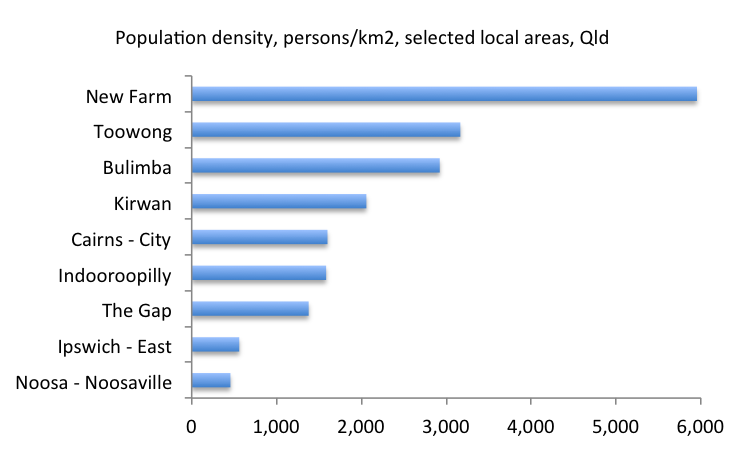
I’ve used the ABS’s new National Regional Profile tool to pull out the population densities of some of my favourite places in Queensland – places where I’ve either lived, worked on interesting projects, wasted too much time, or where I know some of my readers are located).

Toowong, where I currently live, is a very pleasant place (except when it floods) and I can see no problems with densities of around 3,000 persons per square kilometre across our urban areas. There is definitely scope for further population growth in Ipswich’s eastern suburbs, and I expect to see its population density increase as Springfield continues to grow. I’m a little surprised Indooroopilly’s density isn’t higher, but that may be due to the footprint of the behemoth that is the Shoppingtown.

Posted in Population | Leave a comment

Cairns pins hopes on FIFO, Bundaberg on DIDO

The resources boom is creating many employment opportunities in Queensland, but they’re not evenly distributed across the State. Hence, business and community leaders in Cairns and Bundaberg, which have endured high unemployment rates since the financial crisis, are looking to whether their cities can serve as bases for fly-in, fly-out (FIFO) or drive-in, drive-out (DIDO) workers:

Cairns is geared up for mining boom: industry leaders

City looks north for more jobs

I can see Cairns becoming a FIFO hub because of its airport, enviable lifestyle, environment and abundance of cheap property. As for Bundaberg’s prospects for becoming a DIDO hub, I’m less sure.

Certainly many Bundaberg-based workers could drive out to coal mines and stay in dongas during the week. But I can’t see a lot of DIDO workers heading up to Gladstone each day because it’s at least a two-hour drive, which would mean four hours on the road each day.

And I’d recommend Bundaberg business leaders give up the idea of a tilt train to Gladstone because there is absolutely no way it could stack up as an economic investment.

Posted in Cairns, Labour market, Mining | Leave a comment

Retail recovery continues

The ABS retail trade data released today confirm the economy is set to recover and has the Australian Retailers Association excited about the Christmas season (Christmas miracle for retailers). This chart from the OESR brief shows positive growth is locked in (although the rate of growth is unspectacular):

Food retailing has been the best performing category. This is unsurprising given the proliferation of hole-in-the-wall food retailers such as those 2 in 1 Japanese bakeries and Pie Face shops.

Posted in Retail trade | Leave a comment