ABS data confirm Qld tourism stuck below pre-crisis levels

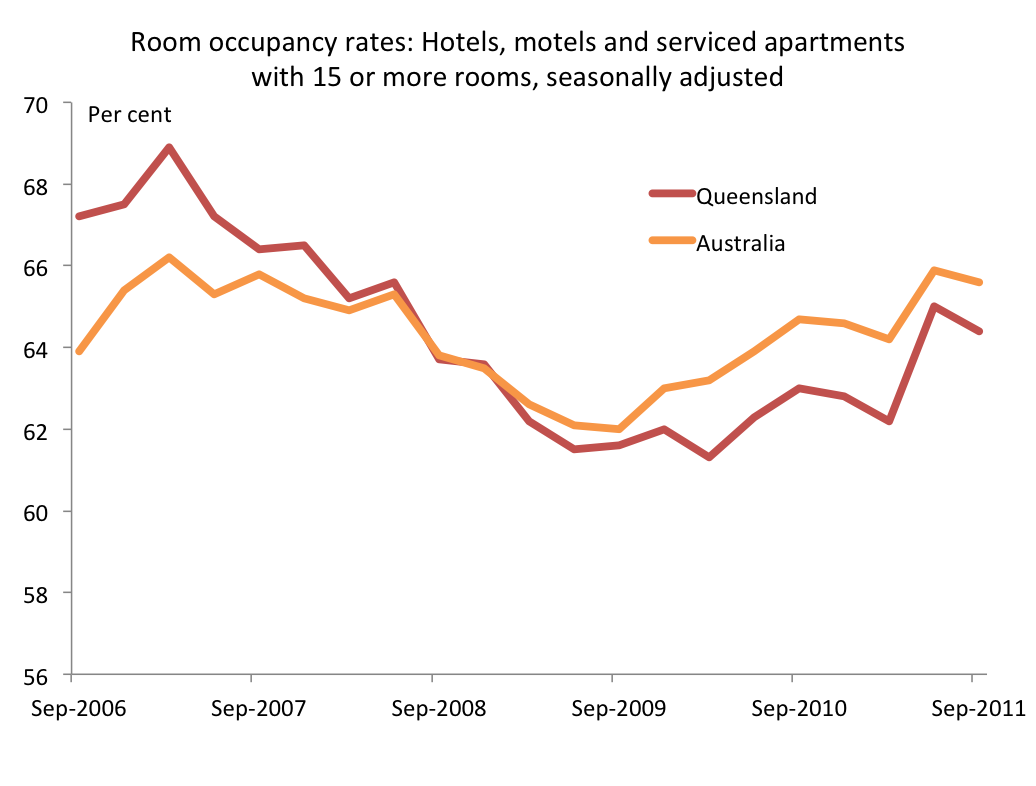
While hotel, motel and serviced apartment occupancy rates appear to have recovered nationally, the occupancy rate in Queensland remains significantly below pre-financial crisis levels, according to the new ABS Tourist Accommodation data released today:

Posted in Tourism | Leave a comment

Should the Government provide social housing?

Today’s Courier-Mail report on problems with the management of Queensland’s social housing stock makes me wonder if there is a better way for the Government to assist poor households (70,000 on housing wait list):

There are 69,180 people, roughly the population of Rockhampton, waiting months and years for a roof over their heads. That is more than double the Housing Department’s official wait list of 31,315 – a tally that counts only actual applications, not how many people are involved in each…

…Meanwhile, more than 7100 of the state’s 54,468 social housing properties are not fully utilised. About 680 houses are vacant, there are 5617 properties with three bedrooms or more tenanted by singles, and a further 816 residences are occupied by households earning more than the $80,000 threshold.

At least since the late 1990s it’s been a well-understood principle that governments can be a purchaser of services but they don’t necessarily have to be the provider. While there will exist a legacy public housing stock that will need to be managed and eventually sold off, the Government should cease investing in new social housing and simply pay poor households who need assistance in finding housing instead.

Ideally the State Government would coordinate with the Commonwealth so this could be in the form of a boost in rent assistance already offered by Centrelink. The Government should aim to assist as many households experiencing difficulties keeping a roof over their heads as possible. Currently it isn’t assisting the tens of thousands of households on the waiting list, but is assisting at least 816 households earning above $80,000 p.a. which probably don’t need social housing any more.

Posted in Housing | Leave a comment

Governments will need to re-think childcare reforms

The Productivity Commission is by now used to governments ignoring its well-crafted, realistic economic policy advice, but usually the advice is ignored because it’s politically toxic – e.g. it would upset the entire population of Tasmania. Currently, however, governments across Australia are ignoring Commission advice that would push them in the direction of their clear political interests. I’m referring to the Commission’s advice from last year on the impact of new COAG childcare reforms on the cost of childcare and female workforce participation (see Childcare reforms to push up fees by 15pc, says Productivity Commission).

The Gold Coast Bulletin reports this morning (Coast childcare costs to rise $15 a day):

THE cost of childcare centres on the Gold Coast will rise by up to $15 a day, forcing some parents to quit work because it is too expensive to have their children looked after.

From this week fees at centres across the Coast are set to rise by between $2 and $15 a day per child to fund the introduction of new Australian legislation.

The new legislation, which replaces Queensland’s Child Care Act 2002 and Child Care Regulation 2003, will force all childcare staff to be trained to higher standards meaning costs will be passed on.

The sweeping changes have panicked some mothers who fear they will have to give up working.

I expect governments will find ways to relax the requirements to minimise the political impact, which will become more apparent as working couples return to work after the Summer break.

Posted in Education | Leave a comment

New driver’s licence rules reduce youth workforce participation

This story in the Courier-Mail yesterday (Mum’s taxi staying in service longer) made me wonder about the impact of driver’s licence changes on youth workforce participation, given that having to rely on public transport or mum or dad will make it difficult for many young people to find and retain part-time employment:

THE parental taxi is staying on the road for longer than it used to as more young people put off getting their driver’s licence until their mid-20s.

Transport and Main Roads statistics show changes to licensing introduced in 2007 have led to more people delaying their driving test until later.

Since 2007, the number of learners has blown out by 70 per cent, growing from 105,751 to 179,709 in 2011.

Almost 20 per cent of those on their L-plates are now aged 20 to 24 years, up from 15 per cent two years ago, and the number of 19-year-old learners has climbed from 10,450 to 14,228 since 2009.

Once drivers turn 25, they no longer have to complete the 100-hour logbook, which is a requirement for learners aged from 16 to 24.

Australian Driver Trainers Association’s Alan Farley said the logbook system was a burden for many young people, particularly those without access to a car.

“It’s just a too-hard situation if they haven’t got easy access to a vehicle, because having to do the 100 hours through a driving school is very expensive,” Mr Farley said.

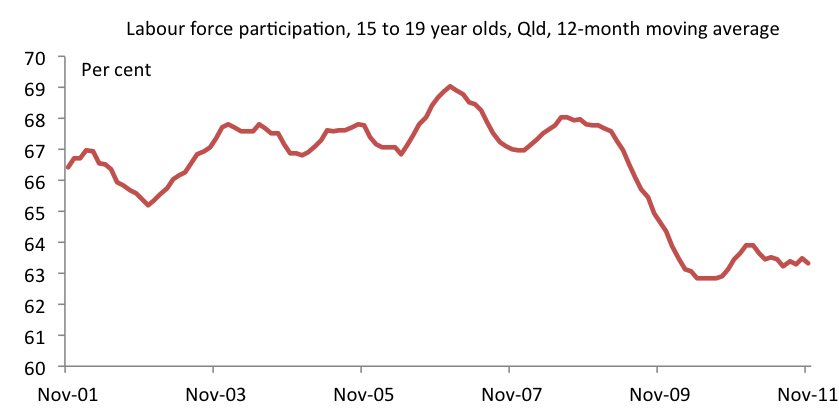
The ABS labour force data (from super table LM8) support my hypothesis, as labour force participation among 15 to 19 year olds in Queensland has fallen over the last few years (although I acknowledge in part this may be due to a weaker labour market):
This is definitely worthy of further investigation.

Note: the labour force participation rate is calculated as the sum of employed and unemployed persons (those actively looking for work) divided by the population in that age group.

Posted in Labour market | Leave a comment

Eurozone crisis watch

Today’s Italian bond auction went significantly better than expected, although nervous market watchers still found a reason to worry, as reported on the Guardian’s excellent Eurozone Crisis Live Blog:

At first glance, the results are slightly better than feared (the yields on the three and 10-year bonds are lower than the record highs recorded last month).

But, Italy only sold a total of €7.017bn of debt, out of a maximum target of €8.5bn. That’s worrying, when the country needs to auction around €440bn of debt in 2012.

And a yield of almost 7% is still unsustainable over a long period.

Yes, 7% is unsustainable over a long period, but, if the Europeans muddle through this as I expect they will, the threat of unsustainable debt will force Italy and other European governments to run large budget surpluses to pay down the debt when their economies are in better shape (i.e. probably not before 2014-15).  The challenge of course will be that at the same time they will face large budgetary pressures from ageing populations. I expect this will force European governments to make some very painful decisions on social welfare spending, because they simply won’t have any alternative.

By the way, the Economist has a handy guide to understanding the sustainability of debt here:

Debt dynamics: The maths behind the madness

Posted in Budget, Macroeconomy | Leave a comment

Not another referendum on local government

Australians, rightly in my view, have previously rejected constitutional recognition for local government at referendums in 1988 and 1974 (see this Parliamentary Library paper), but unfortunately the issue keeps coming back, as reported by the Australian this morning:

AN expert panel has ignored warnings from John Howard and recommended a referendum be held in 2013 canvassing recognition of local governments in the Constitution to ensure they can receive direct commonwealth funding.

The recommendation to proceed with a third attempt to recognise the third tier of government in the nation’s guiding document was last night welcomed by Australian Local Government Association president Genia McCaffery, who said financial security through recognition of local councils in the Constitution was necessary for their survival.

The referendum is likely to be met by fierce opposition from some state governments concerned the move would diminish their powers. Western Australia has warned it will actively campaign against financial recognition in the Constitution of local government.

The referendum could also spark broader fears about the unintended legal consequences stemming from High Court interpretations.

I expect Australian voters will again reject any push for constitutional recognition of local government. I suspect that Australians would be worried about local government politicians getting puffed up as a result of constitutional recognition and granting themselves massive pay rises.

Personally I’m against constitutional recognition because Australia is over-governed and constitutional recognition of local government would entrench three levels of government in Australia, when ideally we should move to two levels of government – i.e. a federal government and regional governments (larger and more efficient than current local governments and more nimble and responsive than current State governments).

Posted in Uncategorized | 1 Comment

Council debt worries Rocky residents

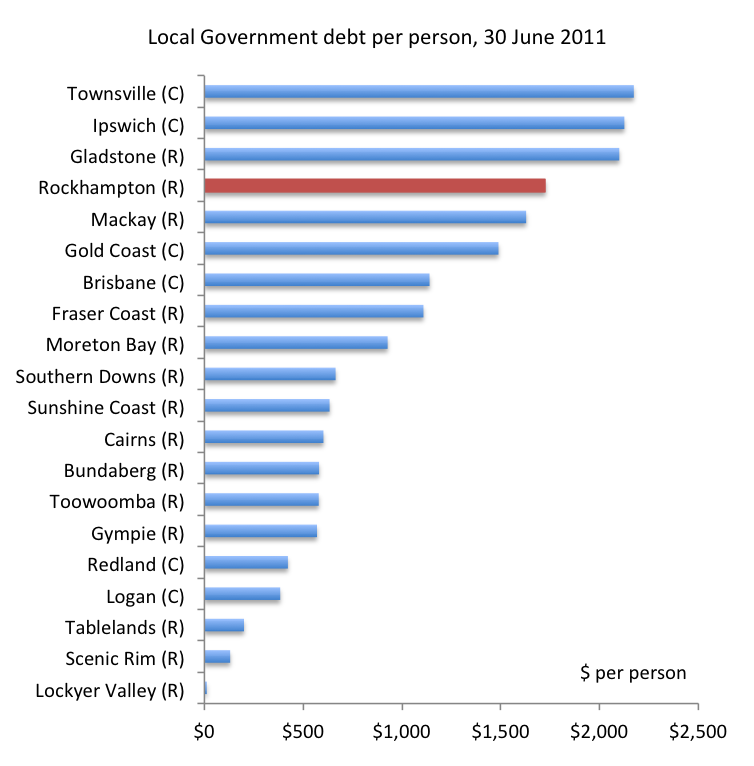
Today’s Rockhampton Morning-Bulletin features an interesting debate between a local resident and Mayor Brad Carter regarding the sustainability of Rockhampton Regional Council’s $200 million debt, which is among the highest in per capita terms of the 20 largest Councils in Queensland (see figure below, based on Queensland Treasury Corporation and OESR data).

I don’t know enough about the merits of the infrastructure investments the Council has funded with recent borrowings to draw a firm conclusion regarding Rocky’s debt level. I do however agree with the Mayor that borrowing is defensible where it pays for necessary infrastructure, and the amount of debt in question is small relative to the size of the Council’s balance sheet.

Posted in Rockhampton | Leave a comment

Strong start to Boxing Day sales

The need for traffic control on the escalators at David Jones, Queens Plaza in Brisbane was a good sign that the Boxing Day sales would go well for retailers (confirming again my belief that the Queensland economy is strong).

Without staff directing the flow of traffic, there could have been a nasty crush as people coming up the escalator from level 1 competed with people entering DJs on level 2 for a step on the escalator to level 3, where Western suburbs gents were racing to pick up their discounted Ralph Lauren polo shirts and Nautica shorts. The Courier-Mail has reported Dawn breaks in Brisbane with mad retail rush, which is a reasonably accurate description.

For those wishing to get to the head of the pack at next year’s Boxing Day sale at DJs, I recommend the main entrance on Level 1 (shown below), which is opened at least 30 seconds earlier than the other entrances.

Posted in Retail trade | Leave a comment

Surge in professional jobs as resources boom continues

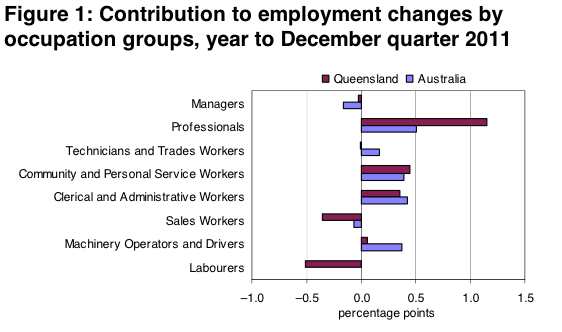
The number of professional jobs increased strongly by 6.2% in Queensland over 2011 according to the latest ABS labour force data, as reported in an information brief from OESR yesterday. The growth in professional jobs accounted for all of the employment growth in Queensland in 2011, with gains and losses from other sectors offsetting each other:

I expect the strong growth in professional jobs is related to the resources sector, which is having significant spillover impacts on professional services in Brisbane and other major centres (including, fortunately, on the demand for economic consultants).

See my previous post That sure is a mining boom for further discussion of these spillover impacts.

Posted in Labour market, Mining | Leave a comment

Guest worker trial for sugar industry

I was pleased to read the Federal Government has announced a trial guest worker scheme for the sugar industry drawing on temporary migrants from East Timor, Tonga, and PNG, among other countries in the region. The Bundaberg News-Mail reports:

LABOUR shortages in the sugar industry may soon be solved.

The Federal Government has announced a small-scale, three-year trial to help ease the crisis.

Workers from countries such as East Timor, Tonga and Papua New Guinea will participate.

Canegrowers chief executive officer Steve Greenwood said the trial would start at the beginning of July next year.

“The sugarcane industry relies upon a workforce with a unique set of skills and abilities,” Mr Greenwood said.

This trial will generate economic benefits in both Australia, by easing labour shortages, and back in source countries via remittances. I expect rich countries such as Australia will need to take on greater numbers of migrants (both temporary and permanent) in the future as the imbalance in labour supply between rich and poor countries becomes greater over time (see Important facts for the national population debate).

Posted in Labour market, Migration, Population | Leave a comment