
In a just released Economic Roundup paper (The Australian Economy and the Global Downturn), the Commonwealth Treasury attempts to rebut one of the standard criticisms of fiscal stimulus, which relates to its impact on the exchange rate:
Another view is that the impact of fiscal stimulus would be fully offset by an appreciation of the exchange rate, this being the standard result in mainstream macroeconomic models of a unilateral fiscal shock, in a world with perfect capital mobility (see, for example, Makin, 2009; Makin, 2010b, Valentine, 2011). Of course, rather than appreciate, the exchange rate fell sharply during the downturn.
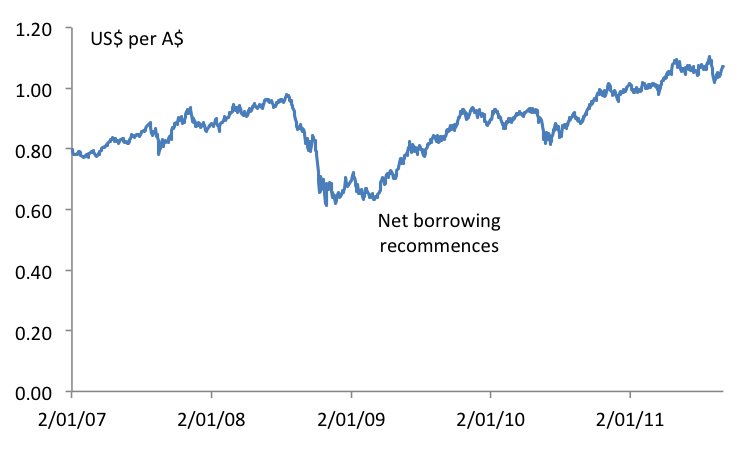
Treasury seems confused about the timing of the stimulus and movements in the exchange rate. Looking at the data (chart below), the exchange rate fell over the second half of 2008, but the stimulus didn’t really begin until the very end of 2008. The cash splashes occurred in December 2008 and April 2009, and the home insulation scheme and Building the Education Revolution money would have flowed over 2009 and into 2010. The Government recommenced net borrowings (i.e. to fund budget deficits) in February 2009, and the exchange rate started to recover from around this time. So Treasury cannot readily dismiss the impact of the stimulus packages on the exchange rate, and some deeper analysis of the issue is desirable.
 Queensland Economy Watch