RBA panics over European debt crisis

Yesterday’s interest rate cut shows the official family in the RBA and Treasury are panicking over the European debt crisis, and are risking the Bank’s inflation-fighting credentials.

On the issue of whether the banks will pass on the rate cut (as reported here in today’s Courier-Mail), I’ve previously written about how the RBA is losing its monetary mojo. Australian banks are heavily reliant on borrowings from overseas, and the interest rates they pay on these borrowings are unaffected by the Australian short-term money market rate that the RBA can influence.

The RBA Governor Glenn Stevens acknowledged the difficulties that banks are facing in securing the big chunks of money they need from overseas in his statement yesterday:

Short-term market interest rates have tended to decline a little further in recent weeks, though term funding conditions for financial institutions have become more difficult.

This means there is no guarantee that banks will pass on reductions in the official cash rate set by the RBA to households.

Posted in Macroeconomy | 1 Comment

People’s Question Time on education and skills

Premier Anna Bligh, Education Minister Cameron Dick and Employment Minister Stirling Hinchliffe are taking part in a People’s Question Time event tomorrow night at the State Library in Brisbane that I am attending. While registrations to attend are closed, you can watch proceedings and submit questions here:

People’s Question Time: Queensland’s future – education and skills 

The topic is education and skills, which means I won’t be able to ask a question about retail trading hours, but I’ll try to ask one around teacher performance pay or the benefits and costs of moving year 7 into high school. If anyone has any suggestions for questions, please include them in a comment below.

Posted in Education | Leave a comment

Budget turnaround looks implausible in Treasurer’s chart

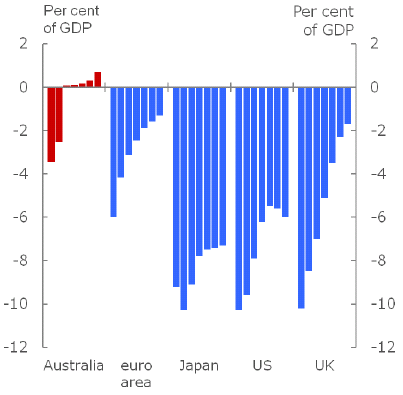
I’m surprised Deputy PM and Treasurer Wayne Swan included this chart of budget balances in his economic note today, because it shows just how big (and implausible) the improvement in the Commonwealth Budget needs to be (i.e. around 2.6% of GDP) for the Government to record a surplus in 2012-13:

Looking at the historical Budget data in the Mid-Year Economic and Fiscal Outlook (Appendix D), the biggest improvement in the Budget balance between two financial years occurred between 1998-99 and 1999-2000, when the budget balance improved from 0.6% to 2.0% of GDP. This improvement was around 1.4% of GDP, compared with the required improvement in 2012-13 of 2.6%. Hence the historical record suggests the Government is very unlikely to achieve a surplus in 2012-13.

Posted in Budget | 2 Comments

Alcohol restrictions may help, but Gold Coast really needs more police

Ever since I was punched in the back of the head by a drunken idiot at Canberra’s Uni Pub the weekend prior to Easter in 2008, I’ve believed that alcohol-related violence is a major issue in Australia and demands a serious crackdown. Hence there may be merit in the proposed after-midnight alcohol restrictions on Surfers Paradise, as reported in today’s Gold Coast Bulletin:

A MAJOR Surfers Paradise business group is lobbying the State Government to mandate mid-strength alcohol after midnight to try to restore the tourist strip’s tarnished image.

The Surfers Paradise Alliance, which represents more than 700 businesses, is also calling for compulsory ID scanners at all licensed venues, a complete ban on glass at major events and “high-risk” clubs and pubs and more police and liquor licensing inspectors.

The best thing we could do to reduce alcohol-related violence (and other crime) on the Gold Coast would be to massively boost police numbers. The Government may have significantly increased numbers earlier this year, and assaults are trending down, but the incidence of violence still remains high and more police officers are obviously needed.

While another boost to Gold Coast police numbers would come at a significant cost, boosting police numbers would yield net economic benefits to the community, if the results from a new RAND Corporation study for the US are applicable here (Save Money-Hire Police):

Although crime in the United States on average has shown a historic decline since the early 1990s, a recent RAND Corp. report shows that a 10% increase in the size of a police force decreases the rate of homicide by 9%, robbery by 6% and vehicle theft by 4% each year. (The effect on rates of sexual assault is less clear.)

And crime is expensive to communities, businesses and victims.

Each homicide costs a community an average of $8 million, according to reliable cost-of-crime studies. At that rate, Los Angeles’ homicides cost it more than $4 billion in 2006, or 2% of the city’s total economic output. That bottom line includes obvious costs of crime: adjudication, coroners, medical costs and incarceration. RAND also figured in a factor for the intangible costs of victims’ pain and suffering.

The high cost of crime to society suggests that adding police officers may give large cities a sizable return on their investments.

Posted in Crime, Gold Coast | Leave a comment

Latest building approvals data disappointing

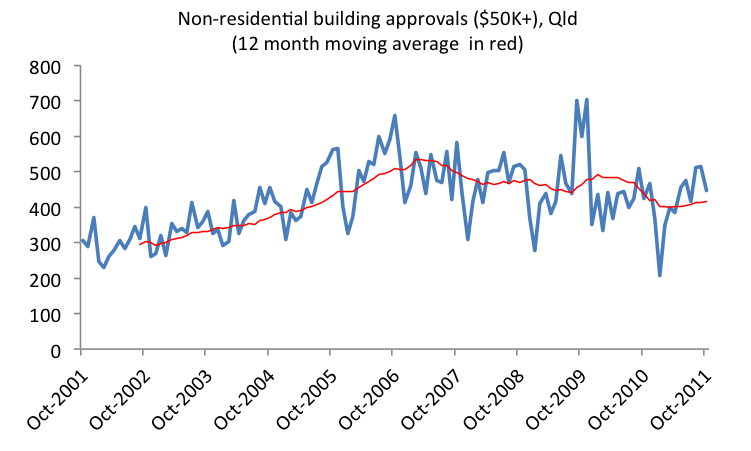
The new ABS building approvals figures are disappointing, suggesting the non-resources part of the economy is sluggish:

Posted in Macroeconomy | Leave a comment

Resources sector accounts for half of GDP growth

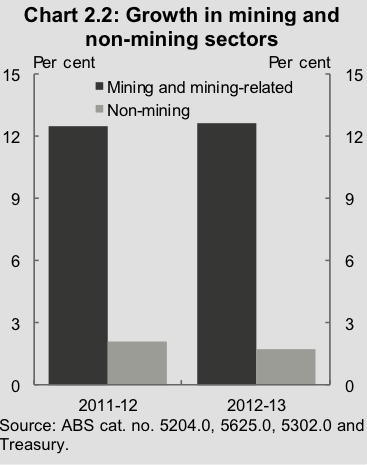
The following chart in yesterday’s Mid-Year Economic and Fiscal Outlook (MYEFO) nicely illustrates the two-speed economy:

Given the resources and resources-related sectors are around 15% of the economy, this chart suggests around half of Australia’s economic growth in the next two years is attributable to the resources sector.

Regarding the Government’s fiscal strategy unveiled in MYEFO, I think the cuts to the federal public service and baby bonus are necessary and desirable. In describing the cut to the baby bonus, the Government has introduced a new euphemism. It’s not a cut, it’s a reset, as in:

Resetting the Baby Bonus to $5,000 and pausing indexation will continue to deliver substantial financial support to new parents while ensuring the ongoing viability of the payment.

I can imagine the Hollowmen moment, somewhere in either Parliament House or down in the Treasury building, when they came up with that one.

Posted in Budget, Mining | Leave a comment

OECD optimistic that European policy makers will prevent crisis

In its latest Economic Outlook, the OECD runs the risk of being subject to the old joke about the economist stranded on a desert island with some tinned food who assumes he has a can opener.  While I agree with the OECD’s assessment, one cannot help wondering when reading it whether the OECD is putting too much faith in the ability and courage of European leaders:

The Outlook’s baseline scenario assumes that policy-makers take sufficient action to avoid disorderly sovereign defaults, a sharp credit contraction, systemic bank failures and excessive fiscal tightening. It sees GDP across the OECD countries slowing from 1.9% this year to 1.6% in 2012, before recovering to 2.3% in 2013. Unemployment in the OECD area is also projected to remain high for an extended period, with the jobless rate staying at around 8% through the next two years.

The OECD chief economist provides a concise summary of what needs to be done:

“Prospects only improve if decisive action is taken quickly,” said OECD Chief Economist Pier Carlo Padoan. “In the euro area, the risk of contagion needs to be stemmed through a substantial increase in the capacity of the European Financial Stability Fund, together with a greater ability to call on the European Central Bank’s balance sheet. Much greater firepower must be accompanied by governance reforms to offset the risk of moral hazard,” he said.

Posted in Macroeconomy | Leave a comment

Townsville CC knocks back Nuns’ plans to rebuild convent

An article in yesterday’s Townsville Bulletin (Fire danger forces Strand nuns out) confirmed the over-zealous stance of the Townsville City Council on heritage, which I’ve noted in a previous post. The Bulletin reports:

NUNS have had to leave a 100-year-old timber convent in the grounds of St Patrick’s on The Strand because of the dangers posed by fire, asbestos and lead paint…

…The Sisters of Mercy applied to council for permission to demolish the convent and to build a new $12 million building with public access areas in its place. The Townsville City Council knocked back the application.

Council instead saw merit in preserving the existing non-serviceable building for posterity and to that end rejected the Sisters of Mercy application.

So enamoured of the present building is the council, it is applying to have it added to the Queensland Heritage Register. If it was successful in having the building registered, the convent would become an architectural curio of no practical use.

Congregation leader for the Sisters of Mercy in Townsville Sister Marie said if it was registered the sisters would be left with no alternative but to lock it up.

The Council’s position defies logic and the wishes of the Sisters of Mercy, who you think would be in the best position to weigh up the competing concerns of the best current use of the site and heritage considerations. Why not extensively photograph or video the convent for the historical record, and then knock it down and build a new convent?

Posted in North Queensland, Townsville | 1 Comment

Commonwealth may need to guarantee State borrowings again

Obviously, if the euro zone breaks up, as many commentators including the Economist (Is this really the end?) see as reasonably likely, the global economy will suffer a massive negative shock and we may need to revisit forecasts of a decade of prosperity for the Queensland economy. Officials at the Queensland Treasury Corporation, which borrows money on the Government’s behalf, are no doubt keenly following international developments. Indeed, they are already feeling the effects of the latest financial turmoil, as reported in this weekend’s Australian Financial Review (No mood for state bonds, p. 17):

Australian state government bonds have been caught in the crossfire of the escalating sovereign debt crisis, with bond spreads blowing out relative to sovereign bonds.

The spreads of semi-government bonds issued by the Queensland Treasury Corporation have been particularly hard hit – widening to as high as 1.5 percentage points above the Australian Government bond, from an annual average of 0.9 of a percentage point.

If this continues, or worsens, I expect the Commonwealth Government will re-instate its guarantee of State Government borrowings, which it introduced in early 2009 for a temporary period until the end of 2010. In the worst case scenario, the Commonwealth Government may even have to consider borrowing on behalf of the States.

I expect (or rather hope) this would force a broad ranging debate about the nature of our federation and whether State Governments should be replaced by smaller regional Governments that would absorb current local governments.

Posted in Uncategorized | Leave a comment

Don’t tie up money in Education Trust, cut taxes instead

The proposed Queensland Education Trust has the look of a policy born out of a focus group, and Treasury must have been asleep when the policy was under development, because the proposed policy fails on basic public finance and economic principles. There are at least four problems with it I see:

  1. it would tie up a substantial sum of money that may have a better use in the future (i.e. it reduces our budgetary flexibility);
  2. while Queensland is still in debt, the Government’s primary focus should be on reducing debt and restoring our AAA credit rating so we can save around 20 basis points (0.2 per cent) on the cost of our borrowing;
  3. if Queensland gets out of debt, the community would likely get a better return from a cut in taxes, especially the highly inefficient stamp duty on property transactions; and
  4. it will have high administration costs and cause a lot of community angst as it isn’t obvious how you define a Queensland baby for the purposes of the Education Trust (e.g. what if someone is born here but only lives here the first six months of their life?).

The discussion paper at least acknowledges the problem of defining a Queensland baby and ensuring that the Trust isn’t rorted by interstate people coming to Queensland to have babies.

Also, the Brisbane Times has picked up that the per capita amounts in the Education Trust are relatively tiny and hence the trust will be ineffectual:

Student nest egg to cover first uni year

At least the Government had the good sense to announce the policy proposal in a discussion paper rather than fully committing to it yet. Deep down, Treasurer Fraser must know it’s a loser.

Posted in Education | Leave a comment