Queensland only third fastest growing State or Territory in 2010-11

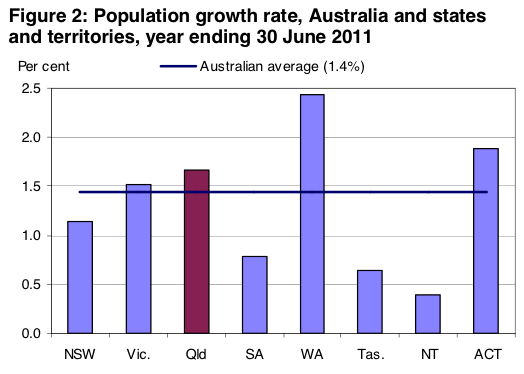
Unsurprisingly WA had the fastest growing population in 2010-11, and had a comfortable lead over the ACT in second place (Canberra must be hiring a lot  of new public servants) and Queensland in third place, according to new ABS demographic data released today. I’ve borrowed this chart from OESR’s briefing note:

I expect a big pick up in Queensland’s population growth rate in 2011-12, which no doubt will have a 2 in front of it, as people living in the sluggish NSW and Victorian economies take advantage of the rebound in Queensland’s economy due to the resources boom.

Posted in Population | 2 Comments

Seriously, are Qld taxpayers paying for zombie apocalypse education?

This is a complete waste of taxpayers’ money and the State Library’s budget should be significantly cut and reallocated to a more deserving organisation if it thinks this is good value for money (Be very quiet, we’re dodging zombies):

Fighting in libraries is generally forbidden, but visitors to the State Library of Queensland this weekend will have to contend with an apocalyptic battle between a team of Bear Grylls styled survivalists and an undead horde.

Hired by staff at The Edge, the zombies and preppers will participate in a live, 36-hour-long battle for survival conceived as an educational alternate reality game.

The Edge acting executive manager Matthew Fallon explains the Zombie Climate Apocalypse was created earlier in the year as a means of challenging perceptions about learning and libraries.

This justification is crazy. Somehow I don’t think high school students need to be prepared to fight off zombie hoards when they’re heading down to the State Library to do some research for their Year 11 Modern History assignment. I hope State Library officials face some tough questions at the next budget estimates hearings.

Posted in Budget | 4 Comments

Treasury reports pessimism around Qld residential construction

Commonwealth Treasury has produced a nice write-up of current economic conditions across the two-speed economy in its latest business liaison report. It contains sobering news for people in the retail sector and Queensland’s residential building industry:

Retail sector contacts report a sluggish start to the Christmas sales period with soft consumer spending on discretionary items, although spending on non-discretionary items remains solid. This weakness is affecting transport activity with little product moving on the east coast…

Contacts report that conditions in the commercial property sector remain weak. Discussions confirm that conditions in the residential construction sector also remain subdued, consistent with the softening housing market. In Victoria, residential construction activity is likely to moderate further from recent elevated levels, while the outlook for the Queensland market remains pessimistic. However, the New South Wales detached housing market is starting to recover from the record low levels of recent years.

Posted in Housing, Macroeconomy, Retail trade | Leave a comment

Was the ABS asleep during the Howard Govt (or has Work Choices gone down the memory hole)?

Former Treasury Secretary Ted Evans, who was the best in living memory according to Treasury old timers, gave a great speech in the 1990s in which he noted something along the lines of “a country chooses the level of unemployment it has.” While of course international factors are important, Evans was correct in so far as Government policy can certainly make the labour market situation worse, especially if it maintains regulations that make it difficult to hire and fire and which set unrealistically high minimum wages.

Now as the outgoing chairman of Westpac Ted Evans is warning the Government not to over-regulate the economy (Westpac to go its own way on rates), and given the frustration of Australian business with the new Fair Work Act I expect in part he is warning about IR regulations.

A big test of the new Fair Work Act will be whether unemployment gets down to around 4% as it did under Work Choices, which I’m very surprised the ABS forgot about in its timeline of major events impacting upon Australia’s labour force in the latest Australian Social Trends. According to the ABS nothing significant happened between 1992 when unemployment peaked at around 11% and 2009 when the Fair Work Act was introduced.

I’m a bit concerned that people at the ABS didn’t notice that Australia experimented with a radical IR reform, Work Choices, that signficantly reduced the cost of hiring people at the bottom end of the labour market (by allowing the removal of costly entitlements) and which saw unemployment reach a rate not seen since the 1970s. I guess being stuck out at Belconnen the ABS could miss some of the policy debate but I find this level of ignorance extraordinary.

Posted in IR | 2 Comments

Bligh’s bold breakup of Queensland Health

Well done to Premier Anna Bligh for promising to break up Queensland Health in the wake of the fake Tahitian prince scandal (Queensland Health to be abolished “as we know it”):

Premier Anna Bligh has announced plans to abolish Queensland Health “as we know it” in the wake of a fraud scandal.

Ms Bligh told reporters Queensland Health would be split into two separate agencies, one focused on frontline services and the other focused on corporate services.

I’m unsure if the Premier has this in mind, but it would be great if the corporate services part of Queensland Health, to be called the Health Services Support Agency, is subject to competition from private providers of corporate services. Indeed, why not put all the corporate services functions out to tender? Of course, given the significant loss of public service jobs that would entail I hardly expect that to happen.

But this latest scandal at Queensland Health should prompt some deep thinking about whether our public service bureaucracies should be exposed to some market competition to ensure they deliver high quality services to the public.


Posted in Health | 1 Comment

Fake Tahitian princes – from Joseph Banks’s time to today

Along with many other Queenslanders I am stunned by Queensland Health’s failure to detect the $16 million fraud of the fake Tahitian prince until recently. Surely whoever is in Government after the next election will need to commission a forensic review of the Department’s operations and make some serious changes.

By the way, googling “Tahitian prince” earlier, I found out that the great man of the age of wonder, Sir Joseph Banks, had promoted a fake Tahitian prince, Omai, in English society in the 1770s (tahiti guide: the prince who never was):

Omai tried hard to be noticed by James Cook during Cook’s first visit to Tahiti to observe the Passage of Venus.   The botanist Joseph Banks was far more impressed with Tupia and made arrangements to take the priest back to London.   Sadly, Tupia died at Batavia in the Dutch East Indies.   Omai may have been aware that he had not impressed Cook.   Accordingly, on the occasion of Cook’s second voyage, he concentrated his efforts upon persuading Tobias Furneaux, Captain of HMS Adventure, consort ship to Cook’s HMS Resolution, to take him to England.   Fortunately for Omai, it seems that Banks had given Furneaux some kind of commission to return with a noble savage.   Banks had a prince or chief in mind.   Furneaux brought him Omai.   Pragmatic as ever, Banks spread the word in 1774 England that Omai was a Tahitian prince or priest.

I feel sorry for any real Tahitian princes out there, for surely no one will trust them now.

Posted in Health | 1 Comment

Paid parking and trading hours deregulation would solve carpark woes

If you want to see aggressive competition and scenes of triumph and despair, the Indooroopilly Shoppingtown carpark on a Saturday afternoon is the place for you. After driving around the carpark for twenty minutes last Saturday afternoon, I was luckily able to find a park on the roof. A young boy, hopping out of a car that also found a park nearby, exclaimed “Finally!”

Hence I’m unsurprised to read about cases of poor manner and carpark rage at shopping centres across Brisbane in the Courier-Mail this morning:

Stolen parking spaces cause carpark rage as tensions run high during Christmas shopping

There are two obvious cost-effective solutions:

  1. paid parking by the hour, to encourage people to use their time at shopping centres efficiently, thereby increasing turnover of carparks; and
  2. deregulate retail trading hours, to provide people with a wider time window during which to go shopping, which should reduce the demand for carparks during peak times.

The Productivity Commission has affirmed its commitment to deregulated trading hours in its final report on the retail sector (p. 312):

Retail trading hours should be fully deregulated in all states (including on public holidays).

UQ Emeritus Professor Geoff Kiel will be pleased the Commission has relied on his 1994 study of retail trading hours, which found no adverse impacts from the deregulation that had occurred up to that time (p. 309):

The ABS data from 2008-09 on business counts supports previous research undertaken by Kiel and Haberken (1994). They examined the hypothesis that increased trading hours will reduce the number of small businesses by comparing the number of retail establishments in ABS retail censuses and changes to trading hours using a statistical analysis. Their analysis found that there was no obvious or immediate connection between shop opening hours and the number of retail establishments or that the number of shops increased or decreased at the same time as trading hours increased.

Posted in Retail trade | 1 Comment

Bligh’s 100,000 jobs target complicates election timing

Yesterday’s ABS labour force data show that the flow-on effects of the resources boom are yet to translate into large numbers of jobs in the rest of the economy. Judith Sloan in the Australian today has a great description of the current state of the labour market:

CONDITIONS in the Australian labour market are soft. Not marshmallow soft, but soft like tofu.

Conditions have actually been subdued for some time – the number of people employed has been essentially flat for more than 12 months.

Recently there has been some jobs growth in Queensland, but it is at a very slow pace, of a few thousand new employed persons each month. Regardless the Bligh Government is only 7,400 jobs short of the target of 100,000 new jobs it set itself at the last election. At the current rate of jobs growth, I expect the target will be hit in around February 2012 (and possibly in January 2012 if the Government is lucky).

Given the one month’s delay in reporting the labour force statistics, this may rule out the Government calling an election in January or February because the positive message it needs on jobs growth may not yet have been reported. Hence I am somewhat skeptical about Antony Green’s prediction of a February or March election (Timetable for Future Australian Elections).

Posted in Labour market | 1 Comment

Company super profits tax would cause budgetary problems for Government

I am surprised the Government is even bothering to investigate the possibility of reforming company tax to only tax super profits, similar to the new minerals resource rent tax, as reported here:

Swan tax shake-up targets super rich

This would cause major budgetary and cash management problems for the Commonwealth, because it would most likely make company tax revenue even more volatile than currently. Thinking back to the financial crisis, I seem to recall that a major reason for the loss of tens of billions of dollars of tax revenue across the budget forward estimates was the massive decline in company tax. If Treasury replaced our current company tax with a super profits tax, I expect revenue would slump even further during downturns, as very few companies would record super profits during downturns.

Furthermore, the tax would be administratively complex and the Tax Office would end up in interminable academic debates with individual companies about the level of profit above which the super profits tax applies.

As a former Treasury man it is painful for me to say this, but the Government ought to reject Treasury’s advice on this tax reform.

Posted in Budget, Tax | 3 Comments

Coal mines re-open – Qld economy bounces back

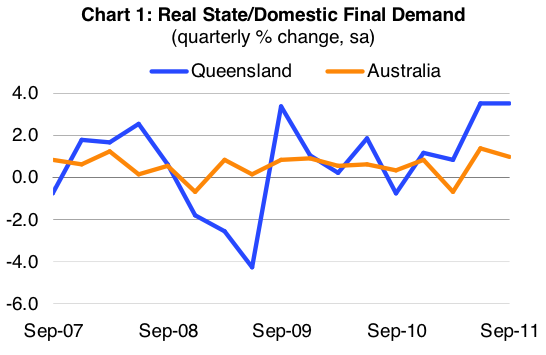
As the formerly flooded coal mines have re-opened, the Queensland economy has bounced back strongly. From OESR’s briefing note on the latest National Accounts figures:

Also regarding the National Accounts, Fairfax economics editor Peter Martin has a great column (Economy is booming – in one State) on the big contribution mining investment in WA has made to today’s great National Accounts result for Australia. So besides WA and Queensland, the rest of Australia is pretty ordinary. I have no doubt interstate migration to Queensland will surge again soon.

Posted in Macroeconomy, Mining | Leave a comment