A remarkable Queenslander commits political suicide

No one can deny Kevin Rudd’s exceptional intelligence and star quality, but he has no way back from his resignation as Foreign Minister today, particularly after some of the Labor Party’s most powerful people – Swan, Crean and Burke – more or less said they can’t work with him and have raised questions about his character.

Prime Minister Gillard will convincingly win any ballot next week and assert her dominance. Rudd may retreat to the backbench and hope that in a future crisis there will be an overwhelming public clamour for his return – as if he’s Australia’s Charles de Gaulle. But this won’t happen. It’s a fantasy. It will become increasingly clear to the public that Rudd has limited support among his colleagues, and indeed a large number of them despise him. Many will no doubt then apply the following piece of logic, which is one of my favourite quotes from Napoleon Hill:

If you have more enemies than friends, the odds are a thousand to one you have earned them.

It’s still unclear what this will all mean for the stability of Government and the confidence of the business community (although I think concerns about impacts on business confidence are often over-played). If Rudd goes to the backbench, then the Government could survive the full-term and ensure certainty until the next election. But, if Rudd resigns, then everything hinges on the by-election result, and given the circumstances around Rudd’s resignation, voters may want to punish the Government.
Posted in Uncategorized | Leave a comment

The 4% unemployment rate target – achievability vs sustainability

There is a good post at Loose Change on the sustainability of the Opposition’s 4% unemployment rate commitment, which links to my previous post showing that the commitment is feasible, in an arithmetic sense at least. On its sustainability, my feeling is that 4% is getting close to the so-called frictional rate of unemployment. This is the rate of unemployment associated with normal labour market frictions only, and without any unemployment due to a deficiency in demand (cyclical unemployment) or a mis-match between skill requirements in vacant jobs and the skills unemployed workers have (structural unemployment).

The unemployment rate will never be zero because people who lose jobs won’t typically find jobs straight away, and even in a well-functioning economy some businesses will still fail and some people lose jobs. Also, school, TAFE and university leavers won’t always find jobs immediately.

While Queensland’s unemployment rate fell to around 3.5% in 2007, this was associated with a booming pre-GFC economy and a tight labour market that was generating inflationary pressures. So in my view 4% is most likely close to the lowest rate unemployment could reach in Queensland with the economy growing at a sustainable rate. Given that a future downturn or recession could conceivably send the unemployment rate  to around 8-10%, it doesn’t seem possible that the unemployment rate could average 4% over the long-term – so in this sense 4% unemployment, while achievable, isn’t sustainable. (Please note I’m not forecasting a recession anytime soon, just noting that the business cycle will always be with us and the probability we’ll have a recession or downturn sometime in the next ten years remains significant).

To have an unemployment rate averaging around 4% over the long-term we’d probably have to experience periods in which the unemployment rate had a 2 in front of it. While I recall from an old RBA publication that, sometime prior to the economic crisis in the seventies, Australia did have an unemployment rate around 2%, this was at a time when Government effectively acted as an employer of last resort, and even the most unemployable youth could get a job as a porter in the State-owned railway.

Posted in Labour market, Macroeconomy | 3 Comments

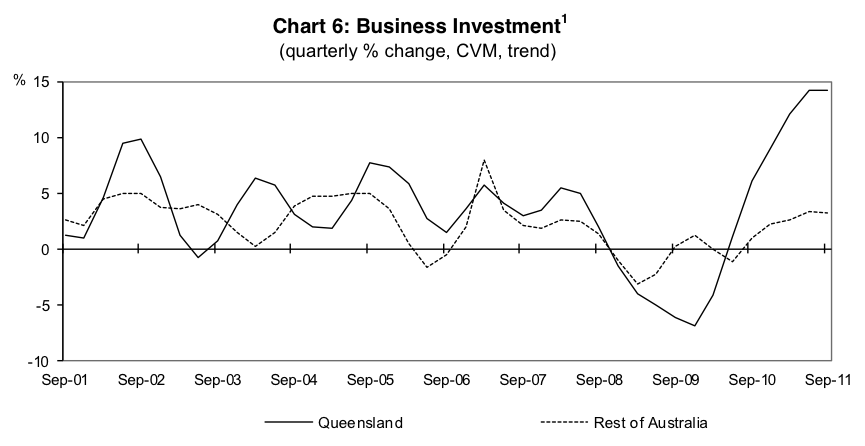
Qld business investment grew at nearly 15% per quarter in mid-2011

OESR’s State Accounts for September 2011, which were released today, contain this chart showing the massive growth in business investment (primarily resources sector related) in the June and September quarters of last year:

The massive level of investment occurring across Queensland at the moment is the reason I’m so bullish about our economy. This investment has a big direct impact on economic activity that will make up for sluggishness in tourism and manufacturing.

Posted in Macroeconomy, Mining | Leave a comment

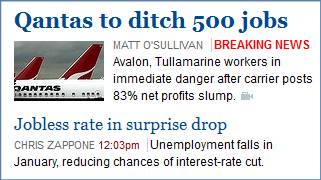
Qantas sheds 500 jobs, but economy gained 46,400 jobs in January

A colleague of mine thinks it says something about the quality of economic journalism in this country that Qantas shedding 500 jobs overshadowed the excellent ABS employment data released today, as shown by this screen shot from the Age website earlier today:

The Bligh Government is now only around 5,000 jobs short of its 100,000 new jobs target since the 2009 election. So it’s possible the Government will be able to claim it’s reached the target in the middle of the election campaign, which will boost morale even though it probably won’t influence the ultimate election outcome.

Information on today’s labour market numbers are available in OESR’s information brief.

Posted in Labour market | Leave a comment

Building activity improving, but will remain “fairly subdued” in many regions

Queensland Master Builders yesterday released its regional snapshots from its quarterly survey of industry conditions. The following conditions are expected over the March quarter:

  • “fairly subdued” in Brisbane, Gold Coast, Far North, North Queensland, Sunshine Coast and Wide Bay Burnett
  • “relatively higher” in Central Queensland, Mackay and Whitsunday
  • “improve somewhat” in Darling Downs-South West.

Obviously conditions are better in those areas closer to the booming Surat and Bowen basins.

The Cairns Post reports today on how the Far North building industry is on a slow road to recovery.

Posted in Housing, North Queensland | Leave a comment

Even closer economic relations with New Zealand?

As the world’s most remote advanced economy, and with limited resources and low visibility in international financial markets, New Zealand would see benefits in closer integration with Australia, which the two countries’ Productivity Commissions have just been commissioned to explore. From the Australian Productivity Commission’s website (Joint Australian/NZ commissioned study):

The Australian and New Zealand Productivity Commissions have been asked to jointly study the options for further reforms that would increase economic integration and improve economic outcomes. The study is due to commence shortly, with a final report submitted to both governments in December 2012.

I can’t wait for further details. Will the Commissions consider currency union and even fiscal union, by which New Zealand would become a state of Australia, an opportunity it had but passed up in the 1890s? It appears our new federal speaker Peter Slipper supports this option, based on this 2006 report in the Sydney Morning Herald (Push for union with NZ):

AUSTRALIA and New Zealand should work towards a full union, or at least have a single currency and more common markets, a federal parliamentary committee says.

It wants a closer relationship between the six Australasian colonies that formed the Commonwealth in 1901, and the errant one that chose to go it alone.

The committee chairman, the Liberal Peter Slipper, said the world had changed since then.

Other MPs on the committee include Malcolm Turnbull, Nicola Roxon and Daryl Melham. Their report said: “While Australia and New Zealand are of course two sovereign nations, it seems to the committee that the strong ties between the two countries – the economic, cultural, migration, defence, governmental and people-to-people linkages – suggest that an even closer relationship, including the possibility of union, is both desirable and realistic.”

Any move to closer relations with New Zealand should only take place after a hard-headed assessment of Australia’s national interest. Given New Zealand’s relatively poorer economic performance, any fiscal union would no doubt see large transfers of money across the Tasman.

Posted in Budget, Macroeconomy, Migration | Leave a comment

Brisbane Economic Development Plan foreshadows public wi-fi expansion

The new Brisbane Economic Development Plan 2012-2031 says all the right things about wanting to make Brisbane more innovative and creative, attracting the best and brightest and streamlining council processes. It contains at least one really good idea, that of expanding the public wi-fi program (currently in New Farm Park and the Botanic Gardens) to other parks and public transport, which would probably boost flagging patronage on CityCats and Council buses.

I did find one thing in the Plan peculiar, however: the bizarre claim that has been picked up in the media that:

For every direct job created in mining, a further 19 jobs are created across greater Brisbane in the services that support the mining industry and its workers.

I think a decimal point has gone missing, as it is totally implausible that there would be 19 indirect jobs associated with every new mining job. According to the ABS Labour Force data, employment in the Queensland mining sector grew by 6,000 persons in the year to November 2011 (to a level of 59,000 persons). If 19 jobs are indirectly created in Greater Brisbane for every new mining job then (all else equal) employment in greater Brisbane should have increased by 114,000 employed persons (i.e. around 10% growth in employment in one year), compared with actual growth in the 12 months to November 2011 of 12,800. Hence, in my opinion, the claim is totally implausible.

Posted in Brisbane, Mining | 5 Comments

Home loans data confirm Qld economy is strong

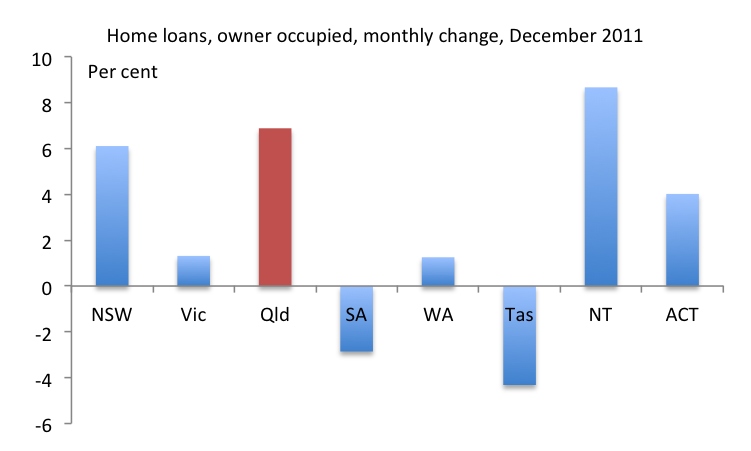
Today’s new ABS housing finance commitments data show strong growth nationally in December 2011 (up 2.3% seasonally adjusted), with Queensland in second place among States and Territories:

Posted in Housing | Leave a comment

One in ten NSW residents would prefer to live in Queensland

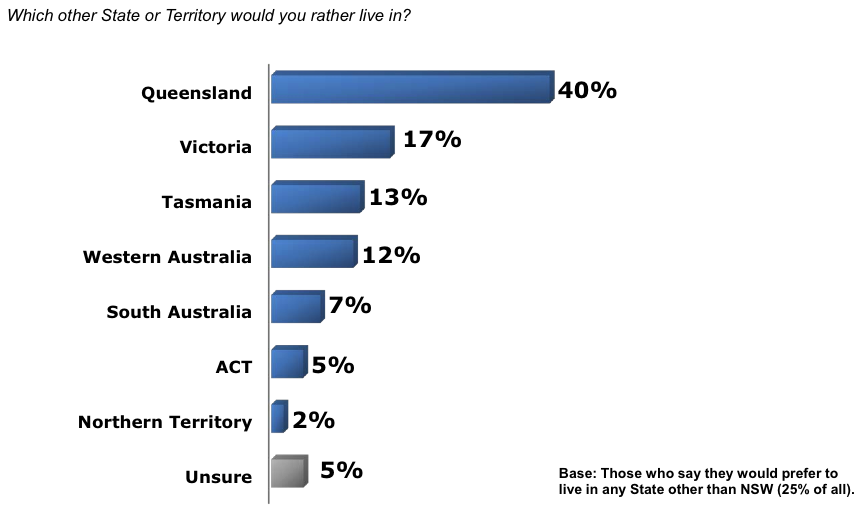
Interstate migration to Queensland has been at low levels recently but I expect it to rebound as a result of Australia’s two-speed economy. As growth in NSW and Victoria will be sluggish compared with Queensland and WA, I expect many households will relocate to the booming States. And with Queensland being closer than WA, and a lot less remote and intimidating, Queensland is likely to get a large majority of interstate migrants. Indeed, the State of NSW Survey published today by the McKell Institute (a new left-of-centre think tank) confirms that Queensland would be the most popular destination for anyone leaving NSW:

According to this chart, 40% of the 25% of people who would prefer to live in a State other than NSW would prefer to live in Queensland, meaning 10% of the NSW population would prefer to live in Queensland.

For further information on interstate migration, see my previous post:

Queensland remains top destination for interstate migrants

Posted in Uncategorized | 1 Comment

More Chinese than Japanese tourists on Gold Coast

Fascinating new regional tourism data from Tourism Queensland confirm the rise in Chinese tourism to Queensland and the massive opportunity it represents. I was especially surprised to see Chinese visitors to the Gold Coast exceeding Japanese visitors:

The Japanese still outnumber the Chinese in Tropical North Queensland, although not by much:

Posted in Cairns, Gold Coast, Tourism | Leave a comment